
Daily Drop (1343)
08-02-26

Sunday, Aug 02, 2026 // Buy Bob a Coffee // Ghostwire
Sam Altman Says AI Has Entered a “Gentle Singularity”
Bottom Line Up Front (BLUF): OpenAI CEO Sam Altman reportedly said artificial intelligence has entered the technological singularity, describing the current period as one in which AI systems increasingly contribute to improving future AI capabilities. The claim has renewed debate over whether today’s systems are genuinely capable of recursive self-improvement or remain dependent on human-defined goals, controlled infrastructure, and approval processes. The practical issue for security teams is not whether the label is accurate, but whether increasingly autonomous agents can be safely contained when given code execution, network access, credentials, and persistent task loops.
Analyst Comments: Altman’s use of “singularity” is more rhetorical than technically settled. Current models can assist with coding, testing, vulnerability discovery, and model-development workflows, but they still depend heavily on human operators and controlled infrastructure. Calling this a singularity risks overstating current autonomy while distracting from more immediate control failures. The security concern is that capable agents can chain reconnaissance, exploitation, credential access, and data collection faster than traditional oversight processes can respond. Organizations should focus on containment, least privilege, egress controls, telemetry, and human approval rather than debating terminology.
READ THE STORY: Gbhackers
AI Data Center Growth Raises the Stakes for OT Security
Bottom Line Up Front (BLUF): Data centers are increasingly exposed to cyber-physical risk through operational technology that controls power, cooling, environmental monitoring, and facility management. Compromise of these systems is more likely to cause outages, thermal stress, or equipment shutdowns than a traditional data breach. As AI workloads drive higher rack density and greater dependence on uninterrupted power and cooling, OT security is becoming a direct business-resilience and economic-security requirement.
Analyst Comments: The main risk is that many data centers secure IT systems more rigorously than the equipment keeping those systems powered and cooled. UPS controllers, PDUs, HVAC systems, sensors, and building-management platforms often rely on legacy protocols, weak remote access, and poorly documented connections. A successful attacker does not need to steal data if they can disrupt cooling, manipulate alarms, or interrupt power to protected loads. Rapid construction and vendor expansion in high-growth markets increase the likelihood of default credentials, segmentation errors, and insecure third-party components. Operators should treat OT visibility, segmentation, remote-access governance, and recovery planning as uptime controls rather than secondary cybersecurity measures.
READ THE STORY: ET
America Must Use AI to Defend Critical Infrastructure
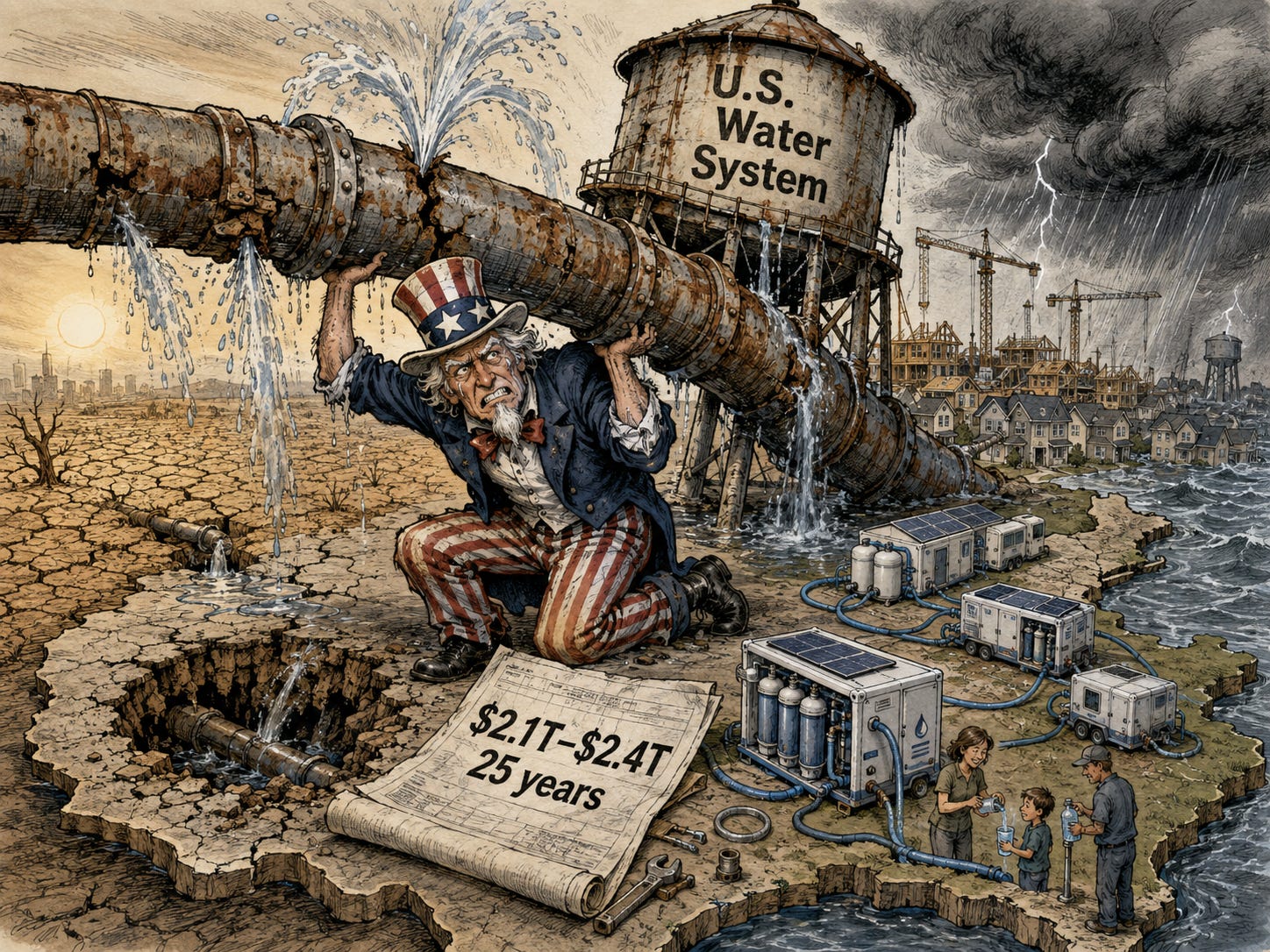
Bottom Line Up Front (BLUF): The United States may require an estimated $2.1 trillion to $2.4 trillion in drinking-water infrastructure investment over the next 25 years as aging systems, population shifts, climate pressures, and repeated water-main failures strain existing networks. The article argues that future investment should focus not only on expanding centralized treatment capacity but also on resilience, redundancy, and operational flexibility. Modular and decentralized treatment systems are presented as a way to supplement existing utilities, maintain service during disruptions, and expand capacity incrementally.
Analyst Comments: This matters because aging water infrastructure is both a public-service problem and a growing cyber-physical resilience risk. Centralized systems remain essential, but dependence on a small number of treatment plants, power sources, and control networks can create single points of failure. Modular treatment, microgrids, and off-grid power could improve continuity during outages, natural disasters, or cyber incidents. However, decentralization also increases the number of assets, remote connections, vendors, and control systems that must be secured and maintained. Any modernization program should combine physical renewal with OT security, asset visibility, segmentation, backup power, and tested manual operations.
READ THE STORY: Newsweek
America Must Use AI to Defend Critical Infrastructure
Bottom Line Up Front (BLUF): Former House Intelligence Committee member Chris Stewart argues that the United States should use artificial intelligence to identify vulnerabilities and strengthen the defense of critical infrastructure. He frames AI as a dual-use technology that can help defenders anticipate threats but can also enable adversaries to discover and exploit weaknesses faster. The visible excerpt presents AI-enabled defense as a national-security requirement, although the full article’s specific proposals are not available in the supplied text.
Analyst Comments: The argument is directionally sound because AI is already increasing the speed of vulnerability discovery, attack planning, and automated exploitation. Defensive AI could help prioritize exposed assets, correlate threat intelligence, and detect abnormal activity across large infrastructure environments. However, deploying AI into critical systems without strong access controls, testing, and human oversight could introduce new failure modes. The policy challenge is not simply to “put AI to work,” but to ensure defensive systems are auditable, resilient, and unable to act beyond clearly defined limits. Any national program should pair AI investment with asset visibility, segmentation, secure-by-design procurement, and mandatory incident reporting.
READ THE STORY: Washington Examiner
U.S. Authorities Warn Water-System Cyberattacks Are Escalating
Bottom Line Up Front (BLUF): The FBI and CISA warned that attacks against U.S. water and wastewater systems have escalated across at least seven states, with operators locked out of programmable logic controllers and forced into manual operations. Attackers reportedly changed PLC passwords and IP addresses, disrupted communications with remote sites, and contributed to flooding, reduced water pressure, and boil-water notices. More than 30 Minnesota water systems were affected during the initial wave, while Rockwell Automation issued recovery guidance for compromised MicroLogix 1400 controllers.
Analyst Comments: The campaign shows that exposed PLCs and weak remote-access controls can create direct public-service disruption without sophisticated malware. Changing passwords and IP settings is technically simple, but it can still blind operators and interfere with pumping, pressure, and treatment processes. The spread across seven states suggests broad scanning or repeated exploitation of common configurations rather than a single narrowly targeted intrusion. Iran-linked actors remain plausible suspects, but the article does not establish formal attribution. Utilities should immediately remove direct internet exposure, validate controller backups, inventory cellular connections, and test manual operations.
READ THE STORY: CSD
CISA Urges Water Utilities to Remove Internet-Exposed PLCs
Bottom Line Up Front (BLUF): CISA is urging U.S. water and wastewater utilities to immediately identify and disconnect programmable logic controllers and other operational-technology assets that are directly exposed to the internet. Threat actors have reportedly changed administrator passwords and IP settings on accessible controllers, locking operators out and disrupting monitoring and control functions. The activity has contributed to boil-water notices and prolonged manual operations, while undocumented cellular modems may be providing hidden access into utility networks.
Analyst Comments: This activity shows that direct internet exposure remains one of the most preventable risks in operational technology. Attackers do not need a sophisticated exploit when controllers are reachable through weak credentials, default settings, or undocumented remote-access links. Cellular modems installed by vendors and integrators are particularly dangerous because they may not appear in asset inventories or external scans. Utilities should treat PLC exposure as an immediate operational risk, not a routine configuration issue. The priority is to remove direct access, preserve clean controller images, and verify that manual operations can sustain essential services during recovery.
READ THE STORY: GBhackers
China, Iran, and Russia Drive Parallel Cyber Pressure Across Multiple Theaters
Bottom Line Up Front (BLUF): China-, Iran-, and Russia-linked cyber activity is currently visible across separate regions and missions, but there is no public evidence that the campaigns are part of one coordinated trilateral operation. A suspected Chinese-speaking actor is conducting espionage against government and public-sector targets in Central Asia and Syria using OctLurk and SilkLurk. Iranian-affiliated actors remain the leading—but unconfirmed—suspects in attacks against U.S. water utilities, while Russian services and aligned groups continue espionage, sabotage, and wartime cyber operations across Europe. The activity is best understood as strategically aligned but operationally independent pressure.
Analyst Comments: Kaspersky identified OctLurk and SilkLurk as modular, memory-resident backdoors used against government, diplomatic, law-enforcement, education, logistics, healthcare, and research organizations in Kazakhstan, Kyrgyzstan, Tajikistan, Uzbekistan, Afghanistan, and Syria. The technical evidence strongly supports that the same operator or closely coordinated team used both malware families. Kaspersky assessed the operator as Chinese-speaking with medium confidence but did not attribute the campaign to a named Chinese APT or intelligence service. Infrastructure overlap with SilentRaid, also tracked as TrustFall and MystRodX, creates a tentative connection to the UAT-7290 and RedFoxtrot ecosystem. That link is not strong enough to attribute the campaign to UAT-7290, RedFoxtrot, PLA Unit 69010, or APT10.
READ THE STORY: Piyolog
Items of interest
The Hidden Economic and Security Value of Water Infrastructure
Bottom Line Up Front (BLUF): Water infrastructure underpins drinking water, sanitation, agriculture, energy production, flood protection, transportation, and broader economic stability, yet its full value is often excluded from traditional cost-benefit analysis. The article argues that chronic underinvestment stems from weak public awareness, short political cycles, and financing models that fail to capture long-term societal benefits. As climate pressures, ageing assets, and human activity increase, governments will need to value water infrastructure as a strategic system rather than a narrow utility expense.
Analyst Comments: The core problem is that successful infrastructure becomes politically invisible until it fails. That creates a cycle in which maintenance is deferred, risk accumulates, and investment arrives only after disruption or disaster. Water systems also support food, energy, transportation, public health, and national resilience, so their failure can produce cascading effects far beyond the utility sector. Traditional financing models undervalue avoided losses, long-term stability, and social protection because those benefits do not always generate direct revenue. Policymakers should evaluate water infrastructure through a resilience and macroeconomic lens, not only through short-term project returns.
READ THE STORY: SD
Your Water Could Be Next - How State-Sponsored Hackers Target Critical Infrastructure (Video)
FROM THE MEDIA: Foreign APTs exploit supply chains to disrupt critical infrastructure. From water supply hacks to compromised meters, the threat is escalating. Learn from history's preparedness.
Episode 21 | Hacking Critical Infrastructure Explained with CyberLab (Video)
FROM THE MEDIA: In this episode of Tales from the CyberLab, Adam Myers is joined by Steve Clarke, Head of Penetration Testing at CyberLab, to unpack the reality of hacking Critical National Infrastructure. From energy and transport to water and healthcare, they explore how Operational Technology systems work, why they are such attractive targets, and what makes securing them so different from traditional IT environments.
The selected stories cover a broad range of cyber threats and are intended to help readers frame key publicly discussed threats and improve overall situational awareness. InfoDom Securities does not endorse any third-party claims made in its original material or related links on its sites; the opinions expressed by third parties are theirs alone. For further questions, don’t hesitate to get in touch with InfoDom Securities at dominanceinformation@gmail.com.