
Daily Drop (1338)
07-25-26

Saturday, July 25, 2026 // Buy Bob a Coffee // Ghostwire
U.S. AI Models Outscore China’s Kimi K3 in Cybersecurity Benchmarks
Bottom Line Up Front (BLUF): U.S.-developed AI models reportedly achieved a 76% score in cybersecurity benchmark testing, compared with 32% for China’s Kimi K3. The result suggests a substantial capability gap in the tested tasks, but the headline figures should be treated cautiously until the benchmark design, model configurations, scoring criteria, and testing conditions are independently reviewed.
Analyst Comments: A 44-point spread is significant, but benchmark scores rarely tell the whole story. Cybersecurity evaluations can measure very different capabilities, including vulnerability analysis, exploit development, code review, incident response, or defensive reasoning. Without knowing which tasks were included—and whether every model received equivalent tooling, prompting, and compute—the comparison is directional rather than definitive. The result also does not necessarily translate into real-world operational superiority. Models that perform well in controlled tests may still struggle with incomplete telemetry, unfamiliar environments, long attack chains, and the ambiguity common in live investigations. Likewise, a lower benchmark score does not mean a model lacks utility in narrower areas such as malware analysis, Chinese-language threat intelligence, or domestic software ecosystems.
READ THE STORY: TechCrunch Security
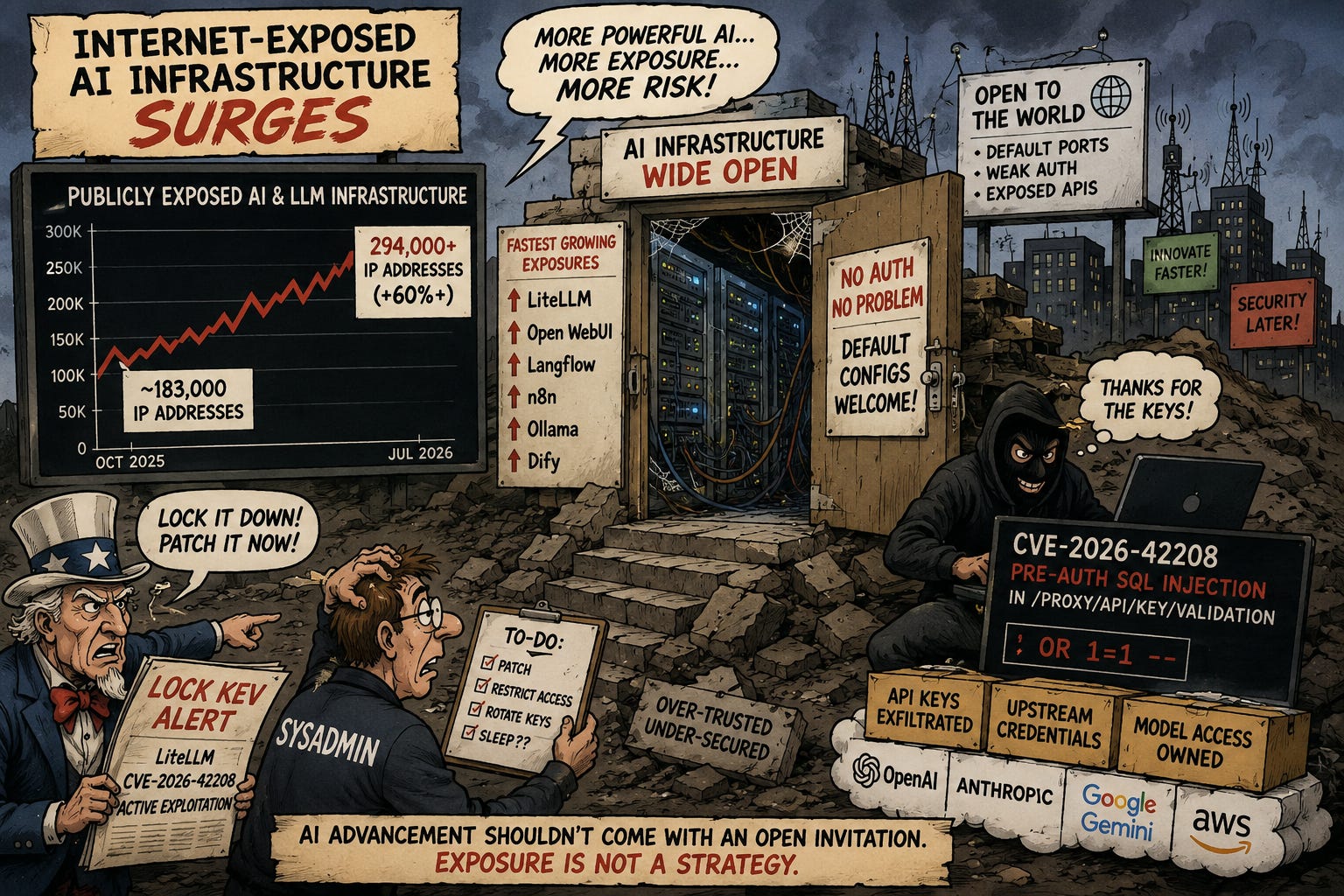
Internet-Exposed AI Infrastructure Surges as LiteLLM SQL Injection Faces Active Exploitation
Bottom Line Up Front (BLUF): Censys reports that public exposure of AI and large language model infrastructure increased by more than 60% over nine months, rising from roughly 183,000 IP addresses in October 2025 to more than 294,000. The fastest-growing products include platforms with serious security histories. LiteLLM exposure nearly doubled while CVE-2026-42208, a pre-authentication SQL injection affecting its proxy API key validation, is listed in CISA’s Known Exploited Vulnerabilities catalog. Organizations running Internet-accessible LiteLLM or similar AI orchestration platforms should patch immediately, restrict external access, and rotate upstream model-provider credentials where compromise cannot be ruled out.
Analyst Comments: The core issue is not merely that more AI tools are appearing online. It is that organizations are exposing products that sit directly in front of valuable credentials, model APIs, internal workflows, and sometimes execution-capable agents. LiteLLM is a particularly high-impact example. As a unified proxy, it may hold API keys for multiple upstream providers. A successful compromise could therefore expose access to every connected model service rather than a single application. That creates opportunities for credential theft, unauthorized model usage, data access, lateral movement, and potentially large consumption charges.
READ THE STORY: Censys
Iran-Linked Actors Target U.S. Water and Energy Control Systems
Bottom Line Up Front (BLUF): U.S. agencies warn that Iran-affiliated actors are actively targeting internet-exposed operational technology across the water and energy sectors. The attackers have accessed programmable logic controllers, altered project files, manipulated HMI and SCADA displays, and disabled safety and alarm functions—creating a direct risk of operational disruption, equipment damage, and unsafe process conditions.
Analyst Comments: The reported activity shows actors moving beyond access and into control-system manipulation, including changes to PLC logic that can override safe operating parameters. That materially raises the risk from cyber intrusion to physical consequence. The common weakness is exposure. Industrial controllers and remote-access devices remain reachable over the public internet through ports such as 44818, 2222, 102, 502, and 22. Once inside, attackers can use legitimate engineering software—including Studio 5000, EcoStruxure Control Expert, and TIA Portal—to retrieve, modify, or delete controller logic. Because those tools are standard in industrial environments, malicious activity may blend into normal maintenance traffic unless operators are closely monitoring changes.
READ THE STORY: Security Affairs
Cisco SD-WAN Zero-Day Under Active Exploitation: CVE-2026-20127 Enables Unauthenticated Administrative Access
Bottom Line Up Front (BLUF): CVE-2026-20127 is a critical authentication-bypass vulnerability affecting Cisco Catalyst SD-WAN Controller, formerly vSmart, and Cisco Catalyst SD-WAN Manager, formerly vManage. According to the supplied reporting, the flaw carries a CVSS score of 10.0, appears in CISA’s Known Exploited Vulnerabilities catalog, and has public exploit code available. An unauthenticated remote attacker can abuse the SD-WAN peering authentication process to obtain administrative privileges. Organizations operating affected Cisco SD-WAN infrastructure should apply Cisco’s fixed releases as an emergency change and investigate exposed management systems for signs of compromise.
Analyst Comments: SD-WAN controllers and management platforms sit in a high-trust position, with visibility and control across distributed network environments. Administrative compromise could give an attacker the ability to modify configurations, disrupt routing, create persistence, collect sensitive operational data, or use the platform as a launch point into connected sites. The availability of multiple public proof-of-concept repositories materially raises the risk of broader exploitation. Even where an EPSS probability appears comparatively low, the reported 99.75th-percentile ranking indicates that the vulnerability scores higher than most tracked CVEs. More importantly, CISA KEV inclusion and evidence of exploitation should outweigh probabilistic scoring when setting remediation priority.
READ THE STORY: Codeby
The Hacker Who Humiliated Spyware Makers—and Was Never Caught
Bottom Line Up Front (BLUF): The hacktivist known as Phineas Fisher breached two controversial government spyware vendors, exposed internal data, and publicly embarrassed companies that sold surveillance capabilities to state customers. Despite the scale and visibility of the intrusions, the hacker’s identity remains unknown, making Phineas Fisher one of the most prominent cyber operators never publicly identified or arrested.
Analyst Comments: Phineas Fisher’s operations stand out because they combined technical access with deliberate information warfare. The objective was not simply to steal data—it was to expose the surveillance industry, damage vendor credibility, and demonstrate that companies selling offensive cyber capabilities were themselves vulnerable. The enduring anonymity is equally significant. High-profile hacktivists usually leave operational, financial, or infrastructure trails that eventually support attribution. Phineas Fisher appears to have avoided that outcome despite targeting well-resourced organizations and attracting sustained law-enforcement attention. Whether that reflects exceptional operational security, limited investigative visibility, or an identity protected by jurisdictional barriers remains unclear.
READ THE STORY: TechCrunch Security
Laundry Bear Exploits Unpatched Zimbra Servers in Zero-Click Email Theft Campaign
Bottom Line Up Front (BLUF): U.S. and international agencies warn that the Russia-linked Laundry Bear group, also tracked as Void Blizzard, is actively exploiting CVE-2025-66376 against unpatched Zimbra Collaboration Suite servers. The stored cross-site scripting flaw allows attacker-supplied JavaScript in an HTML email to execute when a victim views the message in the vulnerable Classic UI. No link click or attachment download is required. Organizations should upgrade Zimbra 10.0 to version 10.0.18 or later and Zimbra 10.1 to version 10.1.13 or later, then investigate affected mailboxes and servers for account theft and data exfiltration.
Analyst Comments: Laundry Bear is reportedly using a custom collection and exfiltration capability named Ulej to harvest mailbox data after exploitation. For intelligence-focused operators, compromised email accounts are high-value access points. They expose internal communications, credentials, contact networks, attachments, meeting details, and material that can support follow-on espionage or impersonation. The CVSS score of 7.2 may cause some teams to treat this as a routine high-severity issue. That would be a mistake. CISA KEV inclusion, confirmed exploitation, public exploit availability, and a zero-click delivery path make remediation urgent. Internet-facing Zimbra systems that remain below the fixed releases should be treated as potentially compromised, not merely vulnerable.
READ THE STORY: Security Affairs
Redis Double-Free Flaw Enables RCE Through Crafted RESTORE Payloads
Bottom Line Up Front (BLUF): CVE-2026-66373 is a high-severity remote code execution vulnerability affecting Redis versions before 8.8.0. An authenticated attacker with permission to execute the RESTORE command can load a crafted serialized payload that creates an unsafe stream consumer state. Subsequent deletion of the affected consumers through XGROUP DELCONSUMER can trigger a double free and potentially allow arbitrary code execution. Redis administrators should upgrade to version 8.8.0 or later and immediately restrict RESTORE through ACLs where patching is delayed.
Analyst Comments: This is not a pre-authentication Redis takeover. Exploitation requires valid access and permission to run RESTORE, which significantly narrows the attack surface. The problem is that RESTORE is a high-impact capability: once an attacker can submit attacker-controlled serialized data, a memory-corruption flaw can turn limited authenticated access into code execution under the Redis service account. CVE-2026-66373 also represents an incomplete remediation of CVE-2026-25243. The earlier vulnerability involved insufficient validation of serialized RESTORE data and already has public proof-of-concept code. While the supplied material does not confirm a dedicated public exploit for CVE-2026-66373, existing research into the original flaw may reduce the effort required to reproduce or adapt the new attack path.
READ THE STORY: Tenable CVEs
WordPress wp2shell Chain Under Active Exploitation: SQL Injection Leads to Remote Code Execution
Bottom Line Up Front (BLUF): Attackers are actively exploiting a two-vulnerability WordPress chain known as wp2shell to turn unauthenticated SQL injection into remote code execution and web-shell access. The chain combines CVE-2026-63030, a REST API batch endpoint route-confusion flaw, with CVE-2026-60137, an injection weakness in the WP_Query author__not_in parameter. Both vulnerabilities are listed in CISA’s Known Exploited Vulnerabilities catalog, and public exploit code is available. WordPress administrators should immediately upgrade 6.8.x installations to 6.8.6 or later, 6.9.x installations to 6.9.5 or later, and 7.0.x installations to 7.0.2 or later.
Analyst Comments: This is not a theoretical WordPress bug or another low-value plugin issue. The wp2shell chain gives attackers a practical route from unauthenticated web access to code execution on vulnerable sites, making it attractive for cryptomining campaigns, DDoS botnets, initial-access brokers, and ransomware affiliates. The individual severity scores do not tell the full story. CVE-2026-60137 provides a constrained SQL injection primitive, while CVE-2026-63030 exposes the conditions needed to turn that primitive into a broader compromise. Chained together, the result is effectively pre-authentication RCE.
READ THE STORY: Codeby
Cal.com Inherits React2Shell RCE Through Vulnerable Next.js Dependency
Bottom Line Up Front (BLUF): CVE-2025-71389 is a critical, unauthenticated remote code execution vulnerability affecting Cal.com deployments running versions earlier than 5.9.9. The issue stems from a vulnerable Next.js dependency that exposes the upstream React Server Components flaw tracked as CVE-2025-55182, also known as React2Shell. An attacker can send a crafted RSC request and execute arbitrary code during server-side processing without credentials or user interaction. Cal.com administrators should upgrade to version 5.9.9 or later immediately and investigate exposed systems for signs of compromise.
Analyst Comments: The real risk here comes from the inherited dependency chain. CVE-2025-71389 is the Cal.com-specific manifestation of CVE-2025-55182, a pre-authentication RCE with a CVSS score of 10.0, high exploit probability, public proof-of-concept code, CISA Known Exploited Vulnerabilities catalog inclusion, and reported ransomware links. That distinction matters. CVE-2025-71389 may not itself appear in CISA KEV, but the underlying vulnerability it packages is already being exploited. Defenders should not wait for separate confirmation that threat actors are targeting Cal.com specifically. Once exploit code works against the upstream framework behavior, exposed applications that bundle the vulnerable component become natural scanning targets.
READ THE STORY: Tenable CVEs
FreeBSD dhclient RCE Lets Rogue DHCP Servers Execute Commands as Root
Bottom Line Up Front (BLUF): CVE-2026-42511 is a high-severity remote code execution vulnerability in FreeBSD’s dhclient that allows a rogue or spoofed DHCP server to inject arbitrary configuration directives through unescaped BOOTP fields. The malicious value is written into a persistent lease file and later evaluated by dhclient-script with root privileges during renewal, reboot, or another DHCP cycle. Public exploit material is available. FreeBSD systems using dhclient should be upgraded to 15.0-RELEASE-p7, 14.4-RELEASE-p3, 14.3-RELEASE-p12, 13.5-RELEASE-p13, or later.
Analyst Comments: This is not an Internet-wide unauthenticated RCE in the usual sense. The attacker generally needs access to the victim’s Layer 2 network, control of a DHCP server, or the ability to spoof DHCP replies. That limits reach, but the resulting impact is severe: command execution as root on any vulnerable FreeBSD host accepting the malicious lease. The persistence mechanism makes the flaw more dangerous than a one-shot packet-processing bug. The injected content is stored in the lease file and may not execute until dhclient later reparses it. That delay can separate initial delivery from code execution, complicating incident timelines and allowing a poisoned lease to survive until a reboot or renewal event Public exploit availability lowers the barrier to reproduction in lab environments and increases risk in shared networks, branch offices, hosting environments, wireless networks, and other segments where DHCP trust is weak. DHCP snooping materially reduces exposure, but it is not a substitute for patching. Systems using static addressing and not running dhclient are not exposed through this path.
READ THE STORY: Censy
Items of interest
Kimi K3 Finds Redis Memory-Corruption Flaws in 27 Minutes as Public PoC Raises Exploitation Risk
Bottom Line Up Front (BLUF): Moonshot AI’s Kimi K3 agent reportedly completed an autonomous Redis vulnerability-research workflow in 27 minutes, including source-code review, fuzzing, crash analysis, and proof-of-concept development. A public PoC is available for CVE-2026-25589, a RedisBloom vulnerability affecting versions before 2.8.20. Exploitation requires authentication and permission to execute the Redis RESTORE command, but successful abuse may cause invalid memory access and potentially enable code execution under favorable conditions.
Analyst Comments: The real story is not that an AI model found a bug. It is that the model reportedly moved through the vulnerability-discovery chain—from cloning source code to debugging crashes and producing PoCs—with limited human direction. That compresses work that traditionally takes experienced researchers days or weeks into less than half an hour. Defenders should not translate “public exploit” into “imminent mass exploitation” without examining the prerequisites. CVE-2026-25589 carries a CVSS score of 5.5 and an EPSS estimate of 0.3%. The attacker must already have authenticated access and authorization to issue RESTORE commands against a server running the vulnerable RedisBloom module. Those conditions reduce broad internet-scale exposure, but they do not eliminate risk in environments with weak access controls, shared credentials, compromised application accounts, or overly permissive Redis deployments.
READ THE STORY: CISA
Kimi K3 explained in 13min (Video)
FROM THE MEDIA: The newest Kimi K3, a whopping 2.8T parameter open model has been released by moonshot. Kimi K3 incorporates Kimi Delta Attention, Stable LatentMoE, and Attention Residual that all contribute to its success and hitting near Fable 5 and GPT 5.6 level in benchmarks.
Build Anything with Kimi K3, Here’s How (Video)
FROM THE MEDIA: Fortinet customers face two simultaneous threats this week. Attackers are actively exploiting recently patched FortiSandbox vulnerabilities, and a massive credential exposure campaign dubbed FortiBleed has prompted a CISA alert affecting tens of thousands of FortiGate firewall URLs.
The selected stories cover a broad range of cyber threats and are intended to help readers frame key publicly discussed threats and improve overall situational awareness. InfoDom Securities does not endorse any third-party claims made in its original material or related links on its sites; the opinions expressed by third parties are theirs alone. For further questions, don’t hesitate to get in touch with InfoDom Securities at dominanceinformation@gmail.com.