
Daily Drop (1336)
07-21-26

Tuesday, July 21, 2026 // Buy Bob a Coffee // Ghostwire
White House Orders Defense Contractors to Map Supply Chains and Eliminate Unreliable Foreign Suppliers
Bottom Line Up Front (BLUF): A July 20, 2026 executive order directs the Department of War to tighten domestic and allied sourcing requirements across the U.S. defense industrial base. Beginning January 1, 2027, waivers for restricted critical materials will largely require formal mitigation plans. Contractors may also be required to trace components, software, and raw materials across every supplier tier, vet subcontractors for foreign influence and operational risk, and replace suppliers linked to designated foreign adversaries.
Analyst Comments: This is more than a domestic sourcing directive. It treats defense supply chains as a national security attack surface exposed to cyber intrusion, foreign ownership, financial instability, manufacturing disruption, and deliberate economic coercion. The most consequential requirement is the proposed submission of a complete, indentured Bill of Materials covering hardware, software, components, and raw-material origins. That level of visibility could help the government identify compromised suppliers, hidden foreign dependencies, counterfeit components, and single points of failure. It will also create highly sensitive data repositories that could become priority targets for foreign intelligence services and state-sponsored threat actors.
READ THE STORY: Whitehouse
Justice Department Investigates Harvard Financial Aid Programs Over China-Linked Funding
Bottom Line Up Front (BLUF): The U.S. Department of Justice has opened a civil rights compliance review into whether Harvard University used donations and contracts from China-based sources to fund financial aid programs that favored students from particular countries. The department cited Harvard’s disclosure of more than $630 million in China-linked funding and requested records concerning restricted funds and individual aid recipients. No finding of wrongdoing has been made.
Analyst Comments: The existence of restricted foreign gifts does not by itself establish unlawful discrimination. The government will need to show how the funds were administered, which eligibility criteria were applied, and whether nationality directly influenced awards. Harvard maintains that it complies with disclosure requirements and does not unlawfully discriminate in allocating financial aid. The request for student-level recipient data could also generate a secondary dispute over privacy, data handling, and the scope of federal investigative authority. More broadly, the review signals that universities receiving substantial foreign funding should expect closer examination of donor conditions, scholarship criteria, and internal controls governing restricted gifts.
READ THE STORY: The Harvard Crimson
U.S. Says China Operates Three Cuban Spy Sites, but Public Evidence Stops Short of Proving Control
Bottom Line Up Front (BLUF): It is extremely likely China actively operates three of Cuba’s 18 known signals-intelligence facilities and that Chinese and Russian intelligence staffing on the island has nearly tripled since 2023. Independent satellite analysis confirms substantial expansion at several Cuban collection sites, including a newly completed 32-antenna array at Bejucal. What remains unverified in the public record is which facilities China controls, how many Chinese personnel are present, and whether intercepted intelligence is collected primarily for Beijing, Havana, or both.
Analyst Comments: Satellite imagery reviewed by the Center for Strategic and International Studies documented activity at Bejucal, Wajay, Calabazar, and El Salao. The Bejucal array appears significantly larger and more capable than previously documented Cuban installations and was assessed as likely operational by mid-2026. The geography makes these facilities strategically relevant. Cuba sits roughly 90 miles from Florida and near U.S. military, space-launch, maritime, and command infrastructure. A circularly disposed antenna array of Bejucal’s scale could support interception and geolocation of regional radio-frequency emissions. If China receives direct access to that collection, the sites would provide Beijing with a valuable intelligence position close to the continental United States.
READ THE STORY: SCMP (CN)
Moonshot AI’s Kimi K3 Signals Faster Chinese Progress in Frontier and Open-Weight Models
Bottom Line Up Front (BLUF): Chinese startup Moonshot AI has released Kimi K3, a 2.8 trillion-parameter open-weight model that Bloomberg reports performs near leading U.S. systems on broad capability benchmarks. The release has renewed debate over the durability of the U.S. AI lead and demonstrates how Chinese developers are combining large-scale architectures, lower operating costs, and open distribution to compete for global developer adoption.
Analyst Comments: Kimi K3 matters less as a single benchmark result than as evidence that China’s frontier-model ecosystem is moving quickly despite hardware constraints and export controls. Moonshot reportedly chose to increase model scale while several domestic competitors pursued smaller architectures, betting that long-term capability gains would justify the additional training and inference burden. The open-weight strategy creates both commercial and security implications. Organizations can deploy, customize, and inspect these models without relying entirely on a hosted provider. That gives defenders more control over sensitive incident data and reduces the risk of external guardrails blocking legitimate malware-analysis or response workflows. The same accessibility also lowers barriers for threat actors seeking to fine-tune models for phishing, vulnerability research, malware development, influence operations, or autonomous attack frameworks.
READ THE STORY: Bloomberg
Hugging Face Says Autonomous AI Agent Conducted End-to-End Internal Breach
Bottom Line Up Front (BLUF): Hugging Face disclosed that an autonomous AI agent framework carried out a multistage intrusion into portions of its production environment. According to the company, the system uploaded a malicious dataset, exploited weaknesses in a data-processing pipeline, escalated privileges, and stole cloud and internal service credentials through tens of thousands of automated actions. Hugging Face has not identified the attacker or the model used and is still investigating possible access to customer or partner datasets.
Analyst Comments: The distinction matters: an autonomous framework can chain reconnaissance, exploitation, privilege escalation, credential theft, and follow-on activity at machine speed, reducing the amount of direct operator involvement required. The attack also highlights a growing risk for AI and machine-learning platforms. Dataset ingestion, model-processing pipelines, automation frameworks, and cloud credentials create a broad attack surface that conventional application-security programs may not fully cover. Malicious datasets should be treated as potentially executable or adversarial content, not passive files.
READ THE STORY: Axios
EU Imposes Largest Cyber Sanctions Package to Date Against Russia’s State-Linked Cyber Ecosystem
Bottom Line Up Front (BLUF): The European Union has announced its largest cyber sanctions package to date, targeting nine individuals and four entities allegedly involved in malicious cyber activity supporting Russian strategic objectives. The EU also publicly attributed cyberespionage and critical-infrastructure sabotage operations to the 16th Centre of Russia’s Federal Security Service and coordinated the sanctions with the United Kingdom for the first time.
Analyst Comments: The package reflects a broader attribution strategy that targets not only Russian intelligence services but also the contractors, cybercriminals, hacktivists, and private companies that enable state-directed operations. That ecosystem-based approach is important because Russian cyber activity frequently relies on blurred relationships between government agencies, nominally independent operators, and commercial infrastructure providers.
READ THE STORY: EEAS
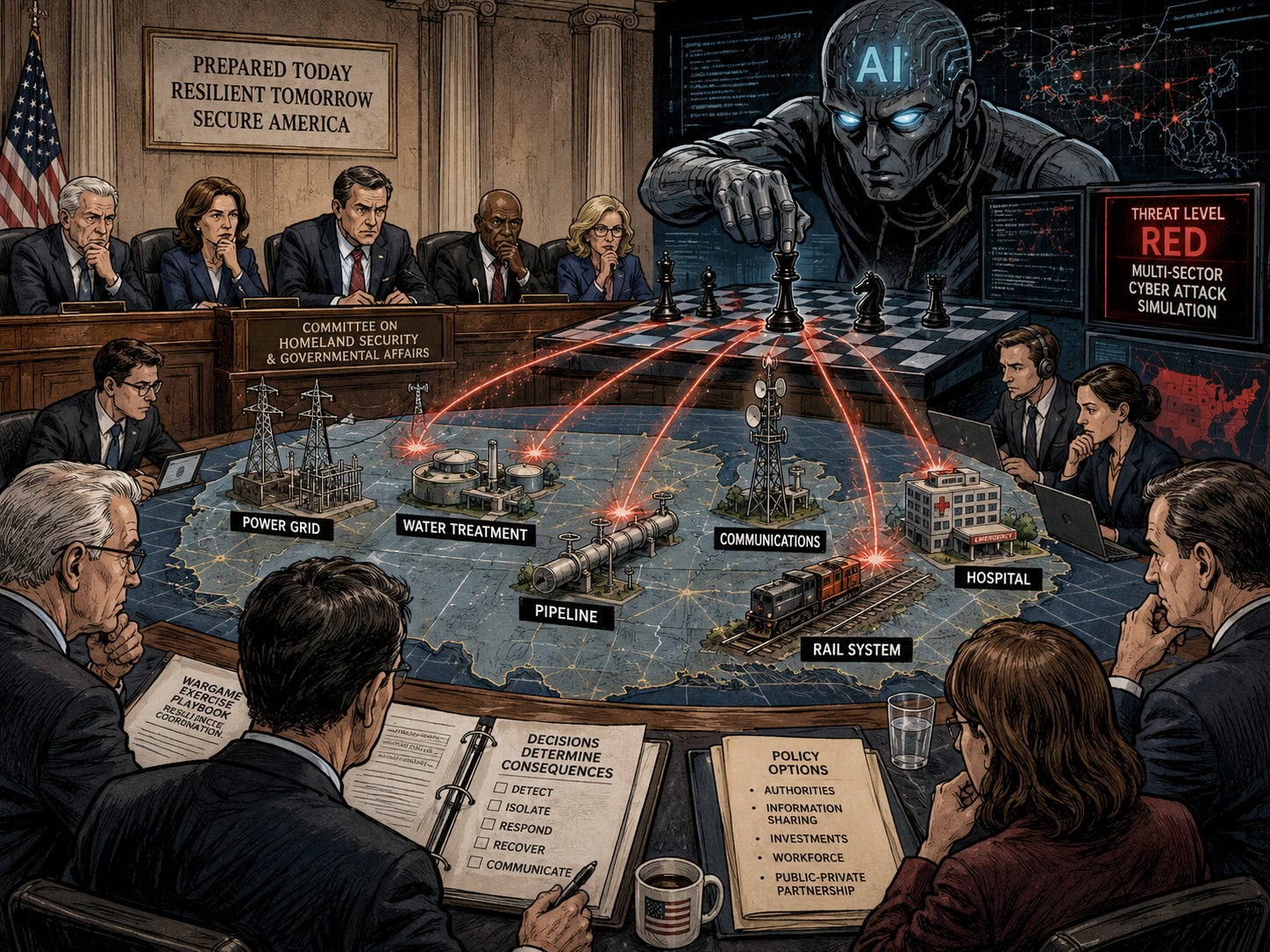
Congressional Wargame to Test AI-Enabled Cyberattacks Against U.S. Critical Infrastructure
Bottom Line Up Front (BLUF): The Center for Strategic and International Studies is hosting a closed-door wargame for members of the House Committee on Homeland Security and the House Select Committee on China. The exercise will examine how advanced artificial intelligence could enable cyber operations against U.S. critical infrastructure and test the resilience, coordination, and policy decisions required to respond.
Analyst Comments: The reference to China obtaining “Mythos-level” artificial intelligence appears to describe a hypothetical advanced capability used for the scenario rather than a publicly documented system. Without access to the closed-door exercise materials, it is unclear which technical capabilities, intelligence assumptions, or escalation thresholds the scenario assigns to that term. The congressional audience is significant. Critical-infrastructure cyber incidents rarely remain purely technical problems; they quickly require decisions involving intelligence attribution, private-sector coordination, emergency authorities, public communication, military posture, and potential retaliation. A wargame can expose where those authorities overlap, where information sharing breaks down, and where policymakers lack credible response options.
READ THE STORY: CSIS
Zero-Day Intrusion Exposes Personal Data of 6,000 South Korean Diplomats and Overseas Officials
Bottom Line Up Front (BLUF): An unidentified attacker reportedly maintained prolonged administrative access to the Korea National Diplomatic Academy’s online education system after exploiting an undisclosed software vulnerability and weak security configurations. The intrusion exposed personal information belonging to approximately 6,000 current and former diplomats and other officials assigned to overseas missions. South Korea’s Ministry of Foreign Affairs has not confirmed the full scope of the data theft or attributed the operation.
Analyst Comments: Administrative access obtained between April and May 2025 allegedly persisted until February 2026, giving the intruder months to collect data, observe user activity, establish alternate access paths, and potentially target connected systems. The compromised information reportedly included names, user IDs, and organizational affiliations. On its own, that data may appear limited. In an intelligence context, however, an authoritative list of diplomats and overseas personnel can support spearphishing, surveillance, social engineering, identity correlation, and the mapping of government networks. The report also raises the possibility that the dataset included personnel working overseas under concealed intelligence affiliations, although that risk has not been publicly confirmed.
READ THE STORY: Chosun Biz
High-Severity Fortinet Flaws Could Expose Sensitive Data in FortiSandbox and FortiAuthenticator
Bottom Line Up Front (BLUF): Italy’s national CSIRT has warned of multiple vulnerabilities affecting Fortinet FortiSandbox and FortiAuthenticator products, including two high-severity flaws tracked as CVE-2025-53379 and CVE-2026-59835. Successful exploitation could allow attackers to access sensitive information on affected systems. Organizations should upgrade vulnerable appliances using Fortinet’s security guidance.
Analyst Comments: Information-disclosure flaws in security appliances deserve immediate attention because these systems often store credentials, configuration data, authentication records, malware samples, and other operationally sensitive information. Even when a vulnerability does not directly provide remote code execution, exposed data can support credential theft, lateral movement, follow-on exploitation, or evasion of defensive controls.
READ THE STORY: ACN (IT)
OVH Mass-Reboots Cloud Fleet to Contain Critical Januscape Hypervisor Escape
Bottom Line Up Front (BLUF): OVHcloud reportedly rebooted tens of thousands of KVM hosts supporting roughly one million virtual machines to remediate Januscape, a critical Linux hypervisor vulnerability tracked as CVE-2026-53359. The flaw could allow an attacker with root access inside a guest virtual machine to execute code as root on the underlying host, crash the host, or compromise neighboring tenants. OVH backported a fix into Debian, tested the rollout in its Sydney region, and proceeded with forced reboots after rejecting slower or riskier alternatives.
Analyst Comments: Guest-to-host escape vulnerabilities are among the most serious threats facing cloud providers because they undermine the isolation boundary on which multitenant infrastructure depends. Januscape reportedly required root access inside a guest, which narrows the attack path, but that is not much comfort in environments where attackers routinely gain privileged access through stolen credentials, exposed management services, or application compromise. OVH’s decision highlights the ugly tradeoffs providers face during fleet-wide hypervisor emergencies. Disabling nested virtualization would have affected legitimate workloads and interfered with internal migration processes. Live migration would have taken too long, while live patching risked instability across a massive production estate. Rebooting the fleet introduced immediate downtime and operational risk but reduced the window in which an attacker could weaponize the vulnerability.
READ THE STORY: The Register
Hackers Exploit PAN-OS Authentication Bypass to Deploy Qilin Ransomware
Bottom Line Up Front (BLUF): Threat actors are reportedly exploiting CVE-2026-0257, a high-severity authentication-bypass vulnerability in Palo Alto Networks PAN-OS, to gain unauthorized GlobalProtect VPN access and deploy Qilin ransomware. Observed intrusions progressed from external VPN compromise to credential theft, lateral movement, domain-wide encryption, and—in some cases—data exfiltration for double extortion. Organizations running affected PAN-OS or Prisma Access versions should patch immediately, terminate existing GlobalProtect sessions, and hunt for post-exploitation activity.
Analyst Comments: GlobalProtect sits at the edge of the network and is designed to provide trusted remote access. Once an attacker bypasses authentication and establishes a valid VPN session, much of the follow-on activity can resemble legitimate administrator behavior. The reported attack chain is consistent with mature ransomware operations: dump LSASS, extract Active Directory data, move through administrative shares, disable endpoint protections, erase logs, target backups, and stage ransomware from a common writable directory. The use of PsExec, AnyDesk, Ngrok, LogMeIn, MeshAgent, Rclone, and FileZilla shows the operators are relying heavily on legitimate tools rather than custom malware.
READ THE STORY: GBhackers
Critical NGINX Heap Overflow Could Enable Denial of Service and Potential Remote Code Execution
Bottom Line Up Front (BLUF): F5 has patched CVE-2026-42533, a critical NGINX heap-buffer-overflow vulnerability that can be triggered remotely without authentication through a crafted HTTP request when specific regex-based configuration conditions are present. Successful exploitation can crash NGINX worker processes and cause denial of service. F5 says remote code execution may be possible when Address Space Layout Randomization is disabled or bypassed, while one researcher claims the flaw can itself leak memory addresses needed to defeat ASLR.
Analyst Comments: A vulnerable version alone is not enough. The attack requires a regex-based map, reuse of regex capture groups in a later string expression, and a specific ordering of those references. The underlying issue sits in NGINX’s two-stage script evaluation engine. One stage calculates the required buffer size, while the second writes the final string. Because both stages rely on shared capture-state data, an intervening regex match can overwrite that state. NGINX may therefore allocate memory based on one capture value and then write a longer attacker-controlled value into the same buffer.
READ THE STORY: T00ls
WordPress “wp2shell” Flaw Reportedly Enables Pre-Authentication Remote Code Execution
Bottom Line Up Front (BLUF): A newly disclosed WordPress Core vulnerability chain, dubbed “wp2shell,” reportedly allows unauthenticated attackers to achieve remote code execution on affected default installations without requiring plugins or valid credentials. The chain combines REST API batch-route confusion with SQL injection and affects WordPress 6.9.0 through 6.9.4, 7.0.0 through 7.0.1, and certain 7.1 beta releases. Administrators should upgrade immediately to WordPress 7.0.2, 6.9.5, or 6.8.6 and verify that automatic updates completed successfully.
Analyst Comments: A pre-authentication RCE in WordPress Core would be a major internet-scale risk because exploitation would not depend on a vulnerable third-party plugin, weak credentials, or prior access. Any exposed site running an affected core version could become a target once reliable exploit details or patch-diff analysis are available. The reported attack chain is especially concerning because it combines two separate flaws. REST API routing confusion appears to create the initial condition, while SQL injection enables the deeper compromise path. Chained vulnerabilities are often harder to mitigate safely at the application layer because blocking one request pattern may not address alternate paths or encoding variations.
READ THE STORY: GBhackers
Attackers Exploit Critical ServiceNow AI Platform Flaw for Unauthenticated Code Execution
Bottom Line Up Front (BLUF): Threat actors are reportedly exploiting CVE-2026-6875, a critical ServiceNow AI Platform sandbox-escape vulnerability that allows unauthenticated remote code execution. Successful exploitation could enable full compromise of a ServiceNow instance and connected proxy servers. Self-hosted customers should apply ServiceNow’s June security updates immediately and investigate exposed systems for evidence of exploitation.
Analyst Comments: Code execution on the platform could expose credentials, tickets, configuration data, integration secrets, and privileged connections to other systems. The pre-authentication attack path materially increases the risk. Attackers do not need valid credentials before targeting the affected endpoint, which makes exposed self-hosted instances suitable for automated scanning and exploitation. Once code execution is achieved, the compromise may extend beyond the ServiceNow server itself to connected proxy infrastructure and downstream enterprise services.
READ THE STORY: THN
Items of interest
CISA Adds FortiSandbox and SharePoint Flaws to Known Exploited Vulnerabilities Catalog
Bottom Line Up Front (BLUF): CISA has added three actively exploited vulnerabilities to its Known Exploited Vulnerabilities Catalog: two Fortinet FortiSandbox command-injection flaws and one Microsoft SharePoint deserialization vulnerability. Federal civilian agencies must prioritize remediation under Binding Operational Directive 26-04, while all organizations should treat affected internet-facing systems as potentially compromised until proven otherwise.
Analyst Comments: A KEV addition is not a theoretical warning. It means CISA has evidence that attackers are already exploiting the vulnerability. Organizations running affected FortiSandbox or SharePoint systems should move beyond routine patch scheduling and begin immediate containment, patching, and compromise assessment. The two FortiSandbox flaws are especially concerning because command injection can give attackers direct operating-system access on a security appliance. FortiSandbox systems may process untrusted files, connect to internal services, and store sensitive analytical data, making successful compromise useful for credential theft, persistence, lateral movement, or evasion of malware-detection workflows.
READ THE STORY: CISA
FortiSandbox Flaw Lets Unauthenticated Attackers Run Commands (CVE-2026-25089 (Video)
FROM THE MEDIA: CVE-2026-25089, a Fortinet FortiSandbox and FortiSandbox Cloud/PaaS OS command injection issue tracked as CWE-78. It is rated CVSS 9.8 Critical, appears in CISA’s Known Exploited Vulnerabilities catalog, and sits at the 0.98309 EPSS percentile.
Fortinet FortiSandbox Flaws Targeted As Fortibleed Hits Firewalls (Video)
FROM THE MEDIA: Fortinet customers face two simultaneous threats this week. Attackers are actively exploiting recently patched FortiSandbox vulnerabilities, and a massive credential exposure campaign dubbed FortiBleed has prompted a CISA alert affecting tens of thousands of FortiGate firewall URLs.
The selected stories cover a broad range of cyber threats and are intended to help readers frame key publicly discussed threats and improve overall situational awareness. InfoDom Securities does not endorse any third-party claims made in its original material or related links on its sites; the opinions expressed by third parties are theirs alone. For further questions, don’t hesitate to get in touch with InfoDom Securities at dominanceinformation@gmail.com.