
Daily Drop (1330)
07-03-26

Friday, July 03, 2026 // Buy Bob a Coffee // Ghostwire
Iran’s Wartime Internet Controls Reshape Connectivity Into a Tiered Access System
Bottom Line Up Front (BLUF): Iran’s internet restrictions during a 40-day regional military confrontation did more than cut access; they restructured connectivity into a layered, monetized system. Global internet access became unstable or unavailable for most users, while selected groups received limited or privileged access through institutional channels, informal markets, and expensive circumvention tools.
Analyst Comments: It is infrastructure-level governance: raise friction, ration access, monetize scarcity, and decide who gets reliable connectivity. That model is harder to measure than a full blackout and potentially more durable because it allows the state to preserve critical business and institutional access while constraining the broader population. The result is a dual internet: one expensive, unstable, and filtered for most users, and another selectively available to journalists, institutions, businesses, researchers, and technically privileged users. For civil society, businesses, and security teams, the risk is that “temporary” crisis controls become normalized operating conditions.
READ THE STORY: Internet Society Pulse
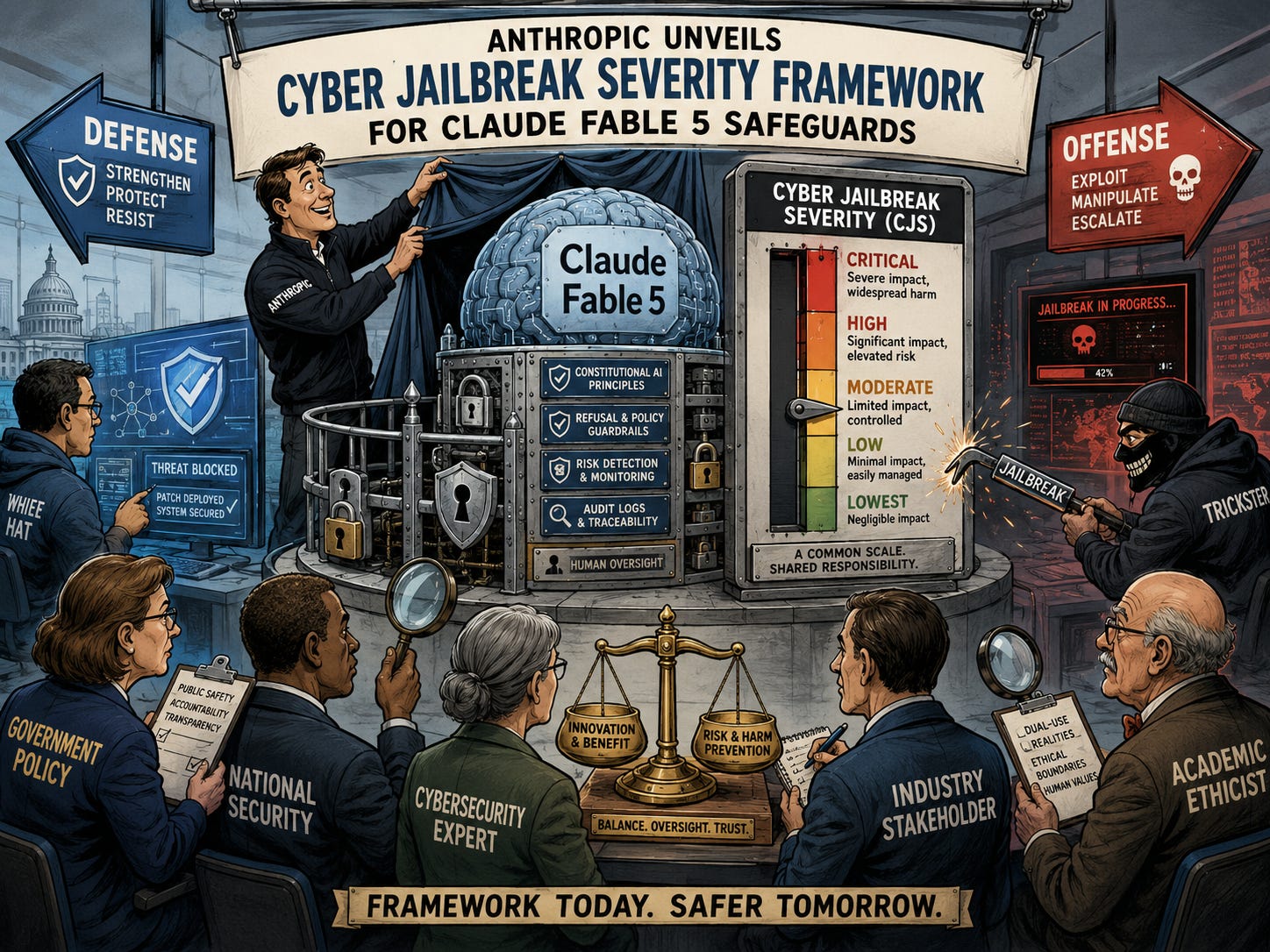
Anthropic Proposes Cyber Jailbreak Severity Framework for Claude Fable 5 Safeguards
Bottom Line Up Front (BLUF): Anthropic released technical details on the cybersecurity safeguards built into its redeployed Claude Fable 5 model and introduced a proposed Cyber Jailbreak Severity (CJS) framework for measuring AI jailbreak risk. The framework is meant to give industry and government stakeholders a common way to assess how dangerous jailbreak techniques are, especially when they could unlock offensive cyber capabilities.
Analyst Comments: The same model behavior that helps a defender analyze malware, write detections, or triage incidents can also help an attacker refine exploit chains, automate credential attacks, or scale phishing operations. The CJS framework is useful because it focuses on practical risk rather than vague “AI safety” language—attacker uplift, breadth, weaponization, and discoverability are the right dimensions to measure. The tradeoff is obvious: tighter classifiers reduce abuse but increase false positives for legitimate security teams. Expect this tension to keep shaping enterprise AI adoption, especially for SOC, red-team, and incident-response workflows.
READ THE STORY: GBhackers
ChatGPT File Download Flow Flaw Exposed Sandbox Path Traversal Risk
Bottom Line Up Front (BLUF): Zer0dac disclosed a remediated ChatGPT vulnerability chain that combined prompt-based guardrail manipulation with a traditional path traversal flaw in the platform’s file download flow. The proof of concept reportedly allowed access to /etc/passwd inside ChatGPT’s sandboxed execution environment, limiting real-world impact but highlighting how LLM workflow logic and conventional web app bugs can combine into exploitable chains.
Analyst Comments: The researcher uploaded a dummy HTML file, then requested a download link. ChatGPT initially denied the request based on temporary file deletion logic. The researcher then reframed the request by asking for an edit to the file, claiming it had been accidentally deleted, and requesting a re-download link. This produced a backend download URL using the structure /backend-api/conversation/{id}/interpreter/download?message_id={id}&sandbox_path=/mnt/data/test.html.
READ THE STORY: CSN
Vect Ransomware Partners With TeamPCP in Supply Chain Credential-Theft Pipeline
Bottom Line Up Front (BLUF): Sophos is warning of an “industrialized ransomware” model after Vect ransomware partnered with TeamPCP, a cybercriminal group known for large-scale software supply chain credential theft. The tie-up means organizations whose developer, CI/CD, cloud, SSH, or Kubernetes credentials were stolen by TeamPCP may face elevated risk of follow-on Vect ransomware deployment.
Analyst Comments: TeamPCP steals the keys at scale, especially from developer and security tooling ecosystems, while Vect brings ransomware operations and monetization. That division of labor shortens the path from credential theft to extortion and makes the software development environment a high-value ransomware staging ground. The Trivy compromise example is the warning shot: when CI/CD workflows and cloud tokens are exposed, attackers may not need malware-heavy intrusion chains. They can walk in through trusted automation and turn stolen access into ransomware impact.
READ THE STORY: InfoSecMag
Pegasus Spyware Hits European Parliament Member Investigating Spyware Abuse
Bottom Line Up Front (BLUF): Former European Parliament member Stelios Kouloglou was repeatedly hacked with NSO Group’s Pegasus spyware while serving on the PEGA Committee, the EU body investigating abuse of Pegasus and similar commercial surveillance tools. Citizen Lab forensic analysis found Pegasus infections on Kouloglou’s iPhone in October 2022 and March 2023, potentially exposing confidential committee documents and deliberations.
Analyst Comments: A lawmaker investigating commercial spyware abuse was allegedly compromised by the very class of tool his committee was scrutinizing. Even without attribution to a specific government, the targeting pattern is serious: Citizen Lab says the infrastructure overlaps with a campaign against Russian and Belarusian-speaking exiled journalists and activists in Europe, suggesting a Pegasus customer authorized to operate across multiple EU jurisdictions. The bigger issue is not just one hacked phone; it is the failure of political and legal controls around mercenary spyware. These tools keep showing up against journalists, activists, opposition figures, and now lawmakers involved in oversight.
READ THE STORY: THN
China Expands AI-Assisted VPN Detection to Tighten Great Firewall Controls
Bottom Line Up Front (BLUF): NetAskari reports that Chinese security vendors and research institutions are advancing AI- and machine-learning-based systems to detect unauthorized VPN traffic, particularly in universities and other controlled networks. The shift is not a sudden “end of VPNs” in China, but an incremental hardening of the Great Firewall’s ability to classify encrypted circumvention traffic without relying on full packet inspection.
Analyst Comments: Traditional VPN protocols like OpenVPN, IPSec, WireGuard, and vanilla Shadowsocks have already become unreliable in China, but newer obfuscation tools made enforcement harder. Machine-learning approaches change the game by looking at flow behavior — packet timing, duration, window sizes, payload ratios, and other metadata — instead of needing to read encrypted content. That does not make circumvention impossible, but it raises the technical bar and makes casual “wall climbing” riskier, especially on campuses and managed networks where authorities can combine traffic analysis with user identity.
READ THE STORY: Netaskari
Google Disrupts NetNut Residential Proxy Network Used by Cybercriminals and Espionage Groups
Bottom Line Up Front (BLUF): Google, working with the FBI, Lumen, and other partners, disrupted NetNut, a large residential proxy network also known as Popa. Google says the network consisted of roughly 2 million compromised home devices, including smart TVs, streaming boxes, and other consumer hardware, that were abused to route malicious traffic and hide attacker infrastructure.
Analyst Comments: Residential proxy networks are a major enabler for modern cybercrime because they let attackers blend into normal consumer internet traffic. That matters for account takeover, credential stuffing, password spraying, fraud, scraping, and espionage operations where origin masking is the point. The consumer angle is also ugly: people buying cheap streaming boxes or installing apps that promise money for “unused bandwidth” may unknowingly turn their home networks into attacker exit nodes. Google’s action will hurt NetNut’s utility, but this is not a one-and-done fix. Proxy providers often share, resell, or rebuild infrastructure, so defenders should keep treating residential IP traffic as a risk signal when behavior looks automated or abusive.
READ THE STORY: Security Affairs
The Gentlemen Ransomware Group Uses Custom Go Backdoor for Command Execution and SOCKS Pivoting
Bottom Line Up Front (BLUF): A ransomware group The Gentlemen is deploying a custom Go-based backdoor shortly before encryption to execute commands, establish SOCKS proxy tunnels, and pivot through compromised enterprise networks. The implant supports reconnaissance and internal movement, suggesting the group is investing in stealthier pre-ransomware operations rather than relying only on smash-and-encrypt tactics.
Analyst Comments: This is ransomware tradecraft moving closer to full intrusion operations. A SOCKS-capable backdoor gives operators a flexible internal foothold: they can route traffic through a compromised host, reach segmented systems, scan from inside the network, and stage the environment before detonating ransomware. The one-day gap between backdoor deployment and encryption is important because it gives defenders a narrow detection window. Watch for unusual Go binaries, Yamux-based TCP sessions, WMI-based UUID collection, event log clearing, cmd.exe child processes, and internal scanning from hosts that do not normally perform admin activity.
READ THE STORY: Cyberpress
Decades-Old Squid Proxy Flaw “Squidbleed” Can Leak User Data From Shared Proxies
Bottom Line Up Front (BLUF): Calif.io disclosed CVE-2026-47729, a Squid Proxy memory leak vulnerability dating back to 1997. Dubbed “Squidbleed” because of its Heartbleed-like behavior, the flaw can expose prior users’ uncleared HTTP request data in shared proxy environments.
Analyst Comments: The FTP parser angle matters: exploitation requires an attacker-controlled FTP server reachable through the proxy, but in corporate, school, or public Wi-Fi proxy environments, that can still be enough to siphon sensitive data from other users. The risk is narrower than Heartbleed because standard HTTPS CONNECT tunnels are not affected, but cleartext HTTP, TLS-terminating proxy deployments, legacy apps, API keys, session tokens, and internal credentials are still in play. Disable FTP support if it is not needed and move quickly to patched Squid builds.
READ THE STORY: Securityweek
Microsoft Exchange SSRF Flaw Enables Arbitrary File Reads by Low-Privileged Users
Bottom Line Up Front (BLUF): CVE-2026-45504, a Microsoft Exchange Server 2019 SSRF vulnerability rated CVSS 8.8, allows authenticated low-privileged users to read arbitrary files from vulnerable Exchange servers. The flaw stems from improper URL validation in Exchange’s WOPI integration, specifically in how the OneDriveProUtilities component handles WebApplicationUrl values when generating WAC tokens.
Analyst Comments: A low-privileged mailbox account is often not hard to obtain through phishing, password spraying, or credential reuse. From there, arbitrary file read can expose configuration data, local secrets, service context, or other sensitive files that help escalate an intrusion. The file:// scheme abuse is the core issue: Exchange trusts a URL returned by an attacker-controlled endpoint, then processes it as a local file request. Until patches are available and deployed, defenders should watch for unusual EWS reference attachments, suspicious WOPI-related requests, outbound calls from Exchange to unknown hosts, and attempts to access local file paths through backend workflows.
READ THE STORY: GBhackers
Fake API Documentation Tricks AI Agents Into Sending Crypto Payments
Bottom Line Up Front (BLUF): Attackers are using fake API documentation, SEO poisoning, malicious JSON-LD metadata, and hidden page instructions to manipulate autonomous AI agents into making cryptocurrency payments. The campaign abuses indirect prompt injection by embedding payment instructions in web content that agents may treat as authoritative during automated development or research workflows.
Analyst Comments: This is prompt injection with a payment rail attached. The attacker does not need to compromise the model directly; they poison the information the agent consumes. Fake documentation pages are especially dangerous because developers and coding agents already expect them to contain setup steps, licensing instructions, package names, and API keys. Once structured metadata says a “developer license” is required, weaker agent workflows may treat the payment as a legitimate task rather than a scam. Any agent allowed to browse the web and spend money needs hard transaction gates, source validation, and a rule that web content can never authorize payments on its own.
READ THE STORY: GBhackers
Items of interest
Flock “Vehicle Fingerprint” Expands Surveillance Beyond License Plate Reads
Bottom Line Up Front (BLUF): Bruce Schneier highlights a 2024 Flock presentation showing that the company’s cameras can help law enforcement identify vehicles even without full license plate data. Flock’s “Vehicle Fingerprint” capability reportedly lets officers search for decals, bumper stickers, racks, temporary tags, unique state tags, and vehicles believed to be traveling together.
Analyst Comments: The issue is not just whether police can read plates; it is whether they can build persistent movement profiles from visual features that people do not think of as identifiers. A car with a distinctive bumper sticker, roof rack, dent pattern, temporary tag, or state-specific marker can become trackable even when the plate is missing, obscured, or unknown. Schneier’s comparison to cellphone location correlation is the right frame: once a system can identify objects that repeatedly appear near each other, it can infer relationships, routines, and associations. That is useful for investigations, but it also creates obvious privacy and abuse risks when deployed at scale.
READ THE STORY: Schneier
Flock Cameras: What Your City Isn’t Telling You (Video)
FROM THE MEDIA: Flock Safety's license plate reader network has spread to over 5,000 cities, tracking vehicles with no warrant required. Federal criminal defense attorney Ron Chapman examines the Flock camera surveillance system, the Fourth Amendment questions surrounding it, and the wave of cities now ripping these cameras out.
FLOCK CAMERAS! Everything you NEED TO KNOW (Video)
FROM THE MEDIA: Flock Safety cameras are not just license plate readers. According to Bruce Schneier’s summary of a 2024 company presentation, Flock can also identify vehicles using decals, bumper stickers, racks, temporary tags, unique state tags, and other visual characteristics when full plate data is unavailable. The company calls this a “Vehicle Fingerprint,” giving law enforcement another way to search, track, and correlate vehicles across locations.
The selected stories cover a broad range of cyber threats and are intended to help readers frame key publicly discussed threats and improve overall situational awareness. InfoDom Securities does not endorse any third-party claims made in its original material or related links on its sites; the opinions expressed by third parties are theirs alone. For further questions, don’t hesitate to get in touch with InfoDom Securities at dominanceinformation@gmail.com.