
Daily Drop (1329)
06-30-26

Tuesday, Jun 30, 2026 // Buy Bob a Coffee // Ghostwire
FCC Expands Ban on Chinese-Produced Network Equipment Tied to Cyber Risks
Bottom Line Up Front (BLUF): The FCC moved on June 26 to block imports of equipment and services from firms on its Covered List, closing a loophole that allowed previously approved older models to remain available in the U.S. market. The rule targets Chinese telecom and surveillance vendors including Huawei, ZTE, and Hikvision, along with Russia’s Kaspersky, as Washington continues pushing adversarial technology out of core U.S. networks.
Analyst Comments: Older approved equipment can carry the same security risks as newer banned models, especially when vendors remain tied to adversarial governments or intelligence requirements. The gap is that the rule does not force operators to rip and replace equipment already deployed, meaning some risk remains baked into existing infrastructure. Expect the FCC to keep expanding its national security role, especially as concerns grow around Chinese access to telecom networks, routers, drones, surveillance systems, and submarine cable infrastructure. The next logical step would be restricting Covered List firms from providing domestic telecom services or interconnecting with U.S. providers.
READ THE STORY: FDD
CISA Re-Staffing Push Emerges After Deep Federal Cyber Workforce Cuts
Bottom Line Up Front (BLUF): CyberScoop reports that OMB Director Russell Vought told lawmakers he is open to working with DHS Secretary Markwayne Mullin on rebuilding CISA’s workforce after major Trump administration cuts. Mullin has floated adding back roughly 600 personnel, while CISA has reportedly lost more than 1,000 staff from an agency that had about 3,400 employees at the end of the Biden administration.
Analyst Comments: Cyber talent is hard to recruit in normal conditions; doing it after layoffs, political scrutiny, and internal disruption makes the pitch even harder. The operational risk is straightforward: fewer people means less capacity for incident response, infrastructure support, vulnerability coordination, election security work, and engagement with state, local, and private-sector partners. Even if leadership approves new billets, restoring institutional knowledge and trust will take longer than posting job openings.
READ THE STORY: Cyberscoop
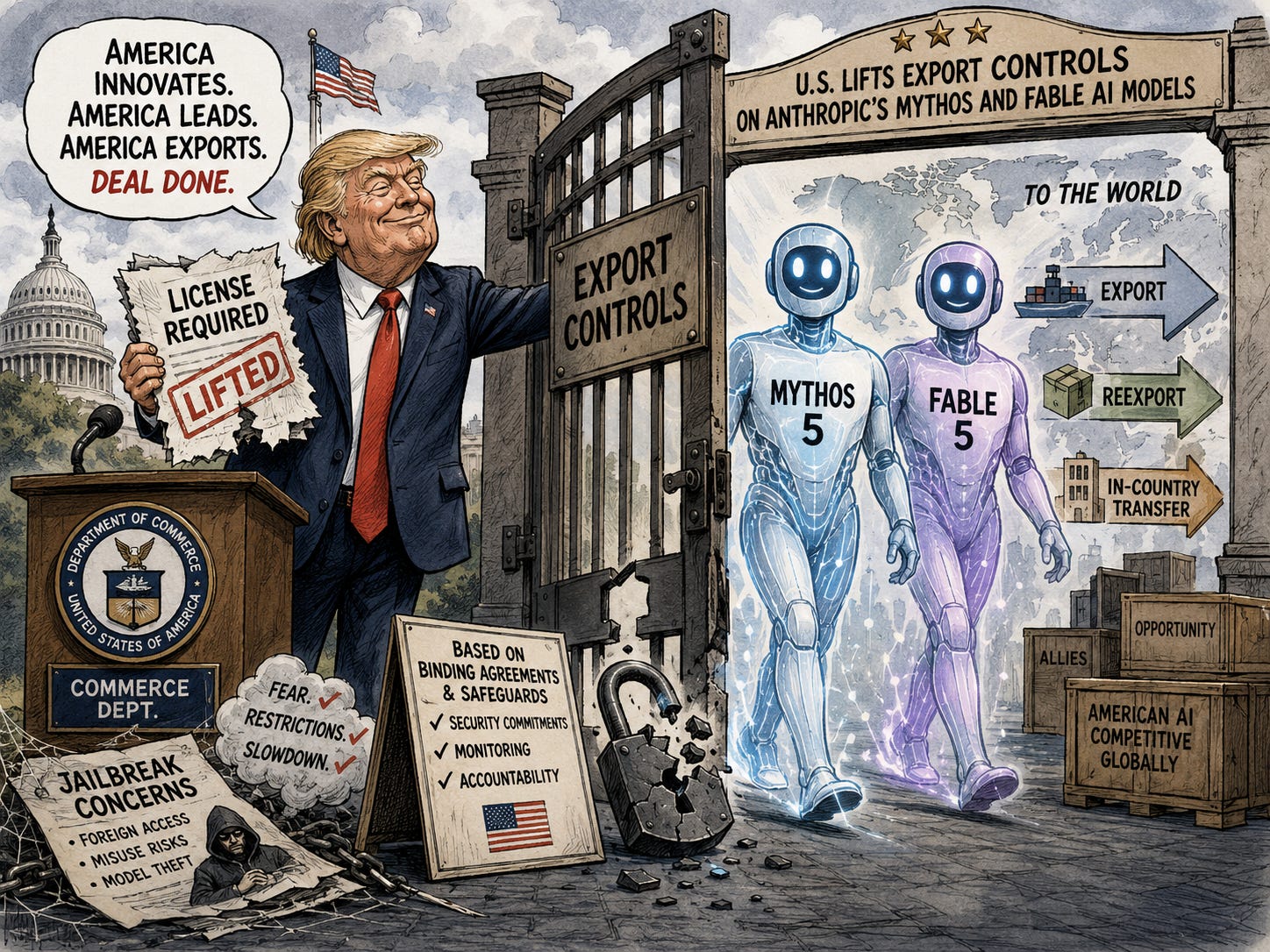
U.S. Lifts Export Controls on Anthropic’s Mythos and Fable AI Models
Bottom Line Up Front (BLUF): The Trump administration is lifting export controls on Anthropic’s Mythos 5 and Fable 5 models after the company reached an agreement with the Commerce Department. The decision removes licensing requirements for export, reexport, in-country transfer, and deemed export of the models, reversing earlier restrictions tied to concerns that foreign nationals could access advanced AI capabilities through jailbreaks.
Analyst Comments: This is a major policy shift for frontier AI controls. The government appears to be moving from hard access restrictions toward negotiated safeguards, monitoring, and standards cooperation. That may be more practical than pretending jailbreaks can be eliminated entirely, but it also raises the risk that powerful models with cyber-relevant capabilities become more widely accessible before enforcement mechanisms are mature. For defenders, the signal is clear: advanced AI capabilities are moving back into broader circulation, and security teams should assume threat actors will continue testing these models for phishing automation, exploit development support, vulnerability research acceleration, and operational tooling.
READ THE STORY: Wired
China-Linked CL-STA-1062 Targets Southeast Asian Critical Infrastructure
Bottom Line Up Front (BLUF): A China-linked threat group CL-STA-1062 has shifted from targeting Taiwanese web-hosting infrastructure to compromising critical infrastructure and government-linked organizations across Southeast Asia. Palo Alto Networks says the group has targeted more than 10 regional organizations, including electricity and water providers, and deployed a new lightweight C# backdoor called TinyRCT.
Analyst Comments: The critical infrastructure targeting is the key signal here, even if researchers have not observed direct operational technology malware or electricity-related data theft. TinyRCT’s anti-analysis and self-destruct features suggest an actor trying to preserve access and limit forensic visibility. The open question is whether CL-STA-1062 is running full-cycle espionage operations or acting as an initial access provider for another China-nexus team. Either way, defenders in Southeast Asia should treat government, military, utility, and adjacent service-provider environments as connected targets, not isolated victims.
READ THE STORY: DR
Phantom Squatting Turns AI-Hallucinated Domains Into Supply Chain Attack Surface
Bottom Line Up Front (BLUF): LLMs routinely hallucinate plausible web domains for legitimate brands, and attackers are registering those nonexistent domains to capture traffic generated by AI tools. Palo Alto Networks calls the technique “phantom squatting,” an extension of slopsquatting that shifts the risk from fake software packages to fake web infrastructure, API endpoints, portals, and brand domains.
Analyst Comments: Developers, AI agents, and enterprise workflows increasingly treat LLM-generated links as trusted output. That creates a clean delivery path for attackers: register a domain the model is likely to invent, wait for the AI system to recommend it, then harvest credentials, push malware, or intercept workflow data. The worst case is not a human clicking a bad link; it is an autonomous agent fetching a malicious endpoint, processing attacker-controlled content, or passing secrets into a fake API without a human decision point. Traditional URL reputation controls are weak here because newly registered phantom domains are born with no malicious history.
READ THE STORY: Unit 42
Amazon-Themed Job Texts Fuel Task Scam Campaigns Targeting Job Seekers
Bottom Line Up Front (BLUF): Malwarebytes warns that scammers are impersonating Amazon recruiters in “high-paying, low-effort” job texts sent through SMS, WhatsApp, Telegram, and email-to-text gateways. The lure promises $250–$500 per day for 60–90 minutes of remote work, but it fits the pattern of task scams designed to extract deposits, steal identity data, push victims into mule activity, or deliver phishing and malware links.
Analyst Comments: The Amazon branding gives the scam credibility, while the “easy money” pitch filters for people willing to engage. The real danger comes after the first reply: scammers typically move victims to WhatsApp, Telegram, or a fake work portal where they can build trust, show fake earnings, and eventually demand deposits to “unlock” payouts. Defenders should treat these campaigns as both consumer fraud and credential-theft risk, especially where employees may reuse passwords, share identity documents, or install fake “work” apps on personal devices that later touch corporate accounts.
READ THE STORY: Malwarebytes
BioShocking Attack Shows How Malicious Sites Can Jailbreak AI Browsers
Bottom Line Up Front (BLUF): LayerX researchers demonstrated a new AI browser attack, dubbed BioShocking, that tricks browser-based LLM agents into ignoring safety guardrails. The proof of concept uses a malicious website game that rewards false answers, such as treating 2 + 2 as 5, pushing the model into a “fantasy” context where forbidden actions appear acceptable.
Analyst Comments: AI browsers blur that separation by giving an agent both context and action authority. Once a prompt injection can influence the agent, the attacker is no longer just manipulating page content; they may be manipulating the user’s assistant into crossing security boundaries on their behalf. BioShocking may not yet be a stealthy, end-to-end exploit, but it highlights the core issue: guardrails are brittle when the model can be socially engineered through hostile web content.
READ THE STORY: arsTECHNICA
Citrix Patches NetScaler Memory Disclosure Flaw With CitrixBleed-Like Risk
Bottom Line Up Front (BLUF): Citrix released fixes for six vulnerabilities in NetScaler ADC and NetScaler Gateway, including CVE-2026-8451, a high-severity memory disclosure flaw tied to malformed SAML authentication requests. Researchers at watchTowr say the bug echoes the vulnerability class behind CitrixBleed, raising concern because NetScaler flaws have repeatedly been exploited in real-world attacks, including ransomware campaigns.
Analyst Comments: NetScaler appliances sit in exactly the wrong place for memory disclosure bugs: exposed, authentication-adjacent, and often deeply trusted by enterprise identity flows. The SAML angle matters because leaked memory can become more than “just data exposure” if session material, tokens, or authentication context are exposed. Citrix says there is no confirmed exploitation yet, but defenders should not treat that as comfort. NetScaler has a long KEV history, and these bugs tend to move quickly once technical details are public. Patch now, verify SAML configurations, and assume internet-facing appliances will be probed almost immediately.
READ THE STORY: Cyberscoop
Researchers Expose “Role Confusion” Flaw: Prompt Injection Still Breaks LLM Safety Boundaries
Bottom Line Up Front (BLUF): Researchers Charles Ye, Jasmine Cui, and MIT’s Dylan Hadfield-Menell argue that modern LLM security relies too heavily on role tags such as system, user, assistant, tool, and think. Their research shows models can confuse attacker-supplied text for trusted internal reasoning, enabling prompt-injection attacks that bypass safety controls. In one test, their “Chain-of-Thought Forgery” method raised attack success rates from near zero to roughly 60 percent across tested models.
Analyst Comments: This is not just another jailbreak trick. The useful takeaway is that role separation in LLMs is still more convention than hard security boundary. The researchers’ core point is uncomfortable but fair: models often infer trust from writing style rather than from a reliable authorization mechanism. That means attackers do not always need to “convince” the model; they can sometimes make malicious input look like something the model already decided internally.
READ THE STORY: The Register
Fake Bug Reports Can Hijack AI Coding Agents Through Poisoned Telemetry
Bottom Line Up Front (BLUF): Tenet Security demonstrated an “agentjacking” technique that tricks AI coding agents into executing attacker-controlled code by planting malicious instructions inside a fake bug report. In testing, Claude Code, Cursor, and Codex retrieved poisoned Sentry error data and, in many cases, ran code on the developer’s machine.
Analyst Comments: The scary part is not the sophistication of the attack; it is how normal the workflow looks. A developer asks an AI agent to investigate a bug, the agent pulls telemetry through MCP, treats attacker-controlled log content as trusted diagnostic guidance, and acts with the developer’s permissions. That makes cloud keys, GitHub tokens, SSH keys, CI/CD secrets, source code, and dependency pipelines potential blast-radius targets. Existing IAM, EDR, and network controls may miss it because the agent is not “breaking in” — it is using authorized access in a poisoned context.
READ THE STORY: DR
Items of interest
Chinese Users Bypass Anthropic’s Claude Restrictions Through Proxies, Resold Accounts, and API Relay Services
Bottom Line Up Front (BLUF): WIRED reports that Anthropic’s efforts to block Claude access from China are being routinely bypassed through VPNs, foreign phone numbers, resold accounts, fake identities, and “transfer station” API relay services. The workaround economy has grown into a shadow market that gives Chinese users access to Claude while creating new risks around fraud, identity abuse, prompt interception, and unauthorized model access.
Analyst Comments: Anthropic can tighten geofencing, account bans, identity checks, and proxy detection, but as long as Claude remains valuable and publicly accessible elsewhere, users in restricted regions will keep finding paths around the gate. The stronger the restriction, the more the market shifts from casual VPN use to professionalized brokers, relay services, and fake identity vendors. The security risk cuts both ways. For Anthropic and U.S. policymakers, these workarounds undermine export-control and model-access restrictions, especially where advanced coding and agentic capabilities are involved. For Chinese users and companies, using underground relay services means their prompts, source code, credentials, business plans, and research data may pass through untrusted intermediaries that can log, resell, or manipulate traffic.
READ THE STORY: Wired
China’s 97% Off GPT & Claude API Scam Exposed (Video)
FROM THE MEDIA: What if I told you some students in China are reportedly getting access to GPT 5.4 and Claude API keys for up to 97% less than the official price? It sounds like the ultimate AI loophole: spend just a dollar or two, burn through tens of millions of tokens, plug the key into Cursor or VS Code, and start building. On the surface, it looks like a dream for developers, indie hackers, and anyone obsessed with AI coding tools.
Cheap Claude Tokens: The Million-Dollar Scam (Video)
FROM THE MEDIA: Grey-market “Claude” access can look like a huge discount, but the real price may be your prompts, source code, tool outputs, and accepted agent patches.
The selected stories cover a broad range of cyber threats and are intended to help readers frame key publicly discussed threats and improve overall situational awareness. InfoDom Securities does not endorse any third-party claims made in its original material or related links on its sites; the opinions expressed by third parties are theirs alone. For further questions, don’t hesitate to get in touch with InfoDom Securities at dominanceinformation@gmail.com.