
Daily Drop (1326)
06-26-26

Friday, Jun 26, 2026 // Buy Bob a Coffee // Ghostwire
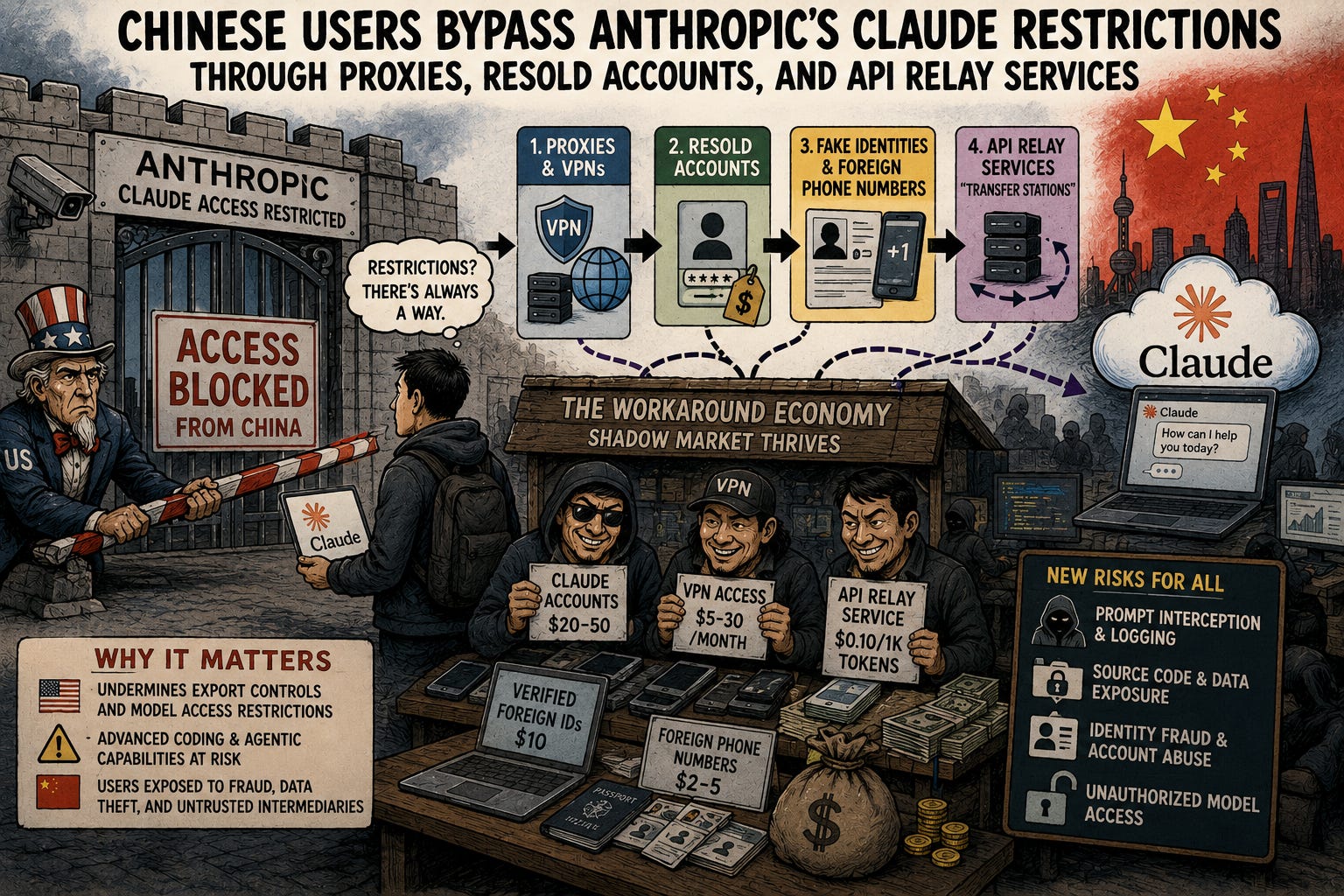
Chinese Users Bypass Anthropic’s Claude Restrictions Through Proxies, Resold Accounts, and API Relay Services
Bottom Line Up Front (BLUF): WIRED reports that Anthropic’s efforts to block Claude access from China are being routinely bypassed through VPNs, foreign phone numbers, resold accounts, fake identities, and “transfer station” API relay services. The workaround economy has grown into a shadow market that gives Chinese users access to Claude while creating new risks around fraud, identity abuse, prompt interception, and unauthorized model access.
Analyst Comments: Anthropic can tighten geofencing, account bans, identity checks, and proxy detection, but as long as Claude remains valuable and publicly accessible elsewhere, users in restricted regions will keep finding paths around the gate. The stronger the restriction, the more the market shifts from casual VPN use to professionalized brokers, relay services, and fake identity vendors. The security risk cuts both ways. For Anthropic and U.S. policymakers, these workarounds undermine export-control and model-access restrictions, especially where advanced coding and agentic capabilities are involved. For Chinese users and companies, using underground relay services means their prompts, source code, credentials, business plans, and research data may pass through untrusted intermediaries that can log, resell, or manipulate traffic.
READ THE STORY: Wired
Russian Intelligence Hackers Target Signal Backup Recovery Keys in Account Takeover Campaign
Bottom Line Up Front (BLUF): The FBI and CISA updated their warning on Russian intelligence-linked phishing campaigns targeting secure messaging accounts, adding a new Signal-specific tactic: attackers are now tricking users into revealing their Signal Backup Recovery Key. Once obtained, the key can allow attackers to restore message backups, read private and group chat history, and potentially take over the account.
Analyst Comments: Signal’s crypto is holding; the account owner is being socially engineered into handing over the recovery material. That makes this campaign especially dangerous for high-value targets because the attackers are no longer just chasing one-time codes or linked-device access. They are going after the key that unlocks the message archive. The persistence angle is ugly. According to the advisory, the old recovery key may remain useful even if the victim creates a new Signal account using the same phone number. That gives defenders a clear remediation step: generate a new recovery key immediately if exposure is suspected. But anything already restored by the attacker should be treated as compromised.
READ THE STORY: THN
Meta Tests Facial Recognition Smart Glasses for Police and Military Use
Bottom Line Up Front (BLUF): Bruce Schneier highlighted reporting that Meta is prototyping facial recognition capabilities for smart glasses with a Pentagon supplier, raising concerns about real-time identification by police, military, and immigration enforcement. The post connects the development to broader fears that wearable facial recognition could normalize persistent public surveillance.
Analyst Comments: Smart glasses with real-time facial recognition are not just another camera platform. They change the surveillance model from fixed infrastructure to mobile, person-mounted identification at street level. The civil liberties risk is obvious: protests, immigration enforcement, political gatherings, and routine policing become easier to monitor without visible checkpoints or fixed cameras. Even if Meta frames this as a prototype or restricted deployment, the concern is function creep. Tools built for military or law enforcement use tend to migrate, expand, and get normalized once the operational value is proven.
READ THE STORY: Schneier
Confidence Drops in Fully Autonomous AI Penetration Testing
Bottom Line Up Front (BLUF): A new Cobalt report shows confidence in fully autonomous AI penetration testing has fallen sharply, with only 9% of organizations willing to rely on AI-powered pentesting in 2026, down from 29% in 2025. Security teams are still adopting AI for assessment workflows, but most now favor human-in-the-loop testing because autonomous tools miss serious vulnerabilities, generate noisy findings, and create unpredictable costs.
Analyst Comments: The market is correcting from “AI will replace pentesters” to “AI can accelerate pentesters.” That is a healthier place to be. Autonomous tools are useful for breadth, repetition, reconnaissance, first-pass testing, and surfacing leads. They are still weak at judgment, exploitability validation, business-context prioritization, and chaining findings into real-world attack paths.
READ THE STORY: DR
Secret Service Review Finds Personal Phone Use and Weak Mobile Security During Protective Missions
Bottom Line Up Front (BLUF): A Department of Homeland Security inspector general review found that U.S. Secret Service employees routinely used personal phones for official communications during protective operations, including domestic and overseas missions. The report also found government-issued mobile devices lacked continuous threat protection, contained vulnerable apps, and were not consistently wiped after international travel, creating serious operational security risks.
Analyst Comments: Personal phones used during protective missions can expose communications, contacts, photos, location data, and mission details. In this context, phone compromise is not just an IT problem; it can become a physical security problem for agents, protectees, and visiting heads of state. The uncomfortable part is that employees were not simply ignoring policy for convenience. The review found that government-issued devices lacked the capabilities needed to perform mission work, pushing agents toward personal phones, hotspots, and blocked websites. That is how shadow IT becomes normalized: the official tool fails the mission, so the workforce routes around it.
READ THE STORY: The Register
DirtyClone Linux Kernel Flaw Can Enable Local Root Access
Bottom Line Up Front (BLUF): Researchers disclosed DirtyClone, a high-severity Linux kernel local privilege escalation vulnerability tracked as CVE-2026-43503. The flaw can allow a local unprivileged attacker to gain root access by abusing socket buffer fragment handling in the kernel’s networking code. Remote exploitation is not possible, but systems that allow local code execution or unprivileged user namespaces face elevated risk.
Analyst Comments: Most real intrusions eventually reach a point where the attacker has low-privilege code execution and needs root. DirtyClone gives them a plausible path there. The container angle is also worth watching. If unprivileged user namespaces expose capabilities such as CAP_NET_ADMIN inside a namespace, the blast radius may extend beyond a normal local privilege escalation and into container escape scenarios. That does not mean every containerized workload is automatically vulnerable, but it does mean Linux hosts running mixed-trust workloads should move quickly.
READ THE STORY: Linuxiac
Critical Veeam Backup & Replication RCE Threatens Enterprise Recovery Infrastructure
Bottom Line Up Front (BLUF): The Centre for Cybersecurity Belgium is warning organizations to patch CVE-2026-44963, a critical remote code execution vulnerability affecting Veeam Backup & Replication versions 12 through 12.3.2. The flaw carries a CVSS 4.0 score of 9.4 and allows an authenticated domain user to execute code on the Veeam Backup Server over the network.
Analyst Comments: Veeam servers are high-value targets because they often hold stored credentials, manage backup repositories, and control the recovery path after a ransomware incident. If an attacker gets code execution on the backup server, they may be able to delete backups, encrypt recovery data, steal credentials, or pivot into connected infrastructure.
READ THE STORY: CCB
Prinz Eugen Ransomware Abuses RemotePC and PowerShell Stagers for Enterprise Intrusions
Bottom Line Up Front (BLUF): A newly observed ransomware operation is using compromised RDP credentials, legitimate RemotePC remote management software, and PowerShell stagers to deploy Prinz Eugen ransomware. The malware, written in Go, prioritizes recently modified files, uses strong ChaCha20-Poly1305 encryption, removes itself after execution, and avoids writing ransom notes to disk, making post-incident recovery and forensics harder.
Analyst Comments: Prinz Eugen does not look like commodity ransomware sprayed blindly across the internet. The operator appears to understand enterprise environments, forensic blind spots, and victim pressure points. Targeting recently modified files first is especially nasty because it hits active business data before older backup-friendly files, increasing operational pain fast. The abuse of RemotePC is also worth flagging. Threat actors continue to lean on legitimate RMM tools because they blend into normal admin behavior and often bypass controls focused only on malware. Pair that with PowerShell staging, weak or stolen RDP credentials, and a manually created local admin account, and this becomes a familiar but effective intrusion chain.
READ THE STORY: CSN
CISA Orders Urgent Patching for Exploited Cisco Unified CM SSRF Flaw
Bottom Line Up Front (BLUF): CISA added CVE-2026-20230, a critical Cisco Unified Communications Manager Server SSRF vulnerability, to its Known Exploited Vulnerabilities catalog after confirmed exploitation in the wild. Federal agencies have until June 28, 2026 to patch or mitigate the issue under BOD 26-04. CISA also added CVE-2026-12569, a critical RCE flaw affecting PTC Windchill and FlexPLM, with the same deadline.
Analyst Comments: Cisco Unified Communications Manager is not just another enterprise app. It sits inside voice and collaboration infrastructure, often trusted by internal networks and tied into identity, call routing, and business communications. A remotely exploitable, unauthenticated SSRF in that environment is ugly enough. Active exploitation makes this a drop-everything patch item.
READ THE STORY: Bleeping Computer
Operation Endgame Disrupts StealC and Amadey Malware Infrastructure
Bottom Line Up Front (BLUF): International law enforcement and private-sector partners disrupted infrastructure tied to StealC and Amadey, two malware families frequently used together for access, credential theft, payload delivery, and follow-on cybercrime. The action hit 326 servers and 142 domains, froze more than €41 million in crypto assets, and followed a related takedown of SocGholish infrastructure.
Analyst Comments: StealC and Amadey sit in the messy middle of the cybercrime supply chain: initial access, credential theft, loader activity, and payload delivery. That makes them useful to ransomware crews, fraud groups, and access brokers alike. The interesting part is the convergence. Microsoft, Proofpoint, IBM X-Force, Europol, and law enforcement treated separately developed malware families as part of a broader shared operational ecosystem because they relied on overlapping infrastructure. That is the right approach. Malware crews do not operate in clean silos, and defenders should not investigate them that way either.
READ THE STORY: HSN
Microsoft Patches Critical M365 Copilot SearchLeak Vulnerability That Exposed Sensitive User Data
Bottom Line Up Front (BLUF): Microsoft patched a critical vulnerability in M365 Copilot that researchers showed could be abused to steal sensitive data from a user’s Microsoft 365 environment, including 2FA codes stored in email. The exploit chain, dubbed SearchLeak by Varonis, used prompt injection through a search URL parameter, temporary raw HTML rendering, and Bing as an allowed request relay to exfiltrate data without the victim typing anything.
Analyst Comments: The exploit is especially concerning because it targets the enterprise tier of Copilot. That means the exposed data is not limited to personal inbox content. Depending on permissions, Copilot may be able to surface emails, meeting notes, SharePoint documents, OneDrive files, and other indexed organizational data. In other words, SearchLeak turns “whatever this user can access” into the blast radius.
READ THE STORY: arsTECHNICA
Items of interest
U.S. Delays Blacklisting DeepSeek, CXMT, and 100+ Firms Flagged as Security Risks
Bottom Line Up Front (BLUF): Reuters reports that the U.S. has held off adding China’s DeepSeek, memory chipmaker CXMT, and more than 100 other companies to the Commerce Department’s Entity List despite an interagency committee approving them for blacklisting. The delay leaves U.S. goods, software, and technology potentially available to companies already deemed national security risks.
Analyst Comments: The Entity List is supposed to be one of Washington’s sharpest tools for limiting adversary access to sensitive U.S. technology, especially chips, AI tooling, semiconductor equipment, and dual-use systems. If companies have already cleared the interagency process for listing but remain unpublished, the practical effect is a gap attackers, military suppliers, and sanctions-evasion networks can exploit. DeepSeek is the headline name because of AI, but the broader concern is the scale: more than 100 firms reportedly approved but not listed, including entities tied to restricted Nvidia chip flows, Chinese military-linked drone and robot-dog suppliers, and companies allegedly connected to Russian drones recovered in Poland. That points to a larger enforcement problem, not a paperwork delay.
READ THE STORY: Reuters
DeepSeek V4: What Are They Hiding (Video)
FROM THE MEDIA: The long-awaited DeepSeek V4 update raises more questions than answers. When you put the pieces together, the pattern becomes hard to ignore.
DeepSeek dodges addition to US trade blacklist (Video)
FROM THE MEDIA: The US has held off adding China's AI startup DeepSeek, memory chipmaker CXMT and more than 100 other companies flagged as national security risks to a trade blacklist, according to two people familiar with the matter.
The selected stories cover a broad range of cyber threats and are intended to help readers frame key publicly discussed threats and improve overall situational awareness. InfoDom Securities does not endorse any third-party claims made in its original material or related links on its sites; the opinions expressed by third parties are theirs alone. For further questions, don’t hesitate to get in touch with InfoDom Securities at dominanceinformation@gmail.com.