
Daily Drop (1323)
06-22-26

Monday, Jun 22, 2026 // Buy Bob a Coffee // Ghostwire
CyberSentinel AI v3.0 Launches as Open-Source Autonomous Security Platform Integrating 33 Offensive and Defensive Tools (CN TOOL)
Bottom Line Up Front (BLUF): CyberSentinel AI v3.0, a new open-source cybersecurity platform, has been released, combining 33 real-world security tools, threat intelligence feeds, and multiple large language model (LLM) providers into a fully self-hosted, autonomous security platform. The framework supports Claude, GPT-4o, OpenRouter, and offline inference via Ollama, while executing tools such as Nmap, SQLMap, Nuclei, Nikto, and OWASP ZAP within an isolated Kali Linux Docker sandbox. The platform represents a notable step toward AI-driven security automation by enabling agents to autonomously select, execute, and analyze security tools without cloud dependencies.
Analyst Comments: The ability to chain reconnaissance, vulnerability scanning, threat intelligence enrichment, and reporting functions into a single agent-driven workflow significantly reduces the technical barrier to performing advanced security operations. From a defensive perspective, platforms like CyberSentinel could improve SOC efficiency by automating repetitive tasks such as vulnerability validation, IOC enrichment, and attack surface mapping. However, the same capabilities lower the operational overhead required for offensive activity. Autonomous execution of tools like SQLMap, Nuclei, and OWASP ZAP creates dual-use concerns, particularly as open-source AI frameworks increasingly enable less-skilled actors to perform sophisticated reconnaissance and vulnerability discovery at scale.
READ THE STORY: Anquanke
SpaceX Unveils Starfall Orbital Cargo Vehicle for Rapid Global Delivery and In-Space Manufacturing
Bottom Line Up Front (BLUF): SpaceX is preparing to launch the first demonstration of Starfall, a new reusable orbital reentry vehicle designed to enable rapid point-to-point cargo delivery anywhere on Earth and support the emerging in-space manufacturing economy. The saucer-shaped vehicle can carry approximately 1 metric ton (2,200 pounds) of payload, reenter Earth's atmosphere, and splash down under parachutes after missions lasting only a few hours. The platform could provide the U.S. military and commercial customers with a new capability for delivering critical cargo on unprecedented timelines.
Analyst Comments: While marketed as a cargo and manufacturing return vehicle, its most immediate strategic relevance is likely in military applications. The Pentagon has long pursued the concept of Rocket Cargo, where critical equipment, medical supplies, spare parts, or specialized payloads can be delivered globally within hours instead of days or weeks. Starship remains the centerpiece of that vision, but its size and infrastructure requirements limit operational flexibility. Starfall offers a potentially more practical option for smaller, high-priority deliveries that do not require landing a 20-story spacecraft.
READ THE STORY: arsTECHNICA
Researchers Disclose ‘Squidbleed’ (CVE-2026-47729): 29-Year-Old Squid Proxy Flaw Leaks Authorization Headers and API Keys
Bottom Line Up Front (BLUF): Security researchers have disclosed CVE-2026-47729, dubbed “Squidbleed,” a decades-old information disclosure vulnerability in Squid Proxy that can expose sensitive data, including HTTP Authorization headers, bearer tokens, and API keys. The flaw stems from a heap buffer over-read in Squid’s legacy FTP directory listing parser and has reportedly existed since at least 1997. An attacker controlling an FTP server accessible by a vulnerable Squid instance can leak residual memory contents from other users’ sessions, creating significant credential exposure risks in environments using plaintext HTTP or TLS interception.
Analyst Comments: The vulnerability does not provide remote code execution, but information disclosure flaws that expose authentication material can be equally damaging, particularly in enterprise environments where proxies sit in the middle of sensitive communications. The root cause—a subtle misuse of strchr() when processing malformed FTP directory listings—highlights the difficulty of identifying edge-case memory bugs in mature codebases. More concerning is Squid’s use of recycled, uncleared memory pools, allowing stale HTTP request data from one user to be exposed to another. In practical terms, an attacker could potentially recover API keys, bearer tokens, and authorization headers that enable lateral movement or unauthorized access to downstream services.
READ THE STORY: GBhackers
Two Scattered Spider Members Plead Guilty in Transport for London Cyber Attack That Caused £29 Million in Damages
Bottom Line Up Front (BLUF): Two alleged members of the Scattered Spider cybercrime collective, Thalha Jubair (20) and Owen Flowers (18), have pleaded guilty to conducting a cyberattack against Transport for London (TfL) between August 31 and September 3, 2024. The intrusion disrupted critical public transportation services, forced password resets for approximately 28,000 employees, and resulted in an estimated £29 million ($39 million) in financial losses. Investigators also uncovered evidence linking the suspects to intrusions targeting U.S. healthcare organizations, underscoring Scattered Spider's continued focus on identity-based attacks against high-value sectors.
Analyst Comments: Scattered Spider has repeatedly demonstrated that social engineering, credential theft, and abuse of legitimate access mechanisms remain highly effective against large organizations. The group’s success stems from its ability to exploit human trust, help desk procedures, and weak identity controls rather than relying on advanced malware or novel vulnerabilities. The TfL incident is particularly significant because it highlights the real-world consequences of cyberattacks against critical infrastructure. The compromise disrupted transportation services used by millions, impacted children’s travel programs through Oyster photocard service interruptions, and imposed substantial recovery costs. Cyber incidents increasingly produce physical-world effects, even when the initial intrusion vector is purely digital.
READ THE STORY: GBhackers
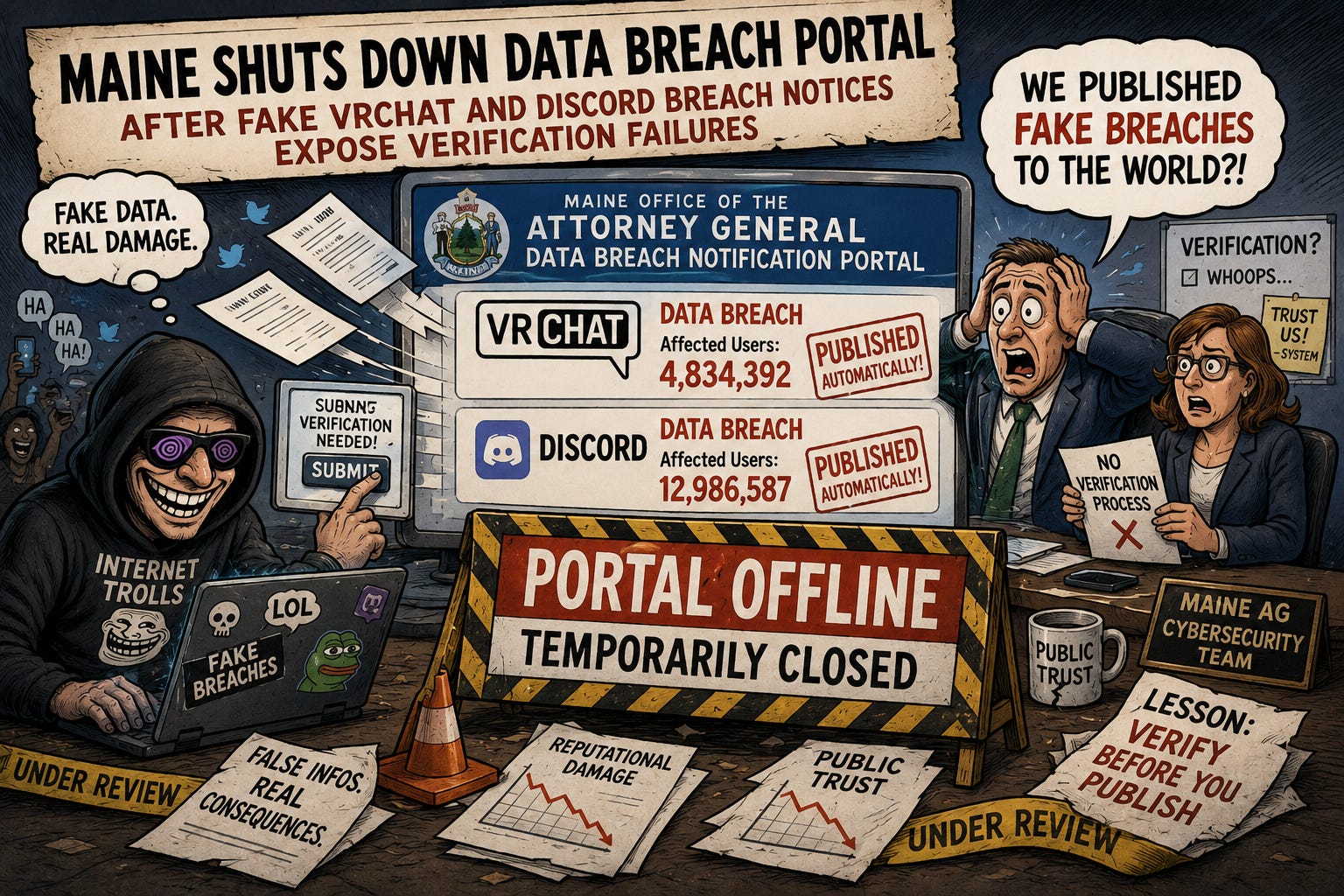
Maine Shuts Down Data Breach Portal After Fake VRChat and Discord Breach Notices Expose Verification Failures
Bottom Line Up Front (BLUF): Maine’s Office of the Attorney General has temporarily taken its public-facing data breach notification portal offline after unknown actors submitted fraudulent breach disclosures impersonating VRChat and Discord. The hoax filings falsely claimed breaches affecting millions of users and exploited a process that automatically published submissions without independent verification. The incident raises concerns about the integrity of public breach reporting systems and demonstrates how trusted disclosure platforms can be manipulated to inflict reputational damage and spread disinformation.
Analyst Comments: State breach registries are widely used by journalists, threat intelligence firms, investors, and security teams as authoritative sources of disclosure information. The ability to publish fabricated breach notices directly onto an official government portal creates opportunities for reputation attacks, market manipulation, and information operations. The abuse also highlights a broader issue: many disclosure ecosystems were designed under the assumption that filers would act in good faith. That assumption no longer holds. As cyber incidents increasingly carry financial, legal, and reputational consequences, adversaries have incentives to weaponize trusted reporting mechanisms.
READ THE STORY: CyberPress // CISO Whisperer
1,000 Data Breaches Later, Disclosure Delays Are Getting Worse Despite Global Privacy Regulations
Bottom Line Up Front (BLUF): Have I Been Pwned (HIBP) founder Troy Hunt marked the platform's 1,000th breach by highlighting a troubling trend: organizations are taking longer than ever to disclose data breaches, even after victims' data is already publicly circulating. Hunt argues that despite the introduction of regulations such as GDPR and CCPA, many companies prioritize legal risk management and litigation concerns over timely customer notification, leaving victims unaware of their exposure for weeks—or potentially indefinitely.
Analyst Comments: Threat actors like ShinyHunters increasingly publish stolen data within days of an intrusion, often distributing it across dark web forums, Telegram channels, and clear-web repositories long before organizations formally acknowledge the incident. The underlying incentives are misaligned. Privacy regulations generally require notification only when organizations determine that a breach is likely to result in significant harm. This creates substantial discretion for companies to delay notifications while conducting investigations or, in some cases, avoid disclosure entirely by narrowly interpreting regulatory thresholds. The result is a system where victims frequently learn of their exposure from third-party services such as HIBP rather than from the organizations entrusted with their data.
READ THE STORY: Troyhunt
FulcrumSec Claims Theft of 1.3TB From Novo Nordisk, Including Drug Research, Clinical Data, and Internal AI Models
Bottom Line Up Front (BLUF): Cyber extortion group FulcrumSec claims it stole more than 1.3 terabytes of data comprising over 700,000 files from pharmaceutical giant Novo Nordisk after allegedly maintaining access to the company's networks for more than two months. The threat actors claim the stolen data includes source code, proprietary drug research, clinical trial information, employee and patient data, manufacturing information, and details related to Novo Nordisk's internal AI models. Novo Nordisk has acknowledged unauthorized data publication claims and is investigating the incident.
Analyst Comments: The alleged theft of unreleased drug research, clinical trial data, and internal AI models could have long-term implications that extend beyond immediate financial losses and regulatory obligations. Pharmaceutical companies are increasingly attractive targets because they sit at the intersection of valuable intellectual property, sensitive health information, and critical manufacturing operations. Drug development timelines span years and require billions in investment, making proprietary research and trial data exceptionally valuable to competitors, nation-state intelligence services, and criminal actors seeking extortion leverage.
READ THE STORY: Benzinga
Texas TPWD Vendor Breach Exposes Personal Data of Over 3 Million Hunting and Fishing License Holders
Bottom Line Up Front (BLUF): The Texas Parks and Wildlife Department (TPWD) disclosed that a cyberattack against its third-party licensing vendor exposed the personal information of 3,087,721 individuals. Compromised data includes driver’s license information, passport numbers, email addresses, phone numbers, and residential addresses. While Social Security numbers, dates of birth, and financial data were not affected, the exposed information creates significant risks of phishing, identity fraud, and targeted social engineering attacks.
Analyst Comments: The breach did not occur within TPWD’s own infrastructure, yet more than three million individuals are now dealing with the consequences. The absence of Social Security numbers and financial information lowers the immediate risk of traditional identity theft, but the exposed dataset is still highly valuable to threat actors. Driver’s license information, contact details, and residential addresses provide enough intelligence to build convincing impersonation campaigns, conduct account recovery attacks, and execute highly targeted phishing operations.
READ THE STORY: Bleeping Computer
Ireland’s HSE Fined €300,000 Over Ransomware Breach Affecting 84,000 Patients
Bottom Line Up Front (BLUF): Ireland’s Data Protection Commission fined the Health Service Executive €300,000 after a ransomware incident at Midlands Regional Hospital Tullamore exposed systems processing patient and laboratory data. The breach affected approximately 84,000 individuals and led regulators to find that HSE failed to implement appropriate technical and organizational safeguards under GDPR.
Analyst Comments: Healthcare organizations do not get a pass because the attacker was external; regulators are increasingly judging whether controls were reasonable before the incident happened. The case also highlights the risk of interconnected clinical, lab, and administrative systems. Once ransomware reaches patient data environments, the blast radius can quickly expand from IT disruption to sensitive health-data exposure and compliance liability.
READ THE STORY: CISO Whisperer
Google Patches 74 Chrome Vulnerabilities, Confirms Active Exploitation of CVE-2026-11645
Bottom Line Up Front (BLUF): The Center for Internet Security (CIS) has issued an advisory warning that 74 vulnerabilities in Google Chrome could allow arbitrary code execution, with Google confirming that CVE-2026-11645, an out-of-bounds memory access flaw in V8, is being actively exploited in the wild. Successful exploitation could enable attackers to execute code in the context of the logged-on user, potentially leading to malware installation, data theft, account creation, or system compromise. Organizations should immediately update Chrome to 149.0.7827.102/.103 for Windows and macOS and 149.0.7827.102 for Linux.
Analyst Comments: The overwhelming majority of flaws in this release are use-after-free, out-of-bounds, type confusion, and input validation issues, many of which are historically associated with remote code execution chains. The most important detail is Google’s confirmation that CVE-2026-11645 is already being exploited in the wild. Once a browser zero-day reaches active exploitation status, organizations should assume that exploitation tooling will quickly proliferate among both criminal and state-sponsored actors. Browser vulnerabilities remain attractive because they can be triggered through drive-by compromise scenarios, requiring little more than a user visiting a malicious or compromised website.
READ THE STORY: CIS
Items of interest
Go Security Pitfalls Persist: GolangConf Presentation Highlights Injection, Request Smuggling, and Authentication Risks
Bottom Line Up Front (BLUF): A presentation by MTS Web Services Application Security Engineer Georgy Fateev warns that Go’s simplicity and strong standard library do not inherently produce secure applications. Common vulnerabilities—including command injection, SQL injection, HTTP request smuggling, insecure logging, and authentication flaws—continue to affect production Go environments. The presentation emphasizes that secure development depends more on engineering discipline, testing, and security culture than on language choice.
Analyst Comments: The presentation’s emphasis on “never trust user input” remains highly relevant, as injection-based vulnerabilities continue to drive breaches despite decades of awareness. The recommendation to use reachability-based dependency analysis tools such as govulncheck is particularly noteworthy because it reduces alert fatigue by prioritizing vulnerabilities that are actually exploitable within an application’s code path. The discussion of HTTP request smuggling is also timely. Misconfigurations between reverse proxies and backend services remain a frequent source of high-impact vulnerabilities capable of enabling authentication bypass and request desynchronization attacks. Likewise, insecure logging practices continue to be an underappreciated source of credential exposure and compliance violations.
READ THE STORY: HABR
The GO Situation Is CRAZY... (Video)
FROM THE MEDIA: The video correctly identifies a real concern—software supply-chain attacks in the Go ecosystem
What is LLM Distillation?(Video)
FROM THE MEDIA: Welcome to another Software Architecture in Go/Golang video, in today's episode I'm discussing Security, specifically in the context of Dependencies, this is narrowed down to Standard Library Packages and Third Party Packages.
The selected stories cover a broad range of cyber threats and are intended to help readers frame key publicly discussed threats and improve overall situational awareness. InfoDom Securities does not endorse any third-party claims made in its original material or related links on its sites; the opinions expressed by third parties are theirs alone. For further questions, don’t hesitate to get in touch with InfoDom Securities at dominanceinformation@gmail.com.