
Daily Drop (1318)
06-15-26

Monday, Jun 15, 2026 // Buy Bob a Coffee // Ghostwire
US and Iran Sign Framework Deal to End Conflict, Reopen Strait of Hormuz
Bottom Line Up Front (BLUF): The United States and Iran have signed an initial framework agreement to end their conflict, extend the current ceasefire for another 60 days, and reopen the Strait of Hormuz. The deal, electronically signed by senior officials from both countries, includes the immediate cessation of military operations on all fronts, including Lebanon. Formal signing is scheduled for later this week in Geneva, with negotiations on a permanent settlement to continue during the ceasefire period.
Analyst Comments: The BBC reports direct confirmation from President Trump and senior U.S. officials, significantly increasing the credibility of the agreement. The reopening of the Strait of Hormuz is arguably the most consequential near-term development, as roughly 20% of global oil and natural gas flows through the waterway. Markets have already reacted with declining oil prices. However, the deal remains a framework agreement rather than a final peace settlement, and significant obstacles remain, including Iran's nuclear program, sanctions relief, and Israeli opposition to aspects of the agreement. The risk of spoilers remains high, particularly given reports of continued Israeli strikes in Lebanon after the announcement.
READ THE STORY: BBC
Israeli Backlash Threatens Durability of US-Iran Peace Deal Despite Formal Agreement
Bottom Line Up Front (BLUF): A major update to the U.S.-Iran peace agreement is emerging: while the framework deal has been signed and the Strait of Hormuz is set to reopen, significant Israeli opposition threatens its long-term viability. Israeli officials across the political spectrum have denounced the agreement, rejected provisions affecting Lebanon, and signaled continued military operations against Hezbollah. The biggest risk to the deal may now come from implementation challenges rather than U.S.-Iran negotiations themselves.
Analyst Comments: The center of gravity has shifted. The initial question was whether Washington and Tehran could reach an agreement. They did. The new question is whether regional actors—particularly Israel—will comply with or actively undermine it. Public criticism from Israeli ministers, opposition leaders, and Netanyahu allies indicates a serious strategic divergence between Washington and Jerusalem. Reports that Trump personally rebuked Netanyahu following Israeli strikes in Beirut underscore an unusually public rift between the two governments. This is becoming as much a U.S.-Israel political crisis as a U.S.-Iran diplomatic breakthrough.
READ THE STORY: The Washington Post
Semiconductor Supply Chain “Chokepoints” May Deter Taiwan Conflict More Than Military Power
Bottom Line Up Front (BLUF): A new analysis argues that Taiwan’s so-called “silicon shield” is not TSMC alone but an interconnected global network of semiconductor supply chain chokepoints spanning the United States, Europe, Japan, and Taiwan. The authors contend that these non-substitutable dependencies—particularly ASML’s EUV lithography systems and U.S.-dominated chip design software—create economic and strategic costs that deter conflict over Taiwan. However, aggressive export controls and reshoring policies risk accelerating Chinese self-sufficiency and weakening this deterrent over time.
Analyst Comments: The “silicon shield” narrative has always implied that Taiwan’s chip production alone deters invasion. The authors argue the real deterrent is the broader ecosystem of interlocking dependencies—what they call the “silicon testudo.” For cybersecurity and national security professionals, this matters because advanced computing, AI, and military modernization all depend on these supply chains. The concern is that prolonged export restrictions and supply chain decoupling may incentivize China to build indigenous capabilities, reducing the strategic leverage currently provided by Western technological dominance.
READ THE STORY: WOTR
US Government’s Anthropic Model Ban Sparks Fears of AI Supply Chain and Defensive Security Risks
NOTE:
Strip away the AI-jailbreak framing and this is a dual-use technology control story with an unresolved factual core. The central dispute — whether the bypass is a narrow, single-instance unlock (Anthropic's position) or one that opens the model's full offensive cyber capabilities (the administration's position, reportedly based on findings from Amazon and several other testers) — is exactly the question that should determine whether the response was proportionate, and it isn't settled in public reporting. For defenders, the more durable lesson is structural: if a government can pull a deployed model overnight, AI capabilities embedded in vulnerability management, code review, and SOC workflows become a new supply-chain dependency with its own continuity risk. Expect CISOs to start treating model access like any other critical third-party dependency — inventorying it, abstracting it, and planning for sudden loss.
Bottom Line Up Front (BLUF): The U.S. government’s order forcing Anthropic to pull its Fable 5 and Mythos 5 models offline was reportedly not driven by a sophisticated jailbreak but by concerns over a guardrail bypass related to vulnerability discovery capabilities. The move has triggered criticism from cybersecurity experts who argue the action deprives defenders of advanced security tooling while establishing a precedent for direct government intervention in commercial AI services.
Analyst Comments: The precedent is the real issue. Security teams are increasingly integrating AI into vulnerability management, code review, and defensive operations. If a government can effectively pull a model offline overnight, AI platforms become a new category of supply chain dependency and operational risk. Attackers do not stop pursuing offensive capabilities because of export controls; defenders, however, can suddenly lose tools they rely on. Expect CISOs to begin evaluating AI resilience strategies, including multi-model architectures, abstraction layers, and contingency planning for critical AI-driven workflows.
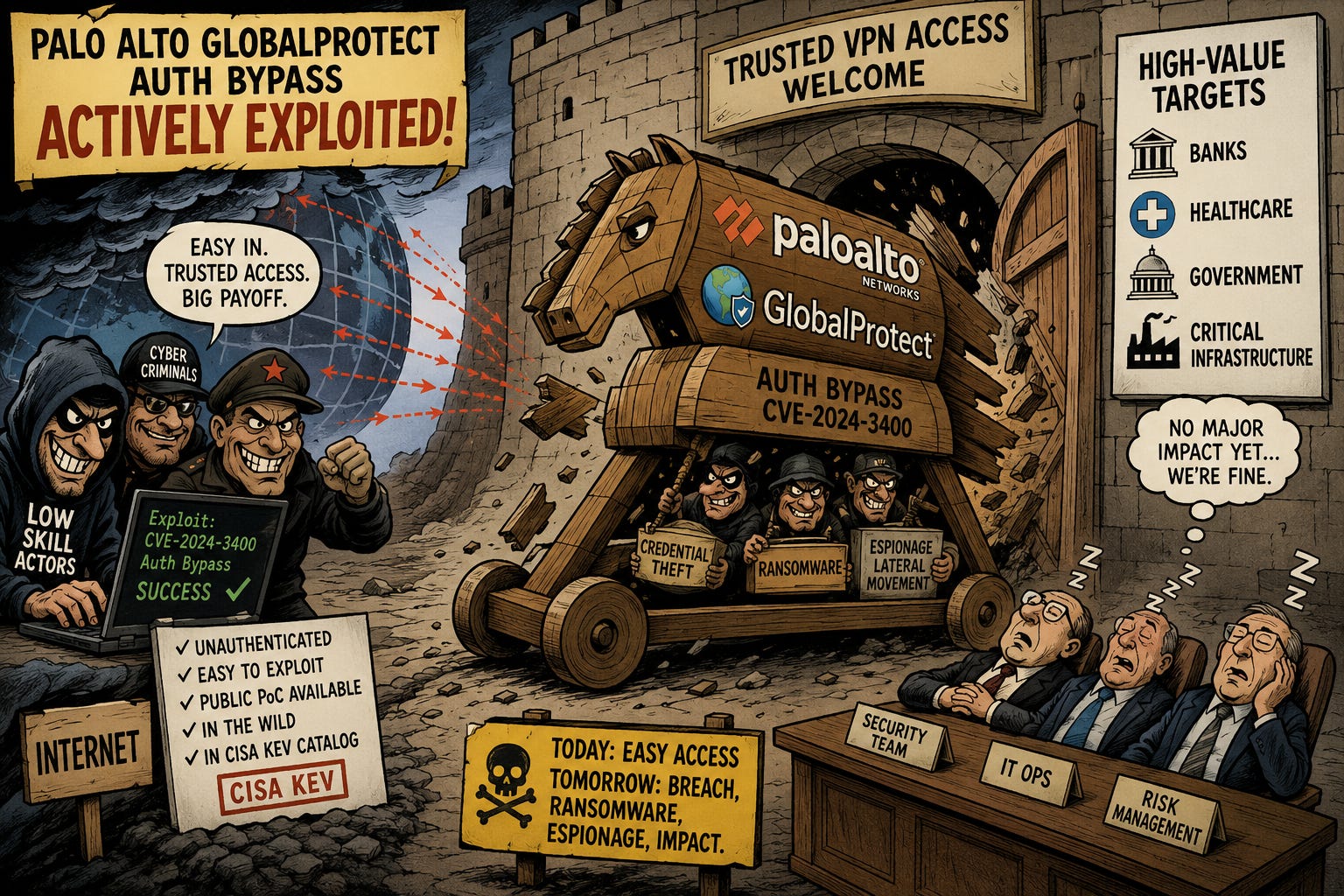
Palo Alto GlobalProtect Auth Bypass Actively Exploited Against VPN Edge Devices
NOTE:
From a threat perspective, the danger is the combination of an easy, unauthenticated bypass with who runs GlobalProtect: the largest banks, healthcare systems, government agencies, and critical infrastructure operators, meaning one bug potentially unlocks the front door at thousands of high-value targets at once. The compromised device is the worst kind to lose — an internet-facing, deeply trusted remote-access VPN that grants internal network access and typically sits outside EDR visibility. The barrier to exploitation is low and dropping fast, since it's already exploited in the wild, listed in CISA's KEV catalog, and backed by public proof-of-concept code that lets even low-skill actors mass-target exposed portals. And while no major lateral movement has been seen yet, edge-VPN access is the classic precursor to credential theft, ransomware staging, and espionage — so the current quiet is a timing artifact, not reassurance.
Bottom Line Up Front (BLUF): Palo Alto Networks confirmed active exploitation of CVE-2026-0257, a GlobalProtect authentication bypass affecting PAN-OS deployments with authentication override cookies enabled and risky certificate reuse. Attackers can forge cookies, bypass login, and establish unauthorized VPN sessions. CISA added the flaw to KEV, and exposed GlobalProtect portals should be patched or mitigated immediately.
Analyst Comments: Help Net Security, and Unit 42 report that CVE-2026-0257 affects GlobalProtect portal and gateway components in PAN-OS and Prisma Access configurations where authentication override cookies are enabled. The issue stems from cookie decryption without proper integrity validation, allowing attackers to craft accepted authentication cookies when certificates are reused. Rapid7 observed exploitation beginning May 17, 2026, with additional activity on May 21. Unit 42 listed observed infrastructure including 23.128.228[.]6, 104.207.144[.]154, 146.19.216[.]119, 179.43.172[.]213, and 202.144.192[.]47. Recommended actions include upgrading to fixed PAN-OS versions, disabling authentication override, or using a dedicated certificate only for cookie encryption and decryption.
READ THE STORY: GBhackers
Researchers Develop AI “Fingerprinting” Method to Detect Misrepresented LLMs and Counterfeit Model Endpoints
Bottom Line Up Front (BLUF): Researchers on the Kanxue Security Community have proposed a technique for identifying whether an AI service is actually running the model it claims to provide. The method uses genetic algorithms to generate highly discriminative prompts and then analyzes response embedding distances to classify model identities. The authors claim the approach can distinguish among multiple commercial and open-source models, potentially exposing “transfer stations” that rebrand lower-tier models as premium offerings.
Analyst Comments: As organizations increasingly rely on third-party AI gateways, API aggregators, and regional providers, model provenance has become a supply chain issue. A service advertising GPT-5.5 but quietly routing requests to another model introduces security, privacy, and compliance concerns. Beyond detecting counterfeit AI services, the technique could also be adapted for attribution, benchmarking, and monitoring unauthorized model substitution in enterprise environments. Expect model fingerprinting and attestation mechanisms to become increasingly important as AI ecosystems become more fragmented.
READ THE STORY: Kanxue
Chinese Perspective of Red Teams Shift to “Unorthodox” Phishing Techniques to Bypass Mature Email Defenses
Bottom Line Up Front (BLUF): Chinese security researchers report that red teams are increasingly abandoning traditional email phishing in favor of unconventional delivery channels that bypass enterprise controls. Emerging tactics include targeting third-party contractors outside EDR coverage, abusing customer support and ticketing systems to deliver malware, leveraging personal email accounts, and compromising centralized management platforms to distribute malicious payloads. Mac systems with low EDR adoption are also becoming attractive initial access targets.
Analyst Comments: This trend reflects a simple reality: traditional phishing is becoming less effective in mature environments. As email gateways, attachment sandboxing, and user awareness programs improve, adversaries are looking for blind spots in the enterprise attack surface. The focus has shifted from defeating security controls head-on to identifying places where controls do not exist. Third-party personnel, niche file-sharing channels, and unmanaged endpoints represent high-value opportunities because they often combine weaker security monitoring with legitimate access to corporate resources. Defenders should view this as another evolution of “living off the environment” tactics—except the environment now includes business processes and supply chains.
READ THE STORY: Kanxue
EtherRAT Campaign Uncovers Shared Criminal Infrastructure Hosting Malware, Phishing Kits, and Remote Access Tools
Bottom Line Up Front (BLUF): Chinese security researchers report that red teams are increasingly abandoning traditional email phishing in favor of unconventional delivery channels that bypass enterprise controls. Emerging tactics include targeting third-party contractors outside EDR coverage, abusing customer support and ticketing systems to deliver malware, leveraging personal email accounts, and compromising centralized management platforms to distribute malicious payloads. Mac systems with low EDR adoption are also becoming attractive initial access targets.
Analyst Comments: This is more than another commodity RAT campaign. The story here is the infrastructure. The operators appear to maintain a multi-purpose ecosystem capable of supporting malware delivery, phishing operations, and potentially multiple affiliates or customers. The use of blockchain-based C2 discovery is particularly notable because it reduces dependence on static infrastructure and complicates traditional domain takedown efforts. The discovery of open directories and exposed phishing kits also
READ THE STORY: Malwarebytes
Cisco SD-WAN Manager Zero-Day Added to CISA KEV After Root Escalation Attacks
Bottom Line Up Front (BLUF): CISA added CVE-2026-20262 to its KEV catalog after active exploitation against Cisco Catalyst SD-WAN Manager. The flaw lets authenticated low-privilege attackers abuse file upload handling to create or overwrite files, potentially escalating to root. Cisco has released fixed versions and says there are no workarounds.
Analyst Comments: The credential requirement lowers the rating, but stolen or low-privileged accounts are not exactly rare. Once an attacker can write files and pivot to root on SD-WAN management infrastructure, this becomes a serious control-plane risk. Patch this fast and review logs for suspicious file upload activity. CISA added CVE-2026-20262 and CVE-2026-54420 to the KEV catalog on June 15, 2026. Cisco confirmed limited exploitation of CVE-2026-20262 in June and said the flaw affects all Catalyst SD-WAN Manager deployment types. BleepingComputer and The Register report attackers can send crafted HTTP requests to an affected API endpoint to create or overwrite files, later using them to gain root privileges. Cisco advised administrators to review vmanage-server, vmanage-appserver, and serviceproxy-access logs for attempts to upload index.jsp and .war files.
READ THE STORY: The Register
DPAPISnoop Update Enables Offline Cracking of Windows CREDHIST Password History Files
Bottom Line Up Front (BLUF): Researchers from Nettitude CyberLabs updated the open-source DPAPISnoop tool to extract offline-crackable hashes from Windows DPAPI CREDHIST files. The capability allows attackers with filesystem access to recover historical passwords, identify password reuse patterns, and potentially traverse a user's credential history chain. While not a software vulnerability, the technique significantly enhances post-compromise credential access opportunities.
Analyst Comments: This is a post-exploitation capability that defenders should pay attention to because it turns an obscure Windows artifact into a valuable source of password intelligence. The real risk isn't that DPAPI is broken—it isn't. The problem is that once an attacker gains local or administrative access, CREDHIST files can reveal years of password habits, including incremental changes and reuse patterns that often extend into privileged accounts. Older entries protected with weaker cryptography are particularly attractive because they may provide an easier foothold into recovering newer credentials. Expect red teams and threat actors to add this technique to credential harvesting playbooks.
READ THE STORY: Ghostwire
Items of interest
Shadow AIS Fleet Tactics Expose Maritime Sanctions Evasion Across Venezuela, Libya, and the Mediterranean
Bottom Line Up Front (BLUF): The tanker SKIPPER (IMO: 9304667) reportedly went 200 days without AIS transmissions, spoofed a location roughly 1,200 nautical miles away, and appeared off Guyana while allegedly loading at Venezuela’s San Jose terminal. Similar AIS dark activity, false positioning, and identity manipulation are now being observed along the Libyan coast and across Mediterranean smuggling routes.
Analyst Comments: The SKIPPER case matters because it shows how a vessel can create a parallel reality: one track for regulators and commercial monitoring platforms, another for the actual cargo movement. When a tanker “paints” itself hundreds or thousands of miles from its real location, standard compliance workflows can fail unless analysts correlate AIS with satellite imagery, port activity, draft changes, ownership records, and terminal schedules. The same tradecraft showing up near Libya is especially concerning. Libya’s fragmented security environment, contested oil infrastructure, and proximity to Mediterranean shipping corridors make it attractive for smuggling networks. Expect more use of AIS gaps, false destinations, name changes, flag hopping, shell ownership, and ship-to-ship transfers just outside high-visibility zones.
READ THE STORY: Codeby // OCCRP
How to track dark ships using OSINT (Video)
FROM THE MEDIA: In this OSINT deep dive, professional OSINT analyst Ray Baker joins David Bombal to explore the shadowy world of maritime cybersecurity and vessel tracking. Discover the critical differences between the dark fleet and shadow fleet, and learn the exact open-source intelligence methods used to track ships attempting to hide their identities on the open ocean. From manipulating AIS tracking data and repainting ship decks to the terrifying reality of hacking Chinese-made port cranes, this video uncovers the hidden cyber threats facing global supply chains. We also explore the tools used by professionals, such as MarineTraffic and Equasis, to investigate illicit maritime activities and track adversarial movements.
AML Expert Shadow Fleet trailer | Fighting illicit oil | Financial CPD (Video)
FROM THE MEDIA: This Expert AML module uncovers how a single tanker explosion — the Pablo — illuminated one of the fastest‑growing laundering ecosystems on earth: the global shadow fleet. Through the real story of how aging, opaque tankers move sanctioned oil through shell companies, forged documents, AIS manipulation, and digital deception, we unpack how sanctions evasion has evolved into a full‑scale value‑laundering system operating far outside the regulated maritime world.
The selected stories cover a broad range of cyber threats and are intended to help readers frame key publicly discussed threats and improve overall situational awareness. InfoDom Securities does not endorse any third-party claims made in its original material or related links on its sites; the opinions expressed by third parties are theirs alone. For further questions, don’t hesitate to get in touch with InfoDom Securities at dominanceinformation@gmail.com.