
Daily Drop (1316)
06-12-26

Friday, Jun 12, 2026 // Buy Bob a Coffee // Ghostwire
AI Sovereignty Turns Data Centers into Strategic Cyber and National Security Targets
Bottom Line Up Front (BLUF): Researchers from the University of Maryland and Sandia National Laboratories warn that AI sovereignty is increasingly tied to physical infrastructure, making large-scale AI data centers attractive targets for cyber operations, supply chain attacks, influence campaigns, and even kinetic strikes. As nations concentrate AI capabilities into massive facilities housing hundreds of thousands of accelerators, adversaries gain identifiable targets that can be disrupted, degraded, or denied.
Analyst Comments: This research highlights a reality that’s often overlooked in AI discussions: AI isn’t just software anymore. It’s power grids, water systems, semiconductor supply chains, cooling infrastructure, and highly visible facilities with fixed geographic coordinates. For years, cyber strategists focused on protecting data and networks. The AI era expands that attack surface dramatically. Frontier AI capabilities now depend on infrastructure that looks increasingly like critical national infrastructure. A successful cyberattack against cooling systems, power management platforms, or chip supply chains could have strategic consequences comparable to attacks on telecommunications networks or energy assets.
READ THE STORY: HSN
Senate Narrowly Rejects Proposal to Create U.S. Cyber Force
Bottom Line Up Front (BLUF): A Senate Armed Services Committee proposal to establish a standalone U.S. Cyber Force was narrowly defeated in a 14-13 vote, delaying what would have become the nation’s seventh military branch. While lawmakers remain divided on whether Cyber Command requires its own service, the close vote highlights growing bipartisan concerns that current military personnel pipelines are not adequately preparing cyber operators to compete with adversaries such as China and Russia.
Analyst Comments: A near-successful committee vote signals that frustration with the current model is reaching a tipping point. The core issue remains talent generation. U.S. Cyber Command depends on personnel sourced from existing military branches, many of which prioritize traditional warfighting missions over cyber operations. Supporters argue a dedicated Cyber Force would professionalize recruitment, training, and career development for cyber operators in the same way the Space Force did for space operations.
READ THE STORY: The Record
China-Linked JDY Botnet Expands Reconnaissance Against U.S. Military Networks
Bottom Line Up Front (BLUF): Lumen’s Black Lotus Labs reports that the China-linked JDY botnet has grown to more than 1,500 compromised SOHO and IoT devices, up from roughly 650 in January 2024. Unlike commodity botnets, JDY is built for reconnaissance: scanning, fingerprinting, and mapping exposed services—especially networks tied to the U.S. military and associated entities—often within hours of new vulnerability disclosures.
Analyst Comments: The botnet turns compromised routers, cameras, and edge devices into a distributed sensor network. That lets operators scan from legitimate-looking residential and small-business IPs, making geofencing, static blocklists, and IP reputation controls much less effective. The fact that JDY quickly shifted toward Fortinet targets after disclosure of CVE-2026-35616 shows how fast reconnaissance is now being operationalized. For defenders, the lesson is blunt: exposed edge infrastructure needs faster patching and tighter access controls. Waiting days or weeks to patch internet-facing routers, firewalls, VPNs, and IoT devices gives actors like JDY plenty of time to map the environment before exploitation begins.
READ THE STORY: CSO // Bleeping Computer
Chinese APT VerdantBamboo Maintains 18-Month Access Using BRICKSTORM Malware on Firewalls and Edge Appliances
Bottom Line Up Front (BLUF): Researchers at Volexity uncovered a long-running intrusion by Chinese state-linked threat actor VerdantBamboo (also tracked as UNC5221 and WARP PANDA) that leveraged the BRICKSTORM malware family to compromise firewalls, storage appliances, NAS devices, and managed service provider infrastructure. The group maintained access to victim environments for at least 18 months, repeatedly re-establishing persistence even after remediation efforts, highlighting the growing threat posed by attacks against edge infrastructure that often lacks traditional endpoint security controls.
Analyst Comments: Firewalls, NAS devices, VPN gateways, storage systems, and management platforms often sit outside EDR visibility while maintaining privileged access to critical environments. The most concerning aspect isn’t BRICKSTORM itself—it’s VerdantBamboo’s operational discipline. The group compromised an MSP, harvested administrative credentials, leveraged exposed firewalls, deployed multiple fallback implants, and maintained redundant access paths. That’s the behavior of an actor focused on long-term intelligence collection rather than smash-and-grab operations.
READ THE STORY: CSN
Microsoft’s Record 206-CVE Patch Tuesday Signals AI-Driven Shift in Vulnerability Discovery
Bottom Line Up Front (BLUF): Microsoft’s June 2026 Patch Tuesday set a new company record with fixes for 206 vulnerabilities, surpassing the previous high of 175 CVEs. The release includes three publicly disclosed zero-days, 32 critical flaws, and 13 vulnerabilities Microsoft rates as “Exploitation More Likely.” Security researchers increasingly attribute the growing volume of disclosed vulnerabilities to AI-assisted discovery, signaling that large patch cycles may become the norm rather than the exception.
Analyst Comments: Now we’re seeing the other side of the equation: AI dramatically accelerating vulnerability research and disclosure. More bugs found means more bugs patched, but it also means security teams face a growing backlog of remediation work every month. The two most urgent issues are CVE-2026-47291 (Windows HTTP.sys) and CVE-2026-44815 (Windows DHCP Client), both carrying CVSS 9.8 scores and affecting widely deployed Windows systems. The DHCP Client flaw is particularly concerning because of its potential reach across enterprise environments. While not every disclosed vulnerability will see active exploitation, threat actors routinely prioritize critical Windows flaws immediately after release. Organizations that rely on traditional monthly patching cycles may find themselves falling behind as disclosure volumes continue to climb.
READ THE STORY: CISO Whisperer
CISA Orders Federal Agencies to Patch High-Risk Vulnerabilities Within 72 Hours
Bottom Line Up Front (BLUF): CISA has issued Binding Operational Directive (BOD) 26-04, requiring federal civilian agencies to remediate the highest-risk vulnerabilities within three calendar days. The directive replaces previous vulnerability management mandates and shifts federal patching toward a risk-based model that prioritizes vulnerabilities based on exploitability, exposure, and real-world threat activity rather than severity scores alone.
Analyst Comments: The three-day remediation requirement is aggressive but reflects today’s threat landscape. Threat actors increasingly weaponize vulnerabilities within hours of disclosure, and AI-assisted reconnaissance is accelerating target identification. A critical flaw sitting on an internet-facing system is no longer a “patch this month” problem—it’s often a “patch before the weekend” problem. What’s particularly notable is the requirement for forensic triage alongside remediation when dealing with high-risk vulnerabilities. CISA is recognizing that by the time organizations discover a KEV-listed vulnerability, compromise may have already occurred. Patching alone is no longer considered sufficient.
READ THE STORY: GBhackers
Google Confirms ShinyHunters Exploited Oracle PeopleSoft Zero-Day Against Universities
Bottom Line Up Front (BLUF): Google has confirmed that the ShinyHunters cybercrime group exploited CVE-2026-35273, a critical unauthenticated remote code execution vulnerability in Oracle PeopleSoft, as a zero-day before Oracle released mitigations. Google observed attacks between May 27 and June 9, notified more than 100 potentially affected organizations, and linked the activity to data theft campaigns primarily targeting the higher education sector.
Analyst Comments: PeopleSoft remains deeply embedded across universities, government agencies, and large enterprises, often serving as the system of record for HR, payroll, student information, and financial operations. An unauthenticated RCE against those environments is about as attractive as it gets for threat actors. What’s notable is the speed and scale of the campaign. Google observed exploitation activity before public disclosure, while ShinyHunters reportedly targeted roughly 300 PeopleSoft instances across 100 organizations. That suggests the group already had a mature targeting list and moved quickly once it identified a viable attack path.
READ THE STORY: Security Week
Hackers Weaponize AI Safety Guardrails to Evade Malware Analysis
Bottom Line Up Front (BLUF): Security practitioners are discussing a novel evasion technique where threat actors embed prompts related to biological weapons and nuclear weapon design inside code comments to intentionally trigger AI safety mechanisms during automated malware analysis. The technique exploits the fact that some AI-powered security tools may refuse to process content containing prohibited topics, potentially causing malicious code to be skipped or inadequately analyzed.
Analyst Comments: Traditional malware authors spend years learning how to evade signatures, sandboxes, and behavioral detection. Now they’re experimenting with ways to manipulate the decision-making processes of AI-powered security tools. The concept is simple: place adversarial text inside comments that have no impact on code execution but are visible to an AI analyst. If the model prioritizes the embedded prompt over the actual code, it may refuse analysis, generate warnings, or terminate processing. In effect, the attacker attempts to turn safety alignment into a denial-of-analysis mechanism.
READ THE STORY: Tools
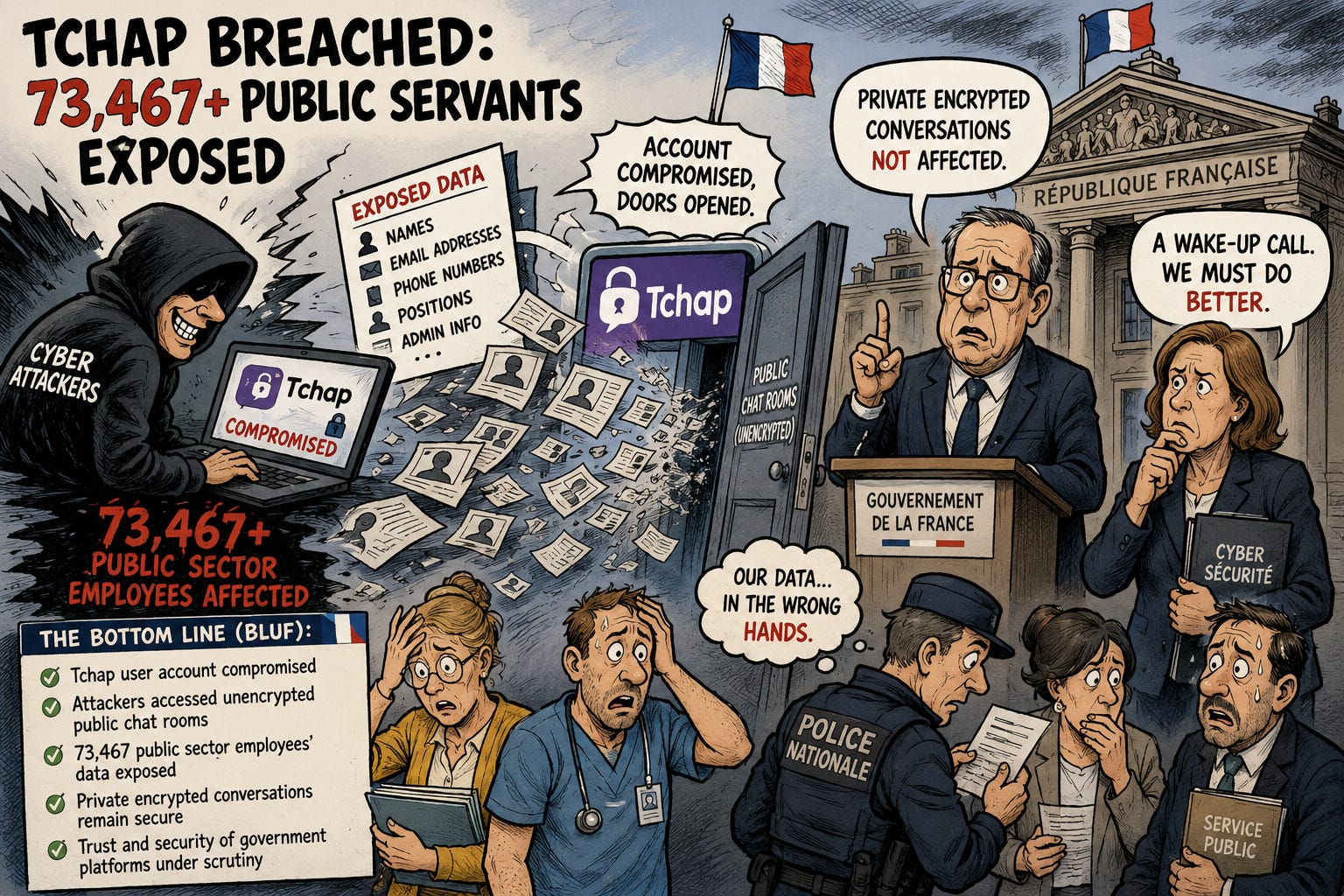
French Government Confirms Tchap Messaging Breach Impacting 73,000+ Public Sector Employees
Bottom Line Up Front (BLUF): The French government has confirmed that a breach of its Tchap encrypted messaging platform exposed data belonging to 73,467 public sector employees after attackers compromised a user account and accessed unencrypted public chat rooms. While private encrypted conversations were not affected, the incident exposed user information and raises concerns about the security of government collaboration platforms increasingly relied upon for official communications.
Analyst Comments: Tchap’s end-to-end protection appears to have worked as designed for private conversations, but public channels created a separate attack surface that became accessible once the threat actor obtained a valid account. The breach highlights a recurring challenge for government collaboration platforms: authentication is often the weakest link. If the attacker’s social engineering claims are accurate, this wasn’t a cryptographic failure or sophisticated exploit—it was an identity compromise that provided legitimate access to sensitive environments.
READ THE STORY: Bleeping Computer
China Launches First Large-Scale Malware Search Engine for Threat Hunting
Bottom Line Up Front (BLUF): Chinese threat intelligence provider ThreatBook has launched what it describes as the country's first large-scale malware search and threat hunting platform, allowing analysts to search across a repository containing hundreds of billions of files and more than 2 million new samples per day. The platform, branded X File Threat Hunting, is designed to help defenders identify malware families, uncover attacker infrastructure, track APT activity, and perform large-scale malware pivoting beyond traditional hash-based searches.
Analyst Comments: This is essentially bringing the “Google for malware” concept to a much broader analyst audience. Most defenders can identify a malicious hash. Far fewer can quickly pivot from a single sample to discover related malware families, backup C2 infrastructure, developer artifacts, signing certificates, and historical variants. The most interesting capability is not the sample volume—it’s the ability to search on behavioral, structural, and content-based indicators rather than simple hashes. Modern threat actors routinely recompile malware, modify packers, and rotate infrastructure. Hashes become obsolete almost immediately. Features like import table hashes, fuzzy hashes, PDB paths, certificate metadata, embedded strings, and raw byte-pattern searches provide much more durable hunting pivots.
READ THE STORY: Kanxue
Items of interest
Chinese Reverse-Engineer of FortiWeb 8.0 Firmware Protection, Recover Root Filesystem Decryption Process
Bottom Line Up Front (BLUF): A researcher published a detailed reverse-engineering analysis of Fortinet’s newer firmware protection mechanisms, claiming to have reconstructed the process used to decrypt Forti 8.0 firmware root file systems. According to the research, Fortinet replaced earlier hardcoded ChaCha20-based protection with an RSA-wrapped key release mechanism and a heavily modified RC4-like stream cipher. The author states the protections can be reversed to recover and decrypt firmware images for analysis, potentially lowering the barrier for vulnerability research and firmware auditing.
Analyst Comments: This is not a vulnerability disclosure in the traditional sense, but it is still important for defenders because firmware encryption and integrity mechanisms often serve as friction points that slow reverse engineering. When researchers publicly document how those protections work, both defenders and attackers gain the ability to analyze firmware internals more efficiently. The key takeaway is that Fortinet appears to have moved away from the older model where decryption material could allegedly be extracted directly from memory. The new design reportedly introduces RSA-based key wrapping and a customized RC4-derived algorithm intended to obscure firmware contents. According to the researcher, those changes increase complexity but do not ultimately prevent determined reverse engineering.
READ THE STORY: Kanxue
How Hackers Reverse Engineer Firmware (Video)
FROM THE MEDIA: Binwalk is a powerful reverse engineering tool used to uncover hidden files, compressed data, and embedded systems inside firmware images. In this video, I’ll show you how to scan, extract, and explore firmware like a pro. We’ll also take a look at the newer Rust-based version of Binwalk now included in Kali Linux, and how it compares to the original.
FortiWeb: Preventing the use of weak cryptographic algorithms (Video)
FROM THE MEDIA: Fortinet is deprecating and removing support for weak cryptographic algorithms in FortiWeb as part of broader efforts to strengthen platform security and align with modern cryptographic standards. Organizations running legacy SSL/TLS configurations, outdated ciphers, or older integrations should review current deployments to ensure compatibility before upgrading.
The selected stories cover a broad range of cyber threats and are intended to help readers frame key publicly discussed threats and improve overall situational awareness. InfoDom Securities does not endorse any third-party claims made in its original material or related links on its sites; the opinions expressed by third parties are theirs alone. For further questions, don’t hesitate to get in touch with InfoDom Securities at dominanceinformation@gmail.com.