
Daily Drop (1313)
06-07-26

Sunday, Jun 07, 2026 // Buy Bob a Coffee // Ghostwire
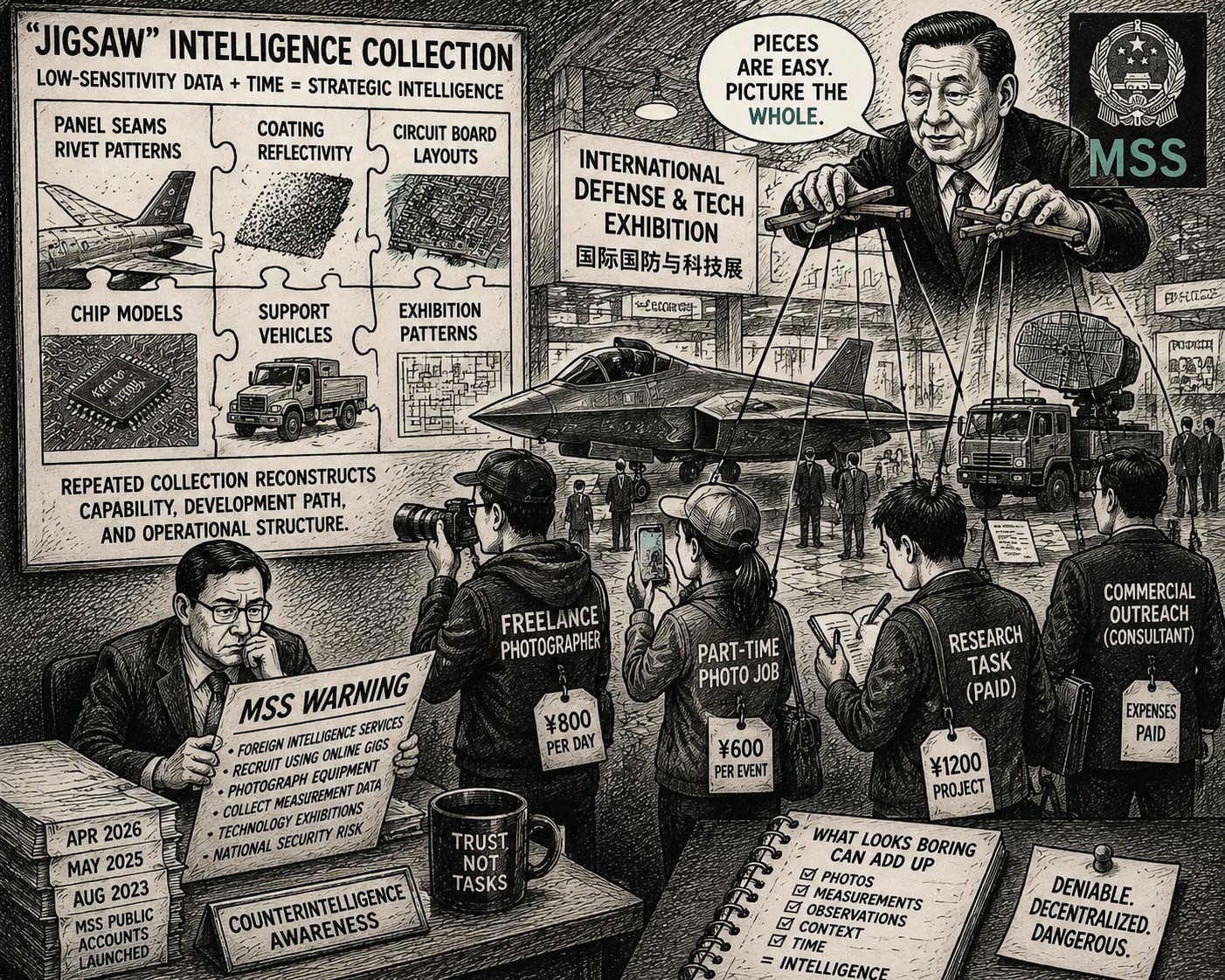
China’s MSS Warns of “Jigsaw” Intelligence Collection at Trade Shows
NOTE:
MSS is likely using these advisories as part of a broader counterintelligence awareness campaign rather than responding to a single incident. Since launching official social-media channels in 2023, the agency has consistently warned about foreign recruitment efforts targeting students, researchers, industry personnel, and the general public. The June 2026 advisory appears designed to deter crowdsourced intelligence collection, encourage reporting of suspicious approaches, and reinforce protection of sensitive defense and technology information. While the specific foreign operations described remain unverified, the messaging reflects Beijing's concern that publicly available data—when systematically collected and analyzed—can reveal military capabilities, technological development trends, and strategic vulnerabilities. In practice, the advisory serves both as a security warning and a signal of which sectors China considers most exposed to foreign intelligence collection.
Bottom Line Up Front (BLUF): China’s Ministry of State Security warned that foreign intelligence services are recruiting people inside China through paid photography gigs, freelance research tasks, and commercial or academic outreach to collect imagery and measurement data at military and technology exhibitions. The advisory is real, dated June 7, 2026, and fits a sustained MSS public-awareness campaign dating back to 2023. The specific foreign operations alleged remain unverified.
Analyst Comments: This is counterintelligence messaging, not a confirmed case report. MSS names no foreign service, cites no arrest, and provides no evidence of a specific operation. That said, the tradecraft described is real: low-sensitivity observations can be aggregated into useful technical intelligence. The warning reads like a mirror of standard OSINT practice — aircraft seams, coating reflectivity, circuit-board layouts, chip models, and support vehicles can all reveal capability when collected over time. The notable angle is the collection layer: gig workers, freelance photographers, research tasks, and commercial cover. That points to a decentralized, deniable model rather than a classic handler-agent network.
READ THE STORY: GT (CN)
Allegations of DoD Use of Anthropic’s Mythos Gain Additional Credibility Through Reuters and Axios
Bottom Line Up Front (BLUF): Reuters and Axios reporting provide independent support for claims that Anthropic’s restricted Mythos Preview AI model is being used within elements of the Department of Defense despite ongoing disputes over the company’s designation as a supply-chain risk. While reports of Anthropic engineers supporting government operations remain unconfirmed, the broader claim that Mythos has been deployed within U.S. defense and national security organizations appears increasingly credible.
Analyst Comments: Axios reported that Anthropic’s Mythos Preview model is being used within the Department of Defense despite Pentagon officials previously designating the company a supply-chain risk. Sources told Axios that Mythos was being used by defense organizations and potentially more broadly across the department. Reuters later reported the same claim, noting that it could not independently verify the information but confirming that Anthropic and the Department of Defense declined to comment. The reporting follows growing attention around Mythos’ cybersecurity capabilities, including Anthropic’s claims that the model can identify vulnerabilities and assist with exploitation workflows at a level significantly beyond previous AI systems. Subsequent reporting from Security Affairs and the Financial Times expanded on the story, alleging that Anthropic engineers were supporting government deployment efforts, though those claims remain unconfirmed.
READ THE STORY: Security Affairs // Reuters // AXIOS
AI Agent Discovers 21 FFmpeg Zero-Days as Chrome Ships Record 429 Security Fixes
Bottom Line Up Front (BLUF): Security startup DepthFirst claims its autonomous AI agent discovered 21 previously unknown vulnerabilities in FFmpeg, including flaws that remained undetected for more than two decades. Days later, Google released Chrome 149 with fixes for 429 vulnerabilities—the largest security patch count ever delivered in a single Chrome release. Together, the events highlight how AI is accelerating vulnerability discovery and increasing pressure on software vendors and open-source maintainers.
Analyst Comments: The FFmpeg findings are the more strategically significant story. FFmpeg is embedded throughout modern media infrastructure—video platforms, container images, security products, mobile apps, and cloud workloads. Finding 21 confirmed vulnerabilities in roughly 1.5 million lines of mature code for an estimated cost of $1,000 suggests AI-assisted vulnerability research is rapidly lowering the cost of bug discovery. The Chrome numbers are equally notable, though for a different reason: defenders are now facing vulnerability volumes that may outpace traditional triage and remediation processes. The bottleneck is no longer finding bugs—it’s validating reports, developing fixes, and deploying patches at scale.
READ THE STORY: Segu-Info
OpenAI Launches Lockdown Mode to Reduce Prompt Injection Risk
Bottom Line Up Front (BLUF): OpenAI has introduced Lockdown Mode, a security-focused configuration for ChatGPT designed to reduce the risk of prompt injection attacks and sensitive data exposure. The feature restricts several high-risk capabilities, including live web browsing, deep research, agent mode, and retrieval of web-hosted images, making it suitable for organizations handling sensitive information.
Analyst Comments: This is one of the first major attempts by an AI provider to operationalize prompt-injection defense through feature restriction rather than detection alone. OpenAI is effectively acknowledging a reality the industry has struggled with: prompt injection is not a solved problem. Rather than claiming to eliminate the threat, the company is reducing attack surface by disabling capabilities most likely to expose sensitive information. The move reflects a broader shift toward security-tiered AI deployments, where organizations may need to trade functionality for assurance. Expect similar "restricted operation" modes from other AI vendors as prompt injection increasingly becomes the AI equivalent of phishing—a persistent risk that cannot be fully eradicated.
READ THE STORY: TC
CISA Adds Actively Exploited SolarWinds Serv-U Flaw to KEV Catalog
Bottom Line Up Front (BLUF): CISA has added CVE-2026-28318, an actively exploited denial-of-service vulnerability affecting SolarWinds Serv-U, to its Known Exploited Vulnerabilities (KEV) catalog. The flaw allows unauthenticated attackers to crash vulnerable Serv-U instances using a specially crafted HTTP POST request, prompting CISA to order federal agencies to remediate affected systems by June 19, 2026.
Analyst Comments: While this is "only" a denial-of-service vulnerability, organizations should not dismiss it based on impact type alone. Serv-U frequently sits in business-critical file transfer workflows, making availability attacks operationally disruptive even without data theft or code execution. The exploit path is straightforward, requiring no authentication and minimal attacker capability. Although current exploit telemetry remains limited, CISA's KEV designation confirms real-world exploitation. Organizations should prioritize remediation based on observed attacker activity rather than predictive scoring alone. Historically, managed file transfer platforms have been attractive targets because they are internet-facing, business-critical, and often facilitate the movement of sensitive data.
READ THE STORY: Security Affairs
Pink Extortion Group Uses Vishing and Microsoft 365 Access to Steal Cloud Data
Bottom Line Up Front (BLUF): Researchers have identified a new financially motivated threat group, tracked as CL-CRI-1147 and known as Pink, that uses voice phishing (vishing) to steal Microsoft 365 credentials and active user sessions. By leveraging legitimate cloud services and compromised accounts rather than traditional malware, the group can rapidly exfiltrate data from OneDrive and SharePoint before launching extortion campaigns against victims.
Analyst Comments: Pink reflects a growing trend among cybercriminals: abandoning malware-heavy operations in favor of identity compromise and cloud-native abuse. The group’s use of vishing to capture authenticated sessions effectively sidesteps many traditional MFA protections, while reliance on legitimate Microsoft tools reduces the likelihood of detection. This isn’t particularly novel tradecraft, but it’s effective. Organizations that focus primarily on endpoint security while neglecting identity monitoring, conditional access controls, and user awareness training remain vulnerable. The use of compromised employee accounts to send extortion demands internally is also a reminder that trusted communications channels can become part of the attack chain.
READ THE STORY: HACKREAD
Critical Everest Forms Pro Flaw Actively Exploited to Take Over WordPress Sites
Bottom Line Up Front (BLUF): Attackers are actively exploiting a critical unauthenticated remote code execution vulnerability in the Everest Forms Pro WordPress plugin to create rogue administrator accounts and gain full control of vulnerable websites. Tracked as CVE-2026-3300, the flaw affects Everest Forms Pro versions 1.9.12 and earlier and has been exploited in the wild since at least April 2026.
Analyst Comments: This is a straightforward patch-now situation. The combination of unauthenticated access, remote code execution, active exploitation, and administrator account creation makes this one of the more dangerous WordPress vulnerabilities disclosed recently. The attack chain is simple, reliable, and provides immediate persistence through rogue admin accounts. Once attackers gain administrator privileges, they can install webshells, modify content, deploy malware, steal data, or pivot further into connected infrastructure. The use of PHP's eval() function in user-controllable calculations is the kind of design decision that continues to produce high-impact WordPress vulnerabilities years after secure coding guidance made the risks well understood.
READ THE STORY: Bleeping Computer
Cisco SD-WAN 0-Day Exploited, Windows Netlogon RCE Under Active Attack
Bottom Line Up Front (BLUF): The past week was dominated by active exploitation of critical infrastructure vulnerabilities, including a Cisco SD-WAN zero-day with no available patch and a Windows Netlogon remote code execution flaw targeting domain controllers. The reporting also highlighted accelerating concerns around AI security, with new research showing autonomous AI worms, widespread AI agent security failures, and growing adoption of defensive controls for agentic systems.
Analyst Comments: Two themes stand out. First, attackers continue to prioritize high-value enterprise infrastructure, particularly identity systems, VPNs, and network management platforms. The combination of an actively exploited Windows Netlogon RCE and an unpatched Cisco SD-WAN privilege escalation vulnerability presents immediate operational risk for defenders. Second, AI security is rapidly shifting from theory to practice. Multiple reports focused on AI agent compromise, memory poisoning, model backdoors, prompt injection defenses, and autonomous offensive capabilities. Organizations experimenting with AI agents should assume these systems now require the same security governance applied to traditional enterprise applications.
READ THE STORY: HNS
Ongoing Attacks Against Internet-Exposed Automatic Tank Gauge Systems
Bottom Line Up Front (BLUF): CISA, FBI, NSA, DOE, EPA, TSA, DOT, and USDA issued a joint advisory warning that threat actors are actively compromising internet-exposed Automatic Tank Gauge (ATG) systems across the United States. The agencies report attackers are leveraging authentication bypasses, hardcoded credentials, command execution, SQL injection, and privilege escalation vulnerabilities to gain control of fuel and liquid storage monitoring systems used throughout critical infrastructure sectors.
Analyst Comments: The fact that federal agencies are emphasizing basic controls—removing systems from the internet, changing default passwords, and restricting remote access—suggests many vulnerable ATG deployments still lack foundational security measures. While the government has not attributed the activity to a specific threat actor, the concern is less about who is conducting the activity and more about what compromised systems could enable. ATGs are often viewed as low-risk monitoring devices, but they can directly influence fuel operations, inventory management, leak detection, and safety monitoring. In OT environments, loss of visibility can become an operational or safety issue long before it becomes a cybersecurity incident.
READ THE STORY: CISA
Jinher OA SQL Injection Flaw Emerges With Limited Public Validation
NOTE:
The most interesting aspect of this CVE is not the vulnerability itself but the lack of ecosystem activity around it. New vulnerabilities affecting Chinese enterprise software often generate discussion across platforms such as FreeBuf, Anquanke, Seebug, CNNVD, or CNVD within days of disclosure. That has not happened here. The current disclosure trail appears limited to a researcher submission that propagated through VulDB into CVE tracking systems. This does not mean the vulnerability is invalid, but it does suggest defenders should treat exploitation claims cautiously until additional technical validation emerges. From a threat-hunting perspective, the software category remains notable: a Chinese enterprise OA platform built on ASP.NET/IIS infrastructure aligns with technology stacks historically targeted by both criminal and state-sponsored actors.
Bottom Line Up Front (BLUF): CVE-2026-11435 is a remote, unauthenticated SQL injection in a business-critical Office Automation (OA) platform. If the vulnerability is valid, an attacker can interact directly with the application's backend database without credentials, potentially exposing sensitive organizational data and creating opportunities for deeper compromise.
Analyst Comments: CVE-2026-11435 affects an unspecified function within Jinher OA's nextselectplan.aspx component and reportedly allows remote SQL injection via manipulation of the httpOID parameter. VulDB states that exploit details have been publicly disclosed and that the vendor did not respond to notification attempts. However, follow-on review of Chinese-language sources found no public CNNVD entry, no visible Chinese security research write-ups, and no discussion across major Chinese security forums. Additionally, the GitHub repository referenced by VulDB appears empty and does not currently contain a proof-of-concept exploit. At present, the vulnerability remains primarily documented through VulDB-derived reporting and CVE aggregation platforms.
READ THE STORY: Tenable
Items of interest
IT-to-OT Lateral Movement: How Attackers Pivot from Active Directory to Industrial Control Systems
Bottom Line Up Front (BLUF): A new Codeby.net article examines how attackers can move from compromised enterprise IT environments into Operational Technology (OT) and Industrial Control System (ICS) networks despite formal segmentation controls. The walkthrough highlights common pivot points including shared credentials, dual-homed hosts, data historians, VPN gateways, and engineering workstations, demonstrating how a compromise of Active Directory can ultimately provide access to PLCs, SCADA systems, and industrial processes.
Analyst Comments: While this is not reporting on an active intrusion, it is highly relevant from a threat-intelligence perspective because it mirrors the techniques used by groups such as Sandworm, XENOTIME/TRITON, and Volt Typhoon. The article accurately reflects a recurring reality in critical infrastructure assessments: network segmentation often exists on diagrams but breaks down operationally through shared accounts, engineering workstations, historians, and contractor access. The most valuable takeaway is that the firewall separating IT and OT is rarely the actual security boundary—trusted business workflows are. Defenders responsible for critical infrastructure should view this as a blueprint of how sophisticated actors think about OT intrusion paths.
READ THE STORY: Codeby
Lateral Movement Explained | How Hackers Quietly Take Over Networks (Video)
FROM THE MEDIA: In this episode of Cybersecurity 101, Mark breaks down Lateral Movement — the critical phase of a cyberattack where attackers quietly move through a network, expanding access and searching for high-value targets.
SOC Incident Walkthrough: Lateral Movement & VPN Compromise (Video)
FROM THE MEDIA: Anton, a Principal Threat Hunting and Response Analyst in our SOC, walks through a real-world security incident.
The selected stories cover a broad range of cyber threats and are intended to help readers frame key publicly discussed threats and improve overall situational awareness. InfoDom Securities does not endorse any third-party claims made in its original material or related links on its sites; the opinions expressed by third parties are theirs alone. For further questions, don’t hesitate to get in touch with InfoDom Securities at dominanceinformation@gmail.com.