
Daily Drop (1311)
06-04-26

Thursday, Jun 04, 2026 // Buy Bob a Coffee // Ghostwire
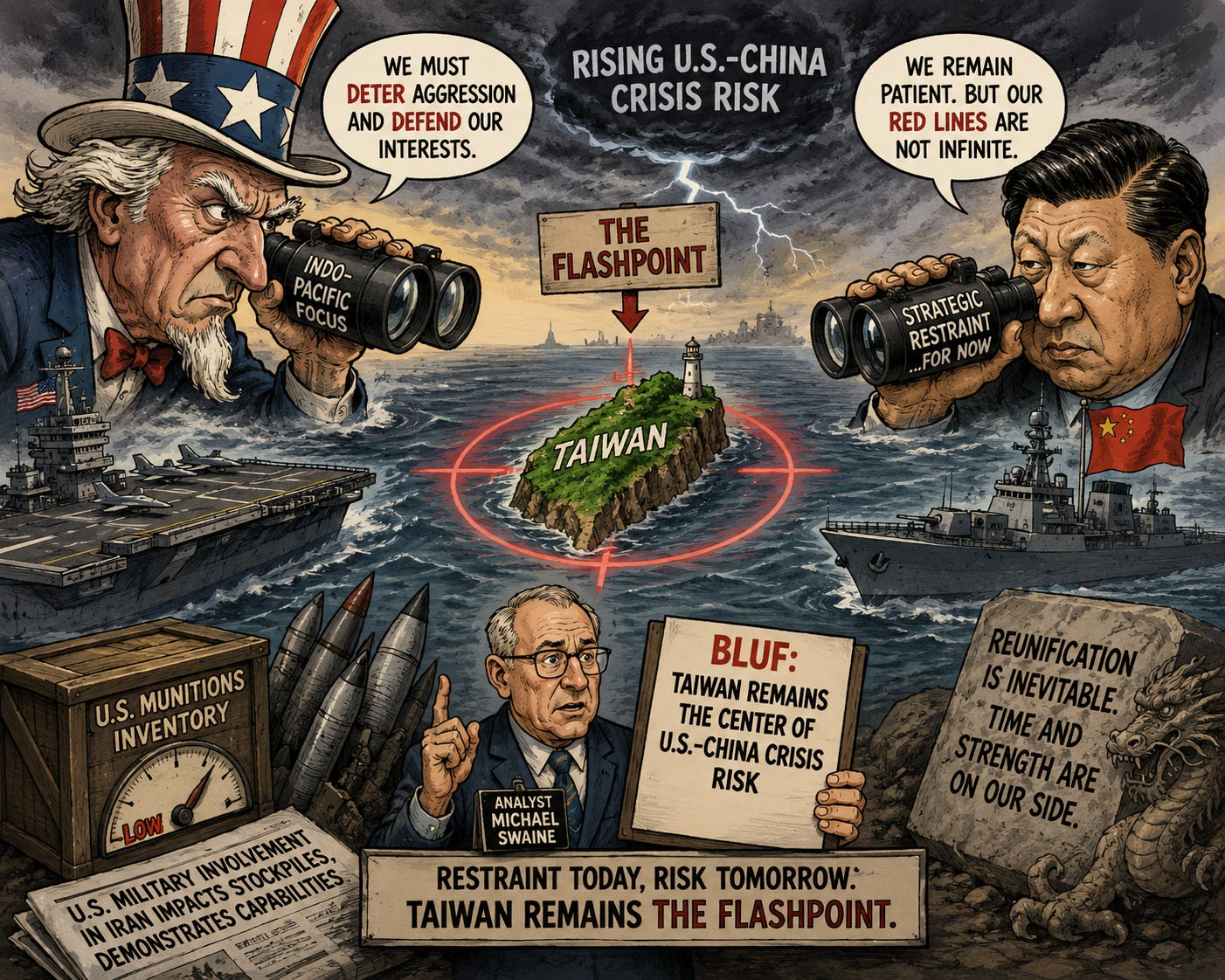
Taiwan Remains the Flashpoint: Analyst Sees Rising U.S.-China Crisis Risk Despite Continued Chinese Restraint
Bottom Line Up Front (BLUF): In a new strategic assessment, China analyst Michael Swaine argues that the risk of a serious U.S.-China crisis remains centered on Taiwan rather than broader military confrontation. While recent U.S. military involvement in Iran has affected American munitions inventories and demonstrated key military capabilities, Swaine contends these developments are unlikely to fundamentally alter Beijing’s long-term approach toward Taiwan. The greater concern remains the gradual erosion of the political understandings that have preserved stability in the Taiwan Strait for decades.
Analyst Comments: He is not arguing that China is preparing to opportunistically invade Taiwan because the United States is distracted elsewhere. That narrative frequently appears in geopolitical commentary whenever Washington becomes involved in another theater, but Beijing’s strategic decision-making tends to operate on much longer timelines. Instead, the warning focuses on structural instability. The risk is less about deliberate war planning and more about the continued breakdown of the political framework that has historically managed cross-strait tensions. As perceptions of the One China policy evolve in Washington, Taipei, and Beijing, the chances of miscalculation increase even if neither side actively seeks conflict.
READ THE STORY: WOR
Banking Anti-Bot Scripts Cross Privacy Boundaries with Local Port Scanning and Browser Profiling
Bottom Line Up Front (BLUF): A security researcher analyzed anti-bot JavaScript deployed on banking-related websites and found that it performs extensive client-side profiling before pages fully load. According to the analysis, the scripts—served from infrastructure associated with Servicepipe—scan localhost ports, probe browser extensions, establish WebSocket communications, employ anti-debugging techniques, and collect behavioral signals designed to distinguish real users from bots and sandbox environments. The findings raise questions about privacy, transparency, and the increasingly aggressive techniques being used in web application defense.
Analyst Comments: The logic is straightforward: fraud platforms, credential stuffing tools, headless browsers, and automated attack infrastructure often operate in sterile environments that look different from real user systems. Defenders increasingly try to identify those differences before allowing access to sensitive applications. The controversy comes from how that determination is made. Local port scanning, extension enumeration, anti-debugging logic, and environment profiling may be effective signals, but they also blur the line between security controls and invasive client-side inspection. Many users have no idea these checks occur before a page even renders.
READ THE STORY: Xakep
You Can’t Patch Your Way Out of This One: HD Moore Highlights the Real Problem Behind Modern Breaches
Bottom Line Up Front (BLUF): A new webinar featuring Metasploit creator HD Moore argues that organizations are over-focusing on vulnerability remediation while underestimating attack-path exposure. The central message is that breaches are inevitable, and the determining factor is no longer whether attackers gain an initial foothold, but what systems, networks, and assets they can reach afterward. The discussion emphasizes attack-path visibility, segmentation validation, and discovery of unmanaged assets across IT, IoT, and OT environments.
Analyst Comments: Most organizations have accepted that patching alone cannot keep pace with modern attack volumes, AI-assisted vulnerability discovery, and increasingly compressed exploitation timelines. The “segmentation illusion” concept is particularly relevant. Many environments look segmented on diagrams but not in reality. Multi-homed devices, forgotten network connections, unmanaged appliances, shadow IT, and OT gateways routinely create unintended bridges between supposedly isolated environments. Attackers don’t care about network diagrams; they care about reachable paths.
READ THE STORY: THN
Poland’s Cyber Frontline: ABW Report Signals Growing Shift Toward Infrastructure Disruption Attacks
Bottom Line Up Front (BLUF): A new analysis of Poland’s Internal Security Agency (ABW) annual report warns that nation-state cyber operations are increasingly targeting critical infrastructure with the potential for real-world disruption rather than traditional intelligence collection alone. The report cites more than 40,000 cybersecurity incidents, 5.5 million alerts, and an 18% year-over-year increase in attacks, with adversaries focusing on military facilities, utilities, transportation networks, supply chains, and industrial control systems. Observers argue Poland’s experience may offer an early indicator of cyber trends likely to spread across other Western nations.
Analyst Comments: For years, most nation-state cyber activity was primarily about espionage—stealing information, collecting intelligence, and maintaining access. Increasingly, governments are preparing for disruption. That doesn’t necessarily mean attackers intend to immediately shut down power grids or water systems, but they are demonstrating the ability to do so if geopolitical circumstances demand it. Poland is a particularly important case study because it sits on the front line of the broader Russia-Ukraine conflict. The country has become a natural proving ground for cyber operations targeting NATO-aligned infrastructure, government systems, logistics networks, and public services. What appears in Poland today often emerges elsewhere tomorrow.
READ THE STORY: CPI
Cyber Espionage Campaign Maintained Five Months of Access to Stock Exchange Executive’s Outlook Account
Bottom Line Up Front (BLUF): Broadcom researchers uncovered a highly targeted espionage operation that maintained access to a senior executive’s Outlook account at a major global stock exchange for approximately five months. Attackers continuously exfiltrated mailbox data in small increments using Dropbox and OneDrive, allowing them to collect negotiations, internal communications, calendars, contacts, and potentially market-moving information while avoiding detection. Researchers assess the operation was intelligence-driven rather than financially motivated.
Analyst Comments: No ransomware. No disruptive malware. No noisy lateral movement. Just patient, methodical collection against a high-value intelligence target. The mailbox was the objective, not a stepping stone. A senior executive’s Outlook account effectively functions as an intelligence goldmine containing strategic plans, executive communications, business negotiations, travel schedules, partner relationships, and often sensitive attachments. For a stock exchange executive, that information can provide extraordinary insight into future market activity and regulatory developments.
READ THE STORY: Security Affairs
CCB Warns Windows Netlogon RCE May Be Under Active Exploitation
Bottom Line Up Front (BLUF): Belgium’s CCB warned that attackers are exploiting CVE-2026-41089, a critical Windows Netlogon remote code execution flaw affecting domain controllers. The vulnerability carries a CVSS 9.8 score and requires no authentication. Microsoft patched the issue in May Patch Tuesday but says it has not confirmed exploitation. Patch immediately.
Analyst Comments: If unauthenticated RCE against Netlogon is confirmed, this becomes a fast path to full Active Directory compromise. The uncertainty matters, but it should not slow remediation. CCB says the warning came from trusted partners, while Microsoft says it has no evidence of active exploitation. That split usually means defenders should assume exploitation is plausible and move patching ahead of normal cycles. Netlogon has history. Anything remotely comparable to prior domain controller-class bugs draws attacker attention quickly because the payoff is massive: code execution on systems that sit at the center of identity, authentication, and enterprise trust.
READ THE STORY: Xakep
Android Zero-Day Exploited in the Wild Enables Privilege Escalation Without User Interaction
Bottom Line Up Front (BLUF): Google confirmed active exploitation of CVE-2025-48595, a high-severity Android Framework vulnerability that allows privilege escalation on Android 14, 15, 16, and 16 QPR2 devices. The flaw can reportedly be exploited without user interaction and may enable attackers to bypass core Android security boundaries, making it a valuable component in sophisticated mobile compromise chains. Google addressed the issue in the June 2026 Android security updates.
Analyst Comments: The most important detail here is not the CVSS score—it’s the combination of active exploitation and no user interaction. Mobile exploit chains become significantly more dangerous when attackers no longer need phishing clicks, malicious app installs, or social engineering to advance privileges. Google has provided very limited technical information, which is common when a vulnerability is being actively weaponized. That usually indicates vendors are trying to maximize patch adoption before detailed exploit information becomes widely available.
READ THE STORY: CSN
CISA Adds Android and Linux Privilege Escalation Flaws to KEV After Active Exploitation Reports
Bottom Line Up Front (BLUF): CISA added two vulnerabilities to its Known Exploited Vulnerabilities (KEV) catalog after confirming active exploitation: CVE-2025-48595, a privilege escalation flaw affecting Android 14–16, and CVE-2022-0492, a Linux kernel vulnerability that can enable container escapes and root-level compromise. Federal agencies were ordered to remediate both issues by June 5, signaling elevated concern around ongoing exploitation activity.
Analyst Comments: Google has been unusually sparse on technical details, which often happens when vendors are trying to limit operational intelligence available to attackers while patch adoption catches up. The Linux flaw is the more strategically significant issue. CVE-2022-0492 has been discussed for years within cloud and container security circles because it targets one of the core assumptions of containerization: isolation. Once attackers gain execution inside a vulnerable container, escaping into the host environment can turn a contained compromise into full infrastructure takeover.
READ THE STORY: Bleeping Computer
The Gentlemen Ransomware Crew Combines Fortinet Exploits, AI, and Custom Tooling to Drive 2026 Operations
Bottom Line Up Front (BLUF): Researchers analyzing leaked internal communications from the Russian-speaking ransomware group The Gentlemen found a highly active operation leveraging Fortinet vulnerabilities, AI-assisted workflows, custom command-and-control infrastructure, credential theft tooling, and hypervisor-focused ransomware. The group has emerged as one of the most active ransomware actors of 2026 and appears to share personnel, infrastructure, and tradecraft with previous ransomware operations including Black Basta.
Analyst Comments: For years, ransomware groups largely shared the same playbook: buy access, deploy Cobalt Strike, steal data, encrypt systems, and negotiate. The Gentlemen appear to be moving away from dependency on commodity tooling by developing their own infrastructure, custom C2 frameworks, and AI-assisted operational workflows. The reported connection to Black Basta reinforces a lesson defenders continue to relearn: ransomware groups rarely disappear. They rebrand, reorganize, merge, and carry institutional knowledge into new operations. Infrastructure gets burned, names change, but operators often remain the same.
READ THE STORY: CSN
Researchers Build Self-Propagating AI Worm Using a Free Open-Source Model and Known Vulnerabilities
Bottom Line Up Front (BLUF): University of Toronto researchers demonstrated a fully autonomous AI-powered worm capable of identifying, exploiting, and propagating through vulnerable enterprise systems using a publicly available open-weight model running on a single GPU. The prototype relied exclusively on known vulnerabilities, misconfigurations, and publicly available exploit information—yet still compromised more than 60% of a test network. The research challenges assumptions that only frontier models such as Anthropic’s Mythos pose significant cyber risk.
Analyst Comments: The researchers intentionally avoided zero-days, advanced evasion techniques, and undisclosed vulnerabilities. Instead, they built a worm around the same things attackers already exploit every day—unpatched systems, misconfigurations, weak credentials, and publicly documented vulnerabilities. That’s precisely what makes the findings credible. The real concern isn’t that this prototype could become another WannaCry tomorrow. It can’t. The worm moved relatively slowly, lacked stealth capabilities, and operated in a simplified environment. The concern is that AI is increasingly becoming an automation layer that reduces operational costs for attackers. What previously required skilled operators manually researching vulnerabilities, generating payloads, and planning lateral movement can now be partially automated.
READ THE STORY: The Register
Medical Device Vendors Losing Contracts as Cybersecurity Becomes a Procurement Requirement
Bottom Line Up Front (BLUF): More than 56% of medical device manufacturers reported losing procurement opportunities because of cybersecurity concerns, according to research cited by RunSafe Security. The figure represents a significant increase from 48% the previous year and highlights how healthcare organizations are increasingly treating cybersecurity as a mandatory purchasing criterion rather than a compliance checkbox. As healthcare systems face growing cyber threats, device security is becoming a direct business and revenue issue for vendors.
Analyst Comments: For years, medical device security was largely viewed as a regulatory obligation or engineering challenge. Now it is becoming a sales and procurement problem. When more than half of vendors are seeing products rejected over security concerns, cybersecurity is no longer just a risk-management function—it is affecting market access. The trend makes sense. Hospitals have spent years dealing with vulnerable imaging systems, outdated operating systems, insecure remote access tools, and medical devices that are difficult or impossible to patch. Many healthcare organizations are finally pushing that risk back onto suppliers during procurement reviews.
READ THE STORY: Cybersecurity Insiders
Trump’s AI Safety Testing Plan Faces Talent Gap After Cybersecurity Workforce Cuts
Bottom Line Up Front (BLUF): President Trump signed a new executive order establishing a voluntary framework for frontier AI model safety testing, but critics argue the initiative may struggle to achieve meaningful results due to reduced cybersecurity staffing, limited testing timelines, and reliance on voluntary industry participation. The order directs the NSA, Treasury Department, and CISA to create classified benchmarking, vulnerability discovery, and safety evaluation programs, but questions remain about whether the government has the expertise and capacity to evaluate rapidly evolving AI systems effectively.
Analyst Comments: The executive order appears to reflect a compromise between AI safety advocates and officials focused on maintaining U.S. competitiveness. The result is a voluntary process with a shortened 30-day testing window rather than the previously discussed 90-day review period. That may be politically easier to sell, but it dramatically limits the amount of meaningful evaluation that can occur before deployment.
READ THE STORY: arsTECHNICA
Amazon Employees Publicly Call for Data Center Regulations as AI Infrastructure Backlash Grows
Bottom Line Up Front (BLUF): Two Amazon software engineers publicly urged Seattle officials to impose regulations on new data center projects, marking what organizers describe as the first known instance of major tech employees openly advocating for restrictions on AI-driven data center expansion. The comments reflect growing tensions over the environmental, economic, and infrastructure impacts of the AI boom as cities, utilities, and residents grapple with rapidly increasing demand for power, water, and land.
Analyst Comments: For the last two years, most discussion around AI has focused on models, chips, and regulation of algorithms. Increasingly, the debate is shifting toward the physical infrastructure that makes AI possible. Data centers require enormous amounts of electricity, water, cooling capacity, transmission infrastructure, and real estate. Communities are starting to ask whether they are receiving sufficient benefits in exchange for bearing those costs. What's notable here is the source of the criticism. Employee activism around AI has historically centered on military contracts, surveillance, labor concerns, or safety risks. Public calls from employees for direct regulation of data center construction represent a new front in the broader AI governance debate.
READ THE STORY: WIRED
Critical Flaws in Securly Chrome Extension Could Expose and Manipulate K-12 Web Filtering Systems
Bottom Line Up Front (BLUF): CERT/CC disclosed seven vulnerabilities affecting version 3.0.7 of the Securly Chrome Extension, a widely deployed web-filtering tool used on K-12 school-managed Chromebooks. The flaws include unencrypted configuration downloads, hardcoded encryption keys, weak cryptography, exposed endpoints, insecure content filtering mechanisms, and denial-of-service conditions. Collectively, the vulnerabilities could allow attackers to recover filtering rules, manipulate content-blocking policies, expose sensitive keyword lists, or disrupt student internet access.
Analyst Comments: Individually, some of these findings would be concerning. Together, they paint a picture of systemic security shortcomings across transport security, cryptography, access control, and application architecture. The most problematic issue is not any single CVE—it’s the combination. An attacker who can intercept traffic, recover hardcoded keys, access exposed endpoints, and manipulate configuration files can potentially reverse-engineer and modify the entire filtering framework. That undermines the primary purpose of the product. The report is also notable because CERT states it was unable to coordinate with the vendor. When a vulnerability disclosure reaches publication without vendor engagement, defenders should assume remediation timelines may be uncertain and compensating controls become more important.
READ THE STORY: Carnegie Mellon University
QuickCMS Flaws Expose Sites to Session Hijacking and MITM-Delivered XSS
Bottom Line Up Front (BLUF): CERT Polska disclosed two vulnerabilities affecting OpenSolution's QuickCMS CMS platform. CVE-2026-33384 allows session fixation attacks that can lead to account hijacking, while CVE-2026-33386 enables attackers to inject malicious JavaScript through an insecure HTTP-based plugin update mechanism. All QuickCMS versions through 6.8 were affected until a patch released on 15 May 2026. Organizations running unpatched deployments remain exposed.
Analyst Comments: Session fixation is an old but still effective attack technique when developers fail to regenerate session identifiers after authentication. If an attacker can force a victim to use a known session ID before login, they can potentially inherit the authenticated session afterward. The more concerning issue is the XSS vulnerability tied to plugin fetching over HTTP. Any attacker capable of performing a Man-in-the-Middle (MITM) attack—whether on public Wi-Fi, compromised networks, or through traffic interception—could deliver arbitrary JavaScript directly into the QuickCMS administrative interface. That creates a path to credential theft, administrative takeover, malware delivery, or full site compromise. The combination of weak session handling and insecure content delivery highlights recurring security issues in legacy web applications that continue to trust unauthenticated and unencrypted network traffic.
READ THE STORY: CERT PL
Acer Wave 7 Router Zero-Days Expose Admin Credentials and Enable Persistent Compromise
Bottom Line Up Front (BLUF): Acer confirmed it is developing firmware fixes for two critical zero-day vulnerabilities affecting Wave 7 routers running firmware T7c_GBL_1.01.000055 or earlier. The flaws expose plaintext admin/Telnet credentials and allow attackers to abuse a hardcoded AES key to inject malicious configurations. A patch is expected by the end of June 2026.
Analyst Comments: This is bad router security in the most familiar way: exposed logs, plaintext credentials, and hardcoded crypto keys. The credential exposure issue gives attackers a straightforward path to administrative access, while the backup-file flaw enables persistence through malicious configuration changes. For home and small-office environments, that means traffic interception, surveillance, DNS manipulation, credential theft, and possible pivoting into internal systems. Until firmware is available, the priority is reducing exposure of the management interface and watching for unexpected config changes or unknown remote access activity.
READ THE STORY: GBhackers
Items of interest
Hidden Lake Brings Anonymous Messaging to Meshtastic and LoRa Mesh Networks
Bottom Line Up Front (BLUF): A researcher demonstrated an experimental integration between the Hidden Lake anonymous network and Meshtastic/LoRa mesh infrastructure, enabling anonymous traffic generation over low-bandwidth decentralized radio networks. The project adapts Hidden Lake’s cryptographic and transport architecture to function within Meshtastic’s strict packet size and duty-cycle constraints, replacing its original hybrid post-quantum scheme with a lightweight symmetric design optimized for sub-200-byte transmissions. The work highlights both the privacy limitations of mesh networking and the growing interest in anonymous communication over decentralized radio systems.
Analyst Comments: This is technically niche, but strategically interesting. Most anonymity systems — Tor, I2P, mixnets — assume reliable IP-based transport and comparatively abundant bandwidth. LoRa mesh networks are the opposite: tiny packets, strict airtime restrictions, high latency, and decentralized radio propagation. Adapting anonymous networking to that environment requires fundamentally different tradeoffs. The article’s strongest point is its discussion of mesh-network deanonymization. Many Meshtastic users implicitly assume encryption equals anonymity. It doesn’t. Traffic analysis, signal localization, node correlation, and timing analysis still work extremely well in low-density radio environments. A determined local observer with enough nodes can often reconstruct communication patterns surprisingly effectively.
READ THE STORY: HABR
What is Meshtastic? (Simple Explanation) (Video)
FROM THE MEDIA: Meshtastic is a text-based messaging system that works totally off-grid using inexpensive LoRa radios. In this video I give an easy-to-understand overview of how it works — how multiple nodes form a mesh, how messages get forwarded between nodes, and how you use your phone over Bluetooth to connect to your node. I also cover the 915 MHz vs 868 MHz bands and the different types of devices you can use, from off-the-shelf nodes to DIY builds to all-in-one keyboard units.
Hidden Lake: An Interview with the Anonymous Network’s Architect (Video)
FROM THE MEDIA: Gennady Kovalenko, creator of Hidden Lake, the only living anonymous network with a mathematically provable model. A conversation about cryptography, privacy, and how one developer is changing the architecture of the internet.
The selected stories cover a broad range of cyber threats and are intended to help readers frame key publicly discussed threats and improve overall situational awareness. InfoDom Securities does not endorse any third-party claims made in its original material or related links on its sites; the opinions expressed by third parties are theirs alone. For further questions, don’t hesitate to get in touch with InfoDom Securities at dominanceinformation@gmail.com.