
Daily Drop (1301)
05-20-26

Tuesday, May 20, 2026 // Buy Bob a Coffee // Ghostwire
Pentagon Oversight Report Cited as Saying Ukrainian Strikes Lack Coordination
Bottom Line Up Front (BLUF): A report submitted to the U.S. Congress reportedly states that Ukrainian strikes against Russian territory have lacked the coordination, tempo, and concentration necessary to significantly impact Russia’s military operations. According to the assessment attributed to the Defense Intelligence Agency (DIA), the attacks have not meaningfully degraded Russian operational capabilities despite continued cross-border strike activity.
Analyst Comments: Long-range strikes can generate political pressure, media attention, and localized disruption without fundamentally degrading an adversary’s warfighting capacity. The key phrase here is “coordination, tempo, and concentration.” Isolated drone attacks and dispersed infrastructure strikes may force Russia to divert air defense resources and increase homeland security costs, but absent sustained targeting against logistics, command-and-control nodes, fuel distribution, rail infrastructure, and force generation hubs, the overall military impact remains limited.
READ THE STORY: TASS
Russia Says No Foundation Exists for Strategic Security Talks With the West
Bottom Line Up Front (BLUF): Russian Deputy Foreign Minister Sergey Ryabkov stated that Moscow sees no current military-political basis for meaningful security or arms control dialogue with Western nations. The comments come amid escalating nuclear rhetoric, expanding NATO defense coordination, and growing European interest in France’s proposed “nuclear umbrella” initiative.
Analyst Comments: The Kremlin continues framing NATO expansion, European rearmament, and nuclear cooperation initiatives as existential threats requiring reciprocal escalation. The reference to France’s proposed pan-European nuclear framework is particularly important. From Moscow’s perspective, expanding French nuclear deterrence cooperation beyond national borders further blurs the line between independent European defense initiatives and broader NATO nuclear integration. Russian officials are likely using this rhetoric to justify continued military modernization, tactical nuclear signaling, and aggressive force posture adjustments near NATO borders.
READ THE STORY: TASS
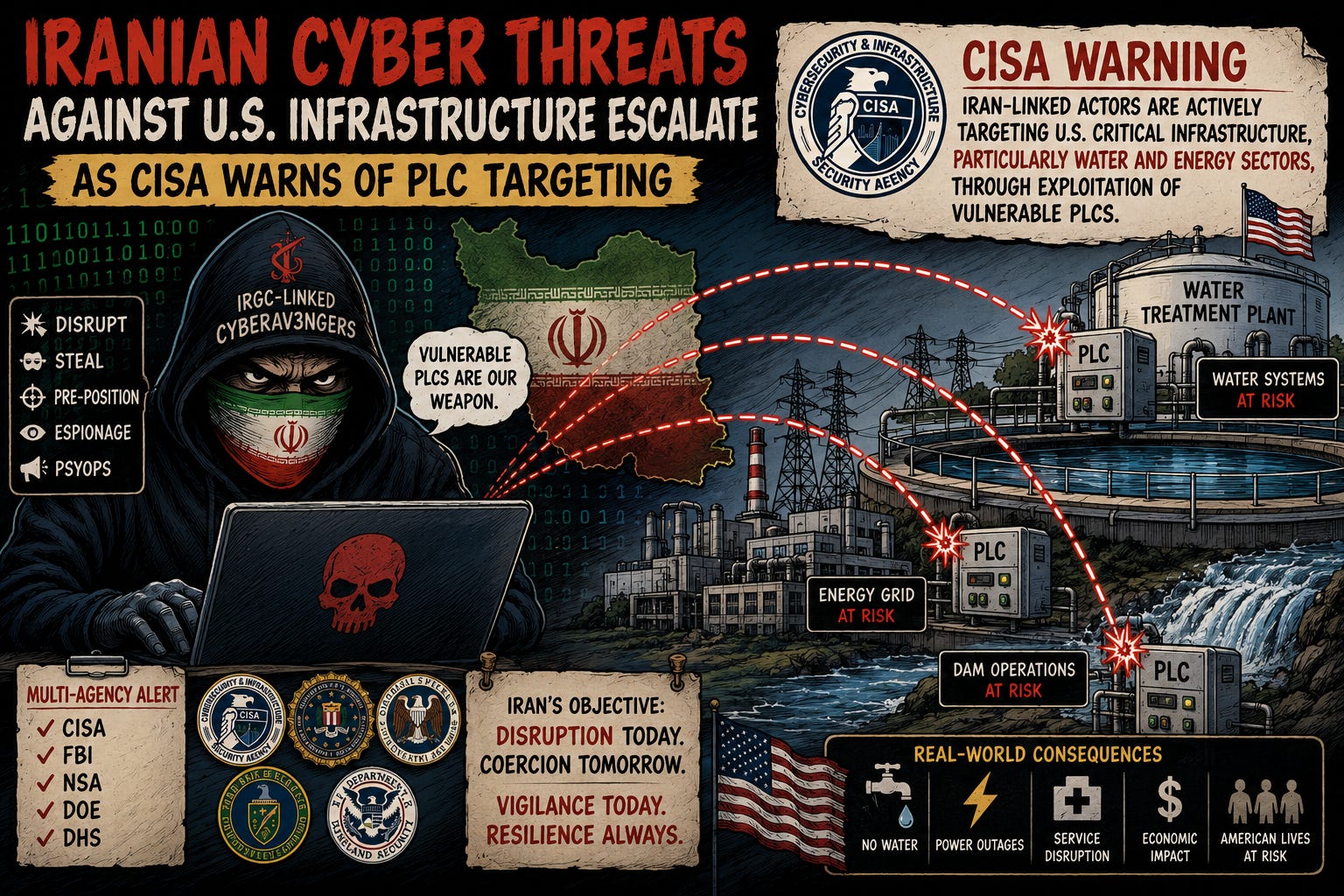
Iranian Cyber Threats Against U.S. Infrastructure Escalate as CISA Warns of PLC Targeting
Bottom Line Up Front (BLUF): CISA and multiple U.S. agencies warned that Iran-linked cyber actors are actively targeting American critical infrastructure, particularly water and energy sectors, through exploitation of vulnerable programmable logic controllers (PLCs). The activity, attributed to the IRGC-linked “CyberAv3ngers” group, reflects a broader Iranian strategy focused on disruption, espionage, pre-positioning, and psychological operations against U.S. and allied targets amid escalating regional tensions.
Analyst Comments: Iranian operators historically favor opportunistic attacks against exposed infrastructure rather than highly sophisticated intrusion chains. That makes them dangerous in a different way: they reliably exploit weak hygiene, outdated OT systems, poor segmentation, and internet-exposed industrial controls that defenders already know are vulnerable but often lack the budget or authority to fix. The bigger concern is the pre-positioning angle. According to the advisory, Iranian actors may have maintained access to victim environments dating back months. That shifts the conversation from nuisance disruption to strategic foothold establishment inside U.S. infrastructure. If tensions escalate further, those access points could support coordinated disruption campaigns against utilities, municipal systems, or transportation networks.
READ THE STORY: CSIS
Verizon DBIR 2026: Vulnerability Exploitation Overtakes Credential Theft as Top Breach Vector
Bottom Line Up Front (BLUF): Verizon’s 2026 Data Breach Investigations Report found vulnerability exploitation surpassed credential theft as the leading initial access vector in confirmed breaches, accounting for 31% of incidents. Researchers warned that AI-assisted exploitation is dramatically shrinking defender response windows while organizations continue struggling with patch management, third-party exposure, and ransomware resilience.
Analyst Comments: AI-assisted reconnaissance, exploit development, and vulnerability weaponization are compressing the time between disclosure and active exploitation from weeks or months into hours. The most alarming metric is not that exploitation overtook credential theft — it’s that organizations are patching slower while the threat cycle accelerates. Median remediation timelines increased to 43 days while attackers automate targeting against newly disclosed flaws almost immediately. That gap is becoming operationally unsustainable.
READ THE STORY: SecurityWeek
Interpol’s ‘Operation Ramz’ Marks Largest Coordinated Cybercrime Crackdown Across MENA Region
Bottom Line Up Front (BLUF): Interpol and law enforcement agencies from 13 Middle Eastern and North African countries conducted a five-month cybercrime operation resulting in 201 arrests, identification of nearly 600 suspected cybercriminals, and takedowns of phishing, fraud, and malicious infrastructure operations across the region. The initiative, dubbed “Operation Ramz,” represents the largest cybercrime coordination effort to date across the MENA region.
Analyst Comments: The real significance is the emergence of operational cybercrime coordination across a region historically fragmented by political tension, uneven legal frameworks, and limited cross-border intelligence sharing. For years, portions of the MENA cybercrime ecosystem benefited from jurisdictional blind spots, weak enforcement coordination, and inconsistent prosecution models. Threat actors often reused infrastructure, phishing kits, and operational patterns with little concern about multinational disruption efforts. Operation Ramz signals that this environment may be changing.
READ THE STORY: DR
Microsoft Disrupts ‘Fox Tempest’ Malware Signing Service Used by Ransomware Gangs
Bottom Line Up Front (BLUF): Microsoft dismantled a criminal malware-signing operation known as “Fox Tempest” that abused the company’s Artifact Signing service to provide legitimate-looking code-signing certificates to ransomware groups. The operation allegedly enabled malware tied to Rhysida, Akira, Qilin, and other threat actors to bypass security controls and infect thousands of systems, including Microsoft-owned devices.
Analyst Comments: Signed malware still carries enormous operational value because many endpoint protections, enterprise allowlists, and user trust decisions implicitly favor digitally signed binaries. Threat actors know that if they can make malware look “legitimate,” they dramatically improve delivery success and reduce detection friction. What makes this case notable is the scale and commercialization. Fox Tempest effectively operated like a ransomware support vendor, selling signed malware capability as a service with tiered pricing models and rapid fulfillment. That is mature cybercrime infrastructure, not random underground opportunism.
READ THE STORY: The Register
Windows Zero-Day Barrage Continues as Researcher Dumps New Exploits Targeting BitLocker, Defender, and SYSTEM Access
Bottom Line Up Front (BLUF): A researcher operating under the name “Nightmare Eclipse” has disclosed multiple Windows zero-days and exploit proofs-of-concept over the last six weeks, including flaws capable of bypassing BitLocker, escalating privileges to SYSTEM, and degrading Microsoft Defender protections. Several vulnerabilities remain unpatched, one has already entered CISA’s Known Exploited Vulnerabilities catalog, and researchers warn the disclosures could enable full attack-chain operations against fully updated Windows systems.
Analyst Comments: The dangerous part is not any single bug — it’s the cumulative attack-chain potential. When you combine local privilege escalation, endpoint protection degradation, and encryption bypasses, you start building realistic post-compromise tradecraft that ransomware operators and intrusion crews can operationalize quickly. MiniPlasma is especially ugly because it targets a vulnerability Microsoft supposedly fixed back in 2020. If the exploit still functions reliably on modern Windows systems, defenders now have to question assumptions around patch completeness and long-term remediation validation. That damages confidence in the entire patch lifecycle.
READ THE STORY: DR
Recorded Future Pushes ‘Agentic Processing’ as Defense Against AI-Accelerated Vulnerability Discovery
Bottom Line Up Front (BLUF): Recorded Future warned that frontier AI models like Mythos and GPT 5.5 are dramatically accelerating vulnerability discovery, forcing defenders into a race they cannot win through manual triage alone. The company argues that threat intelligence-driven automation and “agentic processing” are now essential for prioritizing exploitable vulnerabilities and deploying defensive actions at machine speed.
Analyst Comments: AI-assisted vulnerability discovery is increasing signal volume far faster than human-led security operations can realistically process it. The result is not just alert fatigue — it is prioritization collapse. The most important statistic in this piece is that only 446 out of roughly 50,000 disclosed CVEs in 2025 were reportedly observed exploited in the wild. That reinforces a reality many security teams still struggle with: the challenge is not discovering vulnerabilities anymore. It is determining which ones actually matter operationally.
READ THE STORY: The Recorded Future
Items of interest
CISA Credential Leak Sparks Congressional Scrutiny After GitHub Exposure of Sensitive GovCloud Access
Bottom Line Up Front (BLUF): CISA is under congressional pressure after researchers discovered a publicly exposed GitHub repository containing privileged AWS GovCloud credentials and internal agency access data. The leak, reportedly tied to a contractor-managed repository named “Private-CISA,” raised immediate concerns about potential persistence opportunities for nation-state actors and highlighted ongoing operational security failures inside the federal government’s top cyber defense agency.
Analyst Comments: If valid privileged credentials are sitting in a public repository, attackers skip reconnaissance and exploitation and move straight to access operations. The bigger issue here is not just exposure — it’s trust erosion. CISA is the agency responsible for advising critical infrastructure operators on cyber hygiene, yet it suffered the same GitHub credential leakage problem security teams warn junior developers about weekly. The most concerning detail is the mention of AWS GovCloud credentials potentially enabling persistence. If a state actor accessed the repository before remediation, the risk shifts from “credential leak” to possible long-term cloud foothold establishment. Depending on IAM permissions, temporary tokens, logging gaps, or federated trust relationships, this could become far more serious than a simple secrets exposure.
READ THE STORY: Cyberscoop
CISA Contractor AWS Leak + Industrial Robot Exploits (Video)
FROM THE MEDIA: We analyze a high-stakes CISA supply chain breach involving AWS GovCloud and investigate critical command injection vulnerabilities threatening industrial robot fleets. This briefing also covers new npm-targeting malware and the latest global efforts to dismantle cybercrime infrastructure.
Introduction to secret leaks and getting started with GitHub Secret Protection (Video)
FROM THE MEDIA: Have your secrets leaked? Learn about what you can do to mitigate risk -- and stop secrets from leaking in the first place.
The selected stories cover a broad range of cyber threats and are intended to help readers frame key publicly discussed threats and improve overall situational awareness. InfoDom Securities does not endorse any third-party claims made in its original material or related links on its sites; the opinions expressed by third parties are theirs alone. For further questions, don’t hesitate to get in touch with InfoDom Securities at dominanceinformation@gmail.com.