
Daily Drop (1298)
05-15-26

Friday, May 15, 2026 // Buy Bob a Coffee // Ghostwire
AI Cyber Models Require Human Expertise to Operationalize — Early Adopters
Bottom Line Up Front (BLUF): Early enterprise testing of Anthropic’s Mythos Preview and OpenAI’s GPT-5.5-Cyber shows significant vulnerability discovery gains — Palo Alto Networks found 75 bugs versus its usual 5–10 per month, and Microsoft identified 16 new flaws in the Windows networking and authentication stack — but consistent findings across vendors indicate the models require experienced human operators to be effective. False positive rates ran around 30% at Palo Alto before environment-specific training, Mythos overstated exploit significance in XBOW’s tests, and Cisco’s new open-source “Foundry Security Spec” warns that unreviewed frontier model output is “worthless” at production scale. Separately, the U.K. AI Security Institute noted that Mythos is improving autonomously through inference-time scaling without new model releases.
Analyst Comments: The human-in-the-loop finding is important but shouldn’t be read as reassuring without qualification — and the Palo Alto CPO’s counter is the line that should anchor threat modeling. Defenders need skilled researchers to operationalize these tools; attackers already have the domain expertise those researchers are providing. The asymmetry compounds over time as the models improve. The U.K. AISI’s inference-time scaling observation is the most consequential technical detail in the piece: if capability jumps don’t require new model releases, they also don’t require the kind of visible deployment events that would trigger policy review or export control scrutiny. The 30% false positive rate dropping with environment-specific training also has an offensive implication — a persistent attacker running extended reconnaissance against a target environment will see the same performance improvement that Palo Alto observed on defense. Cisco’s “make claims checkable” prompting approach is a useful operational finding that will likely propagate quickly through enterprise security teams. The broader pattern this week — Mythos, GPT-5.5-Cyber, Microsoft’s agentic system, XBOW, Cisco’s spec — is a coordinated industry normalization push for AI-assisted vulnerability research, arriving just as the TeamPCP Shai-Hulud open-sourcing puts similar-category tooling into uncontrolled circulation.
READ THE STORY: Axios
Cyber Operations Aren’t Slow — Our Thinking Is
Bottom Line Up Front (BLUF): Retiring Air Force cyber officer Timothy Neslony argues that U.S. Cyber Command’s operational slowness is a structural problem, not a technical one — inherited from NSA’s intelligence culture of patience over speed. Drawing on 20 years of offensive cyber operations, he proposes three reforms: automating elite operator tradecraft into AI-assisted tools usable by average operators, inverting the career model to put offense first, and delegating cyber authorities down to operators closest to the fight, analogous to how joint terminal attack controllers operate in special operations. The benchmark he sets is 30 minutes — the real crisis window — against which Cyber Command currently cannot reliably deliver.
Analyst Comments: The speed-control-intensity tradeoff framing (attributed to Lennart Maschmeyer) is analytically useful and the piece’s strongest structural contribution — it names the actual constraint rather than gesturing at bureaucratic friction. The agentic AI section is the most directly relevant to Ghostwire’s beat: Neslony is describing exactly the same capability dynamic that the Axios Mythos piece surfaces from the commercial side, but from the offensive military operator’s perspective. The convergence is notable — both pieces land this week, both conclude that AI lowers the skill floor for complex cyber operations, and both identify human judgment as the remaining bottleneck. The implication Neslony doesn’t fully state but the Palo Alto CPO did: adversarial actors face the same skill-floor compression, without the approval chain latency that Neslony is trying to eliminate. The career inversion proposal (offense → tool development → defense) is operationally coherent but institutionally radical; the services controlling training pipelines is a real structural barrier, and nothing in the current political environment suggests DoD is positioned for that kind of reorganization. The delegated authority proposal is the most actionable near-term reform and the one most likely to see incremental movement given existing JTATC precedent.
READ THE STORY: War on The Rocks
Beyond Acceleration and Automation: How AI + Intelligence Changes Cyber Defense
Bottom Line Up Front (BLUF): Recorded Future CTO Staffan Truvé argues that AI’s most consequential defensive impact is not automation of existing workflows but the continuous fusion of external threat intelligence with internal exposure data — enabling real-time mapping of attacker TTPs against an organization’s specific weaknesses at a scale previously requiring dedicated red teams and threat intelligence staff. Key capabilities he identifies: continuous attack-path modelling enriched with adversary behavior data, predictive prioritization over CVSS-based scoring, and AI-generated adaptive deception environments that invert a portion of the traditional attacker-defender asymmetry by forcing adversaries to verify everything while defenders need only one decoy to succeed. He frames the strategic shift as moving from “attacker vs. defender” to “AI-augmented vs. non-augmented.”
Analyst Comments: The deception section is the most genuinely novel contribution: the observation that AI removes the static-honeypot problem (skilled attackers recognize and avoid them) by generating dynamically adaptive environments is correct, and the intelligence feedback loop — deception generates new adversary tradecraft data, which refines future deception — is a real capability shift, not marketing. The tension Truvé identifies between deception-based intelligence collection and traditional incident response doctrine (minimize dwell time vs. deliberately extend it) is underappreciated in most vendor treatments and deserves more operational attention than it gets here. The piece connects directly to this briefing’s recurring thread: the Axios Mythos piece establishes that AI lowers the skill floor for offense; the Neslony piece argues the same dynamic applies to military cyber operations; Truvé argues defenders can achieve the same compression. All three pieces, landing the same week, collectively describe a capability threshold crossing — the question they leave open is whether the floor drops symmetrically or asymmetrically, and for whom it drops first.
READ THE STORY: Recorded Future
Russia Urges UN Member States to Join Cybercrime Convention
Bottom Line Up Front (BLUF): Russian Deputy Foreign Minister Dmitry Lyubinsky called on non-signatory states to join the UN Convention against Cybercrime and accelerate its enforcement, describing it as “the first universal legally binding treaty in international information security.” Lyubinsky flagged electronic evidence exchange as a key tool the convention provides against hackers and online fraud, and identified expanding the convention’s scope via an additional protocol as a near-term priority.
Analyst Comments: The convention itself is real and contentious — it passed the UN General Assembly in late 2024 over significant Western objections, with critics including the U.S., EU, and major human rights organizations arguing that its broad definitions of cybercrime could be used to criminalize legitimate security research, journalism, and dissent. Russia’s authorship and continued advocacy for the treaty is not incidental; the convention’s design reflects Moscow’s longstanding preference for state-controlled “information security” norms over the Western model of open internet governance and narrow cybercrime definitions. The call to accelerate ratification is worth watching as a diplomatic pressure campaign — the more non-Western signatories it accumulates, the more leverage Moscow gains in framing it as the legitimate multilateral baseline for cybercrime cooperation, complicating Western efforts to build competing frameworks through Budapest Convention expansion.
READ THE STORY: TASS
Moscow Condemns US-Israeli Strikes on Iran, Pledges Coordination With Tehran on Regional Settlement
Bottom Line Up Front (BLUF): Russian Security Council Deputy Secretary Alexander Venediktov met with Iranian Supreme National Security Council Deputy Secretary Ali Bagheri on the sidelines of the SCO security council secretaries’ meeting in Bishkek, condemning U.S. and Israeli strikes on Iranian statesmen and military leaders and pledging close cooperation toward a peaceful resolution. The meeting reflects continued Russia-Iran security coordination under the SCO framework amid the ongoing conflict.
Analyst Comments: Thin on cyber-specific content, but relevant as strategic context for two threads already in this briefing. First, the Iran conflict’s infrastructure targeting dimension — U.S.-Israeli strikes on Iranian military and government leadership increase the probability of retaliatory Iranian cyber operations against Western targets, a pattern well-documented from previous escalation cycles. BAUXITE / Cyber Av3ngers activity noted in the ICS Patch Tuesday entry fits this context. Second, the SCO security council format is worth flagging as a venue where Russia and China coordinate information security norms in parallel to the UN cybercrime convention push covered earlier — the multilateral architecture Moscow is building spans both tracks simultaneously.
READ THE STORY: TASS
Minerals for Regime Security in the DRC
Bottom Line Up Front (BLUF): Michelle Gavin argues that U.S. pursuit of Congolese mineral wealth is functionally underwriting Felix Tshisekedi's consolidation of power and apparent third-term campaign. Key data points: Tshisekedi's mandate expires in 2028; the DRC constitution currently bars a third term; U.S. Treasury sanctioned former president Kabila on April 30, echoing Tshisekedi's own accusations against him; and the Congolese government claimed — before a U.S. embassy denial — that Washington and the UAE were financing a paramilitary force to guard mines. Gavin warns that as repression accelerates under perceived American cover, the U.S. risks long-term influence loss when the political tide eventually turns.
Analyst Comments: The piece is measured advocacy from a credentialed Africa policy hand, and the core observation is structurally sound: transactional diplomacy that visibly advantages a sitting leader's domestic political position is indistinguishable from political interference, regardless of intent. The Kabila sanctions are the strongest data point — the U.S. had years of predicate for sanctioning him on corruption and electoral interference grounds and chose not to; doing so now, on M23 collaboration charges that align precisely with Tshisekedi's internal narrative, is the kind of timing that shapes perceptions durably. The DRC's mineral profile — coltan, cobalt, lithium — places it squarely in the critical minerals competition that is restructuring U.S. foreign policy across the Global South, which gives the pattern Gavin describes legs beyond this specific bilateral. The security angle has a cyber-adjacent dimension worth watching: critical mineral supply chains are an active targeting priority for both state and criminal actors, and any U.S.-backed mine security apparatus in the DRC would become a high-value intelligence and disruption target.
READ THE STORY: CFR
TeamPCP Open-Sources Shai-Hulud Worm — It's Open Season on Developer Infrastructure
Bottom Line Up Front (BLUF): TeamPCP published the full source code of the Shai-Hulud npm worm to GitHub with operational guidance explicitly inviting customization — "Change keys and C2 as needed" — days after a related "Mini Shai-Hulud" campaign compromised 150+ npm and PyPI packages tied to TanStack, Mistral AI, UiPath, OpenSearch, and Guardrails AI. Datadog's static analysis confirms Shai-Hulud is a comprehensive offensive platform: it scans 100+ file paths for credentials across three OS environments, dumps HashiCorp Vault and Kubernetes secrets, reads live process memory to capture secrets before masking kicks in, and includes a deadman switch that wipes the host if a stolen GitHub token is revoked. With stolen npm tokens it automatically republishes poisoned versions of every package the token can reach. BreachForums has simultaneously announced a sponsored supply chain compromise contest, which multiple researchers assess as directly related to the code release.
Analyst Comments: The MIT License choice and the BreachForums contest together are the strategic signal. TeamPCP is not just retiring tooling — they are seeding an ecosystem. The attribution-diffusion rationale is real: once dozens of variants exist, incident responders cannot definitively link attacks to the original group, and threat intelligence that tracks TeamPCP specifically becomes less operationally useful. The deadman switch is the technical detail that should land hardest with defenders — it means revocation of a compromised token triggers destructive action, which inverts the standard incident response playbook. The normal first move on credential compromise is immediate revocation; Shai-Hulud turns that reflex into a liability. Defenders need to sequence revocation after environment isolation, not before. The obfuscation approach — designed to defeat file hashing — is also a deliberate middle finger at the most common supply chain detection layer. Heuristic detection (anomalous egress, unusual credential file access) is the right pivot but carries higher false positive rates, compounding analyst load at exactly the moment volume is about to spike. This entry connects directly to three other pieces in this briefing: the Mythos AI piece (skill floor compression enabling more actors to operationalize complex tooling), the Neslony piece (automation democratizing offensive capability), and the Recorded Future piece (defenders needing continuous exposure mapping, not periodic assessments). Shai-Hulud is the real-world instantiation of what those three pieces describe theoretically.
READ THE STORY: Reversing Labs
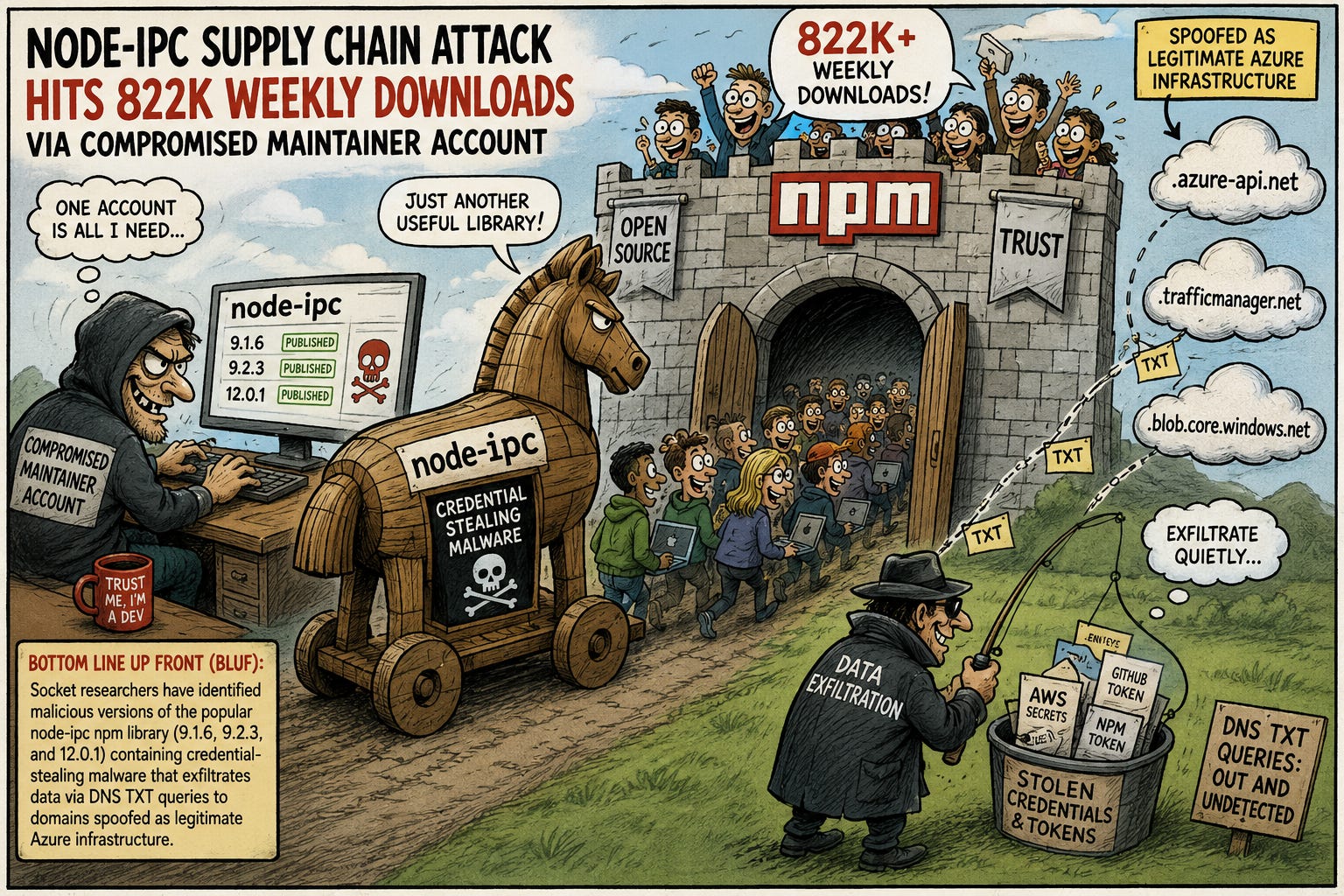
Node-ipc Supply Chain Attack Hits 822K Weekly Downloads via Compromised Maintainer Account
Bottom Line Up Front (BLUF): Socket researchers have identified malicious versions of the popular node-ipc npm library (9.1.6, 9.2.3, and 12.0.1) containing credential-stealing malware that exfiltrates data via DNS TXT queries to domains spoofed as legitimate Azure infrastructure. The payload — embedded in the CommonJS entry point and executing automatically on require — fingerprints the host, enumerates credentials across AWS/Azure/GCP, SSH keys, Kubernetes configs, .env files, and CI/CD secrets, then splits encoded data into thousands of small DNS queries to evade detection. Initial investigation points to a compromised dormant maintainer account (atiertant) accessed via an expired email domain, not a breach of npm infrastructure. node-ipc was previously weaponized in a 2022 geo-targeted destructive malware incident.
Analyst Comments: he expired-domain maintainer account takeover is the technique that deserves the most attention here — it requires no vulnerability exploitation and no npm infrastructure compromise, just patience and domain monitoring. Abandoned maintainer accounts across high-download packages represent a largely unmapped attack surface, and the technique scales: an attacker willing to systematically acquire expired domains tied to dormant npm accounts could queue up a pipeline of legitimate package takeovers. The DNS exfiltration channel is a deliberate detection-evasion choice that specifically targets organizations relying on HTTP/HTTPS egress monitoring without deep DNS inspection — a common gap. The forensic artifact (compressed archive at /tmp/nt-<pid>/<machineHex>.tar.gz, files timestamped Oct 26, 1985) is a useful IR indicator. This entry pairs directly with Shai-Hulud: both hit the npm ecosystem the same week, both target CI/CD credential stores, and both use evasion techniques designed to defeat the most common detection layers. Whether they are coordinated, inspired, or coincidental, the cumulative effect on developer trust in the npm ecosystem is the same.
READ THE STORY: GBhackers
Items of interest
Defending Against China-Nexus Covert Networks of Compromised Devices (CISA AA26-113A)
Bottom Line Up Front (BLUF): A 15-agency international advisory led by UK NCSC and co-sealed by CISA, FBI, NSA, DC3, ASD's ACSC, Canadian Cyber Centre, German BfV/BND/BSI, Japan NCO, Dutch AIVD/MIVD, NZ NCSC, Spain CCN, and Sweden NCSC-SE describes a major shift in China-nexus cyber actor TTPs: a move away from individually-procured infrastructure toward large-scale covert networks of compromised SOHO routers, IoT devices, NAS, and edge networking gear. Volt Typhoon (KV Botnet, primarily Cisco and NetGear routers) used these networks for critical infrastructure pre-positioning; Flax Typhoon (Raptor Train, 200,000+ devices in 2024) used a different network for cyber espionage. Raptor Train was operated by Chinese information security company Integrity Technology Group, which the FBI assesses is responsible for Flax Typhoon activity — confirming the suspected commercial layer between Chinese intelligence services and contractor-run botnets.
Analyst Comments: The cosealer list is the operationally significant detail and worth reading directly. Fifteen agencies across the Five Eyes plus Germany, Japan, Netherlands, Spain, and Sweden putting their seal on the same Chinese attribution and the same defensive playbook is the broadest allied cyber attribution coalition assembled to date — broader than the August 2025 Salt Typhoon advisory and a clear signal that European and Japanese intelligence services are now publicly aligned with US/UK on China cyber attribution rather than hedging on it. The Integrity Technology Group naming is the second-order story: confirming a named Chinese commercial firm as the operator of a botnet attributed to a tracked APT closes the loop between contractor ecosystem and state activity in a way that supports future sanctions, indictments, and supply-chain controls. The "IOC extinction" framing is the defensive shift defenders should internalize — the era of feeding malicious-IP blocklists into firewalls as primary defense against China-nexus actors is functionally over, and the recommended replacement (baseline normal connections, scrutinize consumer-broadband-range inbound, geographic and machine-cert allow-listing) is a meaningful operational lift that most mid-market organizations are not currently resourced for.
READ THE STORY: CISA
How China Uses Your Home Router for Cyber Attacks | Covert Networks Explained (Video)
FROM THE MEDIA: China‑nexus cyber actors are moving away from traditional, centrally owned infrastructure and hiding their operations behind huge covert networks of hacked routers and smart devices. In this video, we break down a 2026 joint advisory from the UK National Cyber Security Centre and international partners on how these networks work and what defenders can do about them.
Inside China’s Cyber War Network (Video)
FROM THE MEDIA: Inside China’s Cyber War Network - An investigative documentary exposing China’s cyber capabilities and the global impact of state-linked hacking operations.
The selected stories cover a broad range of cyber threats and are intended to help readers frame key publicly discussed threats and improve overall situational awareness. InfoDom Securities does not endorse any third-party claims made in its original material or related links on its sites; the opinions expressed by third parties are theirs alone. For further questions, don’t hesitate to get in touch with InfoDom Securities at dominanceinformation@gmail.com.