
Daily Drop (1293)
05-09-26

Saturday, May 09, 2026 // (IG): BB // Ghostwire
AWS US-EAST-1 Cooling Failure Sparks Questions Around Datacenter OT and SCADA Risk
NOTE:
The 2024 Kinesis and October 2025 DynamoDB incidents were classic hyperscaler software failures — distributed systems behaving badly at scale, the kind AWS has decades of muscle for: detect, roll back, post-mortem, harden, move on. The fix is in code. The May 2026 thermal event is a different category, and that distinction matters more than I let on. It’s the first physical-infrastructure failure in the recent US-EAST-1 sequence: not a control-plane bug, not a software race, but a building’s cooling system that couldn’t keep up with the heat its compute was producing. The fix isn’t a code change — it’s mechanical and facilities-side, with a fundamentally different recurrence risk profile, because cooling capacity has to be physically built, installed, and commissioned against multi-year procurement timelines.
It’s also the first in the series that points to a structural rather than circumstantial cause. The Kinesis bug was a specific deployment edge case; the DynamoDB race was a specific automation flaw. Both got fixed. A thermal event in May 2026 — at a moment when AI workload density is outrunning the cooling envelopes data centers were designed for — is a category of failure, not a one-off. And it changes what “concentration risk” means. The prior outages were addressable through architecture: multi-region failover, removing global dependencies on US-EAST-1 endpoints. A physical thermal failure says something different — that the building itself has finite headroom, and that headroom is being consumed by workload trends AWS doesn’t fully control. You can’t multi-region your way out of “the data center got too hot” if every hyperscaler is being pushed toward the same envelope by the same demand curve.
It’s also the first that makes the Northern Virginia concentration story a present-tense problem. Loudoun County hosts what’s commonly cited as around 70% of global internet traffic at some hop. That was always a theoretical risk, but prior outages were software events that could have happened anywhere. A thermal event ties the failure specifically to this physical place — and the corridor has been fighting power and water constraints, grid interconnection delays, and community pushback against new builds for years. Infrastructure is getting tighter while demand accelerates.
STILL could be an attack.
Bottom Line Up Front (BLUF): AWS confirmed a power and cooling failure in the US-EAST-1 use1-az4 availability zone that disrupted EC2 and EBS services after a thermal event impacted datacenter hardware. While there is no evidence of malicious activity, the incident has reignited discussion around the security exposure of datacenter building management systems (BMS) and industrial control infrastructure that underpin hyperscale cloud operations.
Analyst Comments: While the affected systems almost certainly sit on OT/BMS infrastructure with SCADA-style supervisory controls, there is currently no evidence the AWS thermal event resulted from malicious activity. Public indicators instead align with a conventional cooling and power failure isolated to a single availability zone. Notably, no Iran-aligned threat groups, OT security firms, CISA advisories, or cloud-focused threat-intelligence reporting have linked the incident to a cyber operation — significant given the normally noisy claim-and-signal behavior surrounding major infrastructure attacks. Still, the event highlights an uncomfortable reality for hyperscalers: datacenter cooling, power management, and environmental controls increasingly represent an OT attack surface capable of producing real-world physical disruption if compromised. The distinction between mechanical failure and intentionally induced process failure may become harder to determine as cloud infrastructure and industrial control systems converge.
READ THE STORY: The Register // CNBC // The TechMarketer // AWS
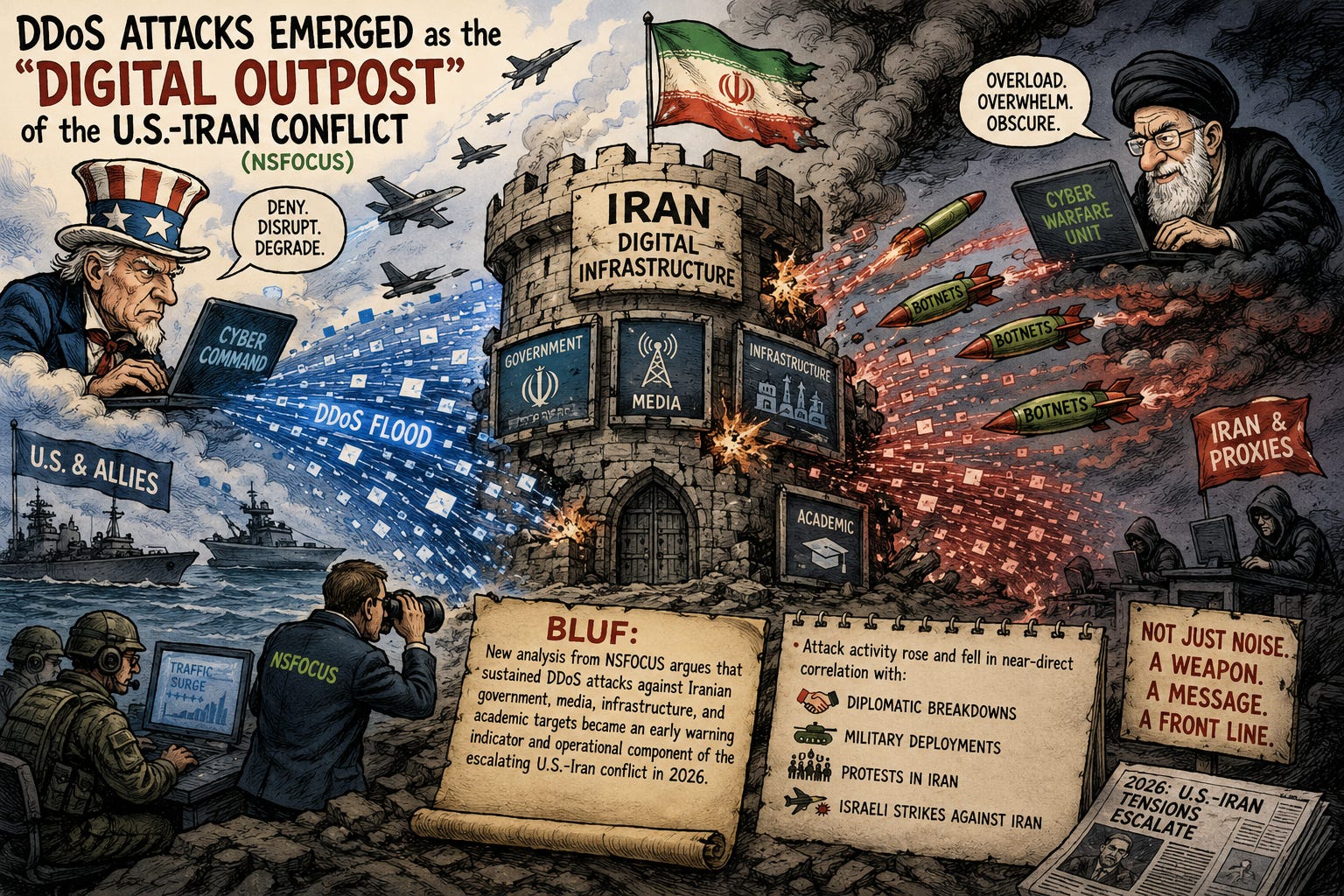
DDoS Attacks Emerged as the “Digital Outpost” of the U.S.-Iran Conflict (NSFocus)
Bottom Line Up Front (BLUF): NSFOCUS reports that between January 4 and late February 2026, 259 Iranian IP addresses were targeted by DDoS attacks, including 15 state entities, 4 state news organizations, 4 national network infrastructure assets, and 12 other institutions. Targets included the Supreme Leader’s official site (khamenei.ir), the IRNA news agency, the Tabnak news portal, the national e-government portal (my.gov.ir), and Sharif University of Technology. Attack methods spanned Mirai-variant botnets driving UDP floods and reflection amplification (NTP, SLP, CLDAP). The firm argues attack volume tracked the political temperature — rising with protests and diplomatic breakdowns, easing during negotiation windows, and surging again around the February 28 joint U.S.-Israeli strikes — and frames DDoS as a low-cost “digital outpost” preceding kinetic escalation. Iran’s subsequent internet shutdown is presented as itself evidence of attack effectiveness.
Analyst Comments: This assessment should be read with source context in mind: NSFOCUS is a Chinese cybersecurity firm analyzing cyber activity around the U.S.-Iran conflict. The report frames DDoS activity against Iranian targets as a “digital outpost” of conflict escalation and repeatedly links attack timing to U.S., Israeli, and Iranian political-military moves. That does not make the telemetry irrelevant, but it does mean analysts should separate observed technical indicators — target counts, attack types, timing, and affected Iranian infrastructure — from the report’s geopolitical interpretation. The strongest value here is the correlation between DDoS spikes and real-world escalation; attribution and intent should be treated cautiously without independent corroboration.
READ THE STORY: NSFocus
U.S.-China Cyber Conflict Expands Into Infrastructure, Telecom, and Economic Warfare
Bottom Line Up Front (BLUF): The strategic cyber competition between the United States and China continues evolving beyond espionage into long-term positioning against critical infrastructure, telecommunications networks, military systems, and financial platforms. Analysts increasingly describe the environment as a “digital Cold War,” where both nations are conducting persistent access operations designed to create leverage during future geopolitical crises.
Analyst Comments: Nation-state operators increasingly focus on persistence inside infrastructure environments where access can later support disruption, coercion, or intelligence collection during a crisis. This mirrors recent warnings tied to Chinese state-linked campaigns targeting telecom providers, energy infrastructure, maritime systems, and logistics networks. The broader trend is the normalization of “gray zone” cyber operations below the threshold of open conflict. Organizations should assume that strategic infrastructure and high-value enterprise environments are already contested spaces.
READ THE STORY: STL
China-Nexus APT UAT-8302 Reuses Shared Malware Arsenal to Target Governments Worldwide
Bottom Line Up Front (BLUF): Cisco Talos disclosed a sophisticated China-linked threat group tracked as UAT-8302 that targeted government entities in South America and southeastern Europe using a broad toolkit of custom malware, credential theft utilities, proxy frameworks, and reconnaissance tooling. The campaign heavily overlaps with previously identified China-nexus operations, including malware families tied to LongNosedGoblin, Earth Estries, UNC5174, and other Chinese-speaking APT clusters.
Analyst Comments: The most important takeaway is not any single malware family — it is the ecosystem convergence. UAT-8302 appears to operate less like an isolated intrusion set and more like a participant inside a shared Chinese intrusion economy where tooling, loaders, stagers, and infrastructure circulate across loosely aligned APT clusters. Talos’ findings reinforce a growing trend in China-linked operations: modular malware reuse, rapid adaptation of public offensive tooling, and extensive reliance on legitimate cloud services like OneDrive, GitHub, and Dropbox for stealthy command-and-control. The operational goal here is clearly long-term persistence inside government environments rather than smash-and-grab disruption.
READ THE STORY: CISCO Talos Blog
Russia Could Replicate Iran’s “Hormuz Playbook” to Disrupt Baltic and Black Sea Shipping
Bottom Line Up Front (BLUF): A new analysis warns Russia could use low-cost drones, deniable attacks, and insurance market pressure — rather than direct naval blockades — to effectively shut down critical maritime chokepoints in the Baltic and Black Seas. The strategy mirrors Iran’s recent disruption of the Strait of Hormuz, where commercial shipping traffic collapsed primarily due to war-risk repricing and insurer withdrawal rather than sustained physical attacks.
Analyst Comments: The key insight is that strategic maritime disruption no longer requires sinking fleets or mining sea lanes. A handful of unattributed drone incidents near chokepoints can trigger insurer withdrawals and commercial self-deterrence faster than NATO can politically respond. Russia is already positioned for this type of operation through its drone production scale, shadow-fleet activity, hybrid maritime operations, and years of gray-zone escalation against European infrastructure. Expect NATO planners to increasingly treat maritime insurance markets as part of the operational battlespace rather than purely commercial actors.
READ THE STORY: War on the Rocks
Iranian Threat Group MuddyWater Abuses Microsoft Teams for Credential Theft and Stealth Intrusions
Bottom Line Up Front (BLUF): Iranian state-linked threat group MuddyWater is exploiting Microsoft Teams chats to impersonate IT support personnel, trick employees into installing remote access tools like AnyDesk and ScreenConnect, then stealing credentials and sensitive corporate data. The campaign culminates with deployment of fake ransomware designed to distract incident responders while the real espionage operation remains active.
Analyst Comments: Instead of malware-heavy intrusion chains, MuddyWater is weaponizing trust in collaboration platforms and legitimate admin tools already normalized in enterprise environments. Teams is becoming the new phishing inbox. The fake ransomware angle is especially notable — it shifts defender focus toward recovery operations while credential theft and persistence mechanisms stay buried in the environment. Organizations still treating Teams, Slack, or Zoom as “trusted internal space” are behind the curve. Expect more state-linked actors to adopt this model because it blends social engineering, remote administration, and low-signature persistence into one highly scalable attack path.
READ THE STORY: DS
Ukraine’s Counter-Drone Expertise Fuels New Alliance Network Outside Washington’s Control
Bottom Line Up Front (BLUF): U.S. allies in the Gulf and Indo-Pacific are increasingly turning directly to Ukraine for drone warfare expertise, intelligence sharing, and asymmetric defense capabilities instead of relying solely on Washington’s traditional security architecture. The shift reflects growing frustration with U.S. bureaucracy, political unpredictability, and slow defense coordination as partners seek battlefield-tested solutions against Iranian and Russian drone threats.
Analyst Comments: By exporting combat-proven counter-drone tactics and low-cost air defense concepts, Ukraine has become a defense innovation hub in its own right. The bigger story is not just about drones — it’s about erosion of the decades-old U.S.-centric “hub-and-spoke” alliance model. Gulf states and Taiwan increasingly view direct partner-to-partner cooperation as faster, cheaper, and more operationally relevant than waiting for Washington-led coordination. Expect this trend to accelerate as adversaries like Russia, Iran, China, and North Korea deepen their own military integration. If the United States fails to adapt, allies will continue building parallel security networks that dilute U.S. influence over interoperability, intelligence flows, and defense standards.
READ THE STORY: War on the Rocks
OpenAI Expands GPT-5.5 “Cyber” Access as AI Vulnerability Research Race Intensifies
Bottom Line Up Front (BLUF): OpenAI is expanding access to a less-restricted version of GPT-5.5 — branded GPT-5.5-Cyber — for vetted defenders responsible for protecting critical infrastructure. The move comes as frontier AI models demonstrate rapidly improving offensive cyber capabilities, with recent testing showing GPT-5.5 and Anthropic’s Mythos models capable of autonomously executing multi-stage simulated cyberattacks.
Analyst Comments: The important story here is not the branding war between OpenAI and Anthropic — it’s that frontier models are crossing from “useful assistant” into operational cyber tooling. Once models can reliably chain together vulnerability discovery, exploit development, lateral movement, and environment analysis, the line between research assistant and autonomous operator gets blurry fast. OpenAI’s strategy appears more commercially scalable than Anthropic’s tightly gated approach: offer partially constrained public models while giving trusted organizations access to reduced-guardrail variants. Expect regulators and intelligence agencies to focus less on model weights themselves and more on access-control frameworks, auditability, and monitoring of high-risk cyber workflows.
READ THE STORY: Axios
Cloudflare says AI made 1,100 jobs obsolete, even as revenue hit a record high
Bottom Line Up Front (BLUF): OpenAI is expanding access to a less-restricted version of GPT-5.5 — branded GPT-5.5-Cyber — for vetted defenders responsible for protecting critical infrastructure. The move comes as frontier AI models demonstrate rapidly improving offensive cyber capabilities, with recent testing showing GPT-5.5 and Anthropic’s Mythos models capable of autonomously executing multi-stage simulated cyberattacks.
Analyst Comments: The important story here is not the branding war between OpenAI and Anthropic — it’s that frontier models are crossing from “useful assistant” into operational cyber tooling. Once models can reliably chain together vulnerability discovery, exploit development, lateral movement, and environment analysis, the line between research assistant and autonomous operator gets blurry fast. OpenAI’s strategy appears more commercially scalable than Anthropic’s tightly gated approach: offer partially constrained public models while giving trusted organizations access to reduced-guardrail variants. Expect regulators and intelligence agencies to focus less on model weights themselves and more on access-control frameworks, auditability, and monitoring of high-risk cyber workflows.
READ THE STORY: TC
Iran Conflict Drives Datacenter Construction Delays and Infrastructure Cost Spikes
Bottom Line Up Front (BLUF): The ongoing Iran conflict and disruption around the Strait of Hormuz are increasing costs and delaying global datacenter construction projects by constraining supplies of steel, aluminum, cement, transformers, copper, and other critical infrastructure components. Industry analysts warn the crisis is amplifying already fragile supply chains supporting hyperscale and AI datacenter expansion.
Analyst Comments: This is the physical infrastructure side of geopolitical risk that the AI boom tends to ignore. Modern datacenters are extremely dependent on energy-intensive industrial supply chains, and chokepoints like Hormuz indirectly affect everything from transformers to cooling systems. The larger issue is cumulative fragility: power shortages, grid connection delays, transformer scarcity, copper constraints, and geopolitical disruptions are all colliding at the same time. AI infrastructure demand assumes infinite build velocity, but the real bottleneck increasingly looks like industrial logistics rather than GPUs. Expect more datacenter operators to diversify suppliers, stockpile long-lead equipment, and reassess regional build strategies if instability around Middle Eastern shipping lanes continues.
READ THE STORY: The Register
Rancher Fleet Flaw Allows Full Kubernetes Cluster-Admin Compromise
Bottom Line Up Front (BLUF): A critical vulnerability in Rancher Fleet, tracked as CVE-2026-41050, allows attackers with limited repository access to escalate privileges to full Kubernetes cluster-admin by abusing Fleet’s Helm deployer and configuration handling. The flaw breaks multi-tenant isolation and enables theft of secrets, service account tokens, and potentially credentials tied to external enterprise infrastructure.
Analyst Comments: This is the kind of GitOps failure that turns automation into an attack surface. The core issue is trust boundary collapse — Fleet executes certain operations with elevated fleet-agent privileges instead of tenant-restricted permissions, effectively letting low-privileged users query or extract secrets from across the cluster. In multi-tenant Kubernetes environments, that is catastrophic. The “valuesFrom” abuse path is especially dangerous because it blends into legitimate workload behavior, making detection difficult without deep audit visibility. Organizations running shared DevOps or managed Kubernetes platforms should treat this as an assumed-compromise scenario until patched and audited.
READ THE STORY: Cyberpress
Hackers Used Claude AI to Target Mexican Water Utility and Probe SCADA Infrastructure
Bottom Line Up Front (BLUF): Attackers leveraged Anthropic’s Claude and OpenAI GPT models during a cyber campaign targeting Mexican government networks and the Monterrey water utility (SADM), using AI-generated tooling to accelerate reconnaissance, credential attacks, lateral movement, and attempts to access OT-adjacent SCADA infrastructure. Researchers found no evidence the attackers successfully compromised operational systems, but the campaign demonstrated how frontier AI models can significantly lower the barrier for targeting critical infrastructure environments.
Analyst Comments: The bigger shift is operational acceleration. Claude reportedly compressed days or weeks of offensive development into hours by generating tooling, prioritizing targets, refining attack paths, and analyzing network architecture in real time. That changes the economics of intrusion activity. Moderately skilled operators can now scale reconnaissance, credential operations, and post-exploitation workflows far faster than most defenders can respond. The fact that the model correctly identified OT-adjacent infrastructure and recommended plausible IT-to-OT pivot strategies without ICS-specific training should get attention from every utility operator still relying on weak segmentation and exposed management interfaces.
READ THE STORY: GBhackers
DOJ Moves to Strip Citizenship from 12 Individuals Accused of Concealing Terror Ties and War Crimes
Bottom Line Up Front (BLUF): The U.S. Department of Justice announced denaturalization proceedings against 12 individuals accused of hiding ties to terrorism, war crimes, extrajudicial killings, and human rights abuses during the immigration and citizenship process. The move signals a renewed federal focus on using civil denaturalization authorities to remove individuals who allegedly obtained U.S. citizenship through fraud tied to national security or atrocity crimes.
Analyst Comments: Denaturalization remains a relatively rare but powerful legal tool that allows the U.S. government to revoke citizenship acquired through material deception. Cases involving terrorist affiliations and war crimes carry significant intelligence and counterterrorism implications because they often expose long-term vetting gaps, fraudulent asylum narratives, or failures in interagency information sharing. Expect increased scrutiny on historical refugee and asylum cases tied to conflict zones where records were incomplete or intentionally manipulated. The announcement also aligns with broader DOJ and DHS efforts to prioritize immigration enforcement actions involving national security threats rather than purely administrative violations.
READ THE STORY: Reuters
TCLBANKER Trojan Hijacks WhatsApp and Outlook Accounts to Spread Financial Malware at Scale
Bottom Line Up Front (BLUF): A new Brazilian banking trojan dubbed TCLBANKER that targets 59 banking, fintech, and cryptocurrency platforms while spreading through hijacked WhatsApp Web sessions and compromised Microsoft Outlook accounts. The malware combines credential theft, remote access, anti-analysis protections, and trusted-contact phishing to create a highly scalable financial fraud and malware distribution operation.
Analyst Comments: TCLBANKER shows how mature Brazilian banking malware ecosystems have become. This is no longer basic overlay malware — operators are integrating anti-debugging, environment-aware payload decryption, WebSocket-controlled social engineering, and trusted-channel worming into commodity crimeware. The WhatsApp and Outlook propagation mechanism is the standout feature because it weaponizes existing trust relationships instead of relying on traditional phishing infrastructure. Security teams should pay attention to the operational model here: attackers are increasingly abusing authenticated business and messaging platforms to bypass email filtering, reputation systems, and user skepticism entirely.
READ THE STORY: THN
Object First Launches Fleet Manager for Distributed Veeam Backup Storage
Bottom Line Up Front (BLUF): Object First released Fleet Manager, a cloud-based service that gives enterprises and service providers centralized visibility across distributed Ootbi backup storage deployments for Veeam environments. The tool is designed to reduce operational overhead while preserving backup immutability and limiting cloud access to telemetry only.
Analyst Comments: Backup infrastructure is now a primary ransomware target, so visibility across distributed storage matters. Fleet Manager’s value is not flashy detection — it is operational control: knowing which clusters are healthy, where capacity is tight, and whether alerts are being missed across remote sites or customer environments. The zero-access design is the right call here; backup management planes should not become another privileged path for attackers to modify or delete recovery data.
READ THE STORY: HNS
Canvas Breach Escalates as Schools Quietly Negotiate With ShinyHunters to Prevent Student Data Leaks
Bottom Line Up Front (BLUF): The hacking group ShinyHunters claims it stole 6.65TB of data tied to nearly 9,000 schools through a breach of the Canvas learning platform, exposing student records, emails, IDs, and private communications. Reuters reports some schools are now directly contacting the attackers in an attempt to prevent public release of the stolen data as disruptions spread across U.S. classrooms during final exam season.
Analyst Comments: This is becoming a textbook education-sector extortion campaign: massive centralized SaaS platform, weak downstream security dependencies, and institutions under operational pressure during a critical academic period. The interesting detail here is the alleged abuse of Canvas’ “Free-for-Teacher” environment — a lower-trust service apparently leveraged as an entry point into broader platform functionality. That’s a recurring SaaS failure pattern: attackers compromise the least-governed environment, then pivot into production-facing systems. Also notable is schools negotiating independently with threat actors instead of relying solely on vendor-led incident response. That fragmentation almost always complicates containment, attribution, and coordinated recovery. Expect lawsuits, FERPA scrutiny, and increased pressure on edtech vendors to segregate trial environments from production infrastructure.
READ THE STORY: Reuters
“Dirty Frag” Linux Kernel Flaw Enables Reliable Root Access Across Major Distributions
Bottom Line Up Front (BLUF): Researchers disclosed a new Linux local privilege escalation vulnerability chain dubbed “Dirty Frag” that allows unprivileged users to gain root access on major Linux distributions including Ubuntu, RHEL, Fedora, AlmaLinux, and CentOS Stream. The exploit combines flaws in the kernel’s xfrm-ESP and RxRPC subsystems and is already seeing limited in-the-wild exploitation activity.
Analyst Comments: Dirty Frag is dangerous because it removes the instability that usually limits Linux LPE exploitation. Unlike race-condition exploits that crash systems or fail unpredictably, this chain is deterministic, reliable, and reportedly capable of achieving root access with a single command. Defenders should pay attention to the exploit’s use of legitimate kernel networking paths rather than obscure edge cases. The overlap with Dirty Pipe and Copy Fail also suggests attackers are systematically mining Linux page-cache logic for reusable privilege escalation primitives. The operational risk here is highest for shared Linux infrastructure, unmanaged edge appliances, CI/CD runners, VPS environments, and enterprise servers where local access is already obtainable through phishing, weak SSH hygiene, or web application compromise.
READ THE STORY: THN // Bleeping Computer
NVIDIA GeForce NOW Partner Breach Exposed User Emails, Phone Numbers, and Birth Dates
Bottom Line Up Front (BLUF): NVIDIA cloud gaming partner GFN.AM confirmed a data breach exposing user email addresses, usernames, birth dates, phone numbers, and in some cases real names tied to Google SSO accounts. The intrusion reportedly went undetected for nearly two months, increasing the risk of targeted phishing and social engineering attacks against affected gamers.
Analyst Comments: Attackers reportedly maintained unauthorized access from March 9 until discovery on May 2, which raises questions about monitoring maturity, logging visibility, and anomaly detection inside third-party gaming infrastructure. While passwords were reportedly not exposed, the combination of email addresses, DOBs, phone numbers, and real identities is more than enough for credential stuffing, SIM-swap attempts, and highly personalized phishing campaigns. Gaming ecosystems remain attractive targets because users often reuse credentials across gaming, social media, and financial platforms while maintaining weaker security hygiene overall.
READ THE STORY: GBhackers
Quasar Linux RAT Targets Developers to Hijack Software Supply Chains and Cloud Infrastructure
Bottom Line Up Front (BLUF): Researchers uncovered a sophisticated Linux malware implant dubbed Quasar Linux RAT (QLNX) that targets developers and DevOps environments to steal credentials tied to package repositories, cloud infrastructure, Kubernetes clusters, Docker environments, and CI/CD pipelines. The malware combines stealth persistence, rootkit functionality, credential harvesting, and post-exploitation tooling designed for long-term software supply chain compromise.
Analyst Comments: QLNX is dangerous because it attacks the trust layer of modern software development. Instead of encrypting systems or smashing infrastructure, it quietly steals the credentials developers use to publish packages, manage cloud workloads, and maintain CI/CD pipelines. If an attacker compromises a maintainer’s npm, PyPI, GitHub, AWS, or Kubernetes credentials, downstream compromise becomes scalable and extremely difficult to detect. The malware’s use of fileless execution, eBPF rootkit techniques, PAM credential interception, and multi-layer persistence shows operators are optimizing for stealth and long-term access rather than smash-and-grab operations. This is exactly the type of tooling that enables major software supply chain incidents months before anyone notices.
READ THE STORY: THN
Items of interest
Trump Administration Revives Frontier AI Safety Testing After Anthropic Withholds Claude Mythos
Bottom Line Up Front (BLUF): Ars Technica reports that the Trump administration signed agreements with Google DeepMind, Microsoft, and xAI to conduct government safety evaluations of frontier AI models before and after release, reversing its earlier rejection of Biden-era AI safety testing. The shift followed Anthropic’s decision not to release its Claude Mythos model due to concerns that advanced cybersecurity capabilities could be abused by malicious actors. The renamed Center for AI Standards and Innovation, formerly the U.S. AI Safety Institute, says it has completed roughly 40 evaluations and will use interagency expertise to assess national security risks.
Analyst Comments: This is a policy reversal with real security implications. The administration spent months framing AI safety testing as overregulation, then changed posture once a frontier model was withheld over cybersecurity misuse risk. That tells us the national security concern is no longer theoretical. The hard part is not getting labs to sign voluntary agreements; it is defining what “safe” means, who sets the standard, and whether evaluations can remain technical rather than political. Without published criteria, model testing risks becoming either performative oversight or a tool for political pressure. For defenders, the relevant takeaway is that advanced AI cyber capability is now being treated as a pre-release national security issue, not merely a product-risk question.
READ THE STORY: arsTECHNICA
Trump Admin Will Test New AI Models From Google, Microsoft And XAI Before Release Under New Deal (Video)
FROM THE MEDIA: The Commerce Department on Tuesday announced agreements with Google, Microsoft and Elon Musk’s xAI that will allow the Trump administration to review the company’s new AI models before they are publicly released, a reversal in Trump’s approach to the technology after a fallout with Anthropic.
‘Terrifying warning sign’: Anthropic delays AI model over security concerns (Video)
FROM THE MEDIA: Anthropic says Mythos (officially dubbed “Claude Mythos Preview”) is not ready for a public launch because of the ways it could be abused by cybercriminals and spies, according to Anthropic — a prospect that has prompted widespread concern in Washington and in Silicon Valley.
The selected stories cover a broad range of cyber threats and are intended to help readers frame key publicly discussed threats and improve overall situational awareness. InfoDom Securities does not endorse any third-party claims made in its original material or related links on its sites; the opinions expressed by third parties are theirs alone. For further questions, don’t hesitate to get in touch with InfoDom Securities at dominanceinformation@gmail.com.