
Daily Drop (1285)
04-27-26

Monday, Apr 27, 2026 // (IG): BB // Ghostwire
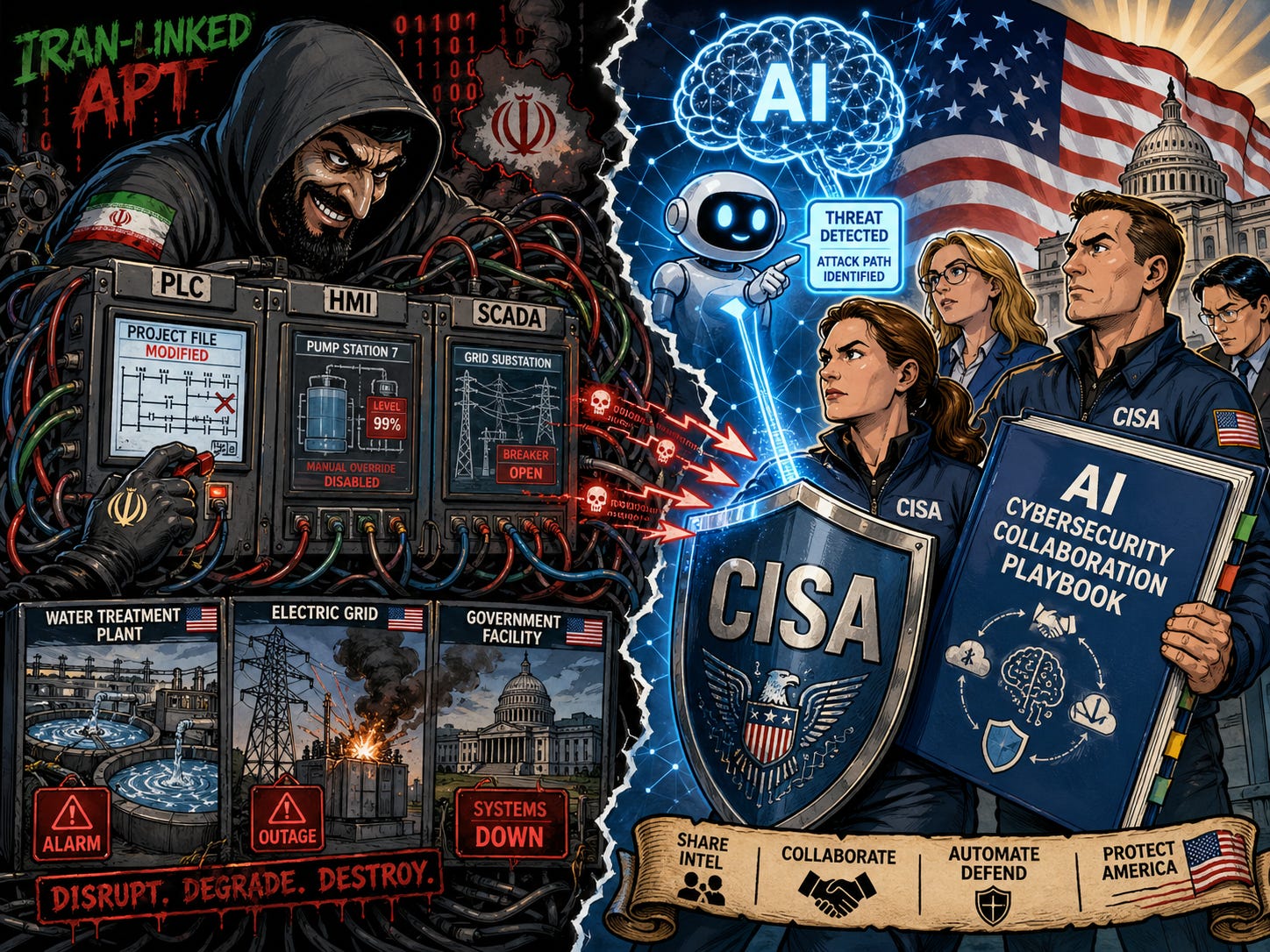
(CN Review)Iran-Linked APTs Target U.S. Critical Infrastructure PLCs as CISA Releases AI Cybersecurity Collaboration Playbook
Bottom Line Up Front (BLUF): Tianji Think Tank summarized two major U.S. cyber defense updates: CISA’s JCDC AI Cybersecurity Collaboration Playbook and a multi-agency warning that Iran-linked APT actors are actively targeting internet-exposed operational technology equipment across U.S. critical infrastructure. The PLC-focused activity includes malicious alteration of project files, manipulation of HMI/SCADA displays, and disruptions affecting government facilities, water and wastewater systems, and energy environments.
Analyst Comments: Internet-facing PLCs remain one of the most avoidable and dangerous exposures in critical infrastructure. Once attackers can reach controllers directly, the problem stops being theoretical network compromise and becomes process manipulation: changed logic, misleading HMI values, disabled safeguards, or operator confusion during live operations. The reported use of Rockwell Automation Studio 5000 Logix Designer is also notable. That suggests adversaries are not just scanning or defacing exposed devices; they are using legitimate engineering workflows and tooling to interact with PLCs. That makes detection harder because malicious activity can resemble normal maintenance unless asset owners baseline who is allowed to connect, when, from where, and what project changes are expected.
READ THE STORY: FreeBuf
China’s Cyber-Espionage Capabilities Now Rival U.S. Levels, Dutch Military Intelligence Warns
Bottom Line Up Front (BLUF): The Netherlands’ Military Intelligence and Security Service warned that China’s cyber-espionage capabilities have reached a level comparable to the United States, with Beijing increasingly targeting Western defense firms and military technologies. Dutch officials now assess China as a major strategic threat to Europe alongside Russia, with Beijing-Moscow cooperation worsening the risk picture.
Analyst Comments: This is not a routine “China is hacking” warning. The key point is capability parity. When a senior Dutch military intelligence official says Chinese cyber operations are now comparable to U.S. capabilities, that signals a mature, well-resourced, and highly organized espionage apparatus—not scattered opportunistic activity. The defense-sector focus tracks with Beijing’s long-running priority: acquire sensitive military, aerospace, dual-use, and advanced technology data without paying the full research-and-development cost. Western defense firms should assume they are persistent targets, especially those working on weapons systems, sensors, satellite technology, secure communications, AI-enabled defense tools, and NATO-adjacent projects.
READ THE STORY: MSN
US Warns Chinese AI Firms May Be Using Distillation to Replicate American Models
Bottom Line Up Front (BLUF): The U.S. State Department reportedly instructed diplomatic posts worldwide to raise concerns that Chinese AI firms, including DeepSeek, may be extracting and distilling proprietary U.S. AI models. The cable frames model distillation as an intellectual property and national security issue, warning that foreign competitors can use outputs from advanced U.S. models to train cheaper systems while potentially stripping safety controls.
Analyst Comments: Distillation is not inherently malicious; it is a standard model-compression and training technique. The problem is alleged unauthorized use of proprietary model outputs at scale, especially when the resulting models compete commercially or are deployed in sensitive government and enterprise settings. The harder issue is proof. Unlike stolen source code or leaked weights, distillation leaves a murkier evidentiary trail. Similar behavior on benchmarks does not automatically prove theft. But if providers can show systematic scraping, synthetic-data harvesting, abuse of API accounts, or prompt-output collection designed to clone capabilities, this becomes more than policy theater.
READ THE STORY: CN
Italy Moves to Extradite Chinese Hacker Suspect Wanted by U.S. Over COVID-19 Research Theft
Bottom Line Up Front (BLUF): Italy has reportedly decided to extradite Xu Zewei, a Chinese national wanted by U.S. authorities on hacking charges tied to the alleged theft of COVID-19 medical research. U.S. prosecutors accuse Xu of participating in cyber operations targeting American universities, immunologists, and virologists working on COVID-19 vaccines, treatments, and testing, and later being linked to the Hafnium cyber-espionage group.
Analyst Comments: This is a legal development with strategic weight. COVID-19 research theft was one of the clearest examples of cyber espionage colliding with public health, economic competition, and national security. If the extradition proceeds, U.S. prosecutors may get a rare opportunity to put alleged state-linked Chinese cyber activity into a courtroom rather than just another indictment or sanctions package. The Hafnium reference is also important. Hafnium was tied to large-scale exploitation activity, including campaigns that affected thousands of systems worldwide. If prosecutors can credibly connect Xu to both pandemic-era research targeting and broader espionage infrastructure, this case could become a useful public record of how tasking, operators, and intrusion activity allegedly linked back to Chinese state interests.
READ THE STORY: Reuters
U.S. Seizes Domains Tied to Iran-Linked Handala Hackers After Cyber Psychological Operations Campaign
Bottom Line Up Front (BLUF): The U.S. Department of Justice announced the seizure of four domains allegedly linked to the Iran-associated Handala hacking group, framing the activity as “Cyber Enabled Psychological Operations” connected to Iran’s Ministry of Intelligence and Security. The domains were reportedly used to publicize hack claims, leak stolen sensitive data, and threaten perceived enemies of the Iranian regime, including dissidents, journalists, and Israelis.
Analyst Comments: The DOJ’s domain seizures are not just takedowns; they are counter-messaging. By labeling the campaign as cyber-enabled psychological operations, U.S. authorities are trying to strip away the group’s activist branding and tie the activity directly to Iranian state objectives. The likely impact is disruption, not elimination. Domain seizures can slow distribution, break infrastructure, and expose operational patterns, but Iran-linked operators can rebuild quickly using new domains, Telegram channels, mirror sites, and compromised infrastructure. Expect rebranding, migration, and retaliatory messaging.
READ THE STORY: MSN
Iran-Linked Handala Hackers Expose Israeli Special Operations Officers’ Identities
Bottom Line Up Front (BLUF): U.S. utility technology provider Itron disclosed that an unauthorized third party accessed certain internal systems, prompting the company to activate its cybersecurity response plan, notify law enforcement, and bring in external advisors. Itron says the activity has been blocked, no follow-up activity has been observed, and customer systems were not affected, though the investigation remains ongoing.
Analyst Comments: The company sits close to critical infrastructure, providing technology for electricity, water, and gas management, with reported operations across 7,700 customers, 100 countries, and 112 million managed endpoints. That makes any intrusion worth scrutiny, even if the company currently says customer environments were not impacted. The good news is that Itron reports no material business disruption and no evidence the unauthorized activity extended to customers. The caution is that early breach disclosures often narrow the language carefully: “certain systems,” “no current expectation,” and “investigation ongoing” leave room for the scope to change.
READ THE STORY: Crypto Briefing
Itron Discloses Internal IT Breach; Critical Infrastructure Customer Systems Reportedly Unaffected
Bottom Line Up Front (BLUF): U.S. utility technology provider Itron disclosed that an unauthorized third party accessed certain internal systems, prompting the company to activate its cybersecurity response plan, notify law enforcement, and bring in external advisors. Itron says the activity has been blocked, no follow-up activity has been observed, and customer systems were not affected, though the investigation remains ongoing.
Analyst Comments: The company sits close to critical infrastructure, providing technology for electricity, water, and gas management, with reported operations across 7,700 customers, 100 countries, and 112 million managed endpoints. That makes any intrusion worth scrutiny, even if the company currently says customer environments were not impacted. The good news is that Itron reports no material business disruption and no evidence the unauthorized activity extended to customers. The caution is that early breach disclosures often narrow the language carefully: “certain systems,” “no current expectation,” and “investigation ongoing” leave room for the scope to change.
READ THE STORY: Bleeping Computer
Thai Council of Engineers Breach Exposes Personal Data of 350,000 Members
Bottom Line Up Front (BLUF): The Council of Engineers Thailand warned that personal data belonging to roughly 350,000 members was stolen after its database was hacked during a server-to-server data transfer. Exposed information reportedly includes names, addresses, phone numbers, licence levels, and other personal details. Officials warned the data could be used for scams or identity fraud, and said the breach may affect an upcoming electronic election for council directors.
Analyst Comments: The exposed license-level data creates a second-order risk: if attackers can tamper with records or convincingly impersonate engineers, the impact could extend into professional licensing, election integrity, and public trust in regulated engineering work. The timing also matters. The breach reportedly occurred during data transfer between servers, which points to a common weak spot: migration windows. Organizations often relax controls, move large datasets, provision temporary access, or expose staging infrastructure during migrations. Attackers know this and watch for it.
READ THE STORY: Bangkok post
National Data of 100,000 Leaked from Golf Course; DPRK Hacking Suspected
Bottom Line Up Front (BLUF): South Korean police are investigating a breach at Lee & Lee Country Club in Gapyeong after personal data tied to roughly 100,000 customers was reportedly leaked. Compromised information includes names, dates of birth, gender, user IDs, passwords, phone numbers, email addresses, and home addresses. Investigators suspect malware linked to a North Korean hacking group may have infected the golf club’s server.
Analyst Comments: Golf courses, resorts, clubs, and other membership-based organizations often hold rich personal data while running relatively modest security programs. For North Korean operators, that kind of environment can be useful for credential theft, identity fraud, social engineering, and follow-on targeting. The inclusion of passwords is the key concern. Even if the golf club itself has limited strategic value, reused credentials could give attackers access to banking, email, corporate portals, or government-adjacent accounts. Organizations should assume exposed passwords will be tested elsewhere. Customers should reset passwords immediately, especially where the same or similar credentials were reused.
READ THE STORY: The Korea Herald
RAMP Leak Exposes Russia’s Ransomware Marketplace and Access-Broker Economy
Bottom Line Up Front (BLUF): A leaked database from the Russian-language RAMP forum exposed a mature ransomware marketplace built around access sales, affiliate recruitment, private dealmaking, and RaaS promotion. The dataset reportedly includes 7,707 user records, 1,732 forum topics, 340,333 IP logs, 1,899 private chat sessions, and 3,875 private messages, offering a rare look at how ransomware operations are structured and commercialized.
Analyst Comments: RAMP is a reminder that ransomware is not just malware. It is an economy. Initial access brokers, ransomware operators, affiliates, recruiters, and escrow-style intermediaries all play specialized roles, which lowers the barrier for new criminals and speeds up attacks. The most operationally relevant detail is the access trade. The article notes 333 topics tied to enterprise network access sales and 60 RaaS recruitment posts. That matters because defenders often focus too late in the chain—on encryption, payloads, and ransom notes—while the real opportunity is earlier: exposed credentials, VPN abuse, suspicious logins, unusual remote access, and brokered access appearing in underground channels.
READ THE STORY: Freebuf
Adobe Acrobat Reader CVE-2026-34621 Sample Shows Persistent JavaScript Payload Behavior
Bottom Line Up Front (BLUF): A malicious PDF sample exploiting CVE-2026-34621 targets Adobe Acrobat Reader through a JavaScript object/prototype handling flaw, with observed in-the-wild exploitation and unusual persistence-like behavior. The sample extracts an obfuscated JavaScript loader from an embedded PDF object, decodes a Base64 payload from a hidden form field, fingerprints the victim environment, contacts a C2 server, decrypts a follow-on payload, and executes it through eval.
Analyst Comments: A PDF sample containing CVE-2026-34621, a critical Adobe Acrobat Reader vulnerability reportedly confirmed in Adobe APSB26-43 on April 11, 2026. The embedded JavaScript is stored in PDF object 9 0 obj and initially appears heavily obfuscated. After handling escaped parentheses and JavaScript string tricks, the loader resolves to logic that reads the hidden PDF form field btn1, Base64-decodes its value, converts it into JavaScript, and executes it after a 500-millisecond delay. The second-stage script is also obfuscated. After deobfuscation, the code reveals environment checks and dynamic URL construction. The C2 server is listed as 169.40.2.68:45191, with paths such as s11, s12, rs1, and rs2 selected based on Reader version and runtime conditions. The script sends victim/environment data including platform, viewer version, active document count, and PDF file path, then retrieves encrypted follow-on content. The payload uses AES and zlib routines before executing decrypted JavaScript through eval.
READ THE STORY: XZ
Nessus Agent Windows Flaw Enables Local Privilege Escalation
Bottom Line Up Front (BLUF): A reported flaw in the Windows version of Tenable Nessus Agent could allow local attackers to escalate privileges on affected systems. The issue appears to involve unsafe handling of agent-side Windows permissions or service behavior, creating a path for a low-privileged user to gain higher-level execution. Organizations using Nessus Agent on Windows should review affected versions, apply vendor updates, and audit endpoint permissions around the agent service.
Analyst Comments: This is the kind of vulnerability that defenders tend to underrate because it requires local access. That is a mistake. Local privilege escalation is often the second step in a real intrusion: phishing gets the foothold, LPE gets the admin rights, and then the attacker moves laterally. Security tooling is also an attractive target. Agents like Nessus typically run with elevated privileges and have broad visibility into the host. If their service paths, update mechanisms, file permissions, plugins, logs, or IPC interfaces are mishandled, they can become privilege-escalation tools sitting on every managed endpoint.
READ THE STORY: GBhackers
CLI npm Package Compromised in Credential-Stealing Supply Chain Attack
Bottom Line Up Front (BLUF): Bitwarden confirmed that its CLI npm distribution channel was briefly compromised after attackers uploaded a malicious @bitwarden/cli package version 2026.4.0. The package was available on April 22, 2026, from 5:57 PM to 7:30 PM ET and contained credential-stealing malware targeting developer secrets, CI/CD tokens, cloud credentials, SSH keys, GitHub tokens, and npm credentials. Bitwarden says vault data, production systems, and the legitimate CLI codebase were not compromised.
Analyst Comments: The payload behavior is nasty. It does not just steal local credentials; it attempts to propagate by using stolen npm tokens to identify packages the victim can modify and inject malicious code downstream. That turns one compromised install into a potential package ecosystem event. The reported overlap with the Checkmarx supply chain attack is also important. Shared infrastructure, obfuscation routines, telemetry endpoints, and GitHub-based exfiltration suggest this is part of a broader campaign against developer tooling rather than a one-off compromise. Treat affected environments as fully exposed, especially CI/CD runners where long-lived tokens and cloud keys often pile up.
READ THE STORY: Bleeping Computer
CODESYS Vulnerability Chain Lets Attackers Backdoor Industrial Control Applications
Bottom Line Up Front (BLUF): Nozomi Networks Labs disclosed three patched vulnerabilities in the CODESYS Control runtime that can be chained by a low-privileged authenticated attacker to replace a legitimate industrial control application with a backdoored version. Successful exploitation can lead to administrative control over the target device and host operating system, creating serious risk for Soft PLC environments used in manufacturing, energy, and other operational technology networks.
Analyst Comments: The attack path also shows why credential hygiene in OT matters. The chain requires Service-level credentials, but those can come from weak defaults, compromised engineering workstations, or local hash extraction. Once authenticated, the attacker abuses normal project backup and restore workflows, which makes the activity harder to distinguish from legitimate engineering operations unless operators are monitoring for project integrity and unexpected changes.
READ THE STORY: GBhackers
Cursor IDE Security Review Finds Prototype Pollution, Debug Field Exposure, and Protobuf Validation Gaps
Bottom Line Up Front (BLUF): A security researcher reverse-engineered Cursor IDE’s Electron client and Connect-RPC API surface, identifying four CVE-class issues: prototype pollution in billing endpoints, an exposed production-side devRawModelSlug debug field, internal service-header information disclosure, and weak validation of several protobuf fields. The research did not find a working plan-bypass for premium models, and the author noted that Cursor’s core authorization model remains largely server-side and resilient.
Analyst Comments: The useful takeaway here is that Cursor’s premium-model access controls appear better designed than many AI SaaS implementations. The JWT reportedly does not carry subscription privileges, and plan checks occur server-side rather than trusting client-side feature gates or claims. That matters because model-entitlement bypasses are one of the obvious abuse paths for AI coding tools. The weaker areas are classic production-hardening problems. __proto__ handling should never produce a 500 on billing routes, especially where subscription state is involved. The devRawModelSlug finding is also worth attention, not because the researcher bypassed routing, but because dormant debug pathways in production tend to become incident material after a config mistake, feature-flag drift, or future code change.
READ THE STORY: HABR
QEMU CTF Device Flaw Enables Guest-to-Host Style Exploit via MMIO Out-of-Bounds Read/Write
Bottom Line Up Front (BLUF): A custom QEMU PCI device challenge, ccb-dev, exposes an out-of-bounds read/write flaw in its MMIO handler. The device stores an attacker-controlled index and uses it directly to access an internal buffer without bounds checks, allowing a guest-side exploit to read and overwrite adjacent QEMU device state. The write-up demonstrates using the bug to leak libc/heap addresses and redirect a logging callback toward command execution in the challenge environment.
Analyst Comments: This is a classic “tiny bug, huge blast radius” pattern in emulator and hypervisor-adjacent code. The vulnerable logic is not complicated: the device accepts an index through one MMIO register, then uses that index to read or write buffer[index] through another register. No bounds check means the guest can walk past the intended buffer and corrupt neighboring fields such as function pointers, format strings, or handler arguments. The important lesson is not the CTF payload itself; it is the trust boundary. In QEMU device models, guest-controlled MMIO/PMIO input should be treated like hostile network input. A single unchecked array index inside an emulated device can become a path from guest interaction to host-side process compromise, especially when function pointers or callback structures sit nearby in memory.
READ THE STORY: XZ
Automated Jailbreak Prompt Generation Framework Targets Chinese LLM Safety Controls
Bottom Line Up Front (BLUF): A Xianzhi Community article describes a framework for automating LLM jailbreak prompt generation, testing, evaluation, and storage. The author presents it as red-team research, but the workflow is operationally risky: it uses structured risk categories, attack-strategy selection, automated target-model testing, secondary harm assessment, and a reusable repository of successful bypass attempts.
Analyst Comments: This is jailbreak research moving from manual prompt tinkering into pipeline automation. The most important takeaway is the closed loop: generate a candidate prompt, test it against a target model, use another model to judge whether the response is harmful, then store successful cases for reuse. That kind of workflow can rapidly scale jailbreak discovery across models, languages, and safety-policy updates. The article also shows why multilingual and stylistic safety testing matters. The author highlights classical Chinese-style prompting as an effective bypass approach against several Chinese-language models. That suggests safety filters may be uneven across language registers, historical writing styles, obfuscation methods, and encoded inputs. For defenders, the priority is not just better refusals; it is stronger prompt-risk detection, output monitoring, adversarial testing, and abuse-pattern telemetry.
READ THE STORY: XY
DeepSeek-V4 Raises Agent Security Stakes with Million-Token Contexts, Tool Calls, and Sandbox Infrastructure
Bottom Line Up Front (BLUF): DeepSeek-V4 is more than a model-capability release. Its million-token context window, lower inference cost, open-source deployment path, stronger agent training, tool-calling format, and sandbox infrastructure reshape AI security boundaries. The core concern is that risk is moving beyond simple prompts and outputs into long context, cached state, tool execution, agent memory, and downstream deployments.
Analyst Comments: The security story here is not “bigger model is riskier” in the abstract. It is that long-context, tool-using agents change where defenders have to look. When a model can ingest full repositories, contracts, email chains, PDFs, logs, and knowledge bases, malicious instructions no longer need to sit in the user’s prompt. They can hide in comments, footnotes, forwarded email history, web pages, tables, or old project notes. The article also gets one major point right: guardrails cannot remain simple output filters. Once agents can call tools, modify code, run commands, browse, access databases, and retain task state, the security layer has to govern execution. That means source labeling, instruction/data separation, tool permission checks, sandboxing, trajectory logs, cache controls, and rollback.
READ THE STORY: Freebuf
EPFL Robotics Framework Lets Robots Share Skills Across Different Hardware Without AI
Bottom Line Up Front (BLUF): EPFL researchers developed a control framework called Kinematic Intelligence that allows robotic arms with different hardware designs to reuse skills from a single human demonstration. The system maps each robot’s mechanical limits and singularity “danger zones” in advance, allowing robots to safely adapt motions across different bodies without retraining or AI-based black-box control.
Analyst Comments: The security and safety angle is straightforward: transferable robot skills are powerful, but they also expand the blast radius of a bad instruction or unsafe task policy. If one demonstration can be deployed across multiple robot types, organizations need strong validation before those skills hit production lines. Safe joint motion is only one layer. The system still needs environmental sensing, human-presence detection, task authorization, object-awareness, and audit logging before it can be trusted in unpredictable industrial settings.
READ THE STORY: arsTechnica
GEOINT Handbook Breaks Down Open-Source Geospatial Intelligence for Beginners
Bottom Line Up Front (BLUF): A Habr article provides a beginner-friendly overview of geospatial intelligence (GEOINT), explaining how satellite imagery and geographically referenced data can be used to analyze conflicts, environmental change, public health trends, and economic activity. The piece emphasizes that GEOINT is no longer limited to government agencies; open-source tools like Google Earth Pro, Sentinel Hub, QGIS, GrassGIS, Whitebox GAT, and OWGIS make entry-level geospatial analysis accessible to researchers, journalists, students, and security practitioners.
Analyst Comments: Analysts no longer need classified imagery or expensive platforms to start asking serious questions about terrain, infrastructure, conflict activity, disaster impact, or environmental change. The caution is that GEOINT can look deceptively simple. A satellite image or map can feel authoritative, but interpretation still requires context, source validation, and awareness of bias. The article gets this right by warning against confirmation bias and purely descriptive analysis. Good GEOINT is not just “look at the map.” It is connecting what is visible to why it matters.
READ THE STORY: HABR
Items of interest
FCC Adds More Chinese Tech Firms to National Security Risk List
Bottom Line Up Front (BLUF): The FCC has reportedly added more China-linked technology companies to its national security risk list, expanding U.S. scrutiny of foreign telecom and technology suppliers. The move signals continued pressure on Chinese vendors tied to communications infrastructure, surveillance technology, and potential state influence.
Analyst Comments: This is less about one product and more about supply-chain exposure. Once a company lands on the FCC’s covered list, U.S. organizations should treat that vendor as high-risk for procurement, compliance, and infrastructure planning. For telecoms, MSPs, critical infrastructure operators, and government contractors, the practical question is simple: do we have any of this equipment, software, or services in the environment? The bigger trend is clear. Washington is continuing to narrow the space for Chinese technology inside U.S. networks, especially where vendors touch communications, routing, surveillance, or sensitive data flows. Security teams should expect more vendor reviews, more procurement restrictions, and more pressure to prove where hardware and software originate.
READ THE STORY: The Register
FCC move: Could Chinese labs be banned from testing US electronics? (Video)
FROM THE MEDIA: The Federal Communications Commission is taking significant steps to address national security concerns regarding electronic device testing. With a scheduled vote on April 30th, the agency plans to propose a total ban on Chinese labs testing electronics meant for the U.S. market.
Rep. Mast: Why are these allies selling crucial technology to China? (Video)
FROM THE MEDIA: If U.S. companies won’t sell out to China, we should expect our closest allies’ companies like Dutch chip equipment manufacturer, ASML, to follow our lead. That’s what true partnership means.
The selected stories cover a broad range of cyber threats and are intended to help readers frame key publicly discussed threats and improve overall situational awareness. InfoDom Securities does not endorse any third-party claims made in its original material or related links on its sites; the opinions expressed by third parties are theirs alone. For further questions, don't hesitate to get in touch with InfoDom Securities at dominanceinformation@gmail.com.