
Daily Drop (1273)
04-07-26

Tuesday, Apr 07, 2026 // (IG): BB // Ghostwire
U.S. Influence in Arab World Declining as Regional Perceptions Shift Toward Rivals
Bottom Line Up Front (BLUF): New polling data indicates a sharp and sustained decline in U.S. favorability across the Arab world following the Gaza war and broader regional conflicts. Public opinion is increasingly shifting toward China, Russia, and even Iran, raising concerns that Washington’s long-term strategic position in the region is eroding.
Analyst Comments: This is a perception problem with strategic consequences. The U.S. hasn’t “lost” the Arab world in a hard-power sense—military presence, partnerships, and economic ties are still there. But legitimacy and influence are clearly degrading at the public level, which is where long-term alignment is shaped. The key driver is consistency—or lack of it. The article points to a growing belief that the U.S. applies international law selectively, particularly in the Israeli-Palestinian conflict. Whether or not that’s accurate, perception is what matters here, and right now the perception gap is widening.
READ THE STORY: Foreign Affairs
Cyber Threats Target Smart Power Grids, Raising Risk to Critical Infrastructure
Bottom Line Up Front (BLUF): Smart power grid systems are increasingly exposed to cyber threats as digital transformation expands attack surfaces across energy infrastructure. The convergence of IT and OT systems introduces vulnerabilities that could disrupt power delivery, with nation-state and criminal actors actively targeting grid technologies.
Analyst Comments: Attackers target interconnected grid systems through IT/OT convergence points, including remote access interfaces, cloud-connected management platforms, IoT devices, and third-party vendor integrations. Initial access is often achieved via credential theft or exposed services, followed by lateral movement into operational systems controlling grid functions.
READ THE STORY: GBA
China Conducts 170M+ Cyber Operations Against Taiwan, Expands Into Election Interference
Bottom Line Up Front (BLUF): Taiwan’s National Security Bureau reports over 170 million cyberattack attempts against government systems in Q1 2026, alongside large-scale influence operations tied to upcoming elections. The activity reflects a coordinated cyber and information warfare campaign aimed at intelligence collection and political manipulation.
Analyst Comments: China-linked actors target Taiwanese government networks (GSN) with large-scale cyber activity for reconnaissance and data collection, while simultaneously conducting influence operations via social media, fake accounts, and AI-generated content (including deepfakes and manipulated polling data) to shape public opinion ahead of elections.
READ THE STORY: MK
Axios Supply Chain Attack Delivers Cross-Platform RAT via Malicious Package Versions
Bottom Line Up Front (BLUF): Attackers compromised the Axios npm package by hijacking a maintainer account, publishing malicious versions that deployed a cross-platform remote access trojan. Given Axios’ massive install base (100M+ weekly downloads), this incident represents a high-impact software supply chain attack with potential widespread downstream compromise.
Analyst Comments: This is a confirmed, real-world supply chain compromise with active malware delivery. Exploitation requires no technical skill from the attacker beyond dependency poisoning—developers and automated systems perform execution during package installation. The scale of Axios usage makes this a high-impact, ecosystem-level threat.
READ THE STORY: Cyberpress
Storm-1175 Exploits Zero-Days to Rapidly Deploy Medusa Ransomware
Bottom Line Up Front (BLUF): China-linked threat actor Storm-1175 is actively exploiting zero-day and recently disclosed vulnerabilities to gain initial access and deploy Medusa ransomware within hours to days. The group targets internet-facing systems across multiple sectors, demonstrating high-speed, multi-exploit intrusion capability.
Analyst Comments: Attackers scan for vulnerable internet-facing systems and exploit a mix of zero-day and N-day vulnerabilities to gain initial access. Post-compromise, they establish persistence via web shells or RMM tools, conduct credential theft (Mimikatz, Impacket), move laterally using tools like PsExec and PDQ Deploy, disable security controls, exfiltrate data, and deploy Medusa ransomware—often within 24–72 hours.
READ THE STORY: THN
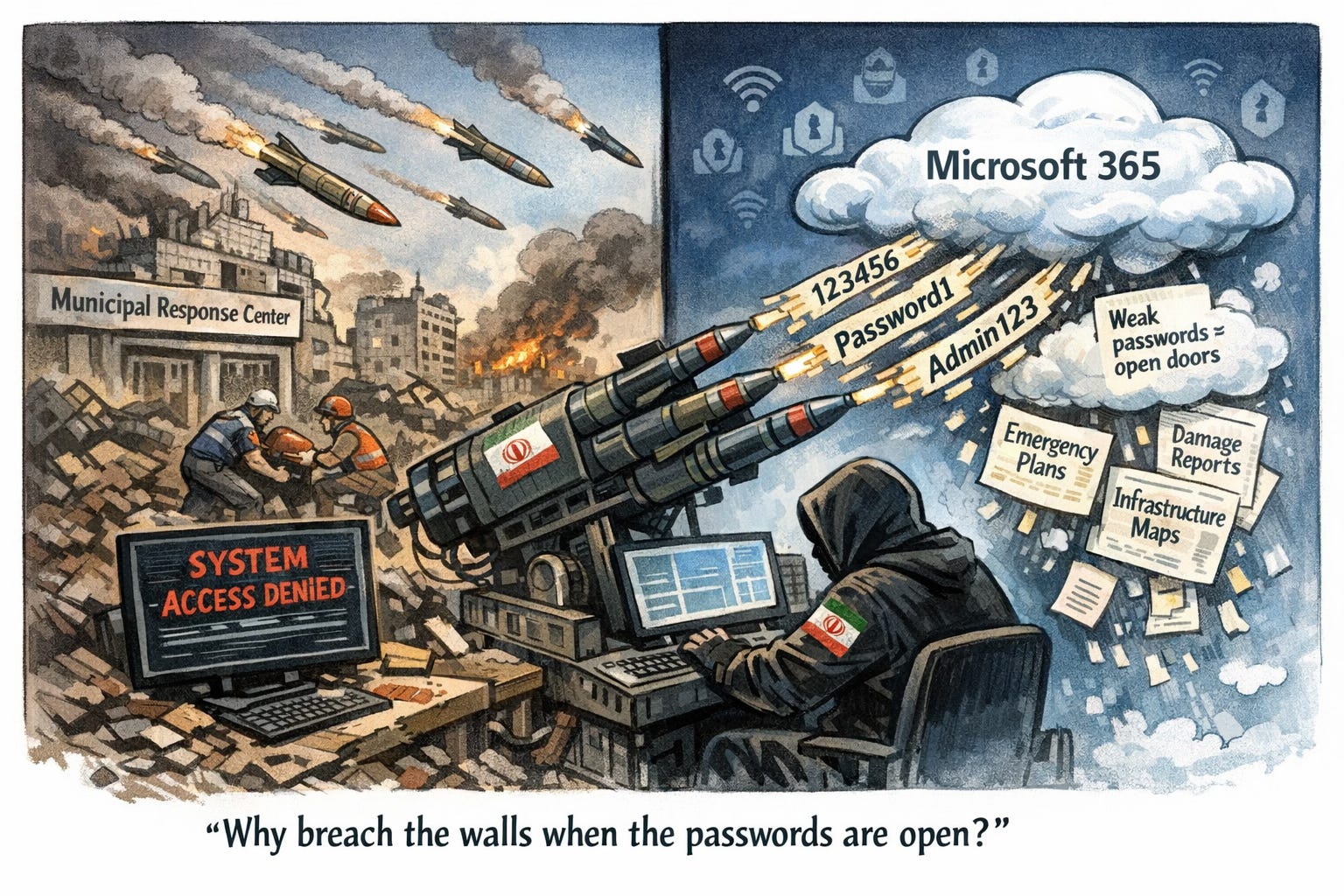
Iran-Linked Password Spraying Campaign Targets Microsoft 365, Tied to Kinetic Operations
Bottom Line Up Front (BLUF): Iran-linked threat actors conducted a multi-wave password spraying campaign against Microsoft 365 tenants, primarily targeting municipalities in Israel and the UAE. The activity shows strong correlation with missile strikes, indicating cyber operations may be supporting real-world military objectives.
Analyst Comments: Password spraying isn’t sophisticated—but it doesn’t need to be. In cloud environments, identity is the perimeter. If MFA isn’t enforced everywhere, attackers will find a way in. What elevates this campaign is timing and target selection. Municipalities are a strategic choice. These environments contain operational data—damage reports, emergency response coordination, infrastructure status—that’s directly useful for situational awareness. The correlation with missile strikes suggests this isn’t just opportunistic access; it’s intelligence collection supporting battlefield assessment. The tradecraft is disciplined: Tor rotation, VPN geo-masquerading to appear local, and user-agent spoofing to blend into normal traffic. Nothing novel individually, but combined, it reduces detection friction significantly.
READ THE STORY: GBhackers
Axios Supply Chain Attack Delivers Cross-Platform RAT via Malicious Package Versions
Bottom Line Up Front (BLUF): Attackers compromised the Axios npm package by hijacking a maintainer account, publishing malicious versions that deployed a cross-platform remote access trojan. Given Axios’ massive install base (100M+ weekly downloads), this incident represents a high-impact software supply chain attack with potential widespread downstream compromise.
Analyst Comments: This is a confirmed, real-world supply chain compromise with active malware delivery. Exploitation requires no technical skill from the attacker beyond dependency poisoning—developers and automated systems perform execution during package installation. The scale of Axios usage makes this a high-impact, ecosystem-level threat.
READ THE STORY: Cyberpress
CUPS RCE Chain (CVE-2026-34980, CVE-2026-34990)
Bottom Line Up Front (BLUF): Two vulnerabilities in the widely deployed CUPS printing system can be chained to achieve unauthenticated remote code execution and root-level file overwrite on affected systems. While exploitation requires specific configurations, the ubiquity of CUPS across Linux and Unix environments gives this flaw significant potential impact.
Analyst Comments: CUPS is everywhere. It’s default on most Linux distros and macOS, and often quietly exposed in enterprise environments where network printing is enabled. That “shared PostScript queue” requirement sounds niche, but in corporate networks, it’s actually pretty normal.
READ THE STORY: The Register
Flowise AI Platform (CVE-2025-59528) Under Active Exploitation, Exposes 12,000+ Instances to Full RCE
Bottom Line Up Front (BLUF): (CVSS 10.0) remote code execution vulnerability in the Flowise AI agent platform is being actively exploited in the wild. The flaw allows attackers with minimal access (API token) to execute arbitrary code on exposed servers, with over 12,000 internet-facing instances at risk.
Analyst Comments: Threat actors are actively exploiting a critical vulnerability in the Flowise AI platform that allows arbitrary code execution via unsafe parsing of user-supplied configuration. The flaw enables access to system-level functions, including command execution and file system operations, leading to full compromise. Over 12,000 exposed instances increase the likelihood of opportunistic exploitation, with activity already observed from identified infrastructure.
READ THE STORY: THN
Ninja Forms RCE (CVE-2026-0740) Exposes 50,000+ WordPress Sites to Full Server Compromise
Bottom Line Up Front (BLUF): A critical unauthenticated file upload vulnerability (CVE-2026-0740) in the Ninja Forms File Upload plugin allows attackers to achieve remote code execution on WordPress sites. With over 50,000 active installations affected, the flaw presents a large, easily exploitable attack surface for mass compromise.
Analyst Comments: Exploitation is straightforward and requires no authentication. The vulnerability enables arbitrary file upload and path traversal, leading directly to remote code execution. Given the large install base and simplicity of the attack chain, rapid mass exploitation is highly likely (if not already underway).
READ THE STORY: GBhackers
Items of interest
DarkSword Leak Forces Apple to Patch iOS 18 Devices Outside Normal Policy
Bottom Line Up Front (BLUF): Apple issued an unusual backported patch to fix the DarkSword exploit chain on iOS 18 devices after the tool leaked publicly, expanding protection beyond its typical patch scope. The move reflects the severity of the threat and the growing accessibility of advanced mobile exploitation frameworks.
Analyst Comments: DarkSword patches to iOS 18 devices after the exploit chain leaked publicly, breaking from its typical update policy that excludes upgrade-capable devices not on the latest OS. Researchers note the exploit is harder to detect than previous chains because it avoids full device rooting while still achieving meaningful privilege escalation. The leak has already led to observed campaigns, including phishing activity and broader experimentation by threat actors.
READ THE STORY: DR
iVerify CEO Rocky Cole explains ‘DarkSword’ iPhone hack and rising mobile threats (Video)
FROM THE MEDIA: iVerify CEO Rocky Cole joins ChicagoLIVE to break down newly discovered mobile attacks like “DarkSword” and how hackers are increasingly targeting smartphones. He explains how these threats work, why they’re becoming more common, and what users can do to better protect their personal data.
Russian Hackers Target Ukrainians with Advanced iPhone Spyware: Darksword Explained (Video)
FROM THE MEDIA: Discover how a new advanced hacking toolkit called Darksword is being used by suspected Russian hackers to steal personal data and cryptocurrency from Ukrainians. Learn about the similarities and differences between Darksword and the previously uncovered Coruna toolkit. Understand the implications of these stealthy and powerful spyware tools for iPhone users worldwide. This video breaks down the technical details, the potential motivations behind the attacks, and what you can do to protect yourself from such threats. Stay informed and secure in the digital age.
The selected stories cover a broad range of cyber threats and are intended to help readers frame key publicly discussed threats and improve overall situational awareness. InfoDom Securities does not endorse any third-party claims made in its original material or related links on its sites; the opinions expressed by third parties are theirs alone. For further questions, don't hesitate to get in touch with InfoDom Securities at dominanceinformation@gmail.com.