
Daily Drop (1269)
03-31-26

Tuesday, Mar 31, 2026 // (IG): BB // Ghostwire
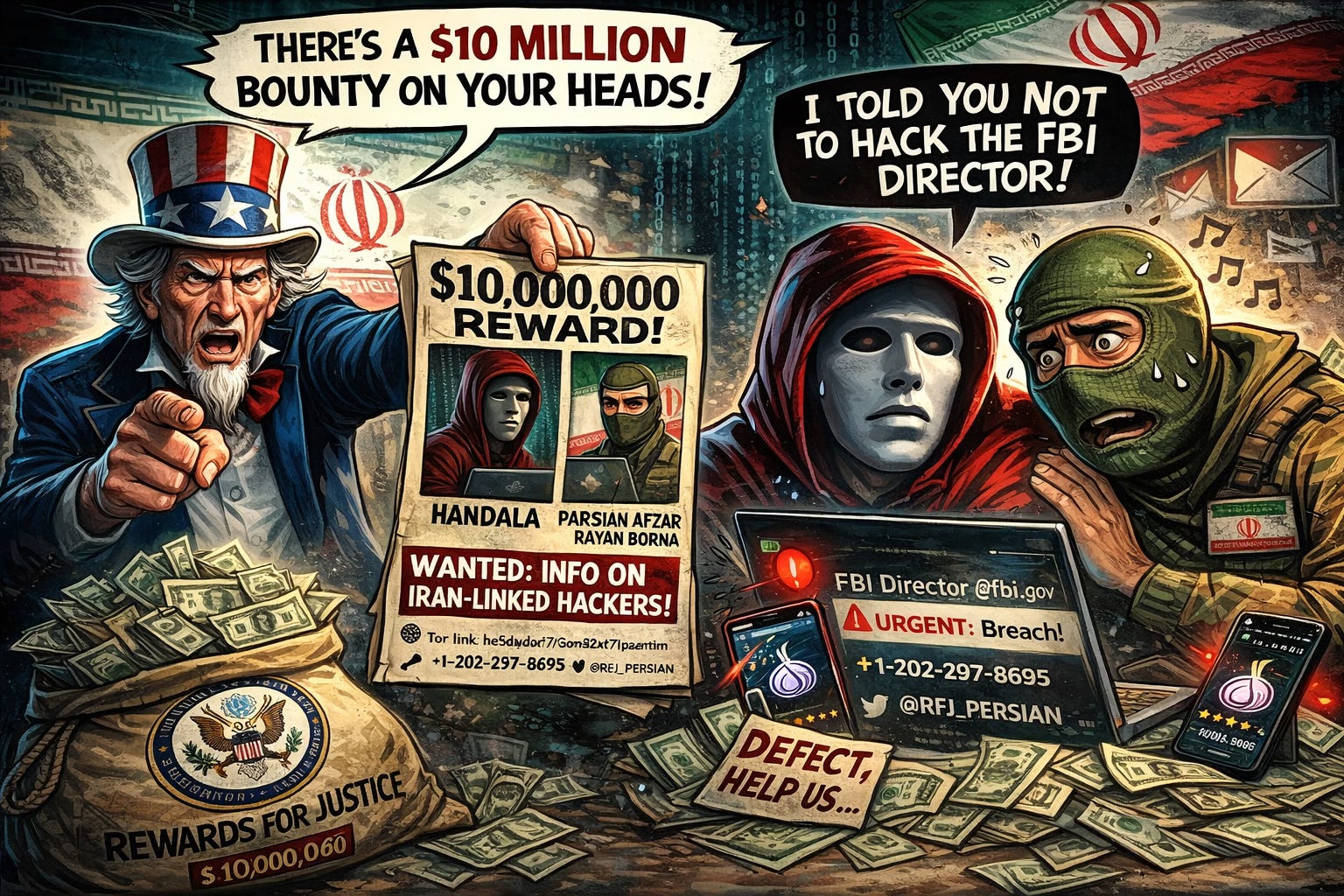
U.S. Reissues $10M Bounty on Iranian Hackers Following Breach of FBI Director’s Email
Bottom Line Up Front (BLUF): The U.S. State Department has reissued a $10 million reward for information on Iranian-linked hackers, specifically naming the Handala group and an associated IT firm, following a confirmed breach of FBI Director Kash Patel’s personal email. The move signals escalating U.S. response to ongoing Iranian cyber operations.
Analyst Comments: This is less about the money and more about signaling. Reissuing—and refining—the reward right after a high-profile compromise is a clear message: the U.S. is prioritizing attribution and disruption of Iranian cyber actors. Handala isn’t new, but it’s becoming more visible and aggressive. Public data leaks, targeting officials, and claiming high-impact attacks all fit a pattern of influence + disruption. Whether every claim is real is secondary—the narrative impact still matters.
READ THE STORY: The Record
China-Iran Intelligence Ties Resurface as Cyber Conflict Echoes Stuxnet Era
Bottom Line Up Front (BLUF): Emerging analysis suggests a potential revival of intelligence cooperation between China and Iran, rooted in historical cyber and espionage exchanges dating back to Stuxnet. While current collaboration remains opportunistic rather than formalized, ongoing geopolitical tensions could drive deeper coordination in cyber operations and counterintelligence.
Analyst Comments: Analysis highlights historical ties between Iran and China in cyber and intelligence operations, including a theory that Iran shared knowledge of CIA communication methods with China following investigations into the Stuxnet attack. China has since expanded its counterintelligence posture through internal purges, centralized security reforms, and increased surveillance capabilities, while continuing offensive cyber operations such as infrastructure-focused campaigns.
READ THE STORY: Dominion Theory
Bejing’s Five-Year Plan Signals Expansion of Offensive Cyber and Tech Sovereignty
Bottom Line Up Front (BLUF): China’s latest Five-Year Plan outlines a strategic expansion of cyber capabilities focused on offensive operations, domestic tech independence, and tighter state control over data and infrastructure—indicating continued long-term investment in cyber as a core instrument of national power.
Analyst Comments: Analysis of China’s Five-Year Plan highlights a strategic focus on advancing domestic technological capabilities, reducing dependence on foreign systems, and strengthening control over data and digital infrastructure. The plan emphasizes cybersecurity as a national priority, integrating it into economic development, national security, and governance frameworks. It also signals continued investment in offensive cyber capabilities and intelligence operations, alongside tighter regulation of private sector technology companies and cross-border data flows.
READ THE STORY: ASPI
Xi Quietly Bolsters Iran Through Intelligence, Cyber Support, and Strategic Investments
Bottom Line Up Front (BLUF): China is providing discreet but meaningful support to Iran through intelligence sharing, cyber defense capabilities, and strategic economic ties, aiming to preserve Tehran’s stability amid external pressure. This reflects a broader effort by Beijing to secure its geopolitical and economic interests while countering Western influence.
Analyst Comments: Reports indicate China is quietly supporting Iran through intelligence cooperation, including sharing insights on foreign espionage efforts and strengthening Tehran’s counterintelligence capabilities. Chinese entities are also believed to be providing advanced cyber defense and surveillance technologies to help Iran protect critical infrastructure and detect covert operations. This support is driven by strategic interests, including Iran’s role in the Belt and Road Initiative and its importance for China’s energy security and regional influence.
READ THE STORY: Republic World
Dutch Ministry of Finance Takes Treasury Systems Offline Following Cyber Intrusion
Bottom Line Up Front (BLUF): The Dutch Ministry of Finance has taken its treasury banking portal offline after detecting unauthorized access to internal systems, impacting ~1,600 public entities. While core tax and public services remain operational, the incident reflects a significant breach of government financial infrastructure with ongoing investigation.
Analyst Comments: Taking a treasury system offline is not a small decision. That’s a high-confidence containment move, which suggests the intrusion had enough credibility—or potential impact—to justify immediate disruption. The scope is interesting: limited to internal systems tied to “policy department” processes, not core tax infrastructure. That could mean segmentation worked as intended, or it could mean the attackers hadn’t pivoted far enough yet. Either way, isolating the treasury portal cuts off a high-value target before things escalate.
READ THE STORY: SA
Apple Subsidiary Fined for Sanctions Breach After Payments to Russian Service
Bottom Line Up Front (BLUF): A UK regulator fined Apple Distribution International (ADI) £390,000 for violating Russia sanctions after it processed £635,000 in payments to a streaming service linked to a sanctioned entity. The case underscores how even indirect exposure—via third parties or recent ownership changes—can trigger enforcement risk.
Analyst Comments: This isn’t a story about Apple skirting sanctions—it’s about how easy it is to get caught in the gray space of ownership, timing, and incomplete intelligence. The key detail: the payments happened just days after the recipient became tied to a sanctioned entity. That’s the kind of edge case compliance teams struggle with. The bigger issue is reliance on third-party screening and static due diligence. OFSI is signaling that “we didn’t know” isn’t a strong defense when the information was publicly available, even if obscure. That raises the bar: organizations need continuous monitoring of ownership changes, not just point-in-time checks.
READ THE STORY: The Guardian
U.S. Lagging in Drone and Cyber Defense as Adversaries Exploit Emerging Warfare Technologies
Bottom Line Up Front (BLUF): New analysis warns that the U.S. is underestimating the combined threat of drone warfare and cyber operations, as adversaries like China, Russia, and Iran demonstrate the ability to penetrate sensitive targets, gather intelligence, and potentially disrupt critical infrastructure with relatively low-cost technologies.
Analyst Comments: The convergence of cheap drones + persistent cyber access is reshaping what “power projection” looks like, and the U.S. is still optimized for a different era. The Barksdale incident is the clearest example. Unknown drones loitering over a strategic bomber command base for hours isn’t just a curiosity—it’s reconnaissance. That’s adversaries probing defenses, collecting telemetry, and mapping response times. If this were prep work for a real conflict, it worked. Same story on the cyber side with campaigns like Salt Typhoon. Long-term access to telecom infrastructure isn’t about immediate disruption—it’s about pre-positioning. When combined with physical systems (drones, EW, missiles), that’s where things get serious.
READ THE STORY: FP
Kremlins Electronic Warfare Diverts Ukrainian Drone Into NATO Airspace: Spillover Risk Expands Beyond Battlefield
Bottom Line Up Front (BLUF): Russian electronic warfare (EW) systems likely diverted Ukrainian strike drones into Finnish airspace, causing multiple crashes and prompting a diplomatic response. The incident highlights how contested electromagnetic environments can unintentionally push kinetic effects across borders—raising escalation risks involving NATO territory.
Analyst Comments: EW is designed to disrupt, jam, and spoof—but it’s inherently imprecise. When you interfere with navigation systems at scale, you’re not just stopping drones—you’re redirecting them unpredictably. That creates a new category of risk: unintentional cross-border kinetic spillover. From a national security standpoint, this matters for two reasons. First, attribution gets messy fast. A drone crashes in Finland—was it Ukraine, Russia, or EW side effects? That ambiguity compresses decision timelines for NATO. Second, it exposes how fragile drone guidance systems remain under heavy EW pressure, even for relatively advanced platforms.
READ THE STORY: United24
Drone and Defense Exports to Gulf from the Ukraine: Combat-Proven Capabilities Enter Global Market
Bottom Line Up Front (BLUF): Ukraine is formalizing 10-year defense agreements with Gulf states to export drones, air defense systems, and battlefield expertise—including maritime drone operations to secure the Strait of Hormuz. This marks a major shift from wartime innovation to global proliferation, introducing advanced, combat-tested capabilities into one of the world’s most volatile regions and directly intersecting with critical energy infrastructure.
Analyst Comments: This is where Ukraine’s wartime innovation cycle turns into a global security variable. What was developed out of necessity is now becoming an صادرات pipeline—hardware, software, and operational doctrine bundled together. The Strait of Hormuz piece is the headline risk. You’re talking about deploying Ukrainian naval drone concepts—originally used to challenge the Russian Black Sea Fleet—into a chokepoint that handles roughly 20% of global oil flow. That’s not مجرد defensive support; it’s the introduction of asymmetric maritime warfare tools into a high-stakes economic artery..
READ THE STORY: The Kyiv Independent
Europe Accelerates Anti-Drone Rearmament: Ukraine War Drives Mass Production of Skynex Systems
Bottom Line Up Front (BLUF): Germany is scaling production of Skynex and Skyranger air defense systems to counter drone threats modeled on lessons from Ukraine, with output expected to reach up to 400 units annually. This reflects a broader shift in European defense posture toward counter-UAS capabilities, signaling that low-cost drone warfare is reshaping air defense priorities and procurement at scale.
Analyst Comments: This is the other side of the drone proliferation story: adaptation. What Ukraine proved on the battlefield—cheap drones overwhelming expensive defenses—is now forcing a doctrinal reset across Europe. Skynex isn’t just another air defense system. It represents a shift back to gun-based, cost-efficient interception. When your adversary is launching $20K drones, firing million-dollar missiles stops making sense. Եվրոպ is relearning that math in real time. The scale-up is the key signal. Going from ~200 systems per year to ~400 isn’t incremental—it’s mobilization. And the fact that multiple countries are expanding production lines tells you this isn’t just about Ukraine; it’s about homeland defense across NATO.
READ THE STORY: United24
Google Rolls Out AI-Driven Ransomware Detection and One-Click Recovery for Drive
Bottom Line Up Front (BLUF): Google has made its AI-powered ransomware detection and bulk file restoration features for Google Drive generally available, enabling automatic attack detection, sync interruption, and rapid recovery without paying ransom. The update significantly improves detection rates and gives organizations a built-in rollback capability.
Analyst Comments: The key innovation here isn’t just detection—it’s interrupting the blast radius. Pausing sync when encryption behavior is detected is the real control. That cuts off ransomware’s ability to overwrite clean cloud backups with encrypted junk, which is exactly how most victims end up stuck. The “14x better detection” claim is worth taking with some skepticism (vendor math is always fuzzy), but the architectural shift is solid: behavior-based detection at the endpoint + automated containment + native rollback.
READ THE STORY: CyberPress
AI-Discovered Zero-Days in Vim and Emacs Signal New Era of Low-Barrier Exploit Discovery
Bottom Line Up Front (BLUF): Researchers demonstrated that a simple prompt to an AI model (Claude) was sufficient to uncover critical zero-day RCE vulnerabilities in Vim and Emacs. One flaw is already patched (Vim), while the Emacs issue remains unpatched and disputed, highlighting both the speed and disruption AI brings to vulnerability discovery.
Analyst Comments: This is the kind of story that sounds overhyped—until you look at the mechanics. The important part isn’t “AI found bugs.” That’s been happening. It’s how little effort it took. A single, vague prompt leading to a working RCE chain in widely used tools is a big deal. That compresses what used to take days or weeks of manual auditing into something much closer to interactive exploration. The Vim bug is a good example of how subtle logic flaws still slip through mature codebases. Sandbox bypass via missing security checks isn’t new—but finding it this quickly is.
READ THE STORY: CyberPress
Axios Supply Chain Attack Delivers Cross-Platform RAT via Compromised npm Maintainer Account
Bottom Line Up Front (BLUF): Attackers compromised the npm account of an Axios maintainer and published malicious package versions that injected a trojanized dependency, deploying a cross-platform RAT on Windows, macOS, and Linux. With Axios seeing ~83 million weekly downloads, this represents a high-impact supply chain compromise with broad downstream risk.
Analyst Comments: No tampering with Axios source code means most traditional review processes would miss it. The real pivot point was the maintainer account compromise. Once attackers had publish access, they didn’t need to break CI/CD—they became the trusted publisher. That’s the failure point that matters. The use of a postinstall script is key. It guarantees execution in developer and CI environments automatically, which is exactly where secrets, tokens, and build artifacts live. This is high-value access.
READ THE STORY: THN
An App called Dangerzone Gains Traction as Practical Defense Against Malicious Documents
Bottom Line Up Front (BLUF): Dangerzone, an open-source tool backed by security-focused developers, is gaining attention for its ability to safely open potentially malicious PDFs and Office documents by converting them into sanitized formats inside isolated containers. It directly addresses a persistent initial access vector: weaponized documents.
Analyst Comments: Malicious documents are still one of the most reliable entry points—phishing attachments, weaponized PDFs, booby-trapped Word docs. And despite years of awareness, users still open them. Dangerzone’s approach is straightforward: treat every document as hostile, render it in isolation, and output something inert (typically a PDF). No macros, no embedded scripts, no active content. That’s a strong defensive pattern—essentially content disarm and reconstruction (CDR), but implemented locally and transparently.
READ THE STORY: Wired
Silver Fox Expands Asia Campaign with New AtlasCross RAT and Large-Scale Typosquatting Infrastructure
Bottom Line Up Front (BLUF): The Silver Fox threat group is actively expanding operations across Asia using a new remote access trojan (AtlasCross RAT) delivered via fake domains impersonating trusted software. The campaign combines social engineering, signed malware, and advanced evasion techniques to target enterprise users and enable long-term access, data theft, and financial fraud.
Analyst Comments: This is a mature campaign, not a smash-and-grab. Silver Fox is blending classic tradecraft (typosquatting, phishing) with increasingly capable tooling—and doing it at scale. The domain strategy stands out. Registering multiple lookalike domains in a single day and impersonating high-trust apps (Zoom, Teams, Signal, VPNs, crypto tools) is a deliberate attempt to own the “download path.” That’s where a lot of orgs still have weak controls. AtlasCross RAT itself is a step up. The integration of the PowerChell framework—effectively embedding a PowerShell execution engine while disabling AMSI and logging—is a direct move to evade endpoint defenses. Add ChaCha20-encrypted C2 and targeted interference with Chinese security tools, and this is clearly designed to survive in monitored environments.
READ THE STORY: THN
Claude Code “Leak” Incidents Highlight AI Agent Supply Chain and Front-End Exposure Risks
Bottom Line Up Front (BLUF): Recent “Claude Code leakage” incidents are not a single critical vulnerability but a pattern of front-end exposure and DevOps misconfigurations amplified by AI coding agents. The result is supply chain-style data leakage, where sensitive code, tokens, and internal logic are unintentionally exposed through tooling, integrations, and weak deployment practices.
Analyst Comments: This is being framed as a “leak,” but that’s misleading. What we’re really seeing is the collision of AI agents with immature security practices around them. AI coding tools dramatically expand the attack surface—pulling in repos, APIs, logs, and secrets—while many teams are still treating them like isolated dev tools instead of privileged automation layers.
READ THE STORY: FreeBuf (CN proxy needed)
OT Security Starts with Asset Visibility—But Most Organizations Still Get It Wrong
Bottom Line Up Front (BLUF): Effective OT (Operational Technology) cybersecurity depends on accurate asset inventory, yet many organizations lack visibility into their industrial control systems. Unlike IT environments, OT requires specialized inventory approaches due to legacy systems, safety constraints, and limited scanning tolerance.
Analyst Comments: Everyone wants detection, threat intel, and shiny dashboards, but if you don’t know what assets exist in your OT environment, none of that works reliably. OT asset inventory is fundamentally different from IT. You can’t just run aggressive scans across a PLC network without risking disruption. Many devices are fragile, undocumented, or decades old. That forces a more passive, methodical approach—network monitoring, protocol analysis, and careful mapping.
READ THE STORY: Medium
“Thinking Tokens” Introduce New Denial-of-Wallet Risk in AI Applications
Bottom Line Up Front (BLUF): Reasoning-based AI models introduce a new attack surface where adversaries can inflate operational costs by triggering excessive “thinking tokens,” leading to denial-of-wallet attacks. Research shows that cheaper-listed models can cost significantly more in practice due to unpredictable internal token consumption.
Analyst Comments: This is one of the more underappreciated risks in AI adoption—and it’s very real. We’ve spent years thinking about denial-of-service in terms of CPU, memory, and bandwidth. Now it’s billing logic. The key issue: reasoning models generate hidden “thinking tokens” (chain-of-thought), and those tokens are often billed at output rates. That creates a gap between expected and actual cost—and attackers can exploit that gap without doing anything obviously malicious.
READ THE STORY: Medium
Citrix NetScaler Zero-Day Exploited Within Days: Session Hijacking Risk for Enterprise Edge Devices (CVE-2026-3055, CVSS 9.3)
Bottom Line Up Front (BLUF): Malicious actors are using link-shortening services (e.g., TinyURL) to distribute and monetize a working exploit for CVE-2026-3055 via crypto-based marketplaces. This adds an obfuscation layer to exploit delivery, increases reach, and signals transition from niche circulation to broader, semi-public distribution—further accelerating the risk of mass exploitation.
Analyst Comments: A TinyURL preview page reveals a redirect to a SatoshiDisk listing offering a CVE-2026-3055 exploit package (Python script, README, requirements) for Bitcoin payment. The redirect mechanism obscures the final destination and enables flexible, trackable distribution of exploit tooling. This activity aligns with ongoing public PoC releases and underground sales, confirming active weaponization and increasing accessibility of the vulnerability.
READ THE STORY: SecurityWeek
Fortinet FortiClient EMS SQLi (CVE-2026-21643) Actively Exploited as Public PoC Enables Mass Scanning
Bottom Line Up Front (BLUF): A critical pre-auth SQL injection in FortiClient EMS 7.4.4 (CVE-2026-21643) is now being actively exploited, with public PoC code and Nuclei templates enabling low-skill attackers to scan and compromise exposed systems at scale. The flaw allows unauthenticated remote code execution and full database access.
Analyst Comments: This is moving fast—public PoC plus confirmed exploitation is the combination that turns a “critical vuln” into an incident response problem overnight. The /api/v1/init_consts endpoint is the weak point here. It’s exposed pre-auth, returns verbose database errors, and lacks lockout protections. That’s basically ideal conditions for error-based SQLi, which is exactly what the PoC code is leveraging. The time-based vector on /auth/signin is secondary—but still useful if defenders try to suppress error leakage without fixing the root issue.
READ THE STORY: SecurityWeek
Items of interest
Malware (GhostSocks) Turns Infected Devices into Residential Proxy Network for Stealth Operations
Bottom Line Up Front (BLUF): GhostSocks is an emerging malware offering that converts compromised systems into SOCKS5 residential proxy nodes, allowing attackers to route malicious traffic through legitimate IP addresses. This significantly degrades traditional detection methods and is already being used alongside Lumma Stealer and by ransomware operators to maintain persistence and evade attribution.
Analyst Comments: This is less about a “new malware family” and more about a shift in attacker infrastructure. GhostSocks operationalizes something threat actors have wanted for years at scale—cheap, rotating residential IP space that blends in by default. That’s a problem because most defenses still treat IP reputation as a meaningful signal. The integration with Lumma Stealer is the real story. Credential theft gets initial access; GhostSocks turns that access into long-term infrastructure. That’s efficient tradecraft. Add TLS-wrapped SOCKS5 traffic and relay-based C2, and you’re looking at activity that won’t trip many traditional controls.
READ THE STORY: GBhackers
He Hunts Malware for a living. Here’s what he’s most afraid of (Video)
FROM THE MEDIA:
Bogdan Botezatu, the Director of Threat Research at Bitdefender. He revealed something terrifying: The biggest threat in cybersecurity isn’t the malware we see; it’s everything hiding beneath the surface. He breaks down how modern threats actually emerge, from stealthy APT malware that stays invisible for years, to the rise of info-stealers that harvest passwords and cookies at scale. He also explains why your smart home might be the weakest point in your entire network.
Infostealer Malware Logs Analyzed by... AI ! (Video)
FROM THE MEDIA: Manage threat intelligence and your exposed attack surface with Flare!
The selected stories cover a broad range of cyber threats and are intended to help readers frame key publicly discussed threats and improve overall situational awareness. InfoDom Securities does not endorse any third-party claims made in its original material or related links on its sites; the opinions expressed by third parties are theirs alone. For further questions, don't hesitate to get in touch with InfoDom Securities at dominanceinformation@gmail.com.