
Daily Drop (1267)
03-27-26

Friday, Mar 27, 2026 // (IG): BB // Ghostwire
US Alleges China’s SMIC Supplied Chipmaking Tech to Iran’s Military Sector
Bottom Line Up Front (BLUF): U.S. officials claim China’s largest chipmaker, SMIC, has been supplying semiconductor manufacturing tools and technical support to Iran’s military-industrial complex. If accurate, this signals a significant escalation in tech transfer risks, with potential implications for sanctions enforcement, regional conflict dynamics, and global semiconductor supply chain controls.
Analyst Comments: U.S. officials allege that SMIC, China’s leading semiconductor manufacturer, has been supplying chipmaking equipment to Iran’s military sector for roughly a year, potentially including technical training. The tools are believed to support Iran’s broader military-industrial complex, though specific applications have not been disclosed. The report comes amid heightened geopolitical tensions tied to ongoing conflict involving Iran, as well as longstanding U.S. efforts to restrict China’s access to advanced semiconductor technology.
READ THE STORY: Cybernews
China Warns on Deepfake Manipulation Risks as Forescout Flags Emerging High-Risk Connected Devices
Bottom Line Up Front (BLUF): China’s Ministry of State Security is warning that “deepfake modification” techniques are becoming a national security concern, with potential use in fraud, disinformation, and espionage. At the same time, Forescout’s 2026 report highlights a growing attack surface in non-traditional connected devices—signaling that threat actors are expanding beyond endpoints into poorly secured operational and embedded systems.
Analyst Comments: Deepfake tooling has moved well past novelty. What’s notable isn’t just realism—it’s adaptability. “魔改” (modified/manipulated) content suggests adversaries are combining generative AI with targeted social engineering, tailoring lures for specific individuals or organizations. That’s where this shifts from misinformation problem to operational risk—think voice cloning for BEC, synthetic video for executive impersonation, or influence ops that are harder to attribute and faster to deploy.
READ THE STORY: 4hou
Beijing Tightens Controls on Autonomous AI (“OpenClaw”) in Financial Sector Over Security Risks
Bottom Line Up Front (BLUF): Chinese regulators are moving aggressively to restrict the use of autonomous AI agents like “OpenClaw” in financial systems, citing risks including prompt injection, plugin supply chain attacks, and unauthorized transactions. The response signals a broader shift: AI agents with operational authority are now treated as high-risk infrastructure, not just software tools.
Analyst Comments: Chinese authorities, including the Ministry of Industry and Information Technology and national cybersecurity bodies, issued coordinated warnings about risks in autonomous AI systems like OpenClaw. Identified threats include prompt injection, malicious plugins, excessive permissions, and potential for erroneous or unauthorized financial transactions. Financial regulators have explicitly prohibited the deployment of uncertified autonomous AI tools in core business processes involving funds or sensitive customer data. The concern centers on AI systems with high privileges, unclear functional boundaries, and insufficient auditability, which could lead to account compromise or systemic failures.
READ THE STORY: Anquanke
AI-Powered Mobile Forensics System Automates Full Device Extraction with Minimal Human Input
Bottom Line Up Front (BLUF): A new AI-driven mobile forensics platform (AI-6200) claims to fully automate smartphone data extraction, reducing manual intervention to under one minute. The system leverages computer vision, automated interaction, and decision logic to bypass traditional bottlenecks in forensic workflows—highlighting both efficiency gains and potential security/privacy implications.
Analyst Comments: Chinese vendor Meiya Pico introduced the AI-6200, described as the first L4-level fully automated mobile phone forensic system. The platform integrates visual recognition, intelligent control, and high-speed data transfer to autonomously perform tasks such as enabling USB debugging, handling pop-ups, and entering credentials during evidence extraction. The system can dynamically switch extraction methods (e.g., direct connection to wireless cloning) based on device conditions, ensuring continuous data acquisition without manual intervention. It also logs all actions with timestamps and video recording to maintain evidentiary integrity.
READ THE STORY: 4hou
US Maintains Venezuela Sanctions Framework Despite “Easing” Narrative
Bottom Line Up Front (BLUF): Despite media reporting suggesting relaxed U.S. sanctions on Venezuela, the underlying sanctions regime remains fully intact. Limited relief has been implemented through revocable licensing mechanisms, preserving economic pressure while enabling selective commercial activity—primarily benefiting foreign firms rather than materially improving conditions on the ground.
Analyst Comments: What’s being framed as “easing” is really a transition to a more flexible sanctions model—one that keeps pressure on while allowing controlled economic engagement. OFAC licensing is the key lever here: واش it doesn’t remove restrictions, it just grants temporary exceptions. That gives Washington two advantages—continued leverage over Caracas and optionality for Western companies looking to re-enter Venezuelan markets. From a strategic standpoint, this hybrid model is more टिकाऊ than full isolation. Pure sanctions tend to push targets toward alternative systems (China, روسيا, informal economies). Licensing, on the other hand, creates dependency and uncertainty—access can be revoked at any time, which keeps both governments and corporations aligned with U.S. policy objectives.
READ THE STORY: Counterpunch
Iran Built for Resilience, Not Parity, Against U.S. “Shock-and-Awe” Warfare
Bottom Line Up Front (BLUF): Iran’s ability to withstand sustained U.S. and Israeli strikes is not a surprise—it is the result of a deliberate, decades-long strategy focused on decentralization, redundancy, and asymmetric response. The conflict exposes a persistent flaw in U.S. military assumptions: early battlefield dominance does not guarantee rapid strategic collapse of adaptive adversaries.
Analyst Comments: Tehran didn’t try to match U.S. القوة; it studied it. After watching campaigns in Iraq, Afghanistan, and Libya, Iran optimized for survivability under decapitation strikes, not conventional victory. That means distributed command structures, redundant systems, and the ability to keep operating even when leadership and communications are degraded.
READ THE STORY: Just Security
Drone Strike Hits Suspected Russian Shadow Fleet Tanker Near Bosphorus
Bottom Line Up Front (BLUF): A drone strike damaged a tanker linked to Russia’s sanctions-evading “shadow fleet” just 15 nautical miles from the Bosphorus Strait, a critical global النفط chokepoint. While attribution remains unclear, the incident signals continued expansion of maritime drone operations targeting energy logistics tied to Russia’s war economy.
Analyst Comments: The Bosphorus is one of the most sensitive maritime chokepoints in the world. Hitting a tanker that close—regardless of attribution—is a message: energy flows tied to Russia are no longer safe even near NATO-adjacent waters. That raises the سقف risk for spillover, miscalculation, or escalation involving third-party states like Turkey. The “shadow fleet” angle matters too. These vessels operate in the gray zone—flags of convenience, opaque ownership, санкции evasion. That makes them attractive targets: economically valuable, politically deniable. We’ve already seen repeated Ukrainian interest in maritime drone warfare; this fits the pattern of targeting logistics rather than just military assets.
READ THE STORY: United24
A551 Botnet Operator Sentenced as Initial Access Ecosystem Remains Intact
Bottom Line Up Front (BLUF): A Russian national tied to the TA551 botnet has been sentenced to two years in prison for enabling ransomware campaigns that generated over $14 million in extortion. The case highlights law enforcement progress—but also reinforces that initial access broker (IAB) ecosystems powering ransomware remain active and resilient.
Analyst Comments: A Russian national, Ilya Angelov, was sentenced to two years in prison and fined $100,000 for his role in operating the TA551 botnet, which distributed malware via phishing campaigns and enabled ransomware attacks against U.S. organizations. TA551 sold access to compromised systems to other cybercriminal groups, including the BitPaymer ransomware operators, who used the access to attack at least 72 U.S. companies and extort more than $14 million. The group also worked with malware operations such as IcedID and later collaborated with actors distributing Conti ransomware.
READ THE STORY: THN
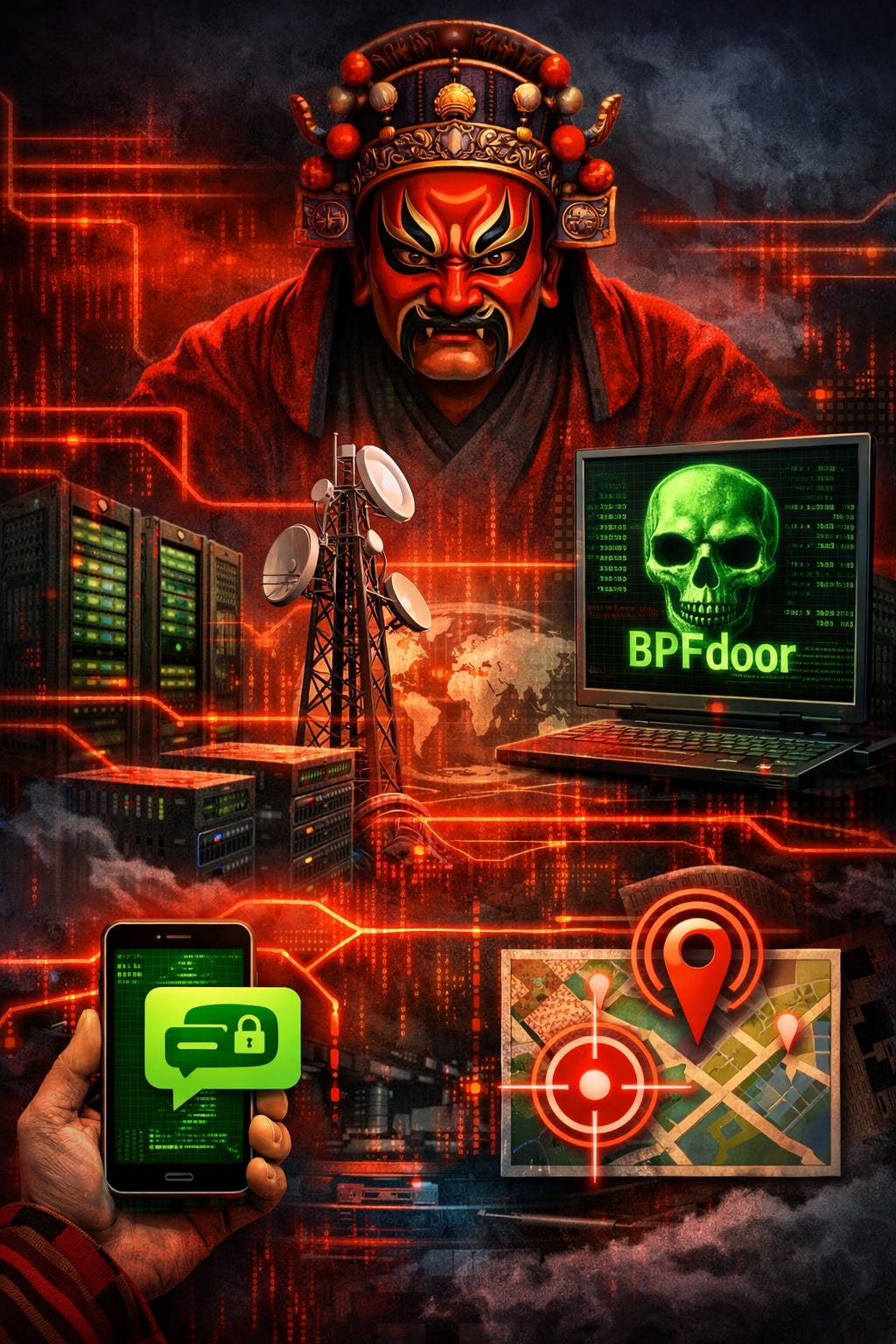
China-Linked Red Menshen Deploys BPFdoor Backdoors in Telecom Core Networks
Bottom Line Up Front (BLUF): A China-linked threat actor (Red Menshen) is deploying BPFdoor, a highly stealthy Linux kernel backdoor, to maintain long-term access inside global telecom networks. By targeting core signaling protocols and avoiding traditional detection mechanisms, the campaign enables large-scale surveillance, including SMS interception and location tracking.
Analyst Comments: Researchers report that the China-linked Red Menshen group is using BPFdoor, a kernel-level Linux backdoor that leverages Berkeley Packet Filter (BPF) functionality to passively monitor traffic and activate only upon receiving specially crafted “magic packets.” The campaign targets telecom networks by first compromising edge infrastructure, then moving laterally into core systems where signaling protocols like SCTP are used. This allows attackers to intercept communications, extract subscriber data, and track user locations.
READ THE STORY: GBhackers
Alleged RedLine Malware Developer Extradited to U.S., Faces Up to 30 Years
Bottom Line Up Front (BLUF): U.S. authorities have extradited an alleged core developer of the RedLine infostealer malware, a tool responsible for widespread credential theft globally. The case underscores continued law enforcement focus on dismantling cybercrime-as-a-service ecosystems—but also highlights how resilient and scalable these operations remain despite prior takedowns.
Analyst Comments: RedLine has been one of the most effective infostealers in circulation because it nailed the “easy button” for cybercrime: low cost, simple deployment, and high return via credential theft. The developer allegedly didn’t just write malware—he helped run the service layer behind it: infrastructure, admin panels, customer support. That’s straight-up SaaS for criminals.
READ THE STORY: The Record
CL-STA-1087 Targets Southeast Asian Military Networks with Stealthy Long-Term Espionage
Bottom Line Up Front (BLUF): A China-linked threat cluster (CL-STA-1087) has been conducting a multi-year espionage campaign against Southeast Asian military networks, leveraging custom malware, in-memory payloads, and stealth persistence techniques. The operation prioritizes long-term intelligence collection over disruption, focusing on command structures and operational planning data.
Analyst Comments: Security researchers identified an ongoing espionage campaign (tracked as CL-STA-1087) targeting Southeast Asian military organizations since at least 2020. The attackers use custom malware, delayed execution, and long dormancy periods to maintain persistence and evade detection. Key tooling includes AppleChris, a backdoor leveraging dead drop resolvers to dynamically retrieve command-and-control infrastructure, and MemFun, an in-memory malware using advanced evasion techniques such as process hollowing and reflective DLL injection.
READ THE STORY: Gbhackers
USB-Based Malware Campaign Targets Southeast Asian Government Networks with Multi-Cluster Espionage Toolkit
Bottom Line Up Front (BLUF): A coordinated cyberespionage campaign leveraged USB-propagated malware, multiple RATs, and custom loaders to infiltrate a Southeast Asian government network. The operation, attributed to China-aligned clusters, emphasizes covert persistence and intelligence collection, using removable media to bypass traditional network defenses.
Analyst Comments: Researchers observed a multi-cluster campaign targeting a Southeast Asian government network, beginning with USB-propagated malware (USBFect/HIUPAN) that spreads via removable drives and deploys the PUBLOAD backdoor for command-and-control. Additional clusters deployed a range of tools including CoolClient, Masol RAT, EggStreme loaders, and FluffyGh0st, using techniques such as DLL sideloading, in-memory execution, and encrypted communications to evade detection.
READ THE STORY: GBhackers
BRUSHWORM Malware Targets Financial Sector with USB Worming and Modular Backdoor Capabilities
Bottom Line Up Front (BLUF): Elastic Security Labs identified a targeted intrusion against a South Asian financial institution using custom malware (BRUSHWORM and BRUSHLOGGER) that combines USB-based propagation, modular payload delivery, and keylogging. Despite relatively unsophisticated code, the campaign is operationally effective—especially in restricted or air-gapped environments.
Analyst Comments: The malware supports persistence via scheduled tasks, AES-encrypted configuration, modular payload downloads, and USB-based propagation. BRUSHWORM spreads via removable drives using lure filenames (e.g., “Salary Slips.exe”) and steals a wide range of file types including documents, spreadsheets, email archives, and source code. In offline environments, it copies stolen data to USB devices for physical exfiltration.
READ THE STORY: Elastic
OpenAI Expands Safety Bug Bounty Program to Address AI-Specific Risks
Bottom Line Up Front (BLUF): OpenAI has expanded its bug bounty program to include AI safety issues such as prompt injection, model manipulation, and data leakage. The move signals a broader industry shift: AI systems are now treated as security-critical infrastructure, requiring continuous adversarial testing beyond traditional software vulnerabilities.
Analyst Comments: The initiative encourages security researchers to identify novel attack techniques specific to AI systems, beyond traditional software flaws. The program reflects increasing recognition that AI models introduce new classes of risk, particularly when integrated into enterprise tools and automated workflows. Researchers are rewarded for uncovering issues that could impact model integrity, confidentiality, or safe deployment.
READ THE STORY: HNS
Critical Kea DHCP Flaw (CVE-2026-3608) Enables Unauthenticated DoS Across Core Network Services
Bottom Line Up Front (BLUF): A high-severity vulnerability in ISC’s Kea DHCP server (CVE-2026-3608) allows unauthenticated remote attackers to crash DHCP services, potentially causing widespread network outages. While no active exploitation is reported yet, the low complexity and network-level impact make this a near-term operational risk.
Analyst Comments: DHCP is foundational. When it breaks, things don’t degrade—they stop. New devices can’t get IPs, existing ones can’t renew leases, and suddenly you’re dealing with cascading outages across enterprise or ISP environments. The vulnerability itself is straightforward: a remotely reachable stack overflow in core services with no auth required. That makes it trivial to weaponize. Even without code execution, reliable DoS against DHCP infrastructure is enough to disrupt entire networks.
READ THE STORY: CyberPress
Cisco Secure Firewall RCE Flaw (CVE-2026-20131) Actively Exploited, Grants Root Access
Bottom Line Up Front (BLUF): A critical Cisco Secure Firewall Management Center (FMC) vulnerability (CVE-2026-20131, CVSS 10.0) is being actively exploited, allowing unauthenticated remote attackers to execute code as root. With no workaround available, immediate patching is the only effective defense—especially for internet-exposed management interfaces.
Analyst Comments: The combination matters. No auth + deserialization bug + exposed management interface = mass exploitation potential. Attackers don’t need creds, phishing, or user interaction—just reachability. That makes this highly automatable and ideal for botnet-style scanning and exploitation at scale. The real risk isn’t just device takeover—it’s what sits behind it. FMC is the control plane for firewall policy. Compromise here means visibility into network flows, the ability to alter rules, disable protections, and pivot internally. In other words, this is a gateway to full network compromise, not just a single box.
READ THE STORY: CyberPress
Items of interest
AI Coding Assistants Introduce New Client-Side Attack Surface, Undermining Endpoint Security
Bottom Line Up Front (BLUF): AI coding tools like Codex, Claude Code, and Gemini are creating a new class of client-side threats by operating with high privileges on developer endpoints. Attackers can exploit configuration files, plugins, and automation features to execute malicious actions—effectively bypassing traditional endpoint defenses.
Analyst Comments: For years, security teams hardened endpoints, moved workloads to the cloud, and reduced local execution risk. AI coding agents just reversed that trend. They need deep local access—filesystems, configs, credentials—so developers grant it. That’s the hole. The real problem isn’t just vulnerabilities—it’s trust. These agents are treated like helpful assistants, not execution engines. But under the hood, they’re running commands, parsing configs, and connecting to services with minimal visibility. The config file angle is especially concerning. We’ve spent decades teaching people not to run unknown binaries—but now a .env or .toml file can trigger execution through an AI agent. That’s a mental model gap attackers will exploit hard.
READ THE STORY: DR
Spec-Driven Development: AI Assisted Coding Explained (Video)
FROM THE MEDIA: Is AI-assisted coding the future? Cedric Clyburn explores spec-driven development, a game-changing approach that combines LLMs with software development best practices. Learn how it differs from vibe coding, integrates SDLC principles, and improves coding workflows with requirements-driven precision.
rom Free to $300 the best options for AI Coding (Video)
FROM THE MEDIA: The best AI coding tools at each tier from FREE to $300.
The selected stories cover a broad range of cyber threats and are intended to help readers frame key publicly discussed threats and improve overall situational awareness. InfoDom Securities does not endorse any third-party claims made in its original material or related links on its sites; the opinions expressed by third parties are theirs alone. For further questions, don't hesitate to get in touch with InfoDom Securities at dominanceinformation@gmail.com.