
Daily Drop (1265)
03-23-26

Monday, Mar 23, 2026 // (IG): BB // Ghostwire
China’s National University Cybersecurity Competition Expands, Signals Growing Focus on “AI + Security” Talent Pipeline
Bottom Line Up Front (BLUF): China’s 19th National University Information Security Competition and 3rd “Great Wall Cup” cybersecurity contest semifinal drew over 10,000 participants across 800+ universities, reflecting rapid scaling of practical, defense-focused cybersecurity training aligned with AI-driven security demands.
Analyst Comments: The numbers matter: 800+ universities and thousands of teams means cybersecurity talent development is being industrialized. The “defense track” (防护赛) focus is also telling. Many competitions historically emphasized offensive skills (CTFs, exploitation). This is explicitly shifting toward operational defense, which aligns with real-world SOC, blue team, and infrastructure protection needs. The “数智安全” (data + AI-driven security) framing is another signal. Training is evolving alongside the threat landscape—AI, data security, and integrated systems are now core, not niche topics. From a global perspective, this highlights a widening gap: regions investing heavily in hands-on, large-scale cyber training pipelines will have a long-term advantage in both defense and offensive capability.
READ THE STORY: 4Hou
Shodan Recon Leads to Application-Layer DoS in Production Infrastructure via Hanging POST Requests
Bottom Line Up Front (BLUF): A bug bounty researcher identified a high-impact application-layer DoS vulnerability in a production system by abusing a Pike HTTP server that indefinitely hangs on POST requests. The flaw allows unauthenticated attackers to exhaust server resources with minimal effort, requiring only concurrent connections—no exploit tooling or amplification needed.
Analyst Comments: No buffer overflow, no race condition—just a missing timeout and poor request handling logic. That’s enough to take down a service.What stands out is how easily this would slip past traditional defenses. There’s no malformed traffic, no signature to catch, no volumetric spike. From a network perspective, this looks like legitimate HTTP traffic. From the server’s perspective, it’s death by a thousand paper cuts—each connection tying up a worker thread indefinitely.
READ THE STORY: InfoSecWrite-ups
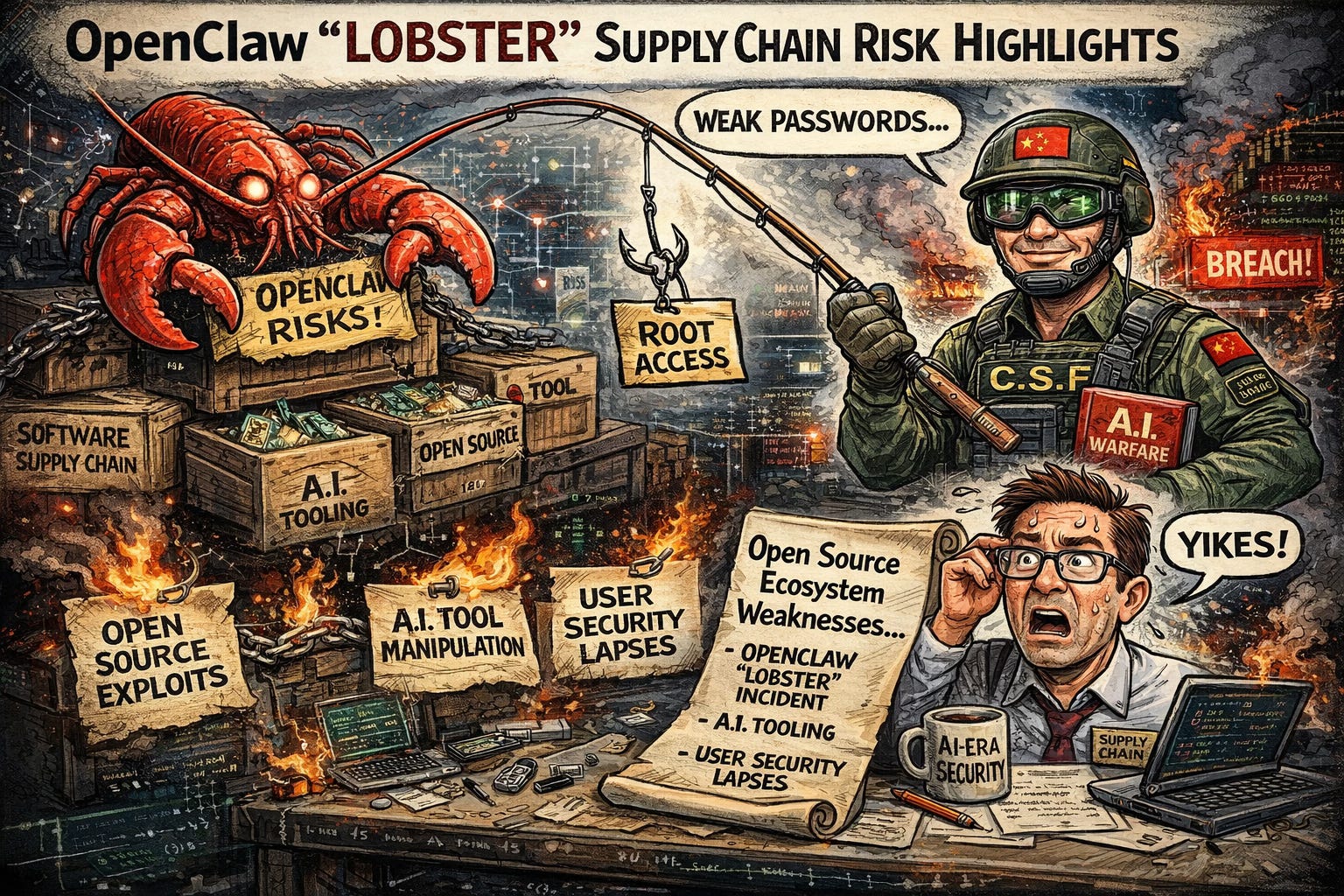
OpenClaw “Lobster” Supply Chain Risk Highlights AI-Driven Software Ecosystem Weaknesses
Bottom Line Up Front (BLUF): The OpenClaw “Lobster” incident is being framed as a warning-level event for AI-era supply chain security, where vulnerabilities in open-source ecosystems, AI tooling, and user practices converge. The risk extends beyond a single flaw—highlighting how AI systems with elevated permissions can be manipulated to impact entire software supply chains.
Analyst Comments: This is less about a single vulnerability and more about a systemic shift in risk. AI tools are now part of the software supply chain—and in many cases, they operate with high levels of trust and access. That’s a dangerous combination. The “Lobster” framing gets at something real: AI doesn’t need traditional exploitation paths if it’s already inside the workflow. If a model can generate code, interact with systems, or process inputs without strict boundaries, it becomes a new attack surface—one that blends social engineering, prompt manipulation, and supply chain compromise.
READ THE STORY: 4Hou
LAPSUS$ Claims AstraZeneca Breach, Shifts to Quiet “Data-for-Sale” Extortion Model
Bottom Line Up Front (BLUF): Actors claiming affiliation with LAPSUS$ allege a breach of AstraZeneca, offering ~3GB of internal data—including source code, cloud infrastructure configs, and credentials—for sale on underground forums. While unconfirmed, the dataset suggests potential exposure of CI/CD pipelines and supply chain systems, marking a shift from public leaks to monetized access.
Analyst Comments: Moving to private sales signals a more mature—and arguably more dangerous—approach. Fewer headlines, more controlled monetization, and less immediate pressure on victims. The combination of source code, Terraform, and secrets is the worst-case bundle. Code tells you how things work. Infrastructure-as-code tells you where things live. Credentials let you walk in the front door. That’s not just data exposure—that’s potential environment compromise.
READ THE STORY: CyberPress
Russian APT28 Exploits Zimbra XSS in “GhostMail” Campaign Targeting Ukrainian Government
Bottom Line Up Front (BLUF): APT28 is running a highly targeted phishing campaign against Ukrainian government entities using a patched Zimbra XSS flaw (CVE-2025-66376). The attack requires no links or attachments—just opening the email triggers in-browser compromise, credential theft, and full mailbox exfiltration. If you’re running unpatched Zimbra or exposing the Classic UI, this is an active and effective intrusion path.
Analyst Comments: This is a sharp evolution of webmail exploitation—no payload delivery, no user clicks beyond opening the message, and everything happens inside a trusted session. That’s hard to detect and even harder to explain to users trained to “not click links.” The AntiSamy bypass is the real story here. Injecting noise into HTML tags to defeat regex-based sanitization isn’t new, but it’s effective—and it worked against a major enterprise platform. That’s a reminder that input filtering is brittle, especially when attackers can rely on browser parsing quirks to reconstruct payloads.
READ THE STORY: CyberPress
Crunchyroll Breach Linked to Outsourcing Partner, 100GB of User Data Allegedly Exfiltrated
Bottom Line Up Front (BLUF): Threat actors claim to have stolen ~100GB of sensitive user data from Crunchyroll via a compromised Telus BPO employee, exposing PII including emails, IPs, and payment details. The incident underscores ongoing supply chain risk, where a single endpoint compromise enables access to downstream enterprise systems.
Analyst Comments: The initial access here wasn’t sophisticated—it was a user executing malware. From there, attackers pivoted into Crunchyroll’s environment, which suggests insufficient segmentation between vendor access and internal systems. The ticketing system compromise is particularly telling. These platforms often sit at the intersection of customer data, support workflows, and internal tooling—high value, but frequently under-protected because they’re “just support systems.”
READ THE STORY: GBhackers
Active Exploitation of CVSS 10.0 Quest KACE SMA Flaw Enables Full Admin Takeover
Bottom Line Up Front (BLUF): Threat actors are actively exploiting CVE-2025-32975, a critical authentication bypass in Quest KACE SMA, to hijack administrative accounts and execute remote payloads. Unpatched, internet-exposed systems are at immediate risk of full compromise, with attackers already deploying credential theft tools and establishing persistence.
Analyst Comments: This is about as bad as it gets—auth bypass + internet exposure + active exploitation. CVSS 10 isn’t always meaningful, but in this case, it tracks. What’s notable isn’t just initial access—it’s how quickly attackers move post-compromise. This isn’t smash-and-grab. They’re establishing admin persistence, modifying the registry, pivoting to backup systems, and pulling credentials with Mimikatz. That’s hands-on-keyboard behavior, not automated spray-and-pray.
READ THE STORY: THN
Bluetooth “WhisperPair” Flaw Enables Covert Tracking and Eavesdropping via Fast Pair Ecosystem
Bottom Line Up Front (BLUF): A critical Bluetooth vulnerability (CVE-2025-36911), dubbed “WhisperPair,” allows attackers to silently pair with vulnerable audio devices, track victims via Google’s Find Hub network, and potentially eavesdrop through onboard microphones. Combined with passive Bluetooth scanning tools like Bluehood, this exposes a broader, low-cost surveillance vector affecting millions of devices.
Analyst Comments: The core issue is trust abuse in Fast Pair implementations: devices accepting pairing requests when they shouldn’t. That breaks a fundamental assumption users rely on—that pairing requires intent. The tracking angle is what elevates this. Hijacking Find Hub effectively turns consumer earbuds into location beacons tied to an attacker’s account. Worse, the delayed or misleading user notifications mean victims may dismiss alerts as glitches. Bluehood adds another layer: even without exploitation, passive BLE collection can map routines, relationships, and behaviors over time. No exploit, no interaction—just patience. That’s surveillance drifting into commodity territory.
READ THE STORY: HABR
VoidStealer Bypasses Chrome Encryption Using Debugger Trick to Steal Master Keys
Bottom Line Up Front (BLUF): VoidStealer malware is actively bypassing Chrome’s Application-Bound Encryption (ABE) by extracting the browser’s master key directly from memory using a debugger-based technique. This allows attackers to decrypt cookies, credentials, and session data without privilege escalation—effectively undermining one of Chrome’s core data protection mechanisms.
Analyst Comments: This is a notable step forward for infostealers—not because it’s fundamentally new, but because it operationalizes a research-grade technique into commodity malware. Chrome’s ABE was supposed to close the gap on credential theft by tying decryption to a SYSTEM-level service. In practice, attackers just sidestepped the control entirely by grabbing the key at runtime. That’s the recurring lesson in endpoint security: if the data must be decrypted for legitimate use, there’s always a window to steal it.
READ THE STORY: BleepingComputer
Simple Network Failures Repeatedly Disrupt San Francisco BART System, Exposing Fragile Infrastructure
Bottom Line Up Front (BLUF): Repeated outages in San Francisco’s BART transit system were caused by basic networking failures tied to aging infrastructure, not sophisticated cyberattacks. A single point of failure in legacy systems led to complete loss of train visibility, halting operations across the network—highlighting systemic risk in critical infrastructure.
Analyst Comments: No zero-day, no APT—just brittle infrastructure. That’s the uncomfortable takeaway. Critical transit systems are still running on legacy tech where a single component failure cascades into full operational shutdown. The key issue here is visibility loss. Once the system couldn’t track train locations, operations had to stop entirely. That’s a safety decision, but it also reveals poor architectural resilience—no redundancy, no graceful degradation, just failure.
READ THE STORY: Malwarebytes
Speagle Malware Abuses Trusted DocGuard Infrastructure for Stealthy Espionage
Bottom Line Up Front (BLUF): The Speagle infostealer hijacks Cobra DocGuard—a legitimate document security platform—to exfiltrate sensitive data while blending into normal enterprise traffic. Evidence suggests targeted espionage, including specific interest in Chinese missile-related documents.
Analyst Comments: Researchers identified Speagle malware abusing Cobra DocGuard infrastructure to steal system, file, and browser data while disguising exfiltration as legitimate traffic. Some variants specifically target aerospace and missile-related documents, suggesting a highly targeted espionage campaign.
READ THE STORY: CyberPress
Quantum Computing Threatens Modern Encryption: “Harvest Now, Decrypt Later” Risk Accelerates
Bottom Line Up Front (BLUF): Quantum computing is on track to break widely used encryption standards (RSA, ECC) within the next decade, putting today’s encrypted data at future risk. The immediate concern isn’t just future systems—it’s adversaries collecting sensitive data now for later decryption. Organizations that delay post-quantum migration are effectively accepting eventual data exposure.
Analyst Comments: There’s a lot of hype around quantum, but this is one area where the concern is justified. You don’t need a working cryptographically relevant quantum computer (CRQC) today to have a problem—you just need data with a long shelf life. “Harvest now, decrypt later” is the real operational threat. Nation-state actors are already incentivized to stockpile encrypted traffic—diplomatic, financial, healthcare—knowing that breaking it is a future problem. That shifts quantum risk from theoretical to strategic.
READ THE STORY: TECHTIMES
Chrome Patches 26 Vulnerabilities Including Multiple RCE Bugs in WebGL and Core Components
Bottom Line Up Front (BLUF): Google released a Chrome update addressing 26 vulnerabilities, including three critical memory corruption flaws that could enable remote code execution via malicious web content. The bugs impact widely used components like WebGL, V8, and WebRTC, making drive-by exploitation a realistic risk.
Analyst Comments: No attachment, no phishing macro—just get a user to load a page. The concentration of memory corruption bugs (out-of-bounds, use-after-free, type confusion) matters. These are the building blocks of real-world exploit chains. One bug gets you code execution in the renderer, another escapes the sandbox, and suddenly you’re on the host. WebGL showing up twice in critical bugs is notable. Graphics pipelines are complex, heavily exposed to untrusted input, and historically tricky to secure. That makes them attractive for attackers looking for reliable primitives.
READ THE STORY: CyberPress
UNISOC T612 Baseband RCE via Cellular Calls — No Click, No App, Just a Call
Bottom Line Up Front (BLUF): A critical flaw in UNISOC T612-series baseband firmware allows remote code execution via a malicious cellular video call. Exploitation happens entirely over the mobile network (IMS/VoLTE), below the OS layer, requiring no user interaction beyond answering the call—and potentially even before that.
Analyst Comments: This is the kind of bug that quietly keeps mobile security people up at night. You’re not attacking Android. You’re attacking the modem—the part of the phone that talks directly to the carrier network. That puts you below the OS, below most security controls, and often outside the visibility of EDR or mobile security tooling. The mechanics matter: an uncontrolled recursion in SIP/SDP parsing → stack overflow → function pointer overwrite → native code execution in the baseband RTOS. That’s a clean, reliable memory corruption chain in a highly exposed attack surface.
READ THE STORY: CyberPress
Items of interest
HackerOne Launches Agentic Prompt Injection Testing as AI Vulnerabilities Surge
Bottom Line Up Front (BLUF): Agentic Prompt Injection Testing” to simulate real-world adversarial attacks against AI systems, as prompt injection vulnerabilities have increased 540% year-over-year. The approach focuses on validating whether AI applications can be exploited in production environments, not just identifying theoretical risks.
Analyst Comments: The 540% spike tells you everything—this isn’t a niche issue anymore. Prompt injection has moved from “interesting research problem” to “reliable attack vector.” What’s changing is how these systems are deployed. LLMs aren’t just chatbots—they’re plugged into data sources, APIs, and internal tools. That turns a prompt injection from a weird input bug into something closer to command injection. If the model can be manipulated, it can act on behalf of the attacker.
READ THE STORY: CyberSecurityInsiders
What Is a Prompt Injection Attack? (Video)
FROM THE MEDIA: Wondering how chatbots can be hacked? In this video, IBM Distinguished Engineer and Adjunct Professor Jeff Crume explains the risks of large language models and how prompt injections can exploit AI systems, posing significant cybersecurity threats. Find out how organizations can protect against such attacks and ensure the integrity of their AI systems.
OWASP’s Top 10 Ways to Attack LLMs: AI Vulnerabilities Exposed (Video)
FROM THE MEDIA: Jeff Crume explains OWASP's Top 10 for LLMs, including risks like prompt injection and data leaks. Discover actionable tips like firewalls and access controls to safeguard your AI systems from attacks and vulnerabilities.
The selected stories cover a broad range of cyber threats and are intended to help readers frame key publicly discussed threats and improve overall situational awareness. InfoDom Securities does not endorse any third-party claims made in its original material or related links on its sites; the opinions expressed by third parties are theirs alone. For further questions, don't hesitate to get in touch with InfoDom Securities at dominanceinformation@gmail.com.