
Daily Drop (1263)
03-19-26

Thursday, Mar 19, 2026 // (IG): BB // Ghostwire
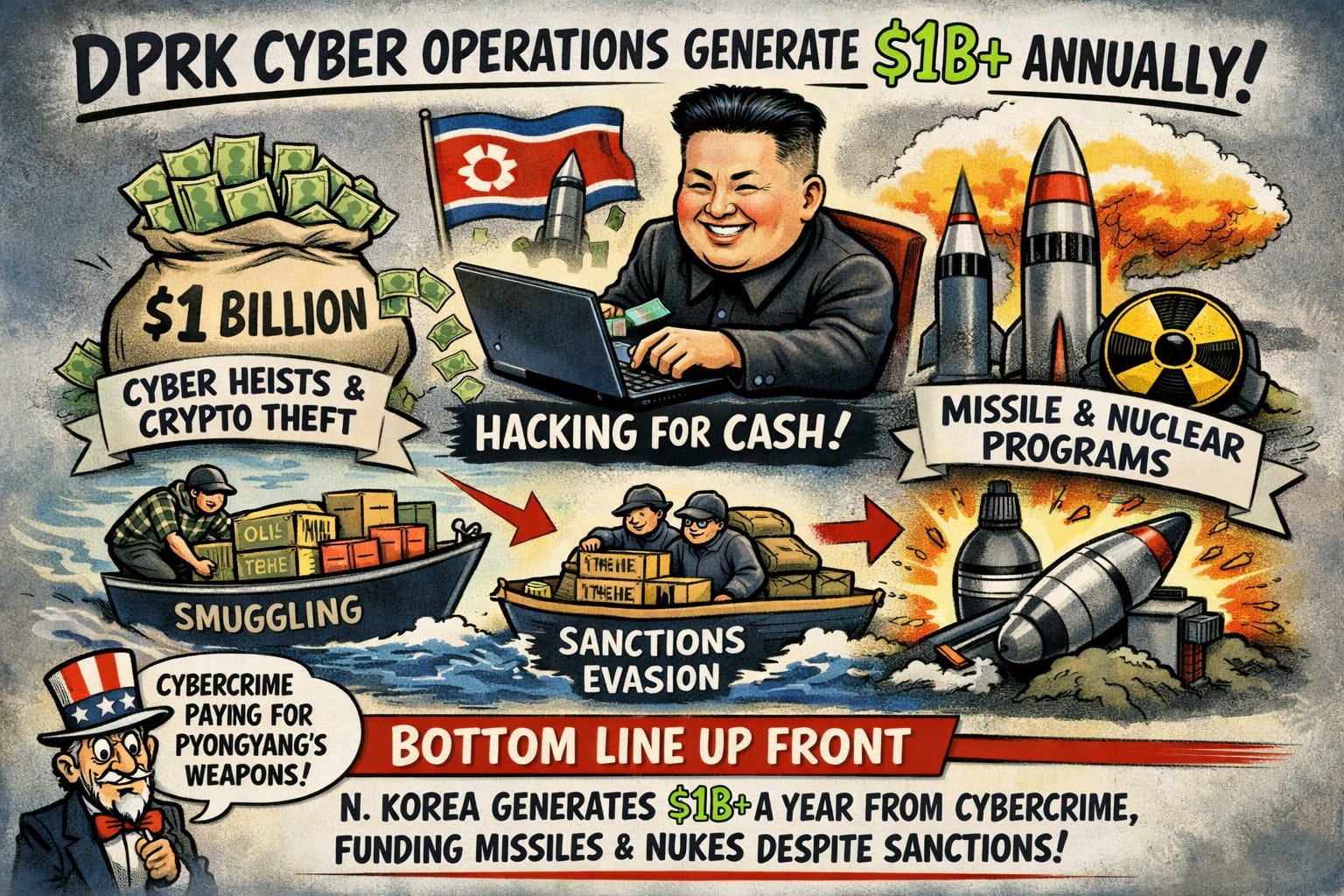
DPRK Cyber Operations Generate $1B+ Annually, Fueling Sanctions Evasion and Weapons Programs
Bottom Line Up Front (BLUF): North Korea is generating at least $1 billion annually through cyber operations, now a core pillar of its foreign currency strategy alongside arms sales to Russia. US intelligence assesses that cybercrime has become a reliable, scalable funding stream supporting Pyongyang’s missile and nuclear development despite international sanctions.
Analyst Comments: This isn’t just “state-sponsored hacking”—it’s a revenue model. North Korea has operationalized cybercrime at a national level, blending espionage, financial theft, and sanctions evasion into a steady income stream. Few actors have closed that loop as effectively. What stands out is consistency and scale. $1B annually isn’t opportunistic theft—that’s repeatable infrastructure, mature tradecraft, and likely multiple specialized teams (e.g., crypto theft, financial fraud, supply chain compromise). Groups like Lazarus aren’t just APTs anymore—they function closer to hybrid intel/financial units.
READ THE STORY: Bloomberg
Automotive Cybersecurity White Hat Conference Hosted in China, Highlighting Offensive Research and Tooling for Connected Vehicles
Bottom Line Up Front (BLUF): China’s inaugural automotive cybersecurity white hat conference showcased growing maturity in vehicle security research, with a strong emphasis on offensive testing, fuzzing, and automated exploitation tooling. The event reflects accelerating investment in vehicle security ecosystems across industry, academia, and independent researchers.
Analyst Comments: The focus on offensive tooling (CAN fuzzing, ROS testing, Android privilege escalation, protocol fuzzing) shows the industry is taking “assume breach” seriously in vehicle environments. What stands out is the normalization of attacker-grade techniques in defensive research. Tools for UDS scanning, ECU interaction, and automated fuzzing aren’t niche anymore—they’re being productized and shared. That lowers the barrier for both defenders and attackers. The gap between research and real-world exploitation continues to shrink.
READ THE STORY: Anquanke
Unverified Claim of 10PB Data Theft from China Supercomputing Center Raises Espionage Concerns
Bottom Line Up Front (BLUF): A threat actor claims to have exfiltrated 10 petabytes of sensitive data from China’s National Supercomputing Center in Tianjin, including military and aerospace research. The breach remains unconfirmed, but if accurate, it would represent one of the largest alleged data exfiltration events tied to strategic research infrastructure.
Analyst Comments: Start with skepticism. A 10PB exfiltration claim is massive—technically possible, but operationally difficult to pull off without prolonged access, significant bandwidth, and likely detection. The low asking price for access also doesn’t line up with the claimed value, which raises questions about authenticity or completeness. That said, even partial compromise would still be a big deal. Supercomputing centers aren’t just storage—they’re aggregation points for high-value research across government, academia, and defense. If segmentation is weak, one foothold can expose multiple institutions at once.
READ THE STORY: VisionTimes
DarkSword iOS Exploit Chain Blurs Line Between Espionage and Cybercrime
Bottom Line Up Front (BLUF): A sophisticated iPhone exploit chain dubbed “DarkSword” leverages multiple zero-day vulnerabilities to fully compromise devices, enabling both espionage and financial theft. The toolkit is being used by a mix of state-linked actors and criminal groups, signaling increased crossover between surveillance capabilities and cybercrime.
Analyst Comments: The most important shift here isn’t the exploit chain itself—it’s who’s using it. Historically, full-chain iOS exploits were tightly controlled, expensive, and almost exclusively in the hands of nation-states or commercial spyware vendors. That boundary is eroding. DarkSword shows what happens when those capabilities leak or get reused: the same tooling can pivot from intelligence collection to crypto wallet theft without modification. That’s not theoretical convergence—it’s operational reality.
READ THE STORY: DarkReading
Critical Telnetd Flaw Enables Pre-Auth Root RCE on Legacy Systems
Bottom Line Up Front (BLUF): A critical vulnerability (CVE-2026-32746, CVSS 9.8) in GNU Inetutils telnetd allows unauthenticated attackers to achieve remote code execution during session negotiation, potentially granting root-level access. With no patch available, exposed Telnet services—especially in OT and legacy environments—represent immediate high-risk targets.
Analyst Comments: This is about as bad as it gets: pre-auth, network-exposed, root-level RCE in a legacy service that still quietly exists in critical environments. The exploit path is straightforward—send a malformed Telnet negotiation packet and trigger a buffer overflow before authentication even begins. No creds, no user interaction, no friction. That combination (low complexity + high impact) is exactly what gets weaponized fast. The real issue isn’t Telnet itself—we already know it’s insecure. It’s where it still lives. ICS, SCADA, embedded devices—systems that can’t be easily patched, upgraded, or even taken offline. That’s where this becomes operational risk, not just IT risk.
READ THE STORY: CyberPress
CISA Flags Wing FTP Server Flaw as Actively Exploited
Bottom Line Up Front (BLUF): CISA has added CVE-2025-47813 (Wing FTP Server information disclosure flaw) to its Known Exploited Vulnerabilities (KEV) catalog, confirming active exploitation in the wild. Organizations are urged to prioritize remediation, as KEV inclusion signals immediate operational risk.
Analyst Comments: KEV additions are one of the clearest “this is being used right now” signals defenders get. This isn’t theoretical risk—it’s confirmed exploitation. An information disclosure bug might sound low impact on paper, but in practice these often act as entry points. Leaked credentials, config data, or session details can quickly turn into full compromise, especially in externally exposed services like FTP. The bigger issue is exposure. FTP services—especially niche ones like Wing FTP—tend to sit quietly on the edge of networks, often overlooked in asset inventories. That’s exactly why attackers target them.
READ THE STORY: CISA
AI Security Agents Catch Hundreds of Bugs—But Leave Critical Gaps
Bottom Line Up Front (BLUF): Cursor’s AI-powered security agents are successfully reviewing thousands of pull requests and catching hundreds of vulnerabilities weekly using surprisingly simple prompts. However, experts warn these systems are only one layer of defense and fall short of a complete enterprise security program—especially around validation, supply chain risk, and governance.
Analyst Comments: This is exactly where AI belongs right now: high-volume, low-friction triage. Catching obvious security issues early in the PR lifecycle is valuable, and doing it with lightweight prompts lowers the barrier to adoption. But there’s a real risk in overestimating coverage. These agents operate within the bounds of their prompts and training—they don’t validate runtime behavior, don’t reason well about complex business logic, and won’t catch nuanced supply chain risks like dependency confusion or malicious package updates unless explicitly tuned.
READ THE STORY: SNYK
Sednit (APT28) Reintroduces Custom Malware Toolkit, Leveraging Cloud C2 for Stealthy Espionage
Bottom Line Up Front (BLUF): Russian-linked APT28 (Sednit/Fancy Bear) has returned to using a sophisticated custom malware toolkit after years of relying on simpler implants. The group is deploying dual implants—BeardShell and a heavily modified Covenant framework—paired with legitimate cloud services for command-and-control, significantly complicating detection and response.
Analyst Comments: This is a notable shift back to “classic APT28”—custom tooling, layered persistence, and long-term espionage over smash-and-grab operations. The dual-implant strategy stands out. Running parallel toolsets with different C2 infrastructure isn’t just redundancy—it’s resilience. Even if defenders burn one channel, the operation survives. The use of legitimate cloud services like Icedrive for C2 is now standard tradecraft, but Sednit’s implementation is more mature than most. Reverse-engineering a service without a public API—and maintaining it through service changes—signals a well-resourced dev pipeline, not opportunistic abuse. That raises the bar for defenders: blocking traffic outright isn’t always viable, and distinguishing malicious from legitimate use becomes a visibility problem, not just a controls problem.
READ THE STORY: DarkReading
CISA Flags Actively Exploited Chrome Zero-Days Impacting Skia and V8 Engines
Bottom Line Up Front (BLUF): CISA has added two critical Chrome zero-day vulnerabilities (CVE-2026-3909, CVE-2026-3910) to the KEV catalog following active exploitation in the wild. Both flaws can be triggered via malicious web pages, enabling memory corruption and potential code execution across Chrome, Chromium-based browsers, and a wide range of dependent platforms—requiring immediate patching.
Analyst Comments: This is the kind of bug class that consistently delivers for attackers—memory corruption in browser engines with reliable drive-by exploitation. No phishing attachment, no macro drama—just get a user to load a page. That’s why these land in exploit chains so often. The Skia angle is what makes this more than “just a Chrome bug.” Skia sits everywhere—Chrome, Android, Flutter apps—so the blast radius is much wider than a typical browser issue. Meanwhile, the V8 flaw is classic sandbox entry point. On its own, it’s contained—but in real operations, nobody runs single exploits. Pair it with a sandbox escape or privilege escalation, and you’ve got full compromise.
READ THE STORY: Gbhackers
EU Sanctions China- and Iran-Linked Firms for Cyber Operations, Targeting “Hack-for-Hire” Ecosystem
Bottom Line Up Front (BLUF): The EU has sanctioned three companies—two in China and one in Iran—for supporting and conducting cyberattacks against European targets. The move targets the growing use of quasi-private firms as operational arms for state-backed cyber activity, aiming to disrupt infrastructure, funding, and mobility rather than directly stop operations.
Analyst Comments: This is less about punishment and more about shaping the battlefield. Governments aren’t just going after APT groups anymore—they’re targeting the commercial layer that enables them. That’s where a lot of the real capability lives: tooling, infrastructure, talent pipelines. The “hack-for-hire” model—especially in China and Iran—isn’t new, but it’s getting more formalized. Companies like iSoon sit in that gray zone: legitimate enough to recruit and operate openly, but closely aligned with state objectives. That dual-use structure is the whole point. It gives governments plausible deniability while scaling operations through the private sector.
READ THE STORY: DarkReading
Cisco FMC Zero-Day (CVE-2026-20131) Exploited to Deploy Interlock Ransomware
Bottom Line Up Front (BLUF): A critical unauthenticated RCE vulnerability (CVE-2026-20131, CVSS 10.0) in Cisco Secure Firewall Management Center (FMC) is being actively exploited to deploy Interlock ransomware. Attackers have had a multi-week head start, leveraging insecure deserialization to gain root access and execute full attack chains across enterprise networks.
Analyst Comments: This is about as bad as it gets for perimeter infrastructure—unauthenticated RCE in a centralized firewall management platform. If FMC is exposed or reachable, it effectively becomes a single point of failure for the entire network. The timeline matters here. Over a month of pre-disclosure exploitation means attackers likely already established footholds in environments that still appear “clean.” Patching stops new infections—it doesn’t remove existing access. That gap is where most organizations get burned.
READ THE STORY: CyberPress
DPRK-Linked “StoatWaffle” Malware Targets Developers via VSCode Supply Chain Abuse
Bottom Line Up Front (BLUF): A North Korea-aligned threat group (WaterPlum) is deploying new “StoatWaffle” malware through malicious VSCode repositories, abusing trusted developer workflows to achieve code execution on folder open. The campaign delivers credential theft and persistent remote access, signaling continued focus on software supply chain compromise—particularly in blockchain ecosystems.
Analyst Comments: No exploit chain, no vulnerability—just abusing expected behavior in a widely trusted tool. If a repo looks legitimate and VSCode is allowed to run tasks on open, that’s enough. The “runOn: folderOpen” trick is doing the heavy lifting here. It turns a passive action—opening a project—into code execution. That’s dangerous because it blends into normal workflow. Developers are conditioned to trust repos, especially in fast-moving ecosystems like blockchain where copying and testing code is routine.
READ THE STORY: GBhackers
Items of interest
ML Malware Detection Under Pressure: Adversarial Attacks Expose Structural Weakness in Static Classifiers
Bottom Line Up Front (BLUF): Static ML-based malware classifiers remain highly effective for scale and speed, but are fundamentally vulnerable to adversarial evasion. Because decisions rely on manipulable PE features—not execution semantics—attackers can shift model verdicts through controlled file modifications (e.g., append, section injection, import manipulation) without breaking payload functionality.
Analyst Comments: This isn’t a “ML is broken” story—it’s a reminder of what static ML actually is: a correlation engine wrapped around feature engineering. The model doesn’t understand malicious intent; it learns statistical patterns in PE artifacts. That works—right up until someone starts deliberately pushing on those patterns. The most important takeaway is the feature space vs. file space gap. In feature space, attacks look clean—gradient methods like FGSM and PGD quickly expose how fragile the decision boundary can be. But real attackers don’t ship vectors—they ship binaries. The constraint isn’t “can I change this feature,” it’s “can I change it without breaking the PE.” That’s where many academic attacks die—but also where practical ones get interesting.
READ THE STORY: CODEBY
Machine Learning for Enhanced Malware Detection & Classification (Video)
FROM THE MEDIA: Malware continues to increase in prevalence and sophistication. VirusTotal reported a daily submission of 2M+ malware samples. Of those 2 million malware daily submissions, over 1 million were unique malware samples. Successfully exploiting networks and systems has become a highly profitable operation for malicious threat actors.
Malware Analysis for Beginners — Static & Dynamic Analysis Explained Step by Step (Video)
FROM THE MEDIA: The basics of malware analysis — both static and dynamic!
The selected stories cover a broad range of cyber threats and are intended to help readers frame key publicly discussed threats and improve overall situational awareness. InfoDom Securities does not endorse any third-party claims made in its original material or related links on its sites; the opinions expressed by third parties are theirs alone. For further questions, don't hesitate to get in touch with InfoDom Securities at dominanceinformation@gmail.com.