
Daily Drop (1262)
03-17-26

Tuesday, Mar 17, 2025 // (IG): BB // Ghostwire
China Signals AI-Centric Economic Strategy in New Five-Year Plan
Bottom Line Up Front (BLUF): China’s latest five-year plan places artificial intelligence and advanced technology at the center of its economic strategy, signaling sustained state investment and long-term prioritization of AI as a driver of growth, competitiveness, and national power.
Analyst Comments: This isn’t a surprise—but it is a confirmation of trajectory. China has moved past “emerging tech adoption” and into full-scale industrial policy around AI. Embedding it in a five-year plan means funding, policy alignment, and state backing are all but guaranteed. The important angle isn’t just economic—it’s dual-use. Investments framed as productivity gains will also translate into military, intelligence, and surveillance capabilities. That’s been the pattern with previous Chinese tech initiatives, and AI accelerates it.
READ THE STORY: NikkeiAsia
Stryker Attack Highlights Shift to Identity-Driven Destruction via Enterprise Management Tools
Bottom Line Up Front (BLUF): The cyberattack on Stryker leveraged compromised administrative access to Microsoft Intune to remotely wipe tens of thousands of devices, demonstrating a shift toward identity-based attacks that weaponize enterprise management platforms instead of deploying traditional malware.
Analyst Comments: Once the attackers obtained Global Admin access, the rest was trivial. They didn’t need custom malware or exploit chains; they used built-in functionality exactly as designed. That’s the uncomfortable reality: if your identity layer is compromised at that level, your own infrastructure becomes the attack tool. Intune didn’t fail—it did exactly what an authenticated admin told it to do. The reported timeline—tens of thousands of devices wiped within a three-hour window—shows how quickly impact scales when the management plane is abused. Traditional defenses (EDR, AV) are effectively bypassed because there’s no malicious binary to detect. From a telemetry standpoint, this looks like routine administrative activity.
EU Sanctions Firms and Individuals Tied to Cyber Operations Targeting Member States
Bottom Line Up Front (BLUF): The European Union has imposed sanctions on three entities and two individuals linked to cyber-attacks against member states, targeting both espionage activity and disruptive operations. The action signals continued willingness to use coordinated economic measures against state-linked cyber actors, though the practical deterrent effect remains limited.
Analyst Comments: This is the EU doing what it’s structurally built to do—respond with coordinated sanctions—but the impact on actual threat activity is usually marginal. These measures are better understood as signaling and attribution tools than disruption mechanisms. The inclusion of commercial firms providing “hacking-as-a-service” capabilities is notable. It reflects a broader shift: state-aligned operations increasingly rely on semi-private contractors to create distance and deniability. Sanctioning those entities is a step toward raising costs, but it doesn’t meaningfully degrade capability unless it’s paired with law enforcement action or infrastructure takedowns. The scale of activity—65,000 compromised devices across multiple member states—underscores how persistent and industrialized these operations have become. Meanwhile, the Iranian-linked activity blends cybercrime, espionage, and influence ops (data theft + Olympic disinformation), which is consistent with Tehran’s playbook of asymmetric pressure.
READ THE STORY: DarkReading
U.S. Cyber Strategy Faces Gaps as State Threats and Ransomware Risks Intensify
Bottom Line Up Front (BLUF): The Trump administration’s newly released cyber strategy is drawing criticism for lacking depth, omitting key adversaries, and overemphasizing offensive operations. At a time of escalating threats from nation-states and cybercriminal groups, analysts warn the approach may outpace the government’s actual capacity to defend critical infrastructure and coordinate response efforts.
Analyst Comments: The core issue here isn’t just what’s in the strategy—it’s what’s missing. A four-page document that barely addresses major state actors signals either a deliberate shift in priorities or a lack of alignment with the current threat landscape. Neither is reassuring. The offense-first posture sounds strong on paper, but it assumes capacity that likely doesn’t exist. Cyber Command is already stretched supporting military operations, and expanding offensive campaigns while defending domestic infrastructure is a resource tradeoff, not a free upgrade. That tension isn’t acknowledged in the strategy.
READ THE STORY: CFR
Persistent Threat Actor Targets Regional Militaries in Years-Long Intelligence Operation
Bottom Line Up Front (BLUF): A suspected Chinese state-backed threat cluster (CL-STA-1087) has conducted a multi-year cyberespionage campaign against Southeast Asian military organizations since at least 2020. The operation emphasizes stealth and persistence, leveraging custom malware, delayed execution, and credential harvesting to support long-term intelligence collection on sensitive defense activities.
Analyst Comments: This is classic long-game espionage—quiet, methodical, and focused on intelligence value over disruption. The six-hour execution delay alone signals deliberate sandbox evasion and operational patience. Combined with dormant persistence and use of shared infrastructure like Pastebin for C2 signaling, this actor is optimizing for longevity, not speed. The tooling isn’t flashy, but it doesn’t need to be. A custom Mimikatz variant (“Getpass”) plus tailored backdoors (AppleChris, MemFun) gives them reliable access to credentials and lateral movement without burning well-known signatures. The real concern is the targeting: joint military exercises, capability assessments, and internal meeting records. That’s strategic intelligence collection aligned with state objectives, not opportunistic intrusion.
READ THE STORY: SCMEDIA
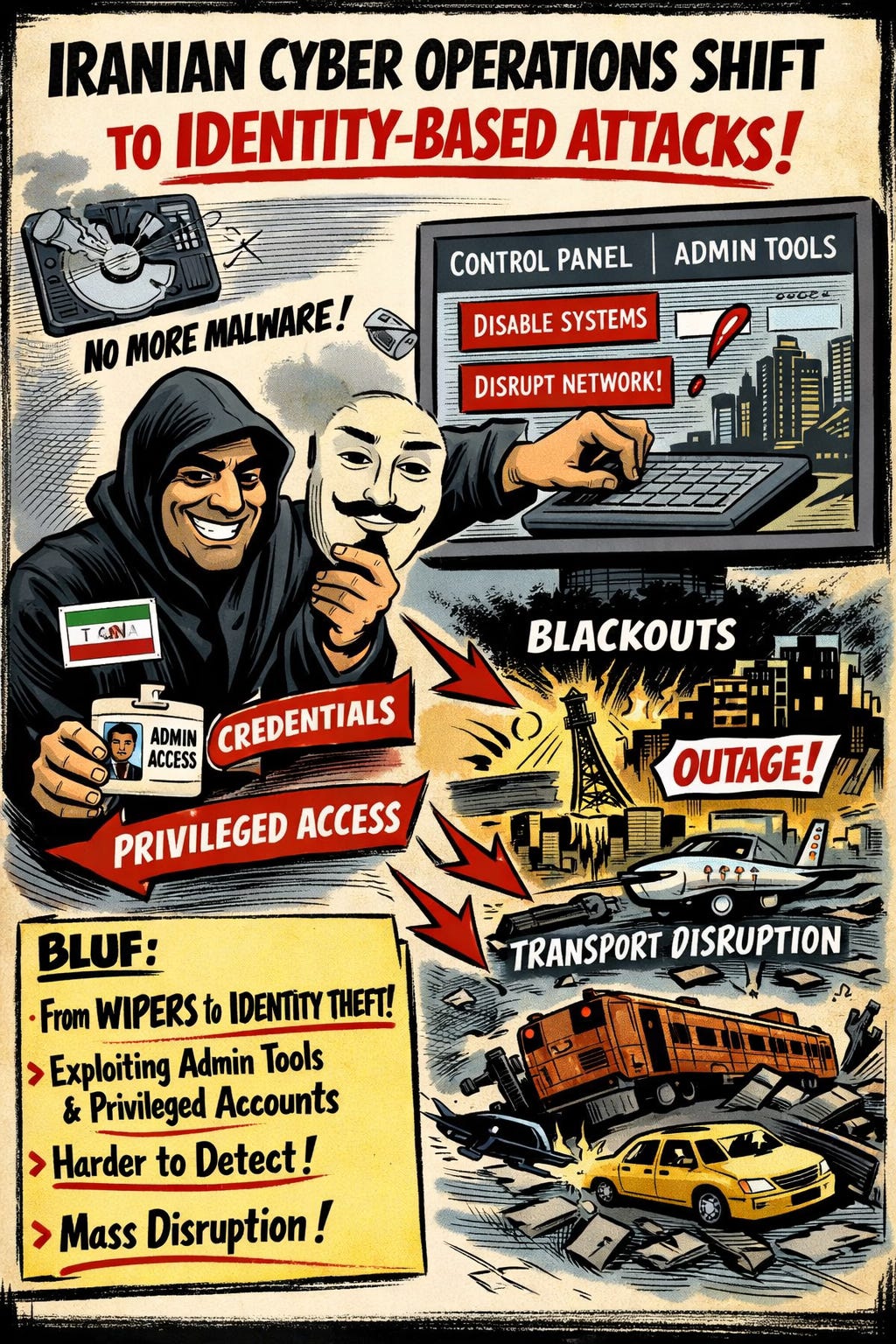
Iranian Cyber Operations Shift to Identity-Based Attacks, Enabling Mass Disruption Without Malware
Bottom Line Up Front (BLUF): Iranian state-aligned threat actors have evolved from deploying destructive wiper malware to exploiting privileged identities and enterprise management tools, enabling large-scale disruption through legitimate administrative functions. This shift significantly reduces detection opportunities and increases the potential impact of attacks.
Analyst Comments: This is a meaningful escalation—not because the capability is new, but because the delivery mechanism is harder to stop. Moving from custom wipers to identity abuse strips defenders of one of their biggest advantages: malware visibility. If an attacker can issue a legitimate remote wipe command through an MDM platform, there’s no payload to catch, no suspicious binary, no obvious IOC. From a detection standpoint, it looks like IT doing its job. That’s a problem. The Stryker incident fits this pattern almost perfectly. Compromise the management plane, weaponize it, and you get instant, global impact. No need to engineer complex wipers when the enterprise already built the kill switch for you.
READ THE STORY: Unit 24
Iran Leverages Cyber Proxies to Sustain Pressure as Conflict Expands Beyond Battlefield
Bottom Line Up Front (BLUF): Iran is using a decentralized network of cyber proxies and hacktivists to sustain operations against the U.S., Israel, and allies despite degradation of its core cyber infrastructure. The strategy prioritizes psychological impact and persistent disruption, demonstrating that Tehran retains meaningful offensive cyber capability even under sustained military pressure.
Analyst Comments: This is asymmetric warfare playing out exactly as designed. Iran doesn’t need pristine, centralized cyber capability to be effective—it needs enough distributed access and motivated operators to create continuous pressure. That’s what the “mosaic defense” concept delivers. The Stryker incident is the clearest signal that this isn’t مجرد hacktivism. When a Fortune 500 healthcare provider is forced to disconnect systems globally, you’re looking at coordinated, high-impact operations with real-world consequences. Whether routed through proxies or not, that level of disruption points back to state-aligned capability. The volume of hacktivist activity should be treated cautiously—claims will outpace reality—but that’s part of the strategy. Flood the zone with noise, force defenders to chase ghosts, and exhaust resources. Even low-confidence threats impose cost.
READ THE STORY: The Soufan Center
AWS Bedrock Sandbox Flaw Enables DNS-Based C2, No Patch Planned
Bottom Line Up Front (BLUF): A design flaw in AWS Bedrock’s AgentCore Code Interpreter allows attackers to bypass sandbox network isolation via DNS queries, enabling covert command-and-control and data exfiltration. AWS has acknowledged the behavior as intended functionality and will not issue a patch, instead advising customers to migrate to more secure configurations.
Analyst Comments: Calling this “intended functionality” doesn’t make the risk go away. If your sandbox can still talk out via DNS, it’s not meaningfully isolated—it’s just constrained in a way attackers already know how to abuse. This is the broader problem with agentic AI environments: they execute code, often with access to data and permissions, but rely on traditional perimeter assumptions that break down quickly. DNS as a covert channel isn’t new, but embedding it inside an AI execution environment dramatically lowers the barrier to exploitation—especially when prompt injection can trigger the behavior indirectly.
READ THE STORY: TechNadu
Cortex XDR Detection Rules Decrypted, Exposing Evasion Path via Hardcoded Whitelists
Bottom Line Up Front (BLUF): Researchers reverse-engineered Palo Alto Cortex XDR’s encrypted BIOC detection rules, uncovering hardcoded global whitelists that allowed attackers to bypass behavioral protections. The issue has been patched, but it highlights systemic risks in closed, “black-box” detection models.
Analyst Comments: This is exactly why “trust the black box” is a dangerous security model. If defenders can’t see how detections work, neither can they spot when those detections are fundamentally flawed. The most concerning part isn’t the decryption—it’s what was inside. A global whitelist that suppresses roughly half of behavioral detections based on a simple string is the kind of logic that turns a high-end EDR into something trivially bypassable. Appending :\Windows\ccmcache to a command line isn’t advanced tradecraft—it’s copy-paste evasion.
READ THE STORY: GBhackers
Items of interest
NAC in SCADA: Why Controlling Internal Network Access Is Critical for OT Security
Bottom Line Up Front (BLUF): Internal connectivity—not external intrusion—is often the weakest link in industrial networks. Contractors, engineers, and vendor devices frequently connect directly into OT segments, where flat architectures and weak access controls allow unauthorized systems to interact with critical SCADA assets. Implementing Network Access Control (NAC) can reduce this risk, but OT deployments must prioritize passive discovery, behavioral profiling, and phased enforcement to avoid disrupting industrial processes.
Analyst Comments: Traditional NAC models used in corporate networks rely on authentication protocols such as 802.1X and assume endpoints can run security agents or tolerate active scanning. OT environments rarely meet these assumptions. Devices like PLCs, RTUs, and HMIs often run legacy stacks, cannot install agents, and may fail when exposed to aggressive network interrogation.
READ THE STORY: CODEBY
SCADA Architecture Simplified: 5-Minute Industrial Control Guide (Video)
FROM THE MEDIA: Discover the fundamental architecture behind the industrial control systems that power our modern world! With 35 years of hands-on experience, I break down SCADA systems into simple, practical components that anyone in the industry can understand.
Introduction To 𝐒𝐂𝐀𝐃𝐀 𝐒𝐲𝐬𝐭𝐞𝐦 (Video)
FROM THE MEDIA: What is Scada?
The selected stories cover a broad range of cyber threats and are intended to help readers frame key publicly discussed threats and improve overall situational awareness. InfoDom Securities does not endorse any third-party claims made in its original material or related links on its sites; the opinions expressed by third parties are theirs alone. For further questions, don't hesitate to get in touch with InfoDom Securities at dominanceinformation@gmail.com.