
Daily Drop (1252)
02-26-26

Thursday, Feb 26, 2025 // (IG): BB // GITHUB // SN R&D
Anthropic Launches Claude Code Remote Control, Enabling Mobile Access to Local Terminals
Bottom Line Up Front (BLUF): A new “Remote Control” capability for Claude Code, allowing developers to manage local terminal sessions from mobile devices or web browsers. While positioned as a productivity enhancement for long-running tasks, the feature introduces meaningful security considerations around remote shell access, credential exposure, and account compromise risk.
Analyst Comments: Anthropic released the Remote Control feature for Claude Code in Research Preview for Claude Max users. Developers initiate the feature using the claude rc command, which generates a session ID and QR code for pairing with the Claude mobile or web interface. The system enables remote monitoring and command execution while compute tasks run locally. Communication occurs via encrypted WebSocket channels over HTTPS, and sessions persist until explicitly stopped.
READ THE STORY: CyberPress
GTIG Disrupts PRC-Linked UNC2814 After 53 Telecom and Government Breaches Across 42 Countries
Bottom Line Up Front (BLUF): Google has taken action to disrupt a threat cluster tracked as UNC2814, dubbed “Gridtide,” which targeted cloud environments by abusing identity mechanisms rather than deploying traditional malware. The campaign leveraged credential theft and token misuse to gain persistent access to cloud resources, reinforcing the growing shift toward identity-centric intrusions.
Analyst Comments: If attackers obtain OAuth tokens, session cookies, or service account credentials, they can operate entirely within legitimate API workflows. That makes detection significantly harder. From a logging perspective, it often looks like a user doing their job. The strategic takeaway is clear: identity is the new perimeter. Once an adversary establishes valid authentication inside a cloud tenant, they can enumerate IAM roles, escalate privileges, create backdoor accounts, rotate keys, and quietly exfiltrate data. In many cases, endpoint telemetry provides little visibility because activity happens entirely within SaaS or IaaS control planes.
READ THE STORY: THN // PCMAG // GBhackers
Ivanti Connect Secure VPN Exploited in Suspected PRC-Linked Breach Impacting US Defense and Aviation Agencies
Bottom Line Up Front (BLUF): Suspected Chinese state-linked actors exploited vulnerabilities in Ivanti Connect Secure VPN appliances used by US federal agencies, prompting emergency directives to disconnect affected systems. The campaign reportedly leveraged a zero-day (CVE-2025-0282) and anti-forensic techniques, with potential impact across defense, aviation, and space-related networks.
Analyst Comments: Ivanti appliances have become repeat targets over the past several years. Edge VPN devices are high-value: they sit at the perimeter, handle authentication, and often provide privileged network access. When exploited, they deliver immediate footholds inside sensitive environments. The concerning detail here is post-patch persistence. If attackers maintained access even after remediation, that suggests web shell deployment, credential harvesting, or deeper appliance-level persistence. VPN compromises often become identity compromises.
READ THE STORY: The 420
Five Eyes Warn of Active Exploitation Targeting Cisco SD-WAN Devices
Bottom Line Up Front (BLUF): Cybersecurity agencies from the Five Eyes alliance have issued a joint warning that threat actors are actively exploiting vulnerabilities in Cisco SD-WAN devices. The advisory highlights ongoing intrusion activity targeting edge network infrastructure, reinforcing the continued risk posed by exposed and unpatched perimeter systems.
Analyst Comments: Cisco SD-WAN vulnerabilities have historically included authentication bypass, privilege escalation, and command injection issues. Once exploited, attackers can implant persistent access mechanisms or modify configurations to maintain control. Organizations should treat SD-WAN compromise like firewall compromise: assume full visibility and potential credential exposure. Patching alone is not sufficient—configuration review and log analysis are necessary.
READ THE STORY: The Record
Hydra and Saiga APT Campaigns Target Government and Telecoms in Coordinated Espionage Push
Bottom Line Up Front (BLUF): Researchers have uncovered espionage activity linked to Hydra and Saiga threat clusters targeting government and telecommunications entities. The campaigns rely on spearphishing, custom malware, and persistence mechanisms designed for long-term access. The tradecraft indicates sustained intelligence collection rather than smash-and-grab disruption.
Analyst Comments: Hydra and Saiga are operating with patience—classic espionage tempo. Initial access via phishing, followed by staged payload delivery and careful lateral movement, suggests operators prioritizing stealth and dwell time over speed. That points to intelligence objectives: data exfiltration, surveillance, and strategic positioning inside critical infrastructure. Telecom targeting is especially telling. Compromise at that layer offers visibility into communications metadata, SMS interception opportunities, and potential pivot points into government networks. That aligns with state-aligned intelligence collection rather than financially motivated crime.
READ THE STORY: GBhackers
Chinese Law Enforcement Linked to ChatGPT-Assisted Smear Campaign Targeting Japan PM
Bottom Line Up Front (BLUF): OpenAI has disclosed that a ChatGPT account linked to an individual associated with Chinese law enforcement was used to draft and manage politically motivated smear campaigns, including efforts targeting Japanese Prime Minister Sanae Takaichi and Chinese dissidents. While ChatGPT did not directly generate malicious content upon request, it was used to refine internal reports and operational planning tied to influence operations.
Analyst Comments: According to OpenAI’s findings, the operator used ChatGPT as a productivity tool—drafting status reports, organizing campaign plans, and refining messaging. When the model refused overtly malicious prompts (e.g., direct requests to smear Takaichi), the user pivoted to using it for less explicit but still operationally useful tasks.
READ THE STORY: DR
USR-W610 IoT Devices (EOL) — CVSS 9.8 Vulnerability With No Patch Available
Bottom Line Up Front (BLUF): CISA has issued a warning about multiple high-severity vulnerabilities in PUSR’s USR-W610 serial-to-Ethernet IoT devices, including CVE-2026-25715 (CVSS 9.8). The product is end-of-life (EOL) and will not receive security patches, leaving affected deployments permanently exposed to authentication bypass, credential theft, and denial-of-service risks.
Analyst Comments: This is what unmanaged IoT risk looks like in 2026: critical vulnerabilities, zero vendor support, and devices still sitting inside production networks. The most severe issue stems from broken authentication logic. The Web management interface allows administrators to set blank usernames and passwords. If that configuration is in place, anyone on the same network can log in via Web or Telnet without credentials and gain full administrative control. That’s effectively disabling authentication on a device designed to bridge industrial systems.
READ THE STORY: Anquanke
SolarWinds Serv-U Vulnerabilities Enable RCE and Privilege Escalation
Bottom Line Up Front (BLUF): Multiple critical vulnerabilities in SolarWinds Serv-U Managed File Transfer (MFT) and Serv-U Secure FTP allow remote code execution (RCE) and privilege escalation. Unpatched systems exposed to the internet are at immediate risk of compromise. Organizations running Serv-U should patch without delay and review logs for signs of exploitation.
Analyst Comments: Serv-U has been on attackers’ radar before, and file transfer appliances remain high-value targets. They sit at the edge of the network, handle sensitive data, and often run with elevated privileges. That’s a perfect storm: external exposure plus trusted internal positioning. RCE in an MFT product isn’t just about dropping a web shell. It can mean direct access to transferred files, credential harvesting, lateral movement, and potential domain compromise depending on how the system is integrated. If Serv-U is tied into Active Directory or automated workflows, blast radius increases quickly.
READ THE STORY: GBhackers // InfoSecMag
Malicious “StripeAPI” NuGet Package Steals Credentials and System Data from .NET Developers
Bottom Line Up Front (BLUF): A malicious NuGet package masquerading as a Stripe API integration library was discovered harvesting credentials and system data from developers who installed it. The package embedded data-exfiltration functionality designed to steal sensitive information during application runtime. This is another software supply chain attack targeting developer trust in public package repositories.
Analyst Comments: This wasn’t a zero-day. It was social engineering aimed at developers. Typosquatting and brand impersonation in public repositories continue to work because modern development pipelines default to speed and convenience. If a package looks legitimate and compiles cleanly, it often gets pulled straight into production builds. A fake “StripeAPI” package is especially clever. Payment integrations are common, and developers expect third-party SDKs. That makes brand spoofing effective—especially when naming closely mirrors official libraries. Once inside the environment, malicious code can exfiltrate API keys, environment variables, tokens, and potentially cloud credentials.
READ THE STORY: THN
Volcano Engine Launches Three-Layer Security Framework for OpenClaw AI Agents
Bottom Line Up Front (BLUF): ByteDance has introduced a three-layer security architecture designed to harden OpenClaw AI agents against prompt injection, high-risk autonomous actions, data leakage, and supply chain threats. The framework spans platform security, AI assistant runtime controls, and Skills supply chain scanning—positioning itself as a defensive baseline for enterprise AI agent deployments.
Analyst Comments: AI agents like OpenClaw are no longer passive assistants—they execute commands, manipulate files, invoke APIs, and control browsers. That elevates them from “content risk” to “system risk.” A compromised agent can delete data, exfiltrate credentials, or execute financial transactions. The attack surface is operational.
READ THE STORY: Anquanke
RAMP Forum Seizure Fractures Ransomware Ecosystem, Disrupts Russian-Language Criminal Hub
Bottom Line Up Front (BLUF): Law enforcement has seized the RAMP cybercrime forum, a long-running Russian-language marketplace tied to ransomware operators and initial access brokers. The takedown disrupts a key coordination and recruitment hub within the ransomware ecosystem, but fragmentation—not elimination—of activity is the likely outcome as actors migrate to alternative platforms.
Analyst Comments: RAMP was not just another carding site—it functioned as connective tissue for Russian-speaking ransomware crews, affiliates, and access brokers. Forums like this reduce friction: they facilitate recruitment, reputation building, tooling sales, and victim data monetization. Removing that infrastructure forces actors to rebuild trust networks elsewhere, which temporarily degrades operational tempo.
READ THE STORY: DR
Items of interest
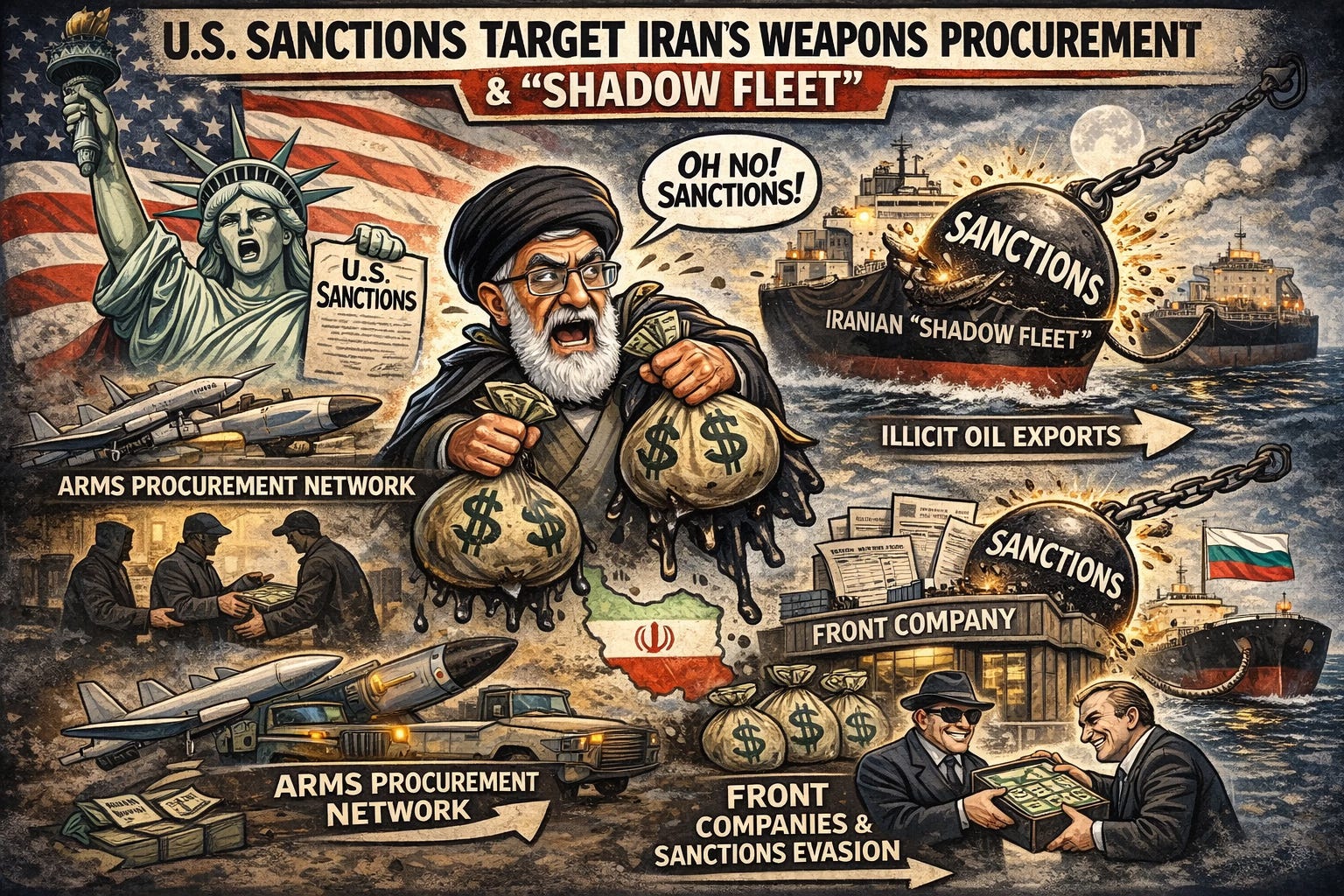
US Sanctions Target Iran’s Weapons Procurement Networks and “Shadow Fleet”
Bottom Line Up Front (BLUF): The U.S. State Department announced new sanctions targeting entities and individuals supporting Iran’s weapons procurement networks and its so-called “shadow fleet” used to evade oil sanctions. The action aims to disrupt Tehran’s ability to fund military programs and sustain illicit oil exports through front companies, maritime deception, and sanctions evasion schemes.
Analyst Comments: Sanctioning procurement networks is equally significant. Iran’s defense programs depend heavily on front companies, intermediaries, and overseas suppliers to obtain restricted components, including dual-use electronics and materials. Targeting these nodes increases friction in acquisition cycles, particularly for missile and UAV programs. From a cybersecurity and risk perspective, maritime logistics firms, shipping insurers, energy traders, and export-controlled component manufacturers should expect heightened scrutiny and potential secondary sanctions exposure. Financial institutions processing maritime transactions tied to opaque ownership structures also face compliance risk.
READ THE STORY: State.gov
US-Iran Tensions: Trump Targets Iran’s Shadow Fleet, Sanctions Aimed Iran’s Ballistic Missiles (Video)
FROM THE MEDIA: U.S. President Donald Trump escalates pressure on Iran by targeting Tehran’s shadow oil fleet and expanding sanctions linked to its ballistic missile program.
How Iran’s Economy and Shadow Fleet are Collapsing (Video)
FROM THE MEDIA: The Iranian economy and shadow fleet are collapsing. For years now, Iran has been under ever increasing strain economically, politically and so much more due to sanctions as well as its own internal inefficiencies. The only reason the state has been able to keep itself afloat is due to the existence of a shadow fleet, which helped it to skirt sanctions. But now all of that is collapsing around it as new technology and efforts by the current US administration is resulting in said fleet being captured.
The selected stories cover a broad range of cyber threats and are intended to help readers frame key publicly discussed threats and improve overall situational awareness. InfoDom Securities does not endorse any third-party claims made in its original material or related links on its sites; the opinions expressed by third parties are theirs alone. For further questions, don't hesitate to get in touch with InfoDom Securities at dominanceinformation@gmail.com.