
Daily Drop (1247)
02-16-26

Monday, Feb 16, 2025 // (IG): BB // GITHUB // SN R&D
Training: RE Exercise
This exercise introduces you to the world of reverse engineering in a fun and practical way — through ROM hacking. We tore apart the Shadowrun Sega Genesis ROM at the byte level with Claude, mapping data structures, uncovering cut content, developer easter eggs, and secrets that nobody had publicly documented in three decades, then built an online ROM editor so you can experiment yourself. The workflow combines AI-assisted pattern analysis with traditional reverse engineering techniques like starting from known goods — using values straight from the game manual to locate unknown structures in the raw binary. What makes this a legitimate learning project isn't the AI, it's the technical reasoning required to interpret output, catch false positives, understand 68000 architecture constraints, and correlate findings across ROM data, disassembly, existing tools, and Game Genie codes. The AI compresses the timeline, but the skills you'll pick up here — constraint reasoning, binary analysis, structured validation — are the same skills reverse engineers have always needed.


News:
Sabotage Targets Russian Rail Logistics Supporting War Effort
Bottom Line Up Front (BLUF): Ukrainian resistance actors reportedly set fire to a Russian electric locomotive used to transport military supplies, underscoring continued targeting of rail infrastructure that sustains Moscow’s frontline logistics. Rail remains a critical artery for ammunition, fuel, and equipment movement inside Russia and occupied territories.
Analyst Comments: Rail sabotage is asymmetric pressure applied where it hurts most—logistics. Russia’s military depends heavily on rail transport to move bulk materiel toward staging areas. Even isolated disruptions force rerouting, slow throughput, and increase security overhead. While a single locomotive loss won’t shift battlefield momentum, persistent low-level sabotage compounds over time. It also forces Moscow to divert security resources to rear-area protection, stretching internal security services and railway guards. There’s also a signaling component. Resistance activity inside Russia or occupied territory reinforces the narrative that rear areas are not secure. That psychological dimension matters, particularly when paired with drone strikes and other long-range disruptions targeting energy and military facilities.
READ THE STORY: United24
Ukrainian Drone Tactics Expose Gaps During NATO Training Exercise
Bottom Line Up Front (BLUF): The drone operators reportedly overwhelmed NATO troops during a recent training exercise, demonstrating how battlefield-hardened UAV tactics can outpace conventional force protection and maneuver practices. The outcome underscores how rapidly evolving drone tradecraft is reshaping ground operations.
Analyst Comments: Ukraine’s forces have iterated drone tactics under live-fire conditions for two years. That kind of operational learning curve is difficult to replicate in peacetime training environments. FPV strike drones, persistent ISR feeds, rapid target handoff, and decentralized execution compress the engagement cycle in ways many conventional units are still adapting to.
READ THE STORY: United24
Kyiv Mayor Warns Ukraine’s Survival Is an “Open Question” as Infrastructure Strikes Intensify
Bottom Line Up Front (BLUF): Ukraine’s ability to endure as an independent state is under mounting strain as sustained Russian missile and drone strikes degrade Kyiv’s critical infrastructure. With air defense munitions stretched thin and political tensions resurfacing inside the capital, the country faces simultaneous military, humanitarian, and governance pressure at a decisive stage of the war.
Analyst Comments: Russia’s campaign has shifted toward systematic infrastructure attrition—targeting heat, power, and water during extreme winter conditions to erode civilian resilience and political cohesion. This is strategic coercion. By stressing Kyiv’s energy backbone, Moscow is seeking cumulative humanitarian and psychological effects that exceed Ukraine’s repair capacity. Vitali Klitschko’s warning that national survival remains an “open question” reflects both the severity of infrastructure degradation and concern over internal fractures. Public disputes between municipal and presidential leadership create exploitable seams. Moscow’s long-standing objective of internal destabilization does not require battlefield breakthroughs—political fragmentation and infrastructure exhaustion can achieve similar strategic outcomes.
READ THE STORY: FT
Connectivity Becomes a Battlefield Liability in Latest Ukraine Cyber Operation
Bottom Line Up Front (BLUF): Ukrainian operators reportedly set up a rogue Wi-Fi network disguised as “Starlink,” tricking Russian soldiers into connecting and exposing device data that enabled geolocation of troop positions. The tactic weaponizes frontline dependence on commercial satellite internet to generate actionable targeting intelligence.
Analyst Comments: By mimicking a trusted SSID, operators exploited auto-connect behavior and weak device discipline. Once a device associates with a controlled access point, even basic connection logs, MAC data, and signal strength measurements can support triangulation. Full credential harvesting isn’t required—metadata alone can be operationally decisive. The operation highlights a growing battlefield reality: commercial tech accelerates communications but expands exposure. Satellite internet, mobile devices, and unmanaged endpoints create a soft underbelly when operational security lags. Expect continued blending of cyber, electronic warfare, and psychological operations to manipulate trust in everyday infrastructure.
READ THE STORY: The Kyiv Independent
Kyiv Claims Major Degradation of Russia’s Pantsir Air Defense Fleet
Bottom Line Up Front (BLUF): Ukraine’s Security Service (SBU) says it has destroyed roughly half of Russia’s key Pantsir air defense systems since the start of the full-scale invasion. If accurate, the losses would represent a significant erosion of Russia’s short-range air defense coverage protecting critical military and infrastructure targets.
Analyst Comments: Pantsir systems serve as point-defense platforms, designed to intercept drones, cruise missiles, and low-flying aircraft while shielding higher-value long-range systems like the S-300 and S-400. Degrading that layer creates exploitable gaps. Ukraine’s expanding drone and long-range strike campaigns depend on exactly this kind of attrition. That said, claims of “half destroyed” warrant caution. Wartime damage assessments are notoriously fluid, and Moscow does not publish transparent loss figures. The more relevant question isn’t total fleet size—it’s operational availability. Even partial damage, maintenance bottlenecks, or redeployment away from the front can degrade effectiveness without total destruction.
READ THE STORY: The Kyiv Independent
Moscow Moves to Restrict WhatsApp and Telegram as Control Over Messaging Tightens
Bottom Line Up Front (BLUF): Russian authorities are escalating pressure on WhatsApp and Telegram, citing national security and data sovereignty concerns while advancing domestic alternatives. The effort aligns with Moscow’s broader strategy to consolidate control over digital communications, expand surveillance visibility, and reduce reliance on foreign platforms.
Analyst Comments: Encrypted messaging platforms that refuse to localize data or provide access to security services sit outside the Kremlin’s enforcement perimeter. That’s strategically unacceptable in an environment where information control is treated as a core pillar of state security. Telegram occupies a gray space. While founded by a Russian national and historically pressured by regulators, it has at times resisted compliance demands. WhatsApp, owned by Meta, falls squarely into the “foreign platform” category and has long been at odds with Russian authorities. Moves to restrict or ban these services reinforce the “sovereign internet” framework Moscow has been building for years.
READ THE STORY: Cyber Mag
Kremlin Tightens Grip on Online Traffic to Marginalize Western Platforms
Bottom Line Up Front (BLUF): Russian regulators are using DNS manipulation and deep packet inspection (DPI) to selectively degrade YouTube, Telegram, and WhatsApp, steering domestic users toward the state-backed MAX platform. The approach relies on traffic throttling and protocol-aware filtering rather than sustained blanket bans, giving authorities granular enforcement control while expanding network visibility.
Analyst Comments: Authorities in Russia are reportedly leveraging DNS-level filtering and deep packet inspection to disrupt access to major Western platforms including YouTube, Telegram, and WhatsApp. Rather than fully blocking these services, regulators are degrading performance and intermittently interrupting traffic. The campaign coincides with government promotion of MAX, a domestic messaging and media application positioned as a compliant alternative. The effort fits within Russia’s broader “sovereign internet” framework aimed at centralizing traffic control and reducing reliance on foreign technology providers.
READ THE STORY: Inkle
China’s Drone Doctrine Moves Past Swarming Toward Coordinated Autonomous Operations
Bottom Line Up Front (BLUF): Analysis suggests Chinese military thinkers are evolving beyond basic drone swarming concepts toward more coordinated, autonomous, and cross-domain unmanned operations. The shift emphasizes integrated command, AI-enabled decision support, and multi-layered effects rather than sheer platform volume.
Analyst Comments: “Swarming” has become shorthand for mass drone attacks, but mass alone isn’t decisive. The more consequential development is coordination—linking UAVs with electronic warfare, cyber effects, ISR feeds, and precision fires into a synchronized kill chain. Chinese doctrinal writing increasingly frames unmanned systems as part of a broader systems-confrontation model. That means drones acting as distributed sensors, decoys, jammers, and strike assets within a unified network, not independent waves of expendable platforms. The integration piece is what scales lethality.
READ THE STORY: SWJ
China Advances AI “Distillation” to Accelerate Military and Industrial Deployment
Bottom Line Up Front (BLUF): Chinese researchers and defense-linked institutions are refining AI “model distillation” techniques to compress large models into smaller, more efficient versions suitable for deployment on constrained systems. The approach reduces compute requirements while preserving performance—an advantage for military platforms, edge devices, and environments where hardware access is limited.
Analyst Comments: Model distillation isn’t new, but its strategic application matters. By transferring knowledge from large, compute-intensive models into lightweight versions, China can operationalize AI in environments where high-end GPUs or cloud connectivity aren’t practical—or available due to export controls. This has direct military implications. Edge-deployed AI on drones, autonomous vehicles, ISR platforms, and electronic warfare systems benefits from reduced size, weight, and power demands. Smaller models also lower infrastructure costs, accelerating scaling across units.
READ THE STORY: Global Security
Concerns Over China Retaliation Stall Public Blame in Broad Cyberespionage Case
Bottom Line Up Front (BLUF): A sprawling cyberespionage operation has reportedly not been publicly attributed due to concerns over potential retaliation from China. The hesitation underscores how geopolitical risk calculations increasingly shape cyber disclosure decisions as much as technical evidence does.
Analyst Comments: When governments hold back naming a suspected actor, it’s often because escalation risk outweighs the deterrent value of public exposure. In cases involving China, retaliation can extend beyond cyber responses to trade, diplomatic, or regional security domains. From a defensive standpoint, the lack of formal attribution doesn’t change the operational reality. If the activity aligns with known PRC tradecraft—living-off-the-land techniques, supply chain compromise, long-term persistence—organizations should defend accordingly. Waiting for official confirmation before adjusting posture is a mistake.
READ THE STORY: SCMEDIA
Beijing Expands Legal Warfare Campaign to Undermine Taiwan’s Sovereignty
Bottom Line Up Front (BLUF): An ASPI analysis assesses that China is intensifying “lawfare” against Taiwan—using domestic legislation, regulatory measures, and legal narratives to legitimize coercive actions and constrain Taipei’s international space. The effort complements military pressure and gray-zone operations by building a pseudo-legal framework for future escalation.
Analyst Comments: Lawfare is about shaping legitimacy before shaping territory. By passing laws that criminalize “separatism,” authorize coast guard enforcement, or formalize jurisdictional claims, Beijing creates internal legal justification for external coercion. That foundation matters domestically and diplomatically—it frames future actions as enforcement rather than aggression.
READ THE STORY: SWJ
Former Ukrainian Energy Minister Detained Amid Major Corruption Probe
Bottom Line Up Front (BLUF): Ukraine’s anti-corruption authorities have reportedly detained a former energy minister at the border as part of what is being described as one of the country’s largest corruption investigations. The case centers on alleged large-scale financial misconduct tied to the energy sector, a strategically sensitive area during wartime.
Analyst Comments: Energy corruption cases in Ukraine carry both domestic and international weight. The sector is critical not just for economic stability but for wartime resilience, grid security, and Western financial support. High-profile enforcement actions signal Kyiv’s continued effort to demonstrate accountability to international partners, particularly as aid flows remain politically scrutinized abroad.
READ THE STORY: The Kyiv Independent
Moscow’s War Economy Shows Signs of Becoming Permanent
Bottom Line Up Front (BLUF): Russia’s wartime production surge—driven by defense spending, sanctions adaptation, and state-directed industrial policy—may outlast active combat in Ukraine. Structural shifts toward militarization and centralized economic control suggest the Kremlin is preparing for prolonged confrontation with the West, not a rapid return to pre-war normalcy.
Analyst Comments: Russia has reoriented significant portions of its industrial base toward sustained defense output, expanding munitions production, stabilizing supply chains through sanctions workarounds, and deepening economic ties with non-Western partners. That kind of restructuring doesn’t unwind overnight. The risk isn’t imminent economic collapse—it’s entrenchment. A defense-heavy economy can sustain employment and industrial output in the near term, especially under centralized control, but it crowds out civilian investment and innovation. Over time, that model trades long-term growth for regime durability and strategic autonomy.
READ THE STORY: The Sun
Defense Contractors Face Sustained Multi-Actor Cyber Targeting
Bottom Line Up Front (BLUF): Google assesses that defense firms and their suppliers are experiencing simultaneous targeting from nation-state operators, hacktivist groups, and ransomware actors. The campaigns range from strategic espionage to disruptive attacks and extortion, underscoring the defense sector’s central role in current geopolitical conflicts.
Analyst Comments: State-sponsored groups are focused on intelligence collection, weapons research, and supply chain mapping. Criminal organizations are pursuing ransomware and data theft for financial gain. Hacktivists are conducting DDoS and defacement operations tied to political narratives. The overlap is where risk compounds. Criminally obtained access can be resold or repurposed for espionage. Disruptive campaigns can mask quieter persistence operations. And subcontractors—often with weaker controls—remain a consistent entry point into larger defense networks.
READ THE STORY: Security Week
Cartels Expand Drone Use Along the Border, Complicating Security Operations
Bottom Line Up Front (BLUF): Criminal organizations operating along the U.S.–Mexico border are increasingly integrating drones into smuggling, surveillance, and tactical coordination. The shift reflects growing technical sophistication among cartels and presents new challenges for border security, law enforcement, and airspace management.
Analyst Comments: Cartels have used UAVs for years to scout patrol routes and move small, high-value payloads. What’s changing is scale and integration. Drones are now part of routine operational planning—used for overwatch, counter-surveillance, and in some cases as weapons platforms or delivery systems for contraband. Low cost and accessibility are the force multipliers. Commercial off-the-shelf drones require minimal training, can be rapidly replaced, and operate below traditional radar coverage. Even without advanced autonomy, persistent ISR from above gives smugglers improved timing and route selection.
READ THE STORY: SWJ
LLM-Generated Malware Exploits “React2Shell” Flaw in Emerging Campaign
Bottom Line Up Front (BLUF): Researchers report active exploitation of a “React2Shell” vulnerability using malware reportedly generated with assistance from large language models (LLMs). The campaign signals a shift toward AI-assisted payload development, lowering the barrier for exploit customization and accelerating weaponization cycles.
Analyst Comments: The headline isn’t that AI wrote malware. That’s already happening. The meaningful shift is speed and adaptability. If LLMs are being used to iterate exploit code around a known vulnerability like React2Shell, attackers can rapidly modify obfuscation layers, delivery scripts, and post-exploitation tooling to evade static signatures. React2Shell—depending on implementation context—appears to enable command execution via improperly handled React-based application components. Web application flaws that bridge front-end logic with backend execution paths are especially attractive because they blend into legitimate traffic patterns.
READ THE STORY: Security Boulevard
Actively Exploited Chrome CSS Bug Prompts Emergency Update
Bottom Line Up Front (BLUF): Google has patched CVE-2026-2441, a high-severity use-after-free vulnerability in Chrome’s CSS handling that is being actively exploited in the wild. The flaw allows remote code execution within the browser sandbox via a crafted HTML page. Users and organizations should immediately update to Chrome 145.0.7632.75/76 (Windows/macOS) or 144.0.7559.75 (Linux), and monitor Chromium-based browsers for corresponding fixes.
Analyst Comments: Browser zero-days remain prime initial access vectors because they require nothing more than user interaction with malicious web content. A use-after-free in CSS—specifically tied to iterator invalidation in CSSFontFeatureValuesMap—suggests memory corruption leading to controlled execution within the renderer process. While sandbox escape is not confirmed here, modern exploitation chains frequently pair renderer RCE with a sandbox bypass to achieve full system compromise.
READ THE STORY: THN
Critical Joomla Flaws in Tassos Framework Expose Sites to Takeover
Bottom Line Up Front (BLUF): Multiple vulnerabilities in the Novarain Tassos Framework for Joomla could allow unauthenticated attackers to execute code, escalate privileges, or fully compromise affected websites. Administrators running vulnerable versions should update immediately, as third-party extension ecosystems remain a consistent weak link in CMS security.
Analyst Comments: Joomla core may be hardened, but its extension layer is where risk concentrates. Framework-style plugins like Tassos are widely embedded across templates and add-ons, meaning a single vulnerable component can ripple across thousands of sites. While technical specifics vary by flaw, extension vulnerabilities typically fall into predictable categories: insufficient input validation, insecure file upload handling, broken access controls, or unsafe deserialization. When these exist inside a foundational framework component, exploitation can cascade into remote code execution or administrative account compromise.
READ THE STORY: GBhackers
ICS Vulnerabilities Identified in ZLAN Industrial Networking Devices
Bottom Line Up Front (BLUF): Multiple vulnerabilities in ZLAN industrial control system (ICS) networking devices could allow remote attackers to bypass authentication, execute arbitrary commands, or disrupt industrial communications. Organizations using affected serial-to-Ethernet and gateway devices should prioritize patching and restrict internet exposure immediately.
Analyst Comments: ICS edge devices like protocol converters and serial device servers are often overlooked in security programs. They sit quietly between legacy industrial equipment and modern IP networks—exactly the kind of bridge attackers look for. When these devices expose weak authentication, hardcoded credentials, or command injection flaws, they become low-effort entry points into operational technology (OT) environments.
READ THE STORY: Cyber Press
Fortinet FortiOS SAML Authentication Bypass (CVE-2025-59718) Enables Unauthenticated Admin Access
Bottom Line Up Front (BLUF): CVE-2025-59718 is a critical (CVSS 9.8) SAML signature validation flaw affecting multiple Fortinet products, including FortiOS, FortiProxy, FortiWeb, and FortiSwitchManager. Improper verification of XML digital signatures in FortiCloud SSO allows unauthenticated remote attackers to bypass authentication and obtain full administrative access to affected devices. Exploitation has been observed in the wild within days of public disclosure.
Analyst Comments: The vulnerability stems from improper verification of XML digital signatures (CWE-347), specifically failures in enforcing signature presence, validating reference integrity, and binding the verified assertion to the processed authentication context.
READ THE STORY: Freebuf
Items of interest
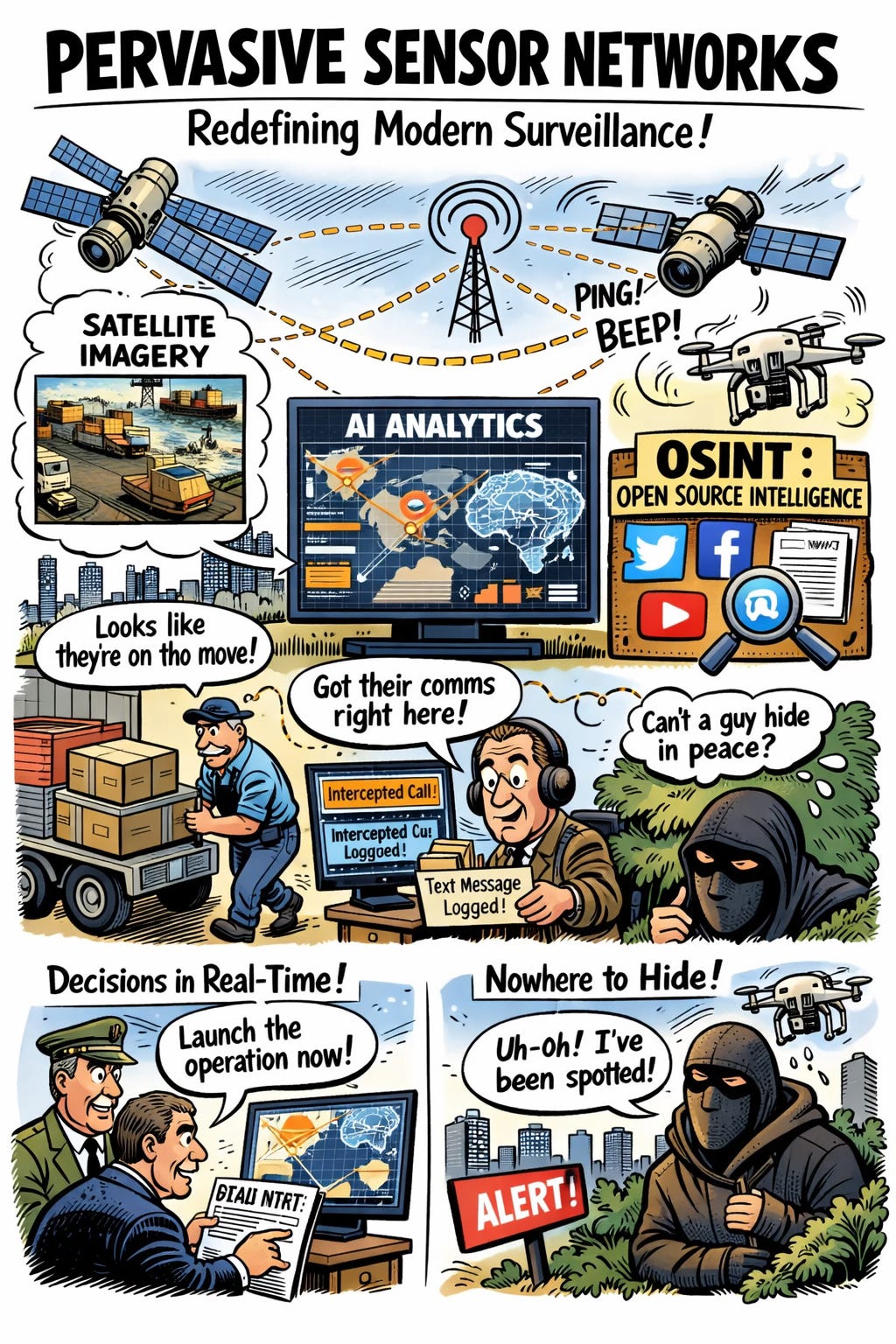
Pervasive Sensor Networks Are Redefining Modern Surveillance
Bottom Line Up Front (BLUF): The spread of commercial satellites, RF mapping tools, connected devices, and AI-driven analytics has created an environment where movements, logistics, and communications generate continuously exploitable data trails. What was once classified collection capability is now widely accessible, compressing decision cycles and making sustained concealment significantly harder for both states and non-state actors.
Analyst Comments: This isn’t just about more cameras or better satellites. It’s about integration. Individually, AIS ship tracking, ADS-B aircraft transponders, cell phone metadata, thermal imagery, synthetic aperture radar (SAR), and social media geolocation are fragmented data streams. Combined and processed with machine learning, they form a layered detection architecture capable of pattern-of-life analysis at scale. The civilian implications are just as significant. Corporate mergers, energy shipments, humanitarian operations, and even political campaigns generate technical exhaust. Data brokers and open-source collectors reduce the barrier to entry for intelligence collection. The line between OSINT and strategic intelligence continues to blur.
READ THE STORY: SWJ
Tool Example: AIS_Tracker
We examined this in December, illustrating how the real power of open-source intelligence lies in disciplined data fusion—where multiple commercial and public feeds, when integrated correctly, produce operationally relevant insight.

From SIGINT to OSINT: Gabriel Fanelli on Languages, Intelligence, and Being Useful (Video)
FROM THE MEDIA: 14 years Army SIGINT. Bronze Star. Former SOCOM OSINT instructor. Fluent in Arabic. Now building world-class intelligence training programs.
What is OSINT and why is it so important? A Former CSIS Officer Explains (Video)
FROM THE MEDIA: A former Intelligence Officer with the Canadian Security Intelligence Service (CSIS), discusses how he first learned about the importance of open-source intelligence (OSINT), the kind of information everyone has access to if they know where to look and the right questions to ask.
The selected stories cover a broad range of cyber threats and are intended to help readers frame key publicly discussed threats and improve overall situational awareness. InfoDom Securities does not endorse any third-party claims made in its original material or related links on its sites; the opinions expressed by third parties are theirs alone. For further questions, don't hesitate to get in touch with InfoDom Securities at dominanceinformation@gmail.com.