
Daily Drop (1244)
02-10-26

Tuesday, Feb 10, 2025 // (IG): BB // GITHUB // SN R&D

TOOL:
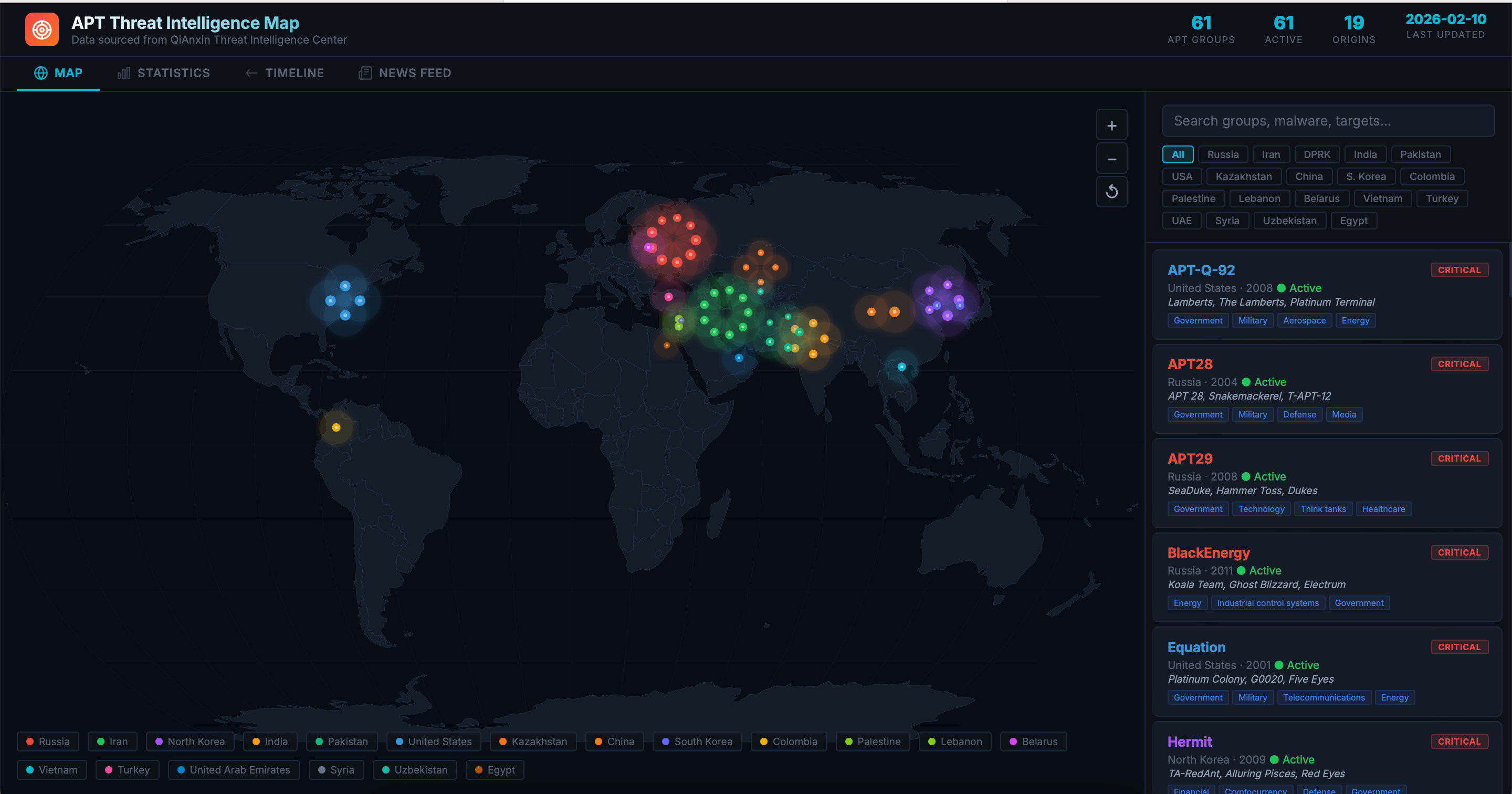
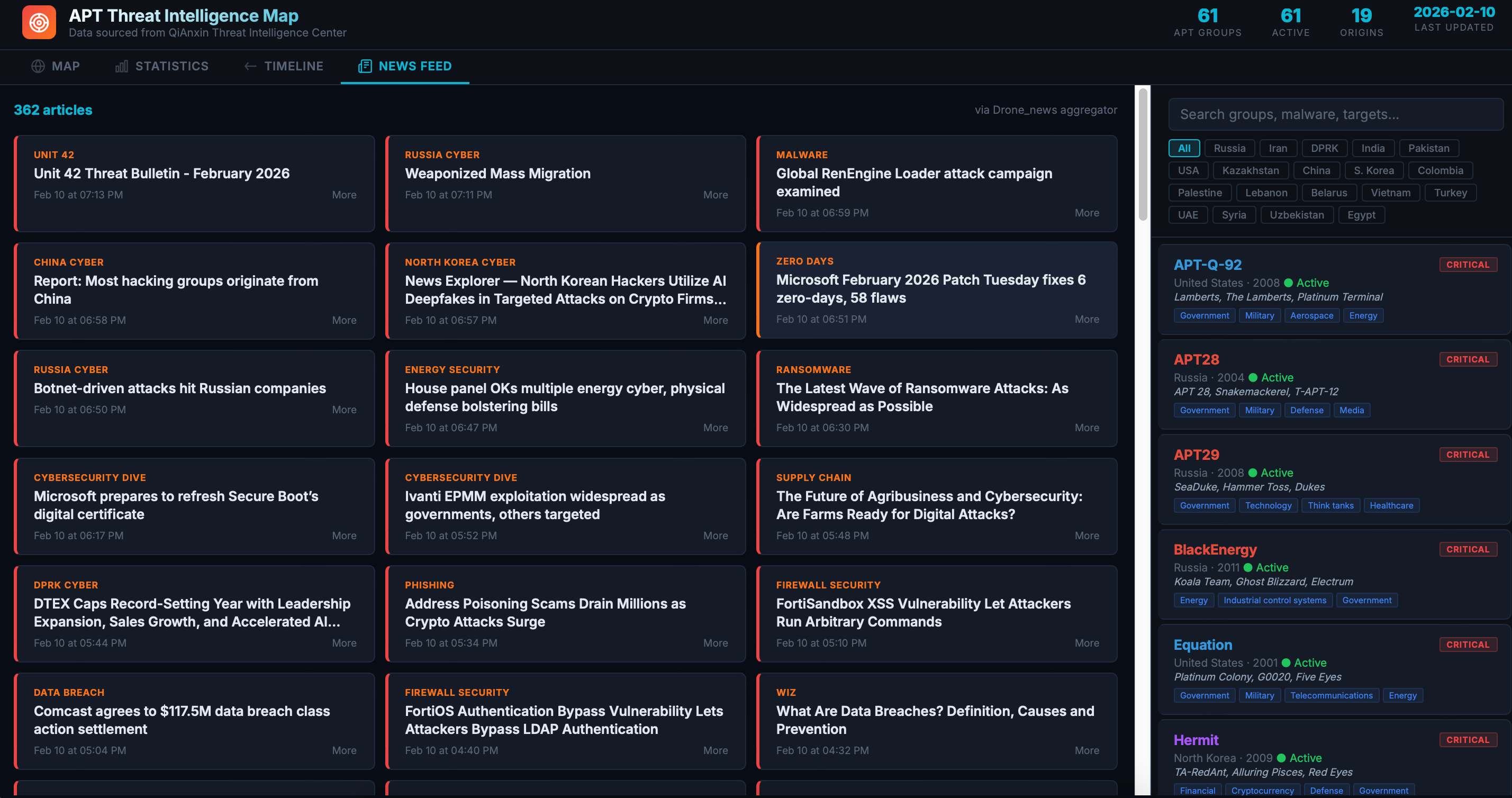
Qianxin Like Threat-intel Panel
Interactive APT threat group map visualization based on QiAnxin Threat Intelligence Center data. Group data is scraped automatically and updated weekly.
NEWS:
Weaponized Mass Migration: Adversaries Turn Human Flows Into Strategic Pressure
Bottom Line Up Front (BLUF): “Weaponized mass migration” describes how hostile states and non-state actors deliberately engineer or exploit migrant flows to coerce Western governments, destabilize societies, and fracture alliances. This is not just a border-management issue: it’s a hybrid-warfare tool that sits alongside energy blackmail, disinformation, cyber operations, and other gray-zone pressure tactics.
Analyst Comments: The mechanics are straightforward: push large numbers of people at vulnerable borders, overload asylum and reception systems, then watch domestic politics tear itself apart. It’s strategically attractive because it’s deniable, morally messy for the target, and cheap for the initiator. For security and policy teams, the shift is mental: migration surges in certain theaters aren’t always just humanitarian spillover—they can be deliberately timed, routed, and amplified. You need intel, border, cyber, and strategic comms people at the same table, because the same actor that helps move bodies to the fence may also run online disinfo, probe border IT systems, and lean on local proxies or NGOs to maximize pressure.
READ THE STORY: FDD
Singapore Says China-Backed Hackers Targeted Largest Phone Companies in ‘Salt Typhoon’ Campaign
Bottom Line Up Front (BLUF): Singapore has disclosed that a China-backed threat group dubbed “Salt Typhoon” targeted the world’s largest telecom operators in a long-running cyber-espionage campaign. The activity appears focused on harvesting call metadata, subscriber information, and network access—turning telcos into strategic intelligence platforms rather than one-off ransomware or disruption targets.
Analyst Comments: A campaign like Salt Typhoon isn’t about billing fraud—it’s about building an enduring, global wiretap-adjacent sensor grid. If you operate a carrier, MVNO, or any core service that touches roaming, lawful intercept, signaling (SS7/DIAMETER), or subscriber management, treat this as confirmation that you are high-priority espionage terrain. For everyone else, the implication is that “secure comms” can be undermined at the infrastructure layer even if app crypto is solid—movement patterns, contact graphs, and identifiers are still in play.
READ THE STORY: TC
CISA Warns of Russian Cyber Threats to Poland’s Power Grid
Bottom Line Up Front (BLUF): CISA has issued a warning about Russian state-linked cyber activity targeting Poland’s power grid, highlighting attempts to compromise ICS/OT networks supporting electricity transmission and distribution. Even if no major outage has occurred yet, the advisory frames Poland’s grid as an active target in the broader Russia–NATO confrontation and a proxy warning for other European and North American operators.
Analyst Comments: Poland is a logistics hub for Ukraine and a frontline NATO state—any serious Russian positioning against its power sector is both leverage and messaging. This should be read in the context of Russia’s past grid operations in Ukraine: pre-positioning in OT networks, using IT-side creds as the entry point, and timing disruption for maximum political or military impact. For defenders in power, gas, and critical infrastructure more broadly, assume: (1) reconnaissance and access attempts against OT are happening now, not hypothetically; (2) identity, remote access, and segmentation between IT and OT are as important as patching any single CVE; and (3) whatever TTPs CISA highlights for Poland are a blueprint for what you should be hunting in your own environment, even if you’re not named in the advisory.
READ THE STORY: CyberScoop
Fancy Bear Exploits Zero-Day in Widely Used Enterprise Software
Bottom Line Up Front (BLUF): Russia-linked APT28 (Fancy Bear) is actively exploiting a previously unknown zero-day in widely deployed enterprise software to gain initial access, steal credentials, and establish persistence in government and high-value corporate networks. For defenders, this is yet another reminder that patching alone won’t save you when the threat actor is living in the pre-patch window—exploitation telemetry, hardening, and rigorous identity controls matter as much as waiting for a vendor fix.
Analyst Comments: The real risk isn’t just initial RCE—it’s everything that happens after: credential harvesting, OAuth and session token abuse, email and document exfil, and quiet persistence that survives patching. By the time public reporting appears, assume they’ve had weeks or months of dwell time somewhere. Defenders should treat this first as an identity and post-exploitation hunt problem: tighten conditional access, enforce phishing-resistant MFA, and go hunting for APT28’s usual TTPs—odd VPN and SSO patterns, suspicious OAuth consents, admin role changes, and living-off-the-land tooling.
READ THE STORY: Cyber Press
Russia Starts Limiting Access to Telegram
Bottom Line Up Front (BLUF): Russian authorities and/or ISPs have begun restricting access to Telegram inside Russia, tightening control over one of the last major platforms that still allowed relatively unfiltered communication. For users, this means more reliance on VPNs and circumvention tools; for policymakers and security teams, it’s another step in Russia’s broader push to segment and control its domestic internet space.
Analyst Comments: The move is about three things at once: information control (especially around war coverage, mobilization, and domestic criticism), security service visibility (pushing people toward more monitored or controllable channels), and leverage over a platform that also hosts cybercrime markets, grey-area channels, and cross-border communities. Practically, expect more Russian users to normalize VPNs and proxy tools, while some communities migrate to smaller, harder-to-track platforms. For threat intel and security teams, don’t forget the other side of this: as Telegram access tightens in Russia, some criminal or state-linked activity may shift to alternative infrastructures, including private forums and different encrypted messengers—your visibility into Russian-origin activity may get noisier, not cleaner.
READ THE STORY: CN
TeamPCP Turns Cloud Infrastructure Into Crime Bots
Bottom Line Up Front (BLUF): Researchers describe TeamPCP abusing mainstream cloud providers to spin up disposable “crime bots” — short-lived cloud instances used for automated attacks and abuse. Instead of relying on traditional botnets or bulletproof hosting, the group is turning elastic cloud resources into attack infrastructure, complicating attribution and making simple IP-based blocking far less effective.
Analyst Comments: Groups like TeamPCP don’t need compromised IoT at scale when they can hijack or cheaply rent cloud accounts, launch credential stuffing, scanning, and other automated abuse from clean, high-reputation IP ranges, then tear everything down and start over. For defenders, that means three practical shifts: (1) stop mentally whitelisting “cloud IPs” — treat them as hostile internet like everything else; (2) lean harder on strong authentication, behavioral and risk-based controls, and rate limiting rather than static IP blocks; and (3) push vendors and cloud partners for better abuse telemetry and takedown responsiveness.
READ THE STORY: DR
APT36 Expands Toolkit to Target Linux Systems
Bottom Line Up Front (BLUF): Pakistan-linked APT36 (aka Transparent Tribe) is reportedly expanding its tooling to include Linux-focused malware, moving beyond its historically Windows-heavy stack. That puts Linux workstations and servers used in government, defense, and research—especially in India and the wider region—firmly in scope for credential theft, espionage, and long-term access operations.
Analyst Comments: Adding native Linux capability means they’re aiming at developers, admins, and mixed-OS environments where the real keys (source code, SSH keys, VPN creds, internal tools) often live. Treat this as an evolutionary step, not a brand-new threat: same targeting, same espionage objectives, but broader coverage across your estate. If your threat model includes South Asia–focused APTs, stop treating Linux as a second-class citizen in your EDR and logging strategy—SSH, sudo, cron, and systemd are now as interesting as Winlogon and LSASS. Also expect the usual APT36 delivery paths: phishing, lure docs tied to regional politics, and fake portals for defense/edu logins pivoting into Linux boxes where possible.
READ THE STORY: GBhackers
Apple AirTag Speaker Easily Disabled, Raising Privacy Concerns
Bottom Line Up Front (BLUF): Security reporting indicates that Apple AirTags can be easily modified to disable their built-in speaker, undermining one of the core anti-stalking safeguards and raising fresh concerns about covert tracking of individuals, vehicles, and high-value assets
Analyst Comments: The speaker is supposed to be the physical fail-safe—if your phone-based alerts don’t trigger or you’re on a non-Apple device, the tag will eventually start making noise. If attackers can cut or remove the speaker in a few minutes with basic tools, or simply buy pre-modified “silent AirTags” online, that safety net effectively disappears. The risk profile is obvious: domestic abuse and intimate-partner stalking, physical surveillance of executives or journalists, and quiet tracking of company vehicles or equipment. Software-side mitigations (iOS alerts, Android apps, periodic checks for unknown trackers) help, but they assume victims have the right device, the right settings, and know what to look for.
READ THE STORY: SCMEDIA
SoundCloud Data Breach Exposes 29.8 Million User Accounts
Bottom Line Up Front (BLUF): Reporting indicates that SoundCloud suffered a data breach exposing information tied to roughly 29.8 million user accounts. Even if passwords weren’t all directly exposed in plaintext, the scale alone makes this a credential-stuffing and phishing enabler, with downstream risk for any other services where users reused the same credentials or email identifiers.
Analyst Comments: Nearly 30 million records means a large pool of emails, usernames, and other account metadata that can feed targeted phishing, password-reuse attacks, and profiling. For enterprises, the immediate concern isn’t SoundCloud itself—it’s employees reusing passwords or email aliases across consumer and corporate accounts. Expect this dataset (or subsets of it) to show up in combo lists used for automated login attempts. Practical moves: push another round of password-manager/MFA hygiene comms, tighten detection for credential-stuffing patterns against your own apps, and assume that any address that ever touched SoundCloud may now receive more convincing, music- or account-themed phishing.
READ THE STORY: WFIN
Items of interest
House Panel OKs Multiple Energy Cyber, Physical Defense-Bolstering Bills
Bottom Line Up Front (BLUF): A US House committee has advanced several bills aimed at strengthening cyber and physical security for the energy sector, including measures to harden critical infrastructure, improve incident reporting and information sharing, and bolster federal support for utilities. None of this changes the threat overnight, but it signals continued bipartisan concern that power, gas, and pipeline operators are not where they need to be on resilience against nation-state and criminal threats.
Analyst Comments: Expect these bills to lean on three themes: more federal money and technical assistance for smaller utilities that don’t have deep security benches; stronger requirements (formal or de facto) around planning, incident reporting, and coordination; and closer integration between energy regulators and national cyber authorities. For operators, the main impact is likely more paperwork and more scrutiny—but also more access to guidance, tools, and funding if you engage early instead of waiting for mandates to land. Don’t treat this as abstract DC noise: if you’re in power, gas, or pipelines, assume that whatever moves out of this committee will eventually show up as new compliance hooks, updated standards, and tougher expectations around OT segmentation, monitoring, and response.
READ THE STORY: SCMEDIA
Power Grid OT Cyber Security (Video)
FROM THE MEDIA: RECAP enables peer cybersecurity assessments among electric utility cooperatives. Jon has conducted multiple RECAP assessments for co-ops throughout the US.
How AI uses our drinking water (Video)
FROM THE MEDIA: There are concerns artificial intelligence is putting stress on drinking water sources. Here, we explain why AI uses water and how even more will be needed in the future.
The selected stories cover a broad range of cyber threats and are intended to help readers frame key publicly discussed threats and improve overall situational awareness. InfoDom Securities does not endorse any third-party claims made in its original material or related links on its sites; the opinions expressed by third parties are theirs alone. For further questions, don't hesitate to get in touch with InfoDom Securities at dominanceinformation@gmail.com.