
Daily Drop (1240)
02-06-26

Friday, Feb 06, 2025 // (IG): BB // GITHUB // SN R&D
Taiwan Defense Minister Warns of Complacency Toward Chinese Military Pressure
Bottom Line Up Front (BLUF): Taiwan’s defense minister has warned that the public risks becoming desensitized to sustained Chinese military pressure, including near-daily PLA aircraft sorties and naval activity around the island. Speaking to local media, he stressed that Beijing’s campaign is designed to normalize coercion, erode vigilance, and weaken societal readiness ahead of any future escalation.
Analyst Comments: This is a candid admission of one of Beijing’s most effective tools: pressure without climax. By maintaining a constant tempo of gray-zone operations, China aims to make extraordinary military activity feel routine. Over time, that dulls public alarm, complicates political decision-making, and raises the risk that a real escalation is misread as just another drill.
READ THE STORY: NOVA
Asian Government–Linked Espionage Campaign Breaches Critical Infrastructure Across Multiple Countries
Bottom Line Up Front (BLUF): An espionage campaign attributed to Asian government–linked threat actors has compromised critical infrastructure networks in at least three countries, according to Cybersecurity Dive. The intrusions targeted sectors including energy, water, and telecommunications, with attackers seeking long-term access rather than immediate disruption—raising concerns about pre-positioning for future crises.
Analyst Comments: While the reporting avoids firm attribution, the tactics align with campaigns associated with China-nexus actors—living-off-the-land techniques, exploitation of edge devices, and patient reconnaissance of OT/ICS environments. The risk isn’t what happened—it’s what could happen later. Access to water treatment controls, power management systems, or telecom routing offers leverage in both peacetime coercion and wartime escalation. For defenders, this reinforces the urgency of segmentation between IT and OT, aggressive patching of perimeter devices, and continuous monitoring for low-and-slow activity that traditional alerting often misses.
READ THE STORY: CyberSecDive
U.S., China Decline to Opt Into AI Military Pledge: Guardrails Take Back Seat to Strategic Competition
Bottom Line Up Front (BLUF): The United States and China refused to opt into a voluntary declaration on military uses of AI at an international summit, underscoring deep mistrust and intensifying competition over AI-enabled warfare. As reported by Cybernews, both powers signaled they are unwilling to constrain development or deployment of AI systems that could offer battlefield or strategic advantage.
Analyst Comments: Voluntary norms only work when leading powers believe restraint benefits them more than their rivals. Right now, neither Washington nor Beijing sees that trade-off. For the U.S., AI is central to maintaining military edge across ISR, targeting, cyber operations, and logistics. For China, AI is a shortcut to offset conventional disadvantages and accelerate modernization. The refusal to opt in doesn’t mean there are no internal rules; it means those rules will remain classified, unilateral, and flexible. That increases the risk of miscalculation, especially as AI systems are integrated into decision-support, cyber operations, and autonomous platforms where speed compresses human judgment. Expect more rhetorical support for “responsible AI,” but little appetite for binding commitments—particularly in the military domain.
READ THE STORY: CN
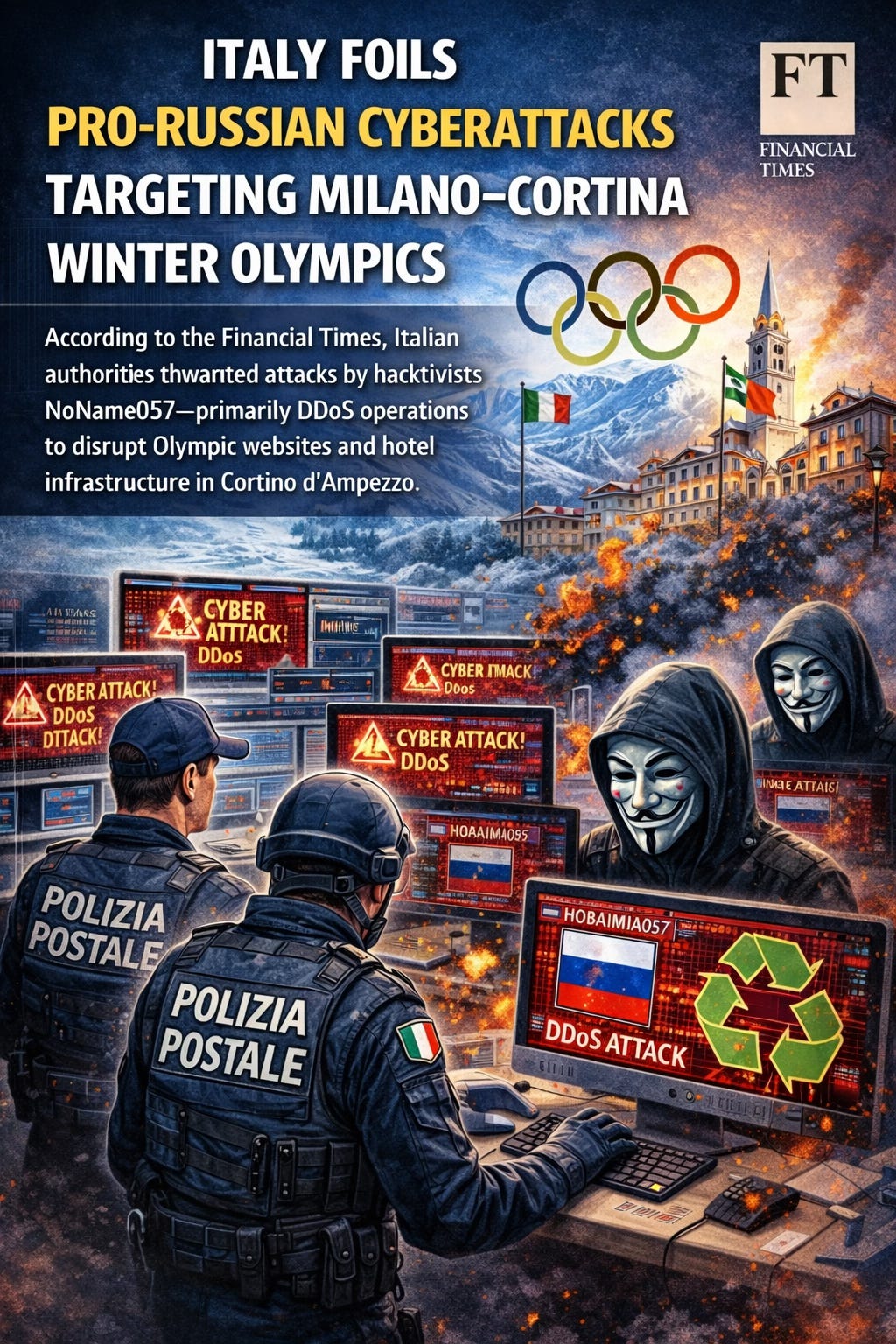
Russia-Linked Hacktivists Target Milano–Cortina Winter Olympics: Italy Repels DDoS Campaign Ahead of Opening Ceremony
Bottom Line Up Front (BLUF): Italian authorities have successfully foiled cyberattacks linked to pro-Russian hacktivists targeting the Milano–Cortina Winter Olympics, according to the Financial Times. The attacks—primarily DDoS operations attributed to the group NoName057—sought to disrupt Olympic-related websites and hotel infrastructure in Cortina d’Ampezzo ahead of the Games’ opening ceremony.
Analyst Comments: Major international events are now routine targets for Russia-aligned cyber actors, especially in countries that openly support Ukraine. While DDoS attacks are technically unsophisticated, they serve strategic messaging goals: disruption, intimidation, and narrative signaling at politically sensitive moments. Italy’s response also tells an important defensive story. Since 2021, Rome has invested heavily in cyber resilience, and it’s paying off. The ability to blunt these attacks—with only ~10% success rates compared to ~50% just a few years ago—shows that institutional cyber maturity works, particularly against nuisance-level threats. That said, hacktivism often functions as a screening layer: low-end attacks can mask reconnaissance or testing activity by more capable state-linked actors operating elsewhere..
READ THE STORY: FT
Norway Warns of Stepped-Up Russian Espionage in the Arctic: Intelligence Activity Targets NATO’s Northern Flank
Bottom Line Up Front (BLUF): Norway’s domestic intelligence service says Russian espionage activity in the Arctic has intensified, with a focus on military infrastructure, energy assets, and NATO operations along the High North. Reporting by Al Arabiya English highlights Oslo’s concern that Moscow is expanding intelligence collection as Arctic routes and resources gain strategic importance.
Analyst Comments: As NATO hardens its northern posture and Arctic sea lanes become more viable, Russia is reverting to a Cold War-style intelligence focus—but with modern tools. Espionage here isn’t limited to classic HUMINT; it increasingly blends SIGINT, cyber intrusion, maritime ISR, and dual-use commercial activity. Norway’s warning matters because it sits at the seam between Russia’s Northern Fleet, undersea infrastructure, and allied early-warning systems. Any intelligence gains in this region directly affect submarine operations, missile defense, and energy security. Expect Russian collection to continue under civilian and commercial cover, alongside probing cyber activity against telecoms, ports, and energy operators.
READ THE STORY: Alarabiya
Russian War Game Simulates NATO Defeat at Suwałki Gap: Exercise Highlights Persistent Baltic Flashpoint
Bottom Line Up Front (BLUF): A recent Russian military war game simulated a scenario in which Moscow’s forces rapidly overran NATO defenses at the Suwałki Gap, the narrow land corridor linking Poland to Lithuania. Reporting by The Telegraph cites a senior Western general warning that the exercise underscores Russia’s continued focus on exploiting one of NATO’s most vulnerable geographic chokepoints.
Analyst Comments: War games like this are less about predicting outcomes and more about shaping doctrine, testing assumptions, and signaling intent. They also serve an internal purpose—reinforcing the narrative that Russia can still challenge NATO despite battlefield setbacks elsewhere. For NATO, the message is clear: deterrence in the Baltics depends on speed, forward presence, integrated air and missile defense, and resilience against cyber and EW disruption in the opening hours of a conflict.
READ THE STORY: The Telegraph
Russia Denies Use of Chinese Chips in S-400 and Su-57 Systems: Assurance Aimed at India Amid Tech Dependence Concerns
Bottom Line Up Front (BLUF): Russia has publicly rejected claims that its S-400 air defense systems and Su-57 fighter jets rely on Chinese semiconductors, asserting that the platforms maintain strategic technological autonomy. As reported on Defence.in, the denial appears calibrated to reassure India, a key defense customer increasingly sensitive to supply chain risk, sanctions exposure, and China-linked technology dependencies.
Analyst Comments: Since Western export controls tightened, Russia’s defense-industrial base has faced acute constraints in microelectronics, forcing reliance on gray-market sourcing, commercial off-the-shelf (COTS) components, and third-country intermediaries. Publicly distancing flagship systems from Chinese chips serves two purposes: preserving export credibility and countering perceptions that Russia has slipped into technological dependence on Beijing.
READ THE STORY: Defense.in
Items of interest
Russian Hackers Weaponize Office Zero-Day Within Days: Rapid Exploitation Targets European Government Networks
Bottom Line Up Front (BLUF): Russian threat actors exploited a previously unknown Microsoft Office vulnerability within days of its discovery, using it in targeted attacks against European government and policy organizations. According to Dark Reading, the zero-day was rapidly integrated into spearphishing campaigns, bypassing standard defenses and enabling remote code execution (RCE) via malicious documents.
Analyst Comments: Russian APTs—likely groups such as APT28 or Sandworm—have shown a consistent ability to operationalize vulnerabilities almost immediately, especially when targeting diplomatic or defense-related networks. The attack chain appears tailored for precision: minimal indicators, rapid delivery, and selective targeting. For defenders, this underscores the urgent need for Office macro hardening, content disarm and reconstruction (CDR), and fast-track patch deployment pipelines. Expect follow-on payloads involving credential theft, C2 beacons, or even wipers in high-value environments.
READ THE STORY: DR
Chaining Vulnerabilities Like a Pro Bug Bounty Hunter (Video)
FROM THE MEDIA: Whether you're a beginner or an experienced bug hunter, this video will give you valuable insights and techniques to elevate your hacking game. Don't miss out—your next big find could be just one chain away.
Sina Kheirkhah - Unveiling the Ivanti vulnerability: from discovery to exploitation (Video)
FROM THE MEDIA: Unveiling the Ivanti vulnerability: from discovery to exploitation
The selected stories cover a broad range of cyber threats and are intended to help readers frame key publicly discussed threats and improve overall situational awareness. InfoDom Securities does not endorse any third-party claims made in its original material or related links on its sites; the opinions expressed by third parties are theirs alone. For further questions, don't hesitate to get in touch with InfoDom Securities at dominanceinformation@gmail.com.