
Daily Drop (1238)
02-04-26

Wednesday, Feb 04, 2025 // (IG): BB // GITHUB // SN R&D
U.S.S. Abraham Lincoln Downs Iranian Drone in Gulf: Rising Tensions Highlight Risk of Escalation in Maritime and Cyber Domains
Bottom Line Up Front (BLUF): The U.S.S. Abraham Lincoln shot down an Iranian drone in the Gulf of Aden on February 2nd, according to a report from the Foundation for Defense of Democracies (FDD). The drone approached within threatening range of the carrier strike group during heightened regional tensions, particularly involving Yemen’s Houthi rebels and Iran’s IRGC-QF.
Analyst Comments: Iran has increasingly leaned on asymmetric assets like drones and cyber capabilities to project power and probe U.S. resolve. The downing of this drone, likely an ISR platform, reinforces red lines around U.S. naval presence—but could also invite retaliation, including cyber disruption targeting maritime logistics or U.S. regional infrastructure. Expect a parallel spike in cyber domain activity: phishing campaigns, ICS reconnaissance, or wiper malware deployments attributed to Iranian APTs, particularly in the Gulf or Red Sea region.
READ THE STORY: FDD
Iranian Cyberattack Disrupted Israeli Air Force Operations: Military Now Treating Cyber as Kinetic Threat Vector
Bottom Line Up Front (BLUF): A recent Iranian cyberattack reportedly disrupted Israeli Air Force (IAF) operations, temporarily grounding flights and triggering a reevaluation of how the military classifies cyber threats. According to The Jerusalem Post, this marks one of the first confirmed instances where a cyber incident directly affected operational readiness in Israel’s military.
Analyst Comments: Cyber has now tangibly crossed into the kinetic realm for Israel’s defense establishment. While details remain classified, grounding aircraft—even briefly—indicates either system-level compromise (e.g., mission planning, comms, or logistics) or credible concern about integrity. Iran has been escalating its cyber ops from nuisance-level defacements to strategic disruption, often via APTs like MuddyWater or Agrius. The IDF’s shift in doctrine—treating cyber incidents as legitimate triggers for kinetic retaliation—raises the stakes for any future campaign. Expect increased Israeli cyber activity, including preemptive strikes and rapid attribution, especially if IRGC-linked operators are involved.
READ THE STORY: JP
U.S. Senator Pushes for Tomahawk Missiles to Ukraine as Russia Renews Long-Range Strikes
Bottom Line Up Front (BLUF): U.S. Senator Lindsey Graham has called for supplying Tomahawk cruise missiles to Ukraine following a renewed wave of Russian missile strikes that targeted cities including Kharkiv and Kyiv. His comments come as Ukraine’s air defense systems remain strained and critical infrastructure faces sustained bombardment.
Analyst Comments: Punishing Owl has conducted stealthy intrusions into multiple high-value networks in Asia, using custom loaders and modular payloads to establish persistence. The group heavily leverages legitimate system tools (LOLBins), minimizing their malware footprint. Their infrastructure overlaps with older, unattributed espionage campaigns, and early indicators suggest links to a larger threat ecosystem active in the region. The report emphasizes that detection is difficult due to the group’s low-and-slow tactics and recommends behavioral monitoring and network anomaly detection over signature-based defenses.
READ THE STORY: United24
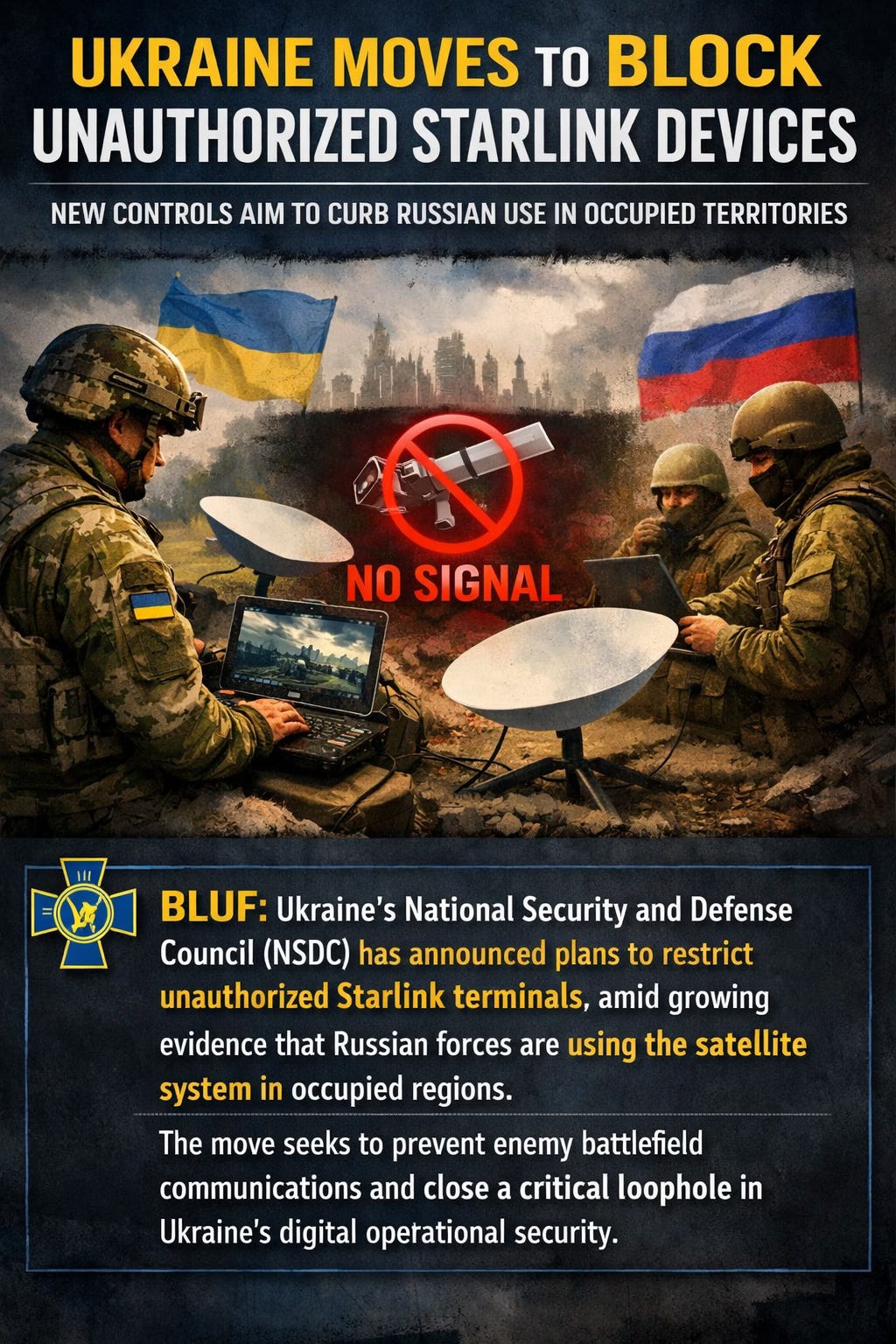
Ukraine Moves to Block Unauthorized Starlink Devices: New Controls Aim to Curb Russian Use in Occupied Territories
Bottom Line Up Front (BLUF): Ukraine’s National Security and Defense Council (NSDC) has announced plans to restrict unauthorized Starlink terminals, amid growing evidence that Russian forces are using the satellite system in occupied regions. The move seeks to prevent enemy battlefield communications and close a critical loophole in Ukraine’s digital operational security.
Analyst Comments: While it remains vital for frontline connectivity, unregulated access—especially through black-market or repurposed terminals—presents a serious risk. Russian forces leveraging Starlink for encrypted, resilient comms poses a direct threat to Ukrainian operational security and ISR efforts. Kyiv’s crackdown is a necessary countermeasure but will require tight coordination with SpaceX and allied partners to enforce geofencing or hardware-level restrictions. This also underscores the fragility of relying on commercial infrastructure in high-intensity conflicts.
READ THE STORY: InCyber
Massive Data Spill Exposes 8.7 Billion Chinese Records: Leaked MongoDB Instance Reveals Years of National Surveillance
Bottom Line Up Front (BLUF): An unsecured MongoDB database exposed 8.7 billion records tied to Chinese citizens, including facial recognition data, license plate scans, and real-time location tracking. Discovered by cybersecurity researcher Jeremiah Fowler, the trove appears to originate from a national-level surveillance program, with ties to Chinese police or military operations. The leak is one of the largest breaches of state-level surveillance data ever recorded.
Analyst Comments: The sheer volume and sensitivity of the records make this a goldmine for foreign intelligence, threat actors, and human rights advocates alike. While MongoDB misconfigurations are depressingly common, the exposure of data at this scale and sensitivity—linked to surveillance infrastructure—points to shocking operational negligence. Expect Beijing to downplay or deny, but behind the scenes, remediation will be urgent and sweeping. If confirmed, this leak could be used for counterintelligence, disinformation targeting, or sanctions justification by foreign governments.
READ THE STORY: Techdigest
UK-Japan Forge Cyber-Minerals Pact to Derisk China: Strategic Alliance Targets Supply Chain and Critical Infrastructure Resilience
Bottom Line Up Front (BLUF): The UK and Japan have announced a joint initiative to strengthen cybersecurity and secure critical mineral supply chains, aiming to reduce strategic dependence on China. The bilateral deal, signed in Tokyo, links digital infrastructure protections with rare earth sourcing, framing the effort as a national security priority amid rising geopolitical tensions.
Analyst Comments: Trade envoys emphasized mutual threats to digital systems and supply security, citing China's dominance in rare earth processing and its record of cyber intrusions. The agreement will fund joint research on post-quantum encryption, critical infrastructure hardening, and traceable, ethical mineral sourcing. Both countries plan to share threat intelligence and conduct joint cyber exercises, particularly targeting supply chain attack simulations. The deal also hints at expanded cooperation with allies like the U.S. and Australia under broader Indo-Pacific security frameworks.
READ THE STORY: TFG
Iran’s Starlink Crackdown and Ukraine’s From Deterrence to Offensive Defense: Türkiye’s NDS-26 Signals Strategic Cyber Posture Shift
Bottom Line Up Front (BLUF): Türkiye’s newly released National Defense Strategy 2026 (NDS-26) outlines a doctrinal shift from reactive deterrence to proactive “offensive defense” in cyberspace. The strategy emphasizes cyber operations, hybrid warfare, and technological sovereignty, positioning Türkiye as a more assertive digital actor amid regional and global power realignments.
Analyst Comments: NDS-26 reflects a growing trend among mid-tier cyber powers: shedding passive doctrine in favor of preemptive or retaliatory capabilities. Türkiye’s move into “offensive defense” parallels developments seen in Iran, Israel, and some NATO states, but with a uniquely multipolar framing—balancing NATO ties with Eurasian ambitions. Expect increased investment in domestic cyber tooling, AI-driven ISR, and dual-use infrastructure. The strategy’s ambiguity around attribution thresholds and red lines may raise concerns about escalation in contested digital spaces like the Eastern Mediterranean or North Africa.
READ THE STORY: Dailysabah
Truesec Flags OpDenmark Threat: Russian Hacktivist “Cyber Army” Warns of Large-Scale Attacks on Danish Critical Infrastructure
Bottom Line Up Front (BLUF): Cybersecurity firm Truesec has warned of credible threats against Danish infrastructure following a public declaration by the pro-Russian hacktivist group “Cyber Army of Russia Reborn.” The campaign, dubbed #OpDenmark, threatens large-scale cyberattacks targeting the country’s energy, water, and government sectors, escalating Moscow-aligned cyber pressure on NATO states.
Analyst Comments: Denmark’s vocal support for Ukraine and its hosting of NATO-critical infrastructure make it a prime symbolic and strategic target. Truesec’s early warning should be taken seriously: we’ve seen this playbook before in Lithuania, Estonia, and Poland—initial disruptions followed by opportunistic intrusions. Organizations in energy, logistics, and public services should activate heightened monitoring, review segmentation controls, and prepare for layered attacks blending nuisance and real compromise attempts.
READ THE STORY: Industrial
Ukraine Moves to Block Unauthorized Starlink Devices: New Controls Aim to Curb Russian Use in Occupied Territories
Bottom Line Up Front (BLUF): Ukraine’s National Security and Defense Council (NSDC) has announced plans to restrict unauthorized Starlink terminals, amid growing evidence that Russian forces are using the satellite system in occupied regions. The move seeks to prevent enemy battlefield communications and close a critical loophole in Ukraine’s digital operational security.
Analyst Comments: While it remains vital for frontline connectivity, unregulated access—especially through black-market or repurposed terminals—presents a serious risk. Russian forces leveraging Starlink for encrypted, resilient comms poses a direct threat to Ukrainian operational security and ISR efforts. Kyiv’s crackdown is a necessary countermeasure but will require tight coordination with SpaceX and allied partners to enforce geofencing or hardware-level restrictions. This also underscores the fragility of relying on commercial infrastructure in high-intensity conflicts.
READ THE STORY: InCyber
Lotus Blossom APT Suspected in Notepad++ Infrastructure Breach: Supply Chain Attack Targets Widely Used Developer Tool
Bottom Line Up Front (BLUF): Security researchers have linked the recent compromise of Notepad++’s infrastructure to the China-aligned APT group Lotus Blossom. The attackers reportedly hijacked the update mechanism of the popular open-source text editor, creating a potential supply chain attack affecting millions of developers and organizations worldwide.
Analyst Comments: Notepad++ is deeply embedded in development and administrative workflows across sectors, meaning compromise here could grant wide access to downstream systems. If confirmed, this fits Lotus Blossom’s past behavior—quiet infiltration via trusted regional software, often to enable espionage and persistent access. The open-source angle is a double-edged sword: transparency doesn’t always translate to secure infrastructure. Organizations should treat recent Notepad++ updates as suspect, audit usage across their environments, and move toward signed, reproducible builds or curated internal mirrors where feasible.
READ THE STORY: SA
Senator Claims Telecom Lobby Blocked Salt Typhoon Report: Alleged Chinese Hacking Campaign Remains Under Wraps
Bottom Line Up Front (BLUF): Senator Maria Cantwell (D-WA) has accused major U.S. telecommunications companies of obstructing the release of a federal report on Salt Typhoon, a suspected Chinese cyber espionage operation targeting U.S. critical infrastructure. The report, drafted by the DHS and FBI, allegedly details intrusions into telecom networks, but remains unpublished amid industry pushback.
Analyst Comments: Telecoms sit at the core of national infrastructure—if adversary access isn’t being disclosed to avoid reputational or regulatory fallout, that’s a systemic vulnerability. Salt Typhoon (also tracked as Volt Typhoon) already represents a shift in Chinese cyber operations: stealthy, long-term access with an eye toward pre-positioning rather than immediate disruption. Transparency matters here. Without visibility into these intrusions, defenders across sectors lose critical context on TTPs and risk exposure. Expect renewed pressure on regulators to compel disclosure and closer scrutiny of private-sector cooperation in infrastructure defense.
READ THE STORY: CS
Critique Emerges Over U.S.–China Tech Policy: Experts Warn Current Restrictions Risk Undermining National Security Goals
Bottom Line Up Front (BLUF): A new Lawfare op-ed argues that the U.S. approach to tech restrictions on China—particularly around semiconductors and AI—may be counterproductive, citing vague policy goals, poor enforcement mechanisms, and a lack of coordination with allies. The piece warns that current measures could harm U.S. innovation and resilience more than they hinder Beijing.
Analyst Comments: The U.S. has leaned hard on export controls and investment screening, but if enforcement is inconsistent and allies aren’t fully aligned, these tools bleed effectiveness. Worse, if domestic R&D is underfunded or burdened by compliance overhead, the U.S. risks weakening its own tech base. From a cyber defense perspective, an overemphasis on blunt restrictions can obscure the need for deeper resilience—like hardening supply chains, securing firmware, and scaling secure-by-design practices. Deterring China’s tech rise is one thing; outpacing it requires more than bans.
READ THE STORY: Lawfare
Post–Rising Lion Shift: Israel Adopts More Assertive, Preemptive Posture Toward Iran
Bottom Line Up Front (BLUF): Since Operation Rising Lion, Israel has visibly hardened its military and cyber posture against Iran, moving from reactive containment to more proactive and preemptive actions. According to a World Israel News analysis, this includes expanded rules of engagement, deeper coordination with Western partners, and enhanced readiness for multi-domain conflict—particularly in response to Iran’s advancing nuclear program and proxy activity.
Analyst Comments: While it has long conducted covert or deniable strikes (including in cyberspace), the aftermath of Rising Lion signals a shift toward bolder, publicly acknowledged action. This likely includes faster attribution, retaliatory hacks, and preemptive strikes on Iranian-linked infrastructure, both physical and digital. For defenders across the region, expect increased cyber spillover, intensified Iranian proxy retaliation, and heightened pressure on air and missile defense systems—especially if cyber capabilities are used to blind early warning assets.
READ THE STORY: WIN
Australia Sanctions Iranian Officials and IRGC Units Over Cyber and Human Rights Abuses
Bottom Line Up Front (BLUF): Australia has imposed new sanctions on multiple Iranian officials and Islamic Revolutionary Guard Corps (IRGC) units, citing widespread repression, cyber operations, and surveillance abuses. The move targets both domestic crackdowns and transnational cyber activity, signaling Canberra’s alignment with broader Western efforts to constrain Iran’s hybrid threat apparatus.
Analyst Comments: The inclusion of IRGC-linked cyber units suggests growing concern over Iranian influence operations and offensive campaigns targeting diaspora communities, dissidents, and foreign infrastructure. It also reinforces a pattern of coordinated sanctions seen in the EU, U.S., and UK. While direct deterrence remains limited, sanctions create operational friction for these units and raise the cost of cross-border cyber repression. Watch for retaliatory targeting of Australian institutions by Iran-aligned threat actors, especially in the information space.
READ THE STORY: IW
U.S. Eyes Sanctions on Foreign Interference in Colombian Elections: Trump-Era Policy Resurfaces Amid New Regional Concerns
Bottom Line Up Front (BLUF): The U.S. is reportedly coordinating with Colombia on potential sanctions related to foreign election interference, revisiting frameworks developed during the Trump administration. While specifics remain unclear, the move appears aimed at countering Russian and possibly Chinese influence operations in Latin America, including disinformation and cyber intrusion campaigns.
Analyst Comments: Colombia is a key regional partner with growing digital vulnerabilities, and any perception of outside manipulation (especially tied to U.S. adversaries) will trigger swift diplomatic and economic responses. While the Trump-era policies focused largely on Venezuela and Cuba, this iteration seems tuned to newer threat actors like Russia’s GRU-linked information ops and China’s expanding tech footprint. For defenders, this underscores the need to monitor regional disinfo pipelines, digital election infrastructure, and adversarial narratives spreading across Spanish-language platforms.
READ THE STORY: AA
China Adopts Hardline Tactics Against Cross-Border Cybercrime: Mass Deportations and AI Surveillance Target Southeast Asia Operations
Bottom Line Up Front (BLUF): China is intensifying its crackdown on cross-border cyber fraud, targeting scam syndicates operating in Southeast Asia with mass deportations, expanded AI surveillance, and joint law enforcement operations. According to CyberNews, the campaign reflects Beijing’s growing concern over the scale and reputational risk of cybercrime originating from neighboring countries but affecting Chinese citizens.
Analyst Comments: China’s moves here signal a sharp pivot from passive toleration to aggressive suppression of cybercriminal ecosystems that once thrived with tacit approval or indifference. The shift is likely driven by internal political pressure and reputational risk as scams targeting Chinese nationals balloon into a national security concern. From a cyber defense standpoint, Beijing’s use of AI for behavioral profiling and cross-border tracking also foreshadows how state-level cyber policing may evolve—blending surveillance, predictive analytics, and political enforcement. Watch for knock-on effects in regional cybercrime flows as displaced actors pivot to Western targets or deepen operational security.
READ THE STORY: CN
Items of interest
Russian Hackers Weaponize Office Zero-Day Within Days: Rapid Exploitation Targets European Government Networks
Bottom Line Up Front (BLUF): Russian threat actors exploited a previously unknown Microsoft Office vulnerability within days of its discovery, using it in targeted attacks against European government and policy organizations. According to Dark Reading, the zero-day was rapidly integrated into spearphishing campaigns, bypassing standard defenses and enabling remote code execution (RCE) via malicious documents.
Analyst Comments: Russian APTs—likely groups such as APT28 or Sandworm—have shown a consistent ability to operationalize vulnerabilities almost immediately, especially when targeting diplomatic or defense-related networks. The attack chain appears tailored for precision: minimal indicators, rapid delivery, and selective targeting. For defenders, this underscores the urgent need for Office macro hardening, content disarm and reconstruction (CDR), and fast-track patch deployment pipelines. Expect follow-on payloads involving credential theft, C2 beacons, or even wipers in high-value environments.
READ THE STORY: DR
Chaining Vulnerabilities Like a Pro Bug Bounty Hunter (Video)
FROM THE MEDIA: Whether you're a beginner or an experienced bug hunter, this video will give you valuable insights and techniques to elevate your hacking game. Don't miss out—your next big find could be just one chain away.
Sina Kheirkhah - Unveiling the Ivanti vulnerability: from discovery to exploitation (Video)
FROM THE MEDIA: Unveiling the Ivanti vulnerability: from discovery to exploitation
The selected stories cover a broad range of cyber threats and are intended to help readers frame key publicly discussed threats and improve overall situational awareness. InfoDom Securities does not endorse any third-party claims made in its original material or related links on its sites; the opinions expressed by third parties are theirs alone. For further questions, don't hesitate to get in touch with InfoDom Securities at dominanceinformation@gmail.com.