
Daily Drop (1231)
01-23-26

Friday, Jan 23, 2025 // (IG): BB // GITHUB // SN R&D
AI-Driven Interceptor Drones Support Ukraine Efforts From Palantir
Bottom Line Up Front (BLUF): Ukraine has begun deploying autonomous interceptor drones powered by AI targeting systems developed in collaboration with Palantir Technologies. The drones are designed to hunt and destroy Russian UAVs in contested airspace, marking a major escalation in the use of battlefield automation.
Analyst Comments: We're entering a new phase of drone warfare—one where kill decisions are increasingly delegated to AI-driven systems operating at machine speed. Ukraine's partnership with Palantir isn’t just about smarter surveillance; it's enabling autonomous kinetic responses in real-time. The implications for both military and civilian infrastructure are massive. Once this tech matures in warzones, expect derivatives to proliferate—whether for border security, counter-UAV defense, or high-risk law enforcement. From a cybersecurity perspective, this raises the stakes around data integrity, AI model poisoning, and adversarial manipulation. Whoever controls the targeting logic, controls the trigger.
READ THE STORY: The Register
Ukraine’s Defense Ministry Leadership to Accelerate War Efforts
Bottom Line Up Front (BLUF): Ukraine’s Ministry of Defense has announced a major internal restructuring, replacing several key department heads to streamline procurement, digital operations, and logistics amid ongoing war demands. The leadership overhaul aims to reduce corruption risk, improve battlefield support, and accelerate defense tech modernization.
Analyst Comments: The Ukrainian government replaced heads of departments including procurement, digital transformation, and logistics within the Ministry of Defense. The move is framed as part of broader wartime reforms to “ensure transparency, efficiency, and technological readiness.” Officials cited the need to respond more rapidly to frontline requirements, and to better integrate advanced technologies—especially drones, electronic warfare tools, and battlefield AI systems. The changes follow increased scrutiny over defense spending and growing public demand for accountability during wartime mobilization.
READ THE STORY: Mezha
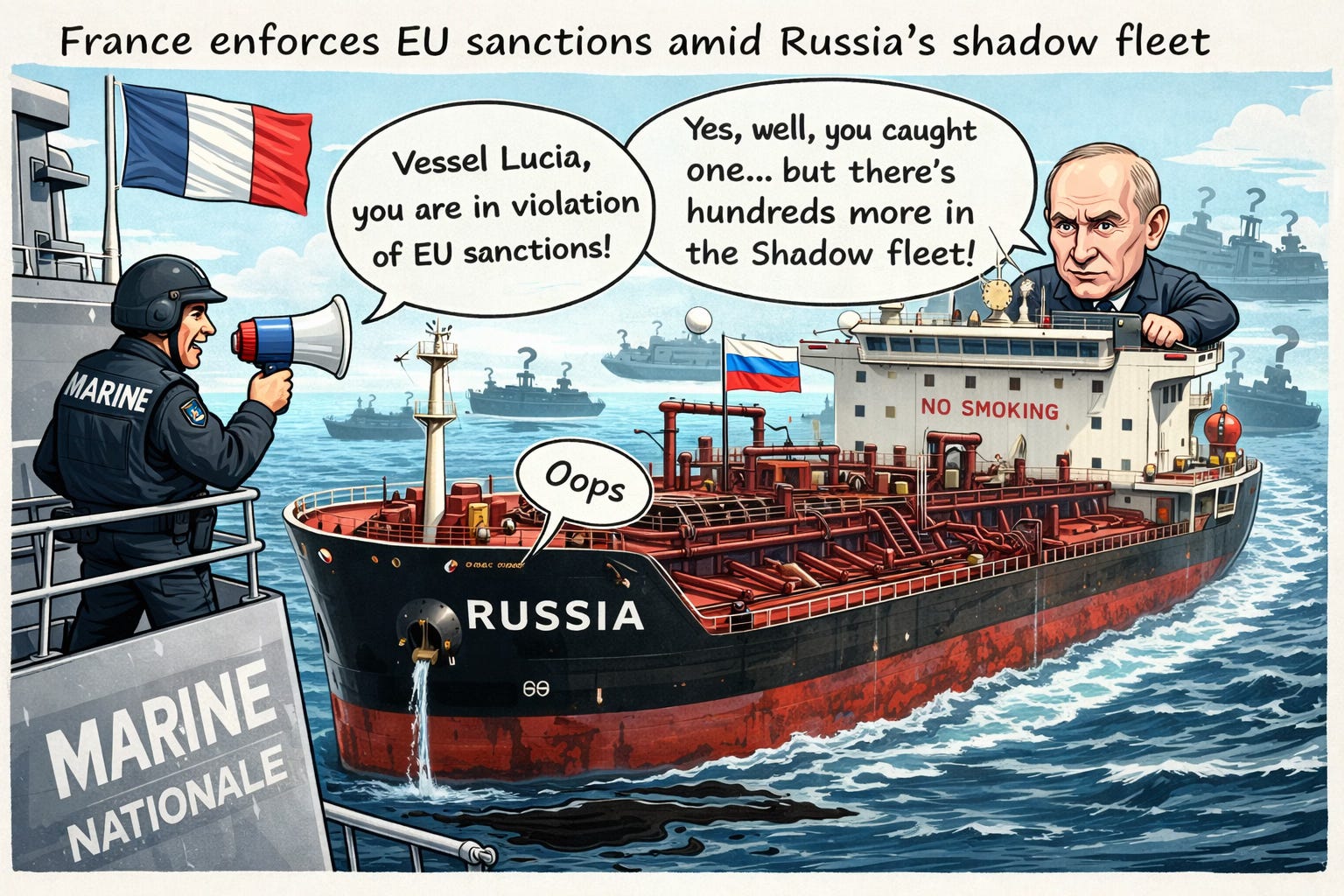
France Seizes Sanctioned Russian Oil Tanker in Mediterranean Waters
Bottom Line Up Front (BLUF): French naval forces have intercepted a Russian oil tanker off the Mediterranean coast suspected of violating EU sanctions. The vessel was reportedly transporting oil in breach of the bloc’s price cap restrictions imposed after Russia’s invasion of Ukraine. The move marks a rare but deliberate enforcement action amid ongoing shadow fleet activity.
Analyst Comments: While much of the Russian oil trade has shifted to opaque networks and third-party intermediaries, active interdiction by EU member states is rare. France’s move signals that at least some European nations are ready to enforce sanctions at sea, not just on paper. It also highlights the role of naval assets in hybrid economic warfare. For security teams monitoring global energy flows, this is another data point that enforcement is becoming kinetic. Also expect Russia to retaliate diplomatically or escalate shadow fleet obfuscation.
READ THE STORY: Shafaq
Spanish Judge Closes NSO Group Spyware Probe, Citing Israeli Stonewalling
Bottom Line Up Front (BLUF): A Spanish court has closed its investigation into the use of NSO Group’s Pegasus spyware against Catalan separatist leader Roger Torrent, citing a lack of cooperation from Israeli authorities. Despite evidence suggesting Pegasus was used to surveil Torrent’s phone in 2020, the judge ruled the probe could not proceed without further information from NSO or Israeli legal assistance—neither of which were forthcoming.
Analyst Comments: Even when surveillance targets are clearly identified—as in this case with a high-ranking Spanish official—legal and diplomatic roadblocks can halt meaningful accountability. NSO Group’s protected status within Israel and the company’s refusal to disclose client details effectively shield state-level spyware abuse from scrutiny. Expect more victims to emerge without legal recourse, particularly in politically sensitive surveillance cases. For defenders, this reinforces the need for mobile threat detection and endpoint monitoring in high-risk sectors like politics, journalism, and activism.
READ THE STORY: The Record
South Korea Investigates Major Bitcoin Theft Tied to Phishing Campaign
Bottom Line Up Front (BLUF): South Korean authorities are investigating a sophisticated phishing operation that led to a “significant” loss of Bitcoin from domestic crypto investors. Attackers reportedly used fake investment apps and social engineering to harvest private keys and seed phrases, enabling direct wallet theft. The incident has triggered warnings from financial regulators and national cybersecurity agencies.
Analyst Comments: This wasn’t a blockchain exploit—it was user-layer compromise, and it worked. By impersonating crypto platforms and preying on investor FOMO, attackers bypassed technical defenses and went straight for credentials. It’s another reminder that seed phrases and private keys are the crown jewels—lose them, and you lose everything. This kind of attack is scalable and hard to trace post-exfiltration, especially if mixers or privacy coins are used. Expect copycats. Exchanges and wallet providers need to double down on client education and phishing-resistant authentication.
READ THE STORY: CoinDesk
Cisco Patches Zero-Day Flaws Amid Ongoing Chinese APT Exploits
Bottom Line Up Front (BLUF): Cisco has issued emergency patches for multiple zero-day vulnerabilities actively exploited by Chinese state-aligned hackers. The flaws affect Cisco's IOS XE software, including web UI components and privilege escalation vectors. Exploitation has been linked to persistent access operations targeting critical infrastructure and government networks.
Analyst Comments: Chinese APT groups leveraging zero-days in edge devices to quietly burrow into high-value networks. Cisco's gear sits at the perimeter—compromise there often means game over. The advisory confirms exploitation in the wild, and defenders should assume exposure if unpatched. This isn't just opportunistic scanning; it's long-term access being established by highly resourced actors. Patch now, and if you're in the public sector or critical infrastructure, go back and check logs from the past few months—there may already be signs of compromise.
READ THE STORY: WPN
New Osiris Ransomware Emerges as Successor to LockBit Infrastructure
Bottom Line Up Front (BLUF): A new ransomware operation dubbed Osiris is leveraging repurposed LockBit infrastructure and affiliates, signaling a fast-moving regrouping of the cybercriminal ecosystem following LockBit’s disruption. Osiris has already launched data leak sites, begun naming victims, and is actively deploying attacks using familiar TTPs tied to former LockBit actors.
Analyst Comments: Osiris appears to be capitalizing on the gap left by LockBit’s recent setbacks—likely absorbing parts of its affiliate base, infrastructure templates, and even negotiation tactics. Expect a rapid ramp-up: affiliate ransomware models scale fast when tooling and brand recognition are in place. While it’s too early to confirm full lineage, Osiris is acting like LockBit 3.5 under new management. Defenders should watch for recycled payloads, reused C2 infrastructure, and familiar tactics (e.g., PowerShell loaders, RDP brute force, double extortion). Same actors, new banner.
READ THE STORY: THN
Cybersecurity Plan Triggers Huawei Backlash Over Planned Tech Phase-Out
Bottom Line Up Front (BLUF): The European Union’s updated cybersecurity strategy is reigniting tensions with China after reaffirming plans to phase out Huawei and ZTE equipment from critical infrastructure. Beijing has condemned the move as discriminatory, while EU officials cite long-standing national security concerns and alignment with NATO and Five Eyes risk assessments.
Analyst Comments: The EU’s push to remove high-risk vendors like Huawei from 5G and backbone networks reflects the West’s broader decoupling strategy, particularly around sensitive sectors like defense, energy, and transportation. For security teams, this means continued fragmentation of supply chains and increased pressure to audit vendor exposure—especially for organizations still relying on legacy Huawei or ZTE hardware. Expect retaliatory rhetoric from China and likely diplomatic escalation, but don’t expect the EU to backtrack. The trendline is clear: trust is now a supply chain criterion.
READ THE STORY: Tovima
Ongoing LastPass Phishing Campaign Targets Users’ Master Passwords
Bottom Line Up Front (BLUF): A new phishing campaign is actively targeting LastPass users, attempting to trick them into revealing their master passwords via fake security alert emails. The attacks impersonate LastPass branding and exploit lingering trust issues following previous breaches. If successful, attackers gain access to users’ entire vaults.
Analyst Comments: With password managers like LastPass acting as single points of failure, the master password is the ultimate prize. These phishing lures are convincingly spoofed, capitalizing on LastPass’s compromised reputation and past incidents. The campaign shows how threat actors recycle breach narratives to increase click-through and exploit user anxiety. Organizations should assume these lures will bypass basic spam filters and push user training around password manager hygiene. And if you're still relying on email-only 2FA for vault access? It’s time to upgrade.
READ THE STORY: RHC
Nike Hacked: Internal Data Reportedly Leaked in Targeted Cyberattack
Bottom Line Up Front (BLUF): Nike has reportedly suffered a cyberattack resulting in the leak of internal corporate data, according to emerging reports. While the company has not confirmed the full scope, attackers claim to have exfiltrated sensitive files, including employee information and internal documentation, which have been posted on a leak site.
Analyst Comments: If internal employee data or proprietary business intel was compromised, this could escalate quickly—especially if Nike chooses not to engage with the attackers. That said, without confirmation of ransomware deployment or disruption to operations, this currently resembles a data breach-driven extortion attempt. Still, it’s a reputational risk moment for a global brand, and a reminder that supply chain and retail giants need mature data loss prevention, not just perimeter defense.
READ THE STORY: RHC
Items of interest
US Presses Denmark for Expanded Military Rights in Greenland
Bottom Line Up Front (BLUF): The United States is seeking to revise its longstanding defense agreement with Denmark to remove limitations on US military operations in Greenland, according to Bloomberg. The proposed change would eliminate requirements for consultation with Denmark and Greenland before expanding bases or altering operations—effectively giving Washington carte blanche in the Arctic region.
Analyst Comments: The push to rewrite the 1951 agreement signals a strategic shift as the US competes with China and Russia for control over northern supply chains, critical minerals, and missile positioning. Greenland’s location offers early-warning advantages and future access to untapped resources, making it a geopolitical chokepoint. From a cybersecurity and defense posture perspective, expect increased US activity in satellite tracking, missile defense, and signals intelligence infrastructure on the island. Also expect friction: Denmark and Greenland aren’t likely to accept a blank check quietly.
READ THE STORY: Bloomberg
GREENLAND FLASHPOINT: Denmark Deploys Combat Troops As Trump Threatens Force For “Total Control” (Video)
FROM THE MEDIA: Denmark has deployed additional combat troops to Greenland as tensions with the United States escalate following President Donald Trump’s threats of tariffs over opposition to American control of the island. Danish Foreign Minister Lars Løkke Rasmussen said Washington would not achieve its aims by putting pressure on Europe, blaming what he described as Trump’s violent statements for derailing diplomatic efforts. Greenland’s prime minister reaffirmed that the island would not be pressured and would defend its right to decide its own future under international law. The dispute has drawn in NATO allies, with Denmark increasing its military presence and NORAD confirming aircraft movements to Greenland amid growing concern over Arctic security.
Trump vs Denmark: Inside the Military Effort to Protect Greenland (Video)
FROM THE MEDIA: Greenland is a self-governing territory of the Kingdom of Denmark, a NATO member that controls the island’s security policy. Its position as a natural barrier between Russia and North America makes it important for the U.S. and President Trump, which has only one active base on the island.
The selected stories cover a broad range of cyber threats and are intended to help readers frame key publicly discussed threats and improve overall situational awareness. InfoDom Securities does not endorse any third-party claims made in its original material or related links on its sites; the opinions expressed by third parties are theirs alone. For further questions, don't hesitate to get in touch with InfoDom Securities at dominanceinformation@gmail.com.
Regarding the AI-driven interceptor drones, wow, what an incredibly insightful analisys! You really hit the nail on the head about entering a new phase of warfare. The implications of delegating kinetic responses to AI, and the cybersecurity risks, are truly massive. It's a critical development to watch closely.