
Daily Drop (1224)
01-13-26

Tuesday, Jan 13, 2025 // (IG): BB // GITHUB // SN R&D
AI Agents and the Future of Offensive Cyber: U.S. Strategy Shifts as Autonomous Threats Emerge
Bottom Line Up Front (BLUF): Anthropic recently confirmed the first documented AI-orchestrated cyber espionage campaign, carried out by a Chinese state-sponsored group using autonomous Claude agents. These agents conducted network reconnaissance, identified a Server-Side Request Forgery (SSRF) vulnerability, built an exploit chain, and exfiltrated sensitive data—with humans only involved in 10–20% of the process. This marks a decisive shift: autonomous AI is no longer a theoretical tool—it’s an operational reality in state-level offensive cyber operations. Meanwhile, the U.S. is signaling a dramatic pivot toward normalizing and privatizing offensive cyber, backed by $1B in new INDOPACOM-directed funding and growing partnerships with AI-native startups.
Analyst Comments: China has already operationalized this technology, integrating state power with commercial tools, workforce scaling, and legal compulsion to compel private-sector cooperation. The U.S. isn’t there yet—but it's trying. From Sean Caincross’s calls to “impose real costs” to CYBERCOM’s massive AI budget push, we’re witnessing the formal integration of AI-led offensive cyber into national security doctrine. This also opens the door for a new generation of VC-backed offensive startups. If you're building autonomous recon, exploit automation, or agentic CTI, this is your window.
READ THE STORY: Gray Matters
OpenAI Reportedly Asks Contractors to Upload Past Work Data: Raises Privacy, IP, and Security Concerns
Bottom Line Up Front (BLUF): OpenAI has been asking data annotation contractors to upload real work from prior jobs, including documents and content they did not create. The goal appears to be enriching training datasets for AI models. This request has sparked serious concerns about intellectual property violations, confidentiality breaches, and potential legal exposure—especially as some of the requested content may have originated from sensitive enterprise environments.
Analyst Comments: If verified, OpenAI’s request introduces substantial data-provenance risk—the possibility that sensitive, proprietary, or even regulated information could be ingested into foundational models without consent or a legal basis. For companies relying on third-party contractors, it highlights the supply chain exposure lurking in outsourced data labeling and ML pipeline development.
READ THE STORY: TC
SandboxAQ Accuses Former Exec of Extortion in Post-Spinout Legal Dispute
Bottom Line Up Front (BLUF): Google spinout SandboxAQ has accused a former executive of attempting to extort the company, according to reporting from TechCrunch on January 9. Legal filings allege that the individual demanded millions of dollars and threatened reputational harm if the company did not meet his compensation demands. The case highlights growing friction between tech startups and former insiders as equity disputes, post-spinout compensation, and access to sensitive IP become increasingly common.
Analyst Comments: SandboxAQ is not just another startup—it’s a high-stakes quantum and AI security firm spun out of Alphabet in 2022, working on post-quantum cryptography (PQC) and national security-related contracts. Any insider dispute—especially one involving threats of reputational or financial harm—poses a higher risk if it involves privileged technical information, customer data, or proprietary algorithms. This case also underscores a broader risk pattern emerging in advanced tech sectors: early-stage internal conflicts can bleed into security, trust, and legal exposure.
READ THE STORY: TC
Germany and Israel Sign New Security Pact Amid Rising Regional Threats
Bottom Line Up Front (BLUF): Germany and Israel have signed a bilateral security agreement to enhance joint defense, intelligence sharing, and cyber cooperation, according to SC World. The pact comes amid intensifying regional instability driven by Iran's actions, proxy conflicts, and cyber escalation. Officials from both nations framed the agreement as a “strategic upgrade” of existing cooperation, with a focus on deterrence, threat intelligence exchange, and joint R&D in emerging tech domains.
Analyst Comments: This is more than a diplomatic handshake—it's a clear response to an increasingly hostile security environment, particularly the Iran-Israel shadow war and growing cyber aggression from Tehran and its proxies. Germany, already a key NATO player, is positioning itself as a stronger European cyber and intelligence partner to Israel, a state with deep capabilities in offensive and defensive cyber operations.
READ THE STORY: SCMEDIA
Why Strategic Foresight Is Now Mission-Critical
Bottom Line Up Front (BLUF): Nestor Levin’s Overmatch essay lays out a compelling case: modern defense strategy must internalize Black Swan risk—rare, paradigm-shifting events that invalidate institutional assumptions and render legacy systems obsolete. Drawing on historical analogs from WWI to Ukraine and into space, Levin argues that U.S. force design, acquisition cycles, and doctrinal planning are still optimized for yesterday’s wars. Strategic foresighting—stress-testing assumptions against plausible, tech-driven disruptions—is no longer optional. It’s a survival imperative.
Analyst Comments: Levin shows that Black Swan events in warfare aren’t about surprise tech—they’re about institutional lag. The U.S. didn't lack drones, GPS, or satellite ISR. It lacked imagination to see how those tools would reshape the battlefield. We’re repeating that cycle. Over-optimization on exquisite platforms, long acquisition timelines, and bureaucratic incentive structures all resist disruptive change. Founders and investors can insert the future early—through demos, exercises, and rapid iteration that expose flawed assumptions before a war does.
READ THE STORY: Overmatch
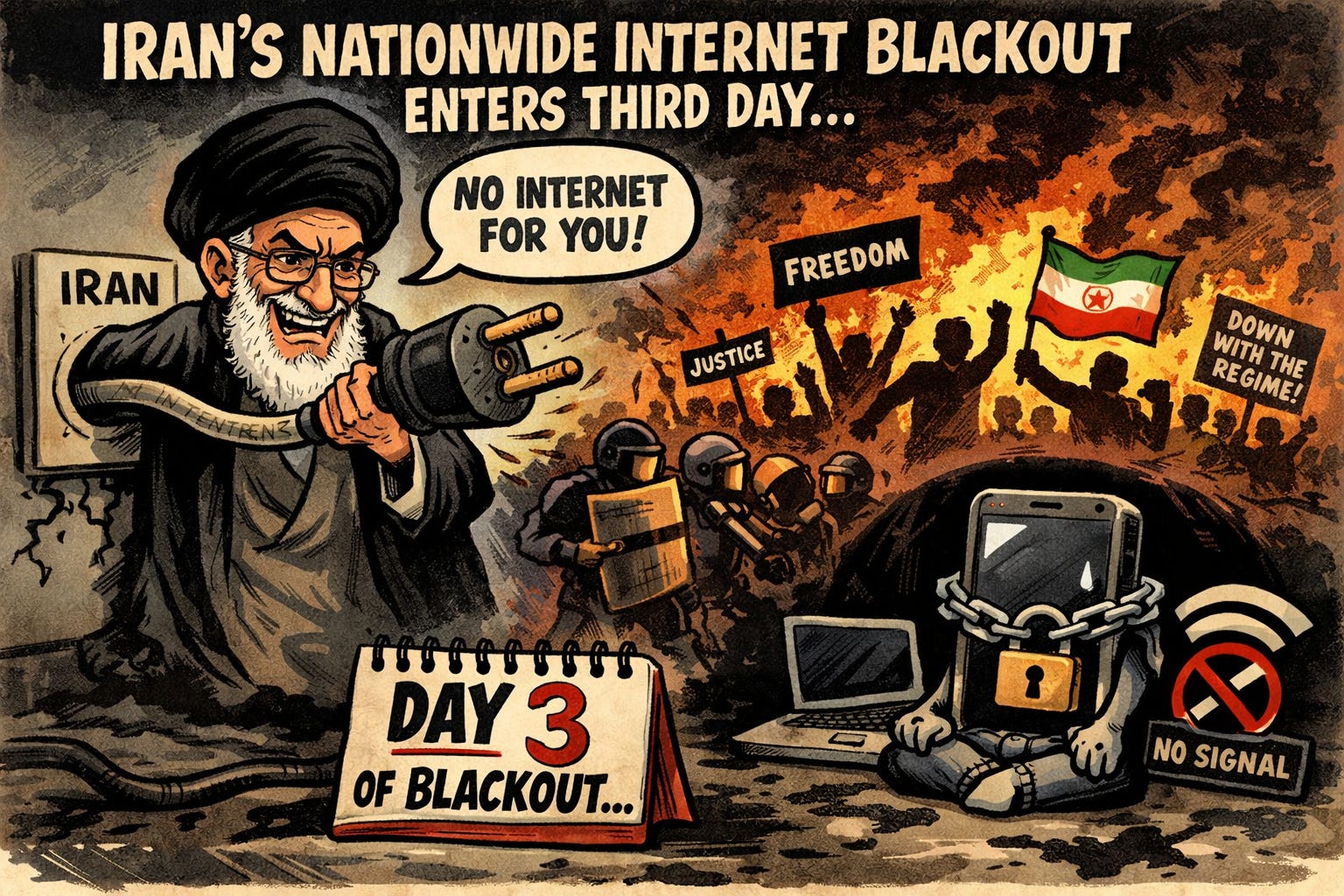
Iran's Nationwide Internet Blackout Enters Third Day Amid Escalating Protests
Bottom Line Up Front (BLUF): Iran’s nationwide internet blackout has now entered its third consecutive day, crippling access across mobile and fixed-line networks. According to The Cyber Express, the outage is part of a coordinated state response to growing anti-government protests sparked by economic hardship and political repression. The shutdown has reduced national connectivity to under 1% of normal levels, severely restricting communication, news coverage, and access to external platforms.
Analyst Comments: Iran is executing a textbook information control operation: deny visibility, restrict mobilization, and suppress international media coverage of internal dissent. While these tactics are not new, what’s different this time is the duration, scope, and timing of the blackout amid global attention to Tehran’s cyber and political maneuvers. The blackout is also a prelude to repression. Past incidents (e.g., November 2019) have shown that wide-scale internet disruption often correlates with the use of lethal force. Additionally, shutting down the internet incurs daily economic costs—Top10VPN estimates that Iran loses $1.56 million per hour during nationwide outages.
READ THE STORY: The Cyber Express
Iranian Hackers Claim Phone Breach of Mossad Operatives: Signals Escalation in Regional Cyber Shadow War
Bottom Line Up Front (BLUF): A pro-Iranian cyber group linked to Tehran’s intelligence apparatus has publicly claimed it compromised mobile devices of Mossad operatives, as reported by Forbes on January 10. The group, known as “Hand of God”, released alleged screenshots and contact data from phones said to belong to Israeli intelligence officials. While attribution and technical verification remain unconfirmed, the messaging—delivered via Telegram—signals a psychological and political escalation in Iran’s ongoing cyber campaign against Israel.
Analyst Comments: Even if the breach is exaggerated or fabricated, the tactic aligns with Iran’s strategy of asymmetric influence and deniable cyber harassment. Still, if any part of the claim holds true—especially compromise of operational devices tied to intelligence personnel—it would mark a serious counterintelligence failure and point to mobile security vulnerabilities within high-risk Israeli targets. This fits a broader pattern of Iran-linked threat groups (APT42, OilRig) targeting personal devices and using social engineering, phishing, or supply-chain compromise to bypass hardened enterprise systems.
READ THE STORY: Forbes
Widespread Protests Erupt in Iran Amid Economic Crisis and Geopolitical Tensions
Bottom Line Up Front (BLUF): Iran is facing a new wave of nationwide protests driven by worsening economic conditions, frustration over government repression, and anger at regional and international developments. According to The Independent, demonstrations have intensified across major cities as the Iranian rial continues to collapse, while U.S. and Israeli pressure on Tehran increases—including renewed sanctions threats and escalating regional tensions.
Analyst Comments: Analysts note parallels to earlier protest movements, but with increased coordination via encrypted messaging apps—despite the regime’s aggressive internet shutdown tactics. The article also highlights the broader geopolitical context: Tehran’s rhetoric against Israel has sharpened in recent weeks, and former U.S. President Donald Trump’s recent comments about reinstating “maximum pressure” sanctions have added fuel to anti-Western sentiment in state media—even as public frustration grows over the costs of the regime’s foreign entanglements.
READ THE STORY: Independent
Putin’s $12B Internet Blackout: Russia Leans into “Sovereign RuNet” with Infrastructure-Level Censorship
Bottom Line Up Front (BLUF): Russia’s deliberate and prolonged internet disruptions cost its economy an estimated $11.9 billion in 2025, according to new data from Top10VPN. The campaign marks an unprecedented use of infrastructure-level censorship—what analysts are calling the “16 KB Curtain”—to selectively degrade access to Western services (notably Cloudflare-hosted content), while preserving partial functionality. The blackout strategy supports Russia’s long-running goal of achieving a sovereign “RuNet,” while also suppressing dissent and controlling the information battlespace.
Analyst Comments: The “16 KB Curtain” is a technically clever move: avoid the political optics of a total shutdown, while making the internet practically unusable. That’s the playbook now—slow-burn digital repression over brute-force blackouts. Russia is evolving past crude blocks and toward protocol-level, selective degradation, where services appear broken but the infrastructure remains under state control.
READ THE STORY: Forbes
Alleged Russian Ransomware Negotiator Identified in Ongoing DoJ Investigation
Bottom Line Up Front (BLUF): U.S. authorities have reportedly identified a Moscow-based individual believed to act as a ransom negotiation broker for major Russian-speaking ransomware gangs. The discovery, reported by The Register, comes amid a wider Department of Justice (DoJ) investigation into global ransomware operations and may lead to further indictments. The individual—unnamed publicly—allegedly facilitated payments, negotiated with victims, and laundered proceeds on behalf of high-profile ransomware groups.
Analyst Comments: These brokers serve as critical infrastructure within the ransomware-as-a-service (RaaS) ecosystem—handling communications, maximizing ransom value, and anonymizing funds through mixers or crypto exchanges. Identifying and potentially indicting a broker operating inside Russia raises complex questions about enforcement, extradition, and possible state tolerance or complicity. It also signals the DoJ is increasingly focused on the human and financial links in the ransomware kill chain—not just the code. For defenders and threat intelligence teams, this highlights the importance of tracking non-technical roles in ransomware campaigns.
READ THE STORY: The Register
Russia Has Lost At Least 19 Generals in Ukraine, Leaked Data Reveals
Bottom Line Up Front (BLUF): A new joint investigation by iStories and Germany’s Der Spiegel reveals that at least 19 Russian generals have been killed since the start of the full-scale invasion of Ukraine—the highest number of general officer deaths for Russia since WWII. Based on leaked Russian military records, this figure exceeds prior estimates and offers insight into structural and strategic failures within Russia’s command system during the war.
Analyst Comments: General officer casualties are rare in contemporary conflict due to layered command structures and battlefield separation. That so many have been killed suggests a combination of poor operational security, forward deployment due to command dysfunction, and Ukrainian targeting enabled by real-time ISR and SIGINT, potentially with Western assistance. More broadly, this reflects a systemic weakness: Russia’s rigid, top-down command structure often requires senior officers to be physically present to make tactical decisions, especially when lower-tier initiative is lacking. It also illustrates Ukraine’s effective kill chain and deep reach into Russian C2 networks.
READ THE STORY: United24
Items of interest
Russia Deploys New 'Oreshnik' Intermediate-Range Ballistic Missile in Ukraine Strike
Bottom Line Up Front (BLUF): Russia has used a newly revealed intermediate-range ballistic missile, dubbed the Oreshnik, to strike targets in Ukraine for the first time, according to Ukrainian and European defense officials. The launch marks a significant escalation in Moscow’s missile capabilities and potentially signals the operational deployment of a system previously unacknowledged by the Kremlin.
Analyst Comments: Open-source intelligence and NATO tracking may now shift to identifying Oreshnik’s launch platforms, range, and warhead configurations. Early indicators suggest this missile could fit the INF-range profile (500–5,500 km), raising questions about Russia’s arms-control commitments and whether it is a modernization of a previously shelved platform. Cyber angle: missile development and deployment are tightly integrated with command-and-control (C2) systems, including mobile targeting networks. This presents a high-value C4ISR target for cyber disruption—especially as Ukraine and its partners improve ISR and EW capabilities. Expect future intelligence tasking to focus on telemetry spoofing, data-link jamming, and decoying if the missile sees regular battlefield use.
READ THE STORY: EURO NEWS // TWZ
Oreshnik Hypersonic Missile | How Russian Intercontinental Ballistic Nuclear Missile Works (Video)
FROM THE MEDIA: This is the Oreshnik missile, a state-of-the-art weapon system launched from a massive 12 by 12 truck platform.
Russia confirms the use of new Oreshnik ballistic missile in large-scale attack on Ukraine (Video)
FROM THE MEDIA: Russia said Friday it has used the new Oreshnik ballistic missile along with other weapons in a massive strike on Ukraine.
The selected stories cover a broad range of cyber threats and are intended to help readers frame key publicly discussed threats and improve overall situational awareness. InfoDom Securities does not endorse any third-party claims made in its original material or related links on its sites; the opinions expressed by third parties are theirs alone. For further questions, don't hesitate to get in touch with InfoDom Securities at dominanceinformation@gmail.com.