
Daily Drop (1223)
01-11-26

Sunday, Jan 11, 2025 // (IG): BB // GITHUB // SN R&D
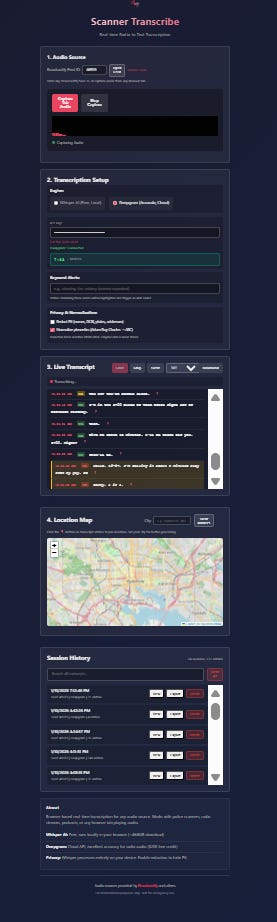
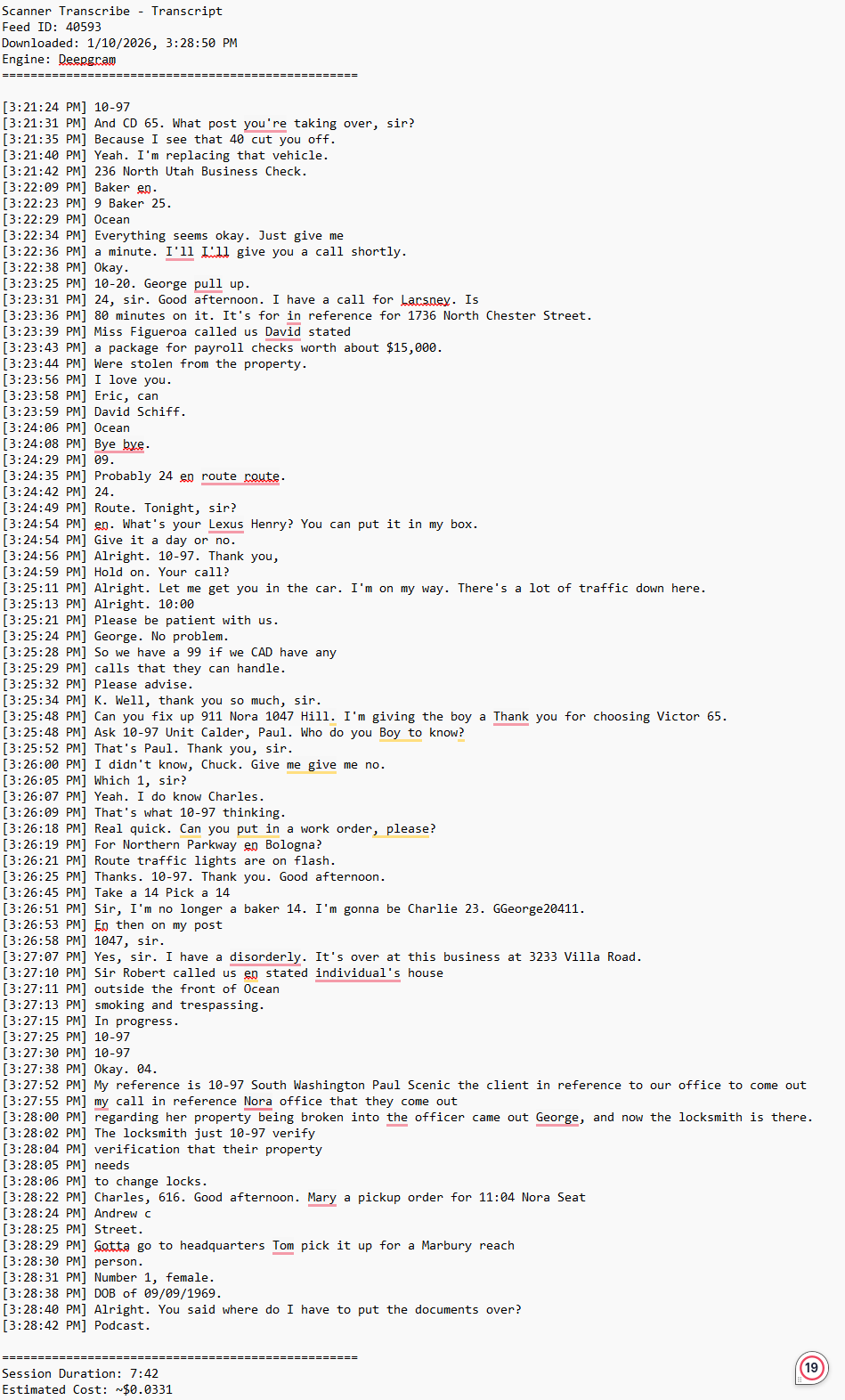
Scanner Transcribe
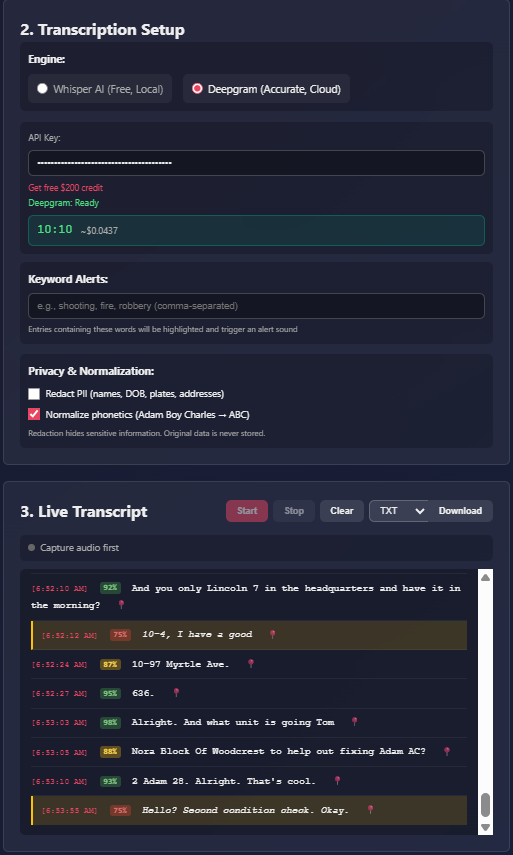
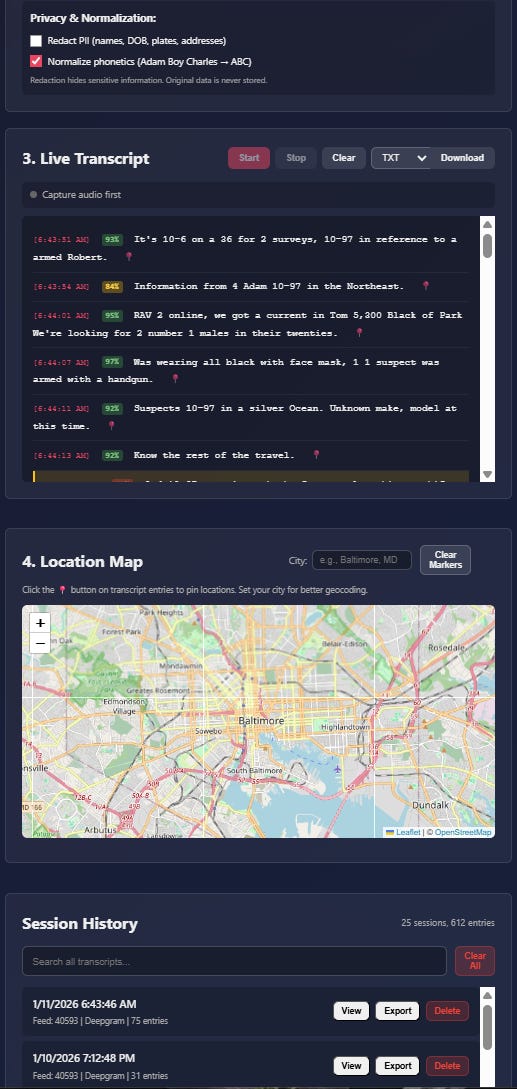
ScannerTranscribe is an open-source, browser-based tool for real-time transcription of police scanner and radio audio feeds, originally developed for Baltimore City Broadcastify coverage. It offers dual transcription engines: Whisper AI (free, local processing with a ~466MB model and custom police/scanner vocabulary prompts) and Deepgram (cloud-based nova-2-phonecall model optimized for radio audio with keyword boosting for 10-codes and phonetic alphabet). The application features a sophisticated post-processing pipeline that corrects common numeric hallucinations, normalizes phonetic alphabet sequences (e.g., "Adam Boy Charles" → "ABC"), and optionally redacts PII such as SSNs, addresses, and license plates. Additional capabilities include keyword alerting with audio notifications, confidence scoring for transcription reliability, IndexedDB-backed session storage with full-text search, multi-format export (TXT, JSON, CSV), and an integrated Leaflet map for geocoding and pinning mentioned locations. The tool runs entirely in-browser using the getDisplayMedia() API for tab audio capture, enabling access on Chrome/Edge desktop without requiring a server backend.
Trump Revives Monroe Doctrine with Maduro Raid: Power, Oil, and a Return to Hemispheric Hegemony
Bottom Line Up Front (BLUF): The U.S. abduction of Venezuelan President Nicolás Maduro has ignited debate over the reemergence of the Monroe Doctrine as a framework for American foreign policy. Once dismissed as an artifact of 19th-century imperialism, the Doctrine is being weaponized by the Trump administration to justify unilateral intervention, control over regional energy assets, and the sidelining of international law. Historian Greg Grandin warns that this revival signals a pivot toward coercive regional dominance untethered from democratic ideals.
Analyst Comments: The original 1823 doctrine was always ambiguous—equal parts anti-colonial rhetoric and imperial ambition—but its current use strips away the pretense. The kidnapping of a sitting head of state, the seizure of Venezuelan oil shipments, and threats toward other Latin American nations reflect a version of U.S. power obsessed with dominance, not stability. Grandin’s essay is a critical reminder that doctrines don’t die—they mutate. The Trump-era Monroe Doctrine trades legitimacy for theatrics, rule of law for “might makes right.” It’s a bet that regional hegemony can be sustained through spectacle, not alliances. If this sets a precedent, expect a sharp escalation in regional instability, diplomatic backlash, and long-term erosion of U.S. soft power.
READ THE STORY: FT
U.S. Raid Shatters Venezuela’s Russian-Iranian Defenses: “Operation Absolute Resolve” a Technological Blowout
Bottom Line Up Front (BLUF): Operation Absolute Resolve—Washington’s lightning strike to extract Venezuelan President Nicolás Maduro—demolished Venezuela’s Russian-, Chinese-, and Iranian-supplied defenses in a single night. The raid demonstrated overwhelming U.S. technological and operational superiority, exposing the limitations of authoritarian militaries that rely on foreign-supplied equipment without the integration, training, and readiness required for real combat.
Analyst Comments: Venezuela’s much-hyped Russian air defenses (Buk-M2E, S-300VM), Iranian-made drones (Mohajer-6/ANSU-100), and Chinese radar systems crumbled against an American multi-domain assault fusing cyber ops, jamming, stealth air power, and special operations. No battlefield engagement. No warning. And no visible resistance. The failure wasn’t just in hardware—it was systemic: brittle command, hollowed-out maintenance, and politicized forces. From a strategic lens, the message is clear: buying gear from Moscow or Tehran doesn’t make a regime secure—especially when Washington brings its A-game. For Beijing, Moscow, and Tehran, this should be a wake-up call: their clients can’t survive Western joint-force warfare.
READ THE STORY: JPOST
Special Forces at Center of U.S. Strategy After Maduro Raid: Covert Ops as Modern Policy Tool
Bottom Line Up Front (BLUF): Following the stunning U.S. special forces raid that resulted in the abduction of Venezuelan President Nicolás Maduro, scrutiny is growing over Washington’s reliance on elite military units for high-risk international operations. Far from a deviation, the Maduro operation fits a long-established pattern—using covert, deniable force as a preferred tool of U.S. power projection in the post-9/11 era. With nearly 70,000 active operators, special forces have become both the most visible and politically expedient wing of American military strategy.
Analyst Comments: Contributor Adam Tooze notes that the U.S. has increasingly relied on elite special forces for missions that would be politically or diplomatically untenable for conventional forces. That includes hostage rescues, decapitation strikes, sabotage, and covert regime influence. The model trades scale for speed, and oversight for deniability. But using special forces as a standing tool of foreign policy also risks normalizing illegal or extra-legal operations under a sheen of tactical success. The blurred line between law enforcement, covert action, and warfighting is growing less theoretical with each high-profile deployment. The Maduro raid—like past ops in Libya or Pakistan—raises the stakes: when the target is a sitting head of state, the line between special operation and state-sponsored abduction disappears.
READ THE STORY: FT
NATO Silent as Trump Threatens Greenland Seizure: European Allies Alarmed
Bottom Line Up Front (BLUF): NATO has so far declined to publicly respond to U.S. President Donald Trump’s threats to seize Greenland by force, prompting alarm across European capitals. The alliance’s silence on defending the territorial integrity of a member state—Denmark—has exposed deep anxieties about NATO’s credibility and its ability to check unilateral action by its most powerful member.
Analyst Comments: Trump’s claim that Denmark is failing to protect Greenland and his suggestion of military action crosses a red line: threatening a fellow NATO member. Article 5 assumes threats originate outside the alliance. If Washington becomes the aggressor, NATO's core fractures. That the Secretary-General, Mark Rutte, has avoided direct condemnation signals a strategic paralysis—caught between placating Trump and upholding the alliance’s founding principles. If this silence continues, expect Article 4 consultations and a broader reevaluation of Europe’s defense dependency on the U.S., especially in Arctic and Nordic policy.
READ THE STORY: FT
Russian Warship Escorts Sanctioned Vessels Near NATO Waters Amid Growing Maritime Tensions
Bottom Line Up Front (BLUF): A Russian Navy destroyer, Severomorsk, was observed escorting two sanctioned cargo vessels—SPARTA IV and MYS ZHELANIYA—off the coast of Portugal on January 9, 2026. The unusual naval escort in NATO-adjacent waters follows recent U.S. seizures of similar Russia-linked ships operating under a shadow fleet logistics network. Although both vessels list Port Said, Egypt, as their destination, prior patterns suggest the potential delivery of sanctioned military or energy cargo to Syria or Libya.
Analyst Comments: Both SPARTA IV and MYS ZHELANIYA are linked to defense and sanctioned energy supply chains, including Syria’s Tartus naval facility and Arctic LNG projects. Following the U.S. seizure of Marinera and Sophia tankers, Russia is now shifting from plausible deniability to overt military shielding of its economic lifelines. Expect heightened tension around the enforcement of maritime sanctions and a potential increase in NATO maritime surveillance activity in the eastern Atlantic and Mediterranean corridors.
READ THE STORY: United24
Iran Erupts in Nationwide Protests as Economic Collapse and Repression Fuel Unrest
Bottom Line Up Front (BLUF): Iran is facing its most serious wave of civil unrest in decades, as protests over inflation, drought, and authoritarian crackdowns sweep across the country. At least 45 civilians have reportedly been killed, and over 2,000 detained in less than two weeks. The regime has responded with lethal force and internet blackouts, while opposition figures—most notably exiled Crown Prince Reza Pahlavi—are openly calling for regime change. Simultaneously, Israel is preparing for potential military action, and former U.S. President Donald Trump has issued threats of intervention if the crackdown escalates.
Analyst Comments: Government brutality lit the match. But what’s different this time is the confluence of mass public rage, public calls for resistance from exiled leadership, and external threats—from both Israel and the U.S.—that could tip this from internal revolt to regional crisis. The involvement of figures such as Pahlavi is stirring nationalist sentiment and reviving monarchist symbolism, as evidenced by the widespread use of pre-revolutionary flags. The lack of coordination among protestors may limit short-term effectiveness, but the regime is clearly rattled—leaks suggest Ayatollah Khamenei is considering evacuation plans. Any military strike by Israel or the U.S. could backfire by unifying public opinion around the regime, despite widespread dissatisfaction.
READ THE STORY: TWZ
Netanyahu Signals Long-Term Goal to Reduce U.S. Military Aid Dependency
Bottom Line Up Front (BLUF): Israeli Prime Minister Benjamin Netanyahu stated in a recent interview that he hopes Israel can begin tapering off its reliance on U.S. military aid over the next decade. While reaffirming the strength of the U.S.-Israel relationship, he indicated a desire for Israel to become more economically and militarily self-reliant in the long term.
Analyst Comments: Netanyahu’s comments may be aimed at domestic audiences seeking greater sovereignty, or at signaling confidence in Israel’s growing defense tech sector. Still, the statement comes amid rising global scrutiny over foreign military assistance, and at a time when U.S. support for Israel faces growing political polarization. Whether this is a serious policy direction or diplomatic posturing remains to be seen—but the implications for U.S.-Israel defense planning and military-industrial ties are significant.
READ THE STORY: The Hindu
China’s Intelligence Presence in Tel Aviv Sparks Escalating Espionage Concerns
Bottom Line Up Front (BLUF): Chinese intelligence operations in Tel Aviv have intensified, with Beijing reportedly leveraging deep personal networks—known as “Guanxi”—to infiltrate Israeli security, academic, and commercial sectors. Israeli and U.S. intelligence agencies have responded by tightening surveillance of Chinese activity, as tensions rise over China's expanding ties to Iran, Hamas, and its pushback against Israeli support for Taiwan and Somaliland.
Analyst Comments: China’s approach isn’t novel, but the stakes have evolved. The targeting of Israeli defense infrastructure, especially around systems like Iron Dome and potential cooperation with Taiwan, signals strategic alignment between China, Iran, and proxies like Hamas. The timing, amid wars in Gaza and growing U.S.-China friction, underscores a geopolitical shift: Israel no longer sees Beijing as just an economic partner, but a legitimate intelligence threat. Expect increased scrutiny of Chinese investments, academic exchanges, and proximity to sensitive infrastructure—not just in Israel, but across allied nations that host dual-use technology.
READ THE STORY: Modern Diplomacy
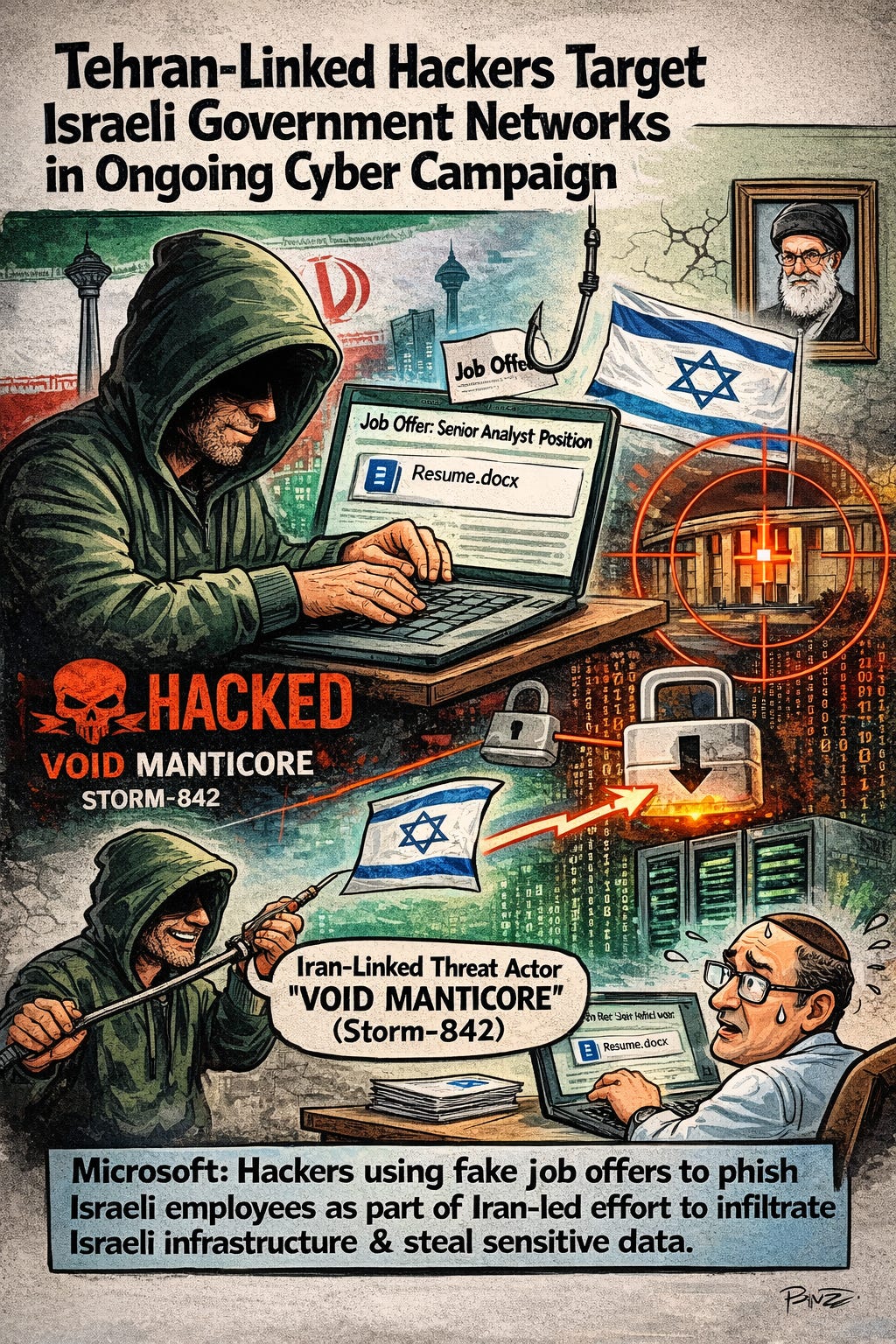
Tehran-Linked Hackers Target Israeli Government Networks in Ongoing Cyber Campaign
Bottom Line Up Front (BLUF): Iranian state-affiliated threat actor “Void Manticore” (aka Storm-842) launched a phishing campaign targeting Israeli government employees using fake job offer lures. Microsoft researchers attribute the activity to a broader Iran-led effort to gain persistent access to Israeli infrastructure and exfiltrate sensitive data, part of Tehran’s ongoing multi-pronged cyber strategy.
Analyst Comments: Government brutality lit the match. But what’s different this time is the confluence of mass public rage, public calls for resistance from exiled leadership, and external threats—from both Israel and the U.S.—that could tip this from internal revolt to regional crisis. The involvement of figures such as Pahlavi is stirring nationalist sentiment and reviving monarchist symbolism, as evidenced by the widespread use of pre-revolutionary flags. The lack of coordination among protestors may limit short-term effectiveness, but the regime is clearly rattled—leaks suggest Ayatollah Khamenei is considering evacuation plans. Any military strike by Israel or the U.S. could backfire by unifying public opinion around the regime, despite widespread dissatisfaction.
READ THE STORY: JPOST
Muddy Water APT Deploys Rust-Based ‘RustyWater’ Implant in Spearphishing Attacks on Middle East Critical Infrastructure
Bottom Line Up Front (BLUF): CloudSEK’s TRIAD team has identified a targeted spearphishing campaign by the Iran-linked Muddy Water APT (aka Earth Vetala, Static Kitten, Mango Sandstorm), leveraging Rust-based implants—dubbed RustyWater—against critical infrastructure in the Middle East. The malware exhibits modular design, registry persistence, anti-analysis features, and asynchronous command-and-control (C2) over HTTP, signaling a significant shift from the group’s legacy PowerShell and VBS tooling.
Analyst Comments: Rust’s cross-platform capabilities, lower detection footprint, and memory safety features make it attractive for stealthy, persistent implants. RustyWater’s layered C2 design—with JSON→Base64→XOR encoding and randomized beaconing—undermines traditional network defenses. Registry persistence and in-memory execution complicate forensic response, while on-demand modular expansion enables tailored surveillance of high-value targets. Given Muddy Water’s historical alignment with Iranian interests and its targeting of the diplomatic and telecommunications sectors, this campaign likely supports strategic intelligence collection. Expect further adoption of Rust-based malware by APTs seeking to evade EDR and maintain flexible, long-haul access.
READ THE STORY: Industrial
Chinese Police Demand NYT Shanghai Bureau Metadata, Escalating Pressure on Foreign Media
Bottom Line Up Front (BLUF): Chinese authorities have reportedly demanded metadata from local staff at The New York Times’ Shanghai bureau, including login records, device access, and possibly location data. The request signals a growing shift from traditional censorship to overt surveillance of foreign media operations in China.
Analyst Comments: While such actions are framed domestically as “national security” measures, they effectively erode press freedom by turning Chinese employees into vectors of surveillance risk. For any organization operating in authoritarian environments, this is a reminder: endpoint and identity security can no longer be treated as internal-only concerns. Local staff must be protected not only legally but also technically—especially when state adversaries leverage metadata.
READ THE STORY: Jack Poulson
LockBit 5.0 Ransomware Emerges with Increased Automation, Broader Targeting
Bottom Line Up Front (BLUF): LockBit has released version 5.0 of its ransomware, enhancing automation and accessibility for its affiliate network. Despite years of law enforcement pressure, the group remains one of the most active Ransomware-as-a-Service (RaaS) operators globally. LockBit 5.0 targets a broad spectrum of victims—from major IT firms to small nonprofits—and includes tools for rapid data theft and encryption, as well as unusual branding tactics intended to position the gang as a “criminal service provider.”
Analyst Comments: Its automation and configuration-free deployment options lower the skill barrier for affiliates, making high-impact attacks more accessible and scalable. The group’s continued dominance—even after global crackdowns—underscores the resilience and adaptability of top-tier ransomware operators. The addition of “Premium Criminal Branding Services” and a self-described “Strategic Manifesto” is both surreal and revealing: LockBit sees itself as a business, not a gang. That shift in tone is matched by its operational efficiency—Stealbit data exfiltration, followed by rapid encryption, is now standard. Defenders must tune detection and response toward early-stage access methods and rapid lateral movement, or risk being caught flat-footed.
READ THE STORY: RHC
ALPHV Ransomware Gang Claims FBI Seized Leak Site, Retaliates with Healthcare Attack
Bottom Line Up Front (BLUF): The ALPHV (BlackCat) ransomware group claims that the FBI briefly took control of its dark web leak site in early December, suggesting a coordinated law enforcement operation. Shortly after, the group claimed responsibility for a ransomware attack on Change Healthcare, a major U.S. healthcare tech firm, framing it as retaliation. The incident disrupted pharmacy and billing services nationwide.
Analyst Comments: The takedown of ALPHV’s leak site, even if temporary, signals that international pressure is tightening. However, ALPHV’s swift reappearance and high-profile targeting of healthcare infrastructure sends a clear message: disruption doesn’t mean dismantling. Their use of “retaliation” language also suggests a pivot in the narrative—portraying themselves as actors in a cyber cold war rather than merely criminals. Organizations in critical sectors should brace for increased aggression and more attention-seeking attacks as ransomware groups push back against law enforcement.
READ THE STORY: BBC
Initial Access Markets Fuel Ransomware Surge Across Australia and New Zealand
Bottom Line Up Front (BLUF): A sharp rise in ransomware activity targeting Australia and New Zealand throughout 2025 has been driven by an increasingly active underground economy for initial access. According to Cyble’s threat landscape report, more than 90 confirmed access listings—primarily targeting retail, BFSI, and professional services—were sold on cybercrime forums. These sales enabled groups like Scattered Spider to launch high-impact intrusions, demonstrating the ecosystem’s growing maturity and decentralization in the region.
Analyst Comments: Initial Access Brokers (IABs) are now operating at scale, feeding fresh victims to ransomware crews through fragmented, low-barrier marketplaces. The emphasis on data-rich targets—retail, financial services, and consultancies—indicates attackers are pursuing both direct monetization and downstream supply-chain access. Australia and New Zealand’s current exposure stems less from novel vulnerabilities and more from systemic gaps in detection and segmentation that allow a single point of entry to snowball into enterprise-wide compromise. The shift toward smaller, one-off sellers makes access harder to track and take down, further complicating defensive attribution and response.
READ THE STORY: GBhackers
Massive Recon Campaign Uses 240+ Exploits to Prep Ransomware Attacks Over Holiday Weekend
Bottom Line Up Front (BLUF): Between December 25–28, 2025, a single threat actor launched a large-scale reconnaissance campaign, probing internet-connected systems with over 240 known exploits. Researchers link the activity to Initial Access Brokers (IABs), who are likely preparing footholds for future ransomware operations. The scans originated from infrastructure associated with CTG Server Limited (AS152194), a provider known for hosting abuse and phishing. Thousands of confirmed vulnerabilities may now be for sale on criminal marketplaces.
Analyst Comments: The use of Nuclei at scale, paired with 57,000+ OAST subdomains via Interactsh, indicates an industrialized vulnerability-harvesting operation. JA4 fingerprinting and machine ID matches confirm that a single operator was responsible for the activity. With initial access data confirmed, ransomware operators may already be negotiating purchases or planning intrusions. Organizations should assume that systems vulnerable during the scan window are already in the attacker’s hands. This also underscores the operational separation in modern ransomware: reconnaissance, access brokering, and monetization are now distinct roles.
READ THE STORY: GBhackers
Instagram Data Leak Exposes 17.5 Million Users on Dark Web
Bottom Line Up Front (BLUF): A database containing sensitive data on 17.5 million Instagram users is reportedly circulating on the dark web, exposing full names, email addresses, phone numbers, account details, and location data. The leak, allegedly sourced from a third-party analytics platform, raises concerns over data aggregation services and weak API protections.
Analyst Comments: Threat actors often harvest social media data via scraping or through poorly secured third-party platforms—this appears to be the latter. Including phone numbers and email addresses makes it highly vulnerable to exploitation. Instagram’s official silence so far is concerning, especially given Meta’s prior issues with user data exposure. Security teams should monitor for targeted phishing campaigns and password reset attempts linked to compromised user data.
READ THE STORY: RHC
U.S. Bitcoin Seizure from Chen Zhi Sparks Beijing’s Legal Counteroffensive
Bottom Line Up Front (BLUF): The extradition of alleged cybercrime kingpin Chen Zhi to China has ignited a geopolitical and legal storm over the U.S. government’s seizure of 127,000 Bitcoins (~HK$90 billion). While Washington portrays the haul as a lawful forfeiture linked to Chen’s alleged “pig-butchering” fraud schemes, Beijing alleges the funds were stolen via state-backed hacking and repackaged as asset recovery—without legal transparency. China now challenges the seizure's legitimacy, raising concerns about sovereignty, jurisdiction, and due process on the global stage.
Analyst Comments: Beijing's accusation that the U.S. essentially "hacked first, justified later" puts Washington in an awkward spot, especially given its vocal condemnation of state-sponsored cyber theft. The U.S. silence on how it obtained the private keys only fuels speculation. If China’s claims hold up technically—and early reports from credible sources suggest they might—the legitimacy of this seizure could become a diplomatic and legal battleground. This is also a warning sign for digital asset holders: sovereignty in cyberspace remains unclear, and state actors may not adhere to the same rules they enforce.
READ THE STORY: DS
Legal Debate Emerges Over AI Liability in Aviation: Can Humanoid Robots Be Criminally Responsible
Bottom Line Up Front (BLUF): A growing body of legal scholarship, including recent analysis from the Sri Lanka Guardian, examines the potential to assign criminal liability to AI systems—particularly humanoid robots—used in airports and on aircraft. As aviation adopts more autonomous systems for security, customer service, and operational tasks, questions of responsibility in the event of accidents, harm, or violations are moving from theoretical to urgent.
Analyst Comments: In aviation, where error margins are razor-thin, delegating tasks to AI raises serious concerns: if a humanoid robot acts negligently or causes harm, who is liable—the operator, the manufacturer, the software developer, or the AI itself? Current legal frameworks don’t recognize criminal liability for non-human entities, but as autonomy increases and robots begin making decisions without direct human oversight, this legal vacuum becomes a risk. The aviation sector must grapple with this now—not after an incident. Expect legal, regulatory, and insurance sectors to push for updated liability doctrines or AI-specific legislation within the next 5 years.
READ THE STORY: Sri Lanka Guardian
Hackers and Privacy Advocates Push Back Against ICE Surveillance via Flock ALPR Systems
Bottom Line Up Front (BLUF): Digital rights activists and hackers are increasingly targeting the surveillance infrastructure used by U.S. Immigration and Customs Enforcement (ICE), especially the Flock Safety automated license plate reader (ALPR) network. Techniques range from adversarial image overlays that fool plate recognition systems to exposing misconfigured Flock camera admin panels left unsecured online. The movement reflects growing public resistance to law enforcement surveillance in public spaces—and the fragility of ALPR systems when met with adversarial tech.
Analyst Comments: Flock operates the largest ALPR network in the U.S., with indirect access for federal agencies such as ICE. While the public narrative around license plate readers often centers on crime prevention, they are increasingly used for immigration enforcement and tracking, with little oversight. The disclosed security flaws—such as exposed admin panels—highlight operational lapses that could allow third parties to tamper with or exploit surveillance data. While some countermeasures (e.g., adversarial stickers) are legally risky, they expose how fragile even billion-dollar surveillance ecosystems can be when challenged by open-source tools and small but skilled adversaries.
READ THE STORY: The Register
Critical Undertow HTTP Server Vulnerability Enables Session Hijacking in Java Apps (CVE-2025-12543)
Bottom Line Up Front (BLUF): A critical flaw in the Undertow HTTP server—used in Java platforms like WildFly and JBoss EAP—allows attackers to hijack sessions via malformed Host headers. Tracked as CVE-2025-12543 (CVSS 9.6), this vulnerability exposes affected systems to session hijacking, cache poisoning, and internal network enumeration. Remote exploitation is possible without authentication, prompting urgent patching.
Analyst Comments: HTTP Host Header manipulation is a well-known attack vector, and its presence in a core Java HTTP engine significantly increases the risk to enterprise systems. Undertow's popularity within Red Hat JBoss EAP and custom Java stacks means the blast radius could extend across public- and private-sector deployments. Given its remote exploitability and potential for internal pivoting, defenders should treat unpatched systems as actively exposed and prioritize patch validation immediately.
READ THE STORY: CSN
Russian Airline Hack Traced to Third-Party Tech Vendor in Supply Chain Breach
Bottom Line Up Front (BLUF): A cyberattack on Russia’s largest private airline, S7, was executed through a third-party software provider, highlighting ongoing global exposure to supply chain vulnerabilities. The attackers reportedly gained access via a compromised IT services vendor, enabling data theft and operational disruption that affected flight scheduling and ticketing systems.
Analyst Comments: The attack bears a resemblance to past supply chain breaches such as SolarWinds and MOVEit, though attribution remains unclear. In Russia’s case, it’s notable that even state-affiliated or hardened private-sector networks aren't immune to contractor compromise. While public details are limited, the operational impact and vendor vector align with tactics used by both financially motivated and state-linked actors. Expect increased scrutiny of vendor relationships and mandatory breach disclosures in global aviation IT frameworks.
READ THE STORY: MSN
Items of interest
Russia Deploys New 'Oreshnik' Intermediate-Range Ballistic Missile in Ukraine Strike
Bottom Line Up Front (BLUF): Russia has used a newly revealed intermediate-range ballistic missile, dubbed the Oreshnik, to strike targets in Ukraine for the first time, according to Ukrainian and European defense officials. The launch marks a significant escalation in Moscow’s missile capabilities and potentially signals the operational deployment of a system previously unacknowledged by the Kremlin.
Analyst Comments: Open-source intelligence and NATO tracking may now shift to identifying Oreshnik’s launch platforms, range, and warhead configurations. Early indicators suggest this missile could fit the INF-range profile (500–5,500 km), raising questions about Russia’s arms-control commitments and whether it is a modernization of a previously shelved platform. Cyber angle: missile development and deployment are tightly integrated with command-and-control (C2) systems, including mobile targeting networks. This presents a high-value C4ISR target for cyber disruption—especially as Ukraine and its partners improve ISR and EW capabilities. Expect future intelligence tasking to focus on telemetry spoofing, data-link jamming, and decoying if the missile sees regular battlefield use.
READ THE STORY: EURO NEWS // TWZ
Oreshnik Hypersonic Missile | How Russian Intercontinental Ballistic Nuclear Missile Works (Video)
FROM THE MEDIA: This is the Oreshnik missile, a state-of-the-art weapon system launched from a massive 12 by 12 truck platform.
Russia confirms the use of new Oreshnik ballistic missile in large-scale attack on Ukraine (Video)
FROM THE MEDIA: Russia said Friday it has used the new Oreshnik ballistic missile along with other weapons in a massive strike on Ukraine.
The selected stories cover a broad range of cyber threats and are intended to help readers frame key publicly discussed threats and improve overall situational awareness. InfoDom Securities does not endorse any third-party claims made in its original material or related links on its sites; the opinions expressed by third parties are theirs alone. For further questions, don't hesitate to get in touch with InfoDom Securities at dominanceinformation@gmail.com.