
Daily Drop (1220)
01-06-26

Tuesday, Jan 06, 2025 // (IG): BB // GITHUB // SN R&D
Maduro Captured by U.S. Forces, Faces Drug Charges in New York: Geopolitical Shockwave Hits Markets and Diplomacy
Bottom Line Up Front (BLUF): Nicolás Maduro and his wife, Cilia Flores, were forcibly taken from Caracas by U.S. forces and brought to New York, where they face charges of narco-terrorism and drug trafficking. The high-risk operation, authorized by President Trump, triggered global political fallout, market swings, and accusations of illegal intervention. A trial is pending, but the broader implications are already unfolding.
Analyst Comments: Whatever legal justifications the U.S. puts forward, the optics are blunt: a foreign leader extracted and paraded into U.S. custody. That’s going to reverberate through every international diplomatic and defense channel. From a security standpoint, the operation signals that the U.S. is willing to use extraterritorial force beyond the traditional counterterrorism lens, reshaping red lines. Expect retaliatory narratives from aligned regimes (China, Russia, Iran), escalated threats from narco-states, and more kinetic policy tools in contested regions like Latin America and West Africa. Internally, Trump’s declaration to "run Venezuela" until a transition is likely to trigger legal challenges, primarily if this case tests presidential war powers under a criminal pretext.
READ THE STORY: FT
China’s AI-Driven Cognitive Warfare Strategy
Bottom Line Up Front (BLUF): Retired Marine and China cyberwarfare expert Bill Hagestad warns that the PRC is actively developing integrated strategies for cognitive and AI-enabled warfare to disrupt adversary decision-making loops (OODA loops). In a new OODAcast interview, Hagestad outlines how China blends AI, information operations, and psychological warfare into a doctrine designed to dominate before kinetic conflict begins—especially targeting Taiwan and regional rivals.
Analyst Comments: This isn’t sci-fi or theoretical—the PLA’s push toward “intelligentized warfare” is being tested in real-world information operations today. Hagestad frames China’s AI development not as a standalone tech race, but as a means to shape perception, control narratives, and induce decision paralysis in adversaries. Think synthetic personas, narrative warfare, and automated influence campaigns embedded within the Belt and Road Initiative or cross-border trade. For CISOs and defense planners, the takeaway is simple: threat models must now account for subtle, AI-driven shaping operations—especially around supply chains, M&A decisions, and public perception. It’s not just about infrastructure—it’s about minds.
READ THE STORY: OODA LOOP
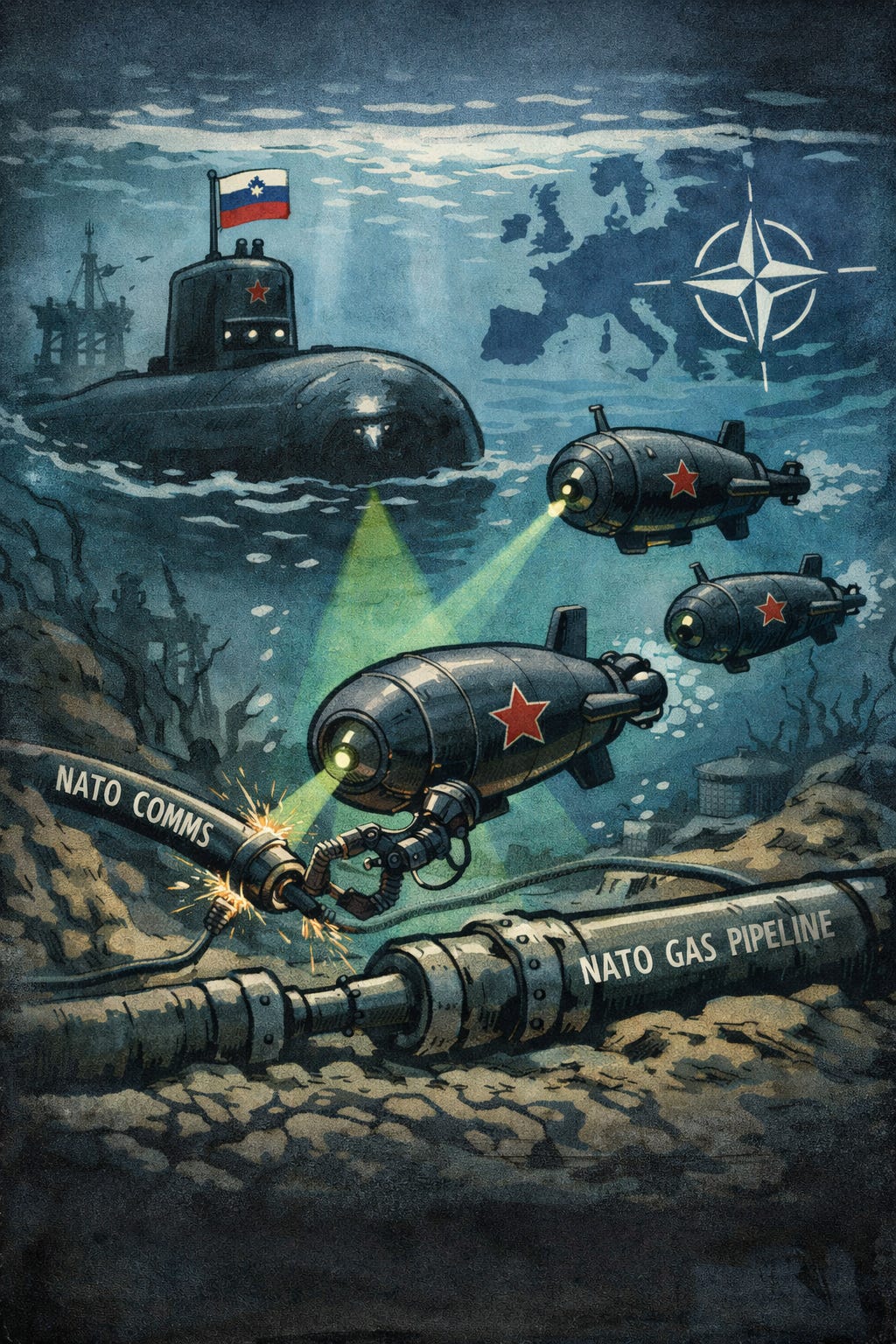
Russia Expands Underwater Drone Fleet: NATO Fears Mount Over Sabotage of Subsea Infrastructure
Bottom Line Up Front (BLUF): Russia is reportedly expanding its fleet of underwater drones with the potential to target critical NATO subsea infrastructure, including communication cables and gas pipelines. Western analysts warn the move could enable covert sabotage operations across the Atlantic, heightening concerns about hybrid warfare tactics in Europe’s undersea domain.
Analyst Comments: After the Nord Stream sabotage and increased Russian naval activity in the North and Baltic Seas, Western militaries are treating undersea infrastructure as a contested battlespace. These drones, especially if capable of long-range autonomous operations, give Russia asymmetric tools to disrupt NATO operations without firing a shot. With limited attribution options and poor seabed monitoring, defending every cable is nearly impossible. Expect NATO to ramp up seabed situational awareness, deploy more of its own maritime drones, and classify parts of this infrastructure as strategic assets.
READ THE STORY: United24
US Treasury Lifts Sanctions on Intellexa Spyware Developers Amid Lobbying Pressure
Bottom Line Up Front (BLUF): The U.S. Treasury has quietly removed sanctions on key individuals linked to Intellexa, the European spyware vendor behind the Predator surveillance tool. Initially blacklisted in July 2023 for enabling authoritarian regimes to target journalists and dissidents, the rollback follows intense lobbying and has sparked concern among digital rights advocates and national security analysts.
Analyst Comments: The Intellexa consortium has been publicly linked to repressive surveillance activities across multiple continents. Lifting sanctions without a clear public rationale suggests either behind-the-scenes diplomatic pressure or a reevaluation of enforcement strategy. From a cybersecurity standpoint, this sends mixed signals: it undermines recent efforts to constrain the commercial spyware industry and may embolden vendors operating in the gray zone. For defenders, it means Predator and similar tools could remain in circulation, potentially with new state clients or rebranded operators. Don’t expect this move to slow offensive spyware development—it may do the opposite.
READ THE STORY: RHC
Handala Hackers Leak Israeli Police Data in Retaliatory Breach
Bottom Line Up Front (BLUF): Pro-Palestinian threat group "Handala Hackers" claims responsibility for breaching Israel’s national police systems, leaking a trove of sensitive data, including police officer records, facial recognition footage, and internal communications. The attack was reportedly carried out in retaliation for the ongoing conflict in Gaza and includes gigabytes of stolen data now circulating on Telegram and dark web forums.
Analyst Comments: The Handala Hackers infiltrated the Israeli police's digital infrastructure and exfiltrated large volumes of sensitive data, including names, positions, facial images, and video files from surveillance systems. Leaked samples posted on Telegram include footage from street cameras and what appear to be internal police investigation files. The group cited the “Zionist occupation’s aggression against Gaza” as their motivation and warned of further breaches. Israeli authorities have yet to confirm the full scope of the incident.
READ THE STORY: GBhackers
Sandworm Targets AWS Customers via Misconfigured Edge Devices in Multi-Year Campaign
Bottom Line Up Front (BLUF): Amazon has confirmed that Russian state-sponsored group Sandworm, linked to GRU military intelligence, spent much of 2025 exploiting misconfigured customer-owned edge devices hosted on AWS infrastructure. The campaign, which appears to have been ongoing since at least 2021, targeted energy companies and other critical infrastructure in North America and Europe—without exploiting AWS itself.
Analyst Comments: Sandworm didn’t breach AWS, but they used customer-operated appliances on AWS—routers, VPNs, gateways—as entry points. These devices often fall through the cracks of cloud security programs: technically on cloud infrastructure but managed like legacy on-premises hardware. The shift from zero-day exploits to persistent exploitation of misconfigurations is cost-effective and scalable for threat actors. If you’re running edge devices in cloud environments, assume they are targets and validate configs against a hardened baseline. Detection of east-west movement across EC2 instances should be a monitoring priority.
READ THE STORY: CRN
Russia-Linked APT UAC-0184 Uses Viber in Ongoing Espionage Campaign Against Ukraine
Bottom Line Up Front (BLUF): APT group UAC-0184 (aka Hive0156), tied to Russian state interests, conducted a 2025 espionage campaign targeting Ukrainian military and government entities. Using Viber as the initial delivery vector, the group sent malicious ZIP files disguised as official parliamentary documents, ultimately deploying Remcos RAT via HijackLoader to exfiltrate sensitive data and maintain persistent access.
Analyst Comments: This campaign reinforces a growing trend: state-linked threat actors exploiting widely used, trusted apps—like Viber, Signal, and Telegram—as covert delivery channels in high-value intelligence operations. UAC-0184 is adapting to platform popularity and user trust, increasing phishing efficacy while evading traditional enterprise detections. The malware stack is familiar, but the execution is polished. Their use of legitimate programs for sideloading and memory injection suggests an evolving OPSEC discipline. Ukrainian and NATO-aligned defenders should assume continued phishing campaigns leveraging local apps, and prioritize monitoring LNK file abuse, PowerShell-based loaders, and suspicious activity tied to messaging platforms.
READ THE STORY: SA
China Reaches Quantum Error Correction Milestone, Signaling Leap Toward Scalable Quantum Computing
Bottom Line Up Front (BLUF): Chinese researchers have announced a critical breakthrough in quantum error correction, demonstrating fault-tolerant operation on their 107-qubit Zuchongzhi 3.2 quantum processor. For the first time, adding error-correcting layers actually reduced overall error—surpassing the long-sought fault-tolerance threshold. The team used a fully microwave-based approach to suppress leakage errors, potentially enabling more scalable and hardware-efficient quantum systems.
Analyst Comments: Error correction has been the Achilles’ heel of quantum computing—without it, systems are too noisy to solve real-world problems. Beijing’s announcement puts it in lockstep with or slightly behind Google’s own milestone earlier in 2026. But China’s use of a microwave-based technique (versus Google’s DC pulse suppression) may lower the hardware complexity barrier, making it easier to scale to practical quantum systems. From a national security and cybersecurity perspective, the geopolitical arms race in quantum continues—and the risk window for post-quantum cryptography is shrinking. Enterprises should treat NIST’s PQC rollout timelines as a floor, not a ceiling.
READ THE STORY: RHC
FCC’s IoT Cyber Trust Mark Program in Limbo After UL Withdraws Over China Probe
Bottom Line Up Front (BLUF): UL LLC, the lead administrator for the FCC’s Cyber Trust Mark program, has withdrawn following a federal investigation into its ties to Chinese entities and operations. The move leaves the future of the U.S. government’s flagship IoT security labeling initiative uncertain, just months before its anticipated launch.
Analyst Comments: The Cyber Trust Mark was the U.S.'s first genuine attempt to create baseline security standards for consumer IoT devices—a sector rife with insecure, mass-produced hardware. UL’s exit isn’t merely administrative; it reflects broader tensions between global supply chains and national security scrutiny. UL’s China-based labs were always going to raise flags under a Trump-led FCC. Now, with no lead administrator and rising political pressure, the program risks being shelved or restructured entirely. Until there's clarity, expect continued variability in IoT device security and greater demand for private-sector certifications.
READ THE STORY: CSD
Israel to Introduce Electronic Tagging in West Bank Amid Security Crackdown
Bottom Line Up Front (BLUF): The Israeli government is moving to implement electronic tagging of particular Palestinian residents in the occupied West Bank, citing security concerns and the need for movement monitoring. The measure is part of a broader escalation in administrative controls following recent violence and heightened tensions in the region.
Analyst Comments: Electronic tagging—typically used in criminal justice systems—being applied to civilians under occupation raises serious questions about proportionality, privacy, and long-term strategic blowback. While Israeli officials claim it's a security necessity, rights groups and international observers are likely to frame it as collective punishment and digital containment. For cyber policy watchers, this is also a case study in biometric control, geofencing, and data governance under conditions of military occupation. Expect potential legal challenges in international forums and scrutiny over which vendors provide the tagging tech.
READ THE STORY: The Hindu
Items of interest
Finnish Authorities Arrest Two Sailors in Baltic Sea Pipeline Sabotage Probe
Bottom Line Up Front (BLUF): Finnish authorities have arrested two foreign nationals in connection with the October 2023 damage to the Balticconnector gas pipeline. The individuals, reportedly crew members aboard the Chinese vessel NewNew Polar Bear, are suspected of involvement in the intentional sabotage of critical energy infrastructure between Finland and Estonia.
Analyst Comments: The arrests suggest Finland may have actionable evidence pointing to deliberate interference rather than accidental damage. While no state attribution has been made, the involvement of a commercial vessel flagged under Chinese ownership but operating near a Russian naval sphere of influence adds a geopolitical layer. The strategic messaging here is clear: Nordic states are treating subsea sabotage as a national security issue, not just an environmental or commercial one. Expect increased patrols, sensor deployments, and intelligence sharing across the Baltic.
READ THE STORY: GBhackers
Hybrid warfare? Baltic Sea pipeline sabotage raises energy security stakes (Video)
FROM THE MEDIA: All summer, we asked if Europe was ready for winter. Now, is Europe prepared for hybrid warfare? Swedish authorities are reporting a fourth leak on the Nord Stream pipelines that connect Russia to Germany via the Baltic Sea. The EU calls Monday's explosions sabotage, with Poland and Ukraine blaming Russia.
How Underwater Drones Became Key to Modern Defence Strategy (Video)
FROM THE MEDIA: Countries are rapidly expanding the use of underwater drones as global conflicts highlight vulnerabilities in deep-sea infrastructure. These autonomous systems can travel long distances, monitor power and telecom cables, scan for mines, and track submarines. Early underwater vehicles were developed during the Cold War, but new technology and recent attacks on pipelines and cables have accelerated investment. Germany has built the Greyshark drone, Australia is developing Ghost Shark with Anduril, the United Kingdom is expanding its uncrewed fleet, and the United States is increasing funding for its programmes. Russia has also tested its nuclear-powered Poseidon drone, signalling a wider global race.
The selected stories cover a broad range of cyber threats and are intended to help readers frame key publicly discussed threats and improve overall situational awareness. InfoDom Securities does not endorse any third-party claims made in its original material or related links on its sites; the opinions expressed by third parties are theirs alone. For further questions, don't hesitate to get in touch with InfoDom Securities at dominanceinformation@gmail.com.