
Daily Drop (1219)
01-05-26

Monday, Jan 05, 2025 // (IG): BB // GITHUB // SN R&D
U.S. Retreats from Global Cyber Leadership as China and Russia Expand Offensive Operations
Bottom Line Up Front (BLUF): Foreign allies and former officials are raising alarms over a perceived U.S. pullback from international cyber engagement in 2025. As Washington scales back its leadership in multilateral cyber initiatives, China and Russia have intensified aggressive cyber campaigns targeting critical infrastructure, telecom networks, and political targets—including pre-election surveillance of U.S. presidential candidates. Meanwhile, Trump-era budget cuts and agency restructuring have hollowed out U.S. cyber capacity at a time of record global cyber incidents.
Analyst Comments: This is the worst possible time for a leadership vacuum. The absence of the CRI summit, CISA cuts, and the dismantling of the State Department’s cyber bureau all signal a U.S. inward shift—one that adversaries are eager to exploit. China’s Salt Typhoon operation, which targeted telecoms and political communications, isn’t just espionage—it’s infrastructure reconnaissance. Russia’s persistent attacks on NATO-aligned networks show the integration of cyber into geopolitical conflict. Allies see the gap growing, and if Washington doesn’t re-engage fast, Beijing and Moscow will fill the void—with their own norms and influence.
READ THE STORY: FP
Beijing Ramps Up Daily Cyberattacks on Taiwan’s Infrastructure, Crossing 2.6 Million Incidents
Bottom Line Up Front (BLUF): Taiwan faced an average of 2.63 million cyberattacks per day in 2025 from China-linked actors, a 6% increase over 2024 and more than double 2023 levels, according to Taiwan’s National Security Bureau. Targets included hospitals, telecoms, banks, and semiconductor firms, often timed with PLA military drills—indicating a coordinated hybrid warfare campaign by Beijing.
Analyst Comments: China isn’t just probing networks—it’s stress-testing Taiwan’s digital resilience while signaling to the international community that it can impose real-world costs without crossing kinetic thresholds. The focus on semiconductor firms is especially concerning, given their centrality to global tech supply chains. If Beijing can compromise operations at TSMC or science parks in Hsinchu, it doesn't just rattle Taiwan—it shakes global markets. Expect Taiwan to prioritize public-private cyber defense integration and to look to partners such as the U.S. and Japan for more robust threat intelligence sharing and infrastructure hardening.
READ THE STORY: Modern Diplomacy
China’s Multi-Front Infiltration Campaign in the U.S. Exposed in 2025
Bottom Line Up Front (BLUF): Throughout 2025, U.S. federal agencies uncovered a sweeping campaign of espionage and infiltration tied to Chinese intelligence, spanning military secrets, biological smuggling, cyber intrusions, and strategic land acquisitions. The incidents paint a picture of a broad, multi-domain effort by the Chinese state to compromise U.S. national security from within.
Analyst Comments: The Chinese Ministry of State Security (MSS) is no longer just targeting trade secrets; it’s actively recruiting U.S. service members, probing telecom infrastructure, and even exploiting university labs to smuggle agricultural pathogens. The acquisition of land near Whiteman AFB isn’t a coincidence—it’s classic gray-zone maneuvering. Expect increased scrutiny of foreign land ownership, academic research partnerships, and telecom backdoors in 2026. Defenders should closely track Salt Typhoon and similar APTs, while counterintelligence requires more resources to combat this long-term infiltration.
READ THE STORY: Vision Times
U.S. Cyber Operations Suspected in Venezuelan Power Cut During Maduro Capture
Bottom Line Up Front (BLUF): During a U.S. military operation that resulted in the capture of Venezuelan President Nicolás Maduro on January 3, 2026, internet connectivity across Caracas sharply declined—allegedly due to power disruptions linked to U.S. cyber or technical operations. President Trump suggested publicly that the U.S. used its "expertise" to plunge the capital into darkness. Concurrently, Tor usage in Venezuela spiked, a standard indicator of digital repression and public fear of surveillance.
Analyst Comments: If cyber capabilities were used to disable power in support of a kinetic strike, this would mark a rare and highly public application of offensive U.S. cyber power in a regime-change context. That’s a sharp escalation from past doctrine, pushing cyber firmly into overt geopolitical maneuvering. The surge in Tor traffic suggests a population scrambling for secure communication and information access, hinting at censorship, surveillance, or both. Combine that with PDVSA’s cyberattack claim, and you’ve got a full-spectrum information control battle playing out in real time. Expect scrutiny from the international community and further discussion over norms governing offensive cyber use during military operations.
READ THE STORY: Security Affairs
Ukraine’s Drone Defense Evolves Amid Escalating Russian UAV Threat
Bottom Line Up Front (BLUF): Facing relentless Russian drone strikes, Ukraine is rapidly scaling its electronic warfare (EW) and counter-drone capabilities. A new wave of tactical innovations—ranging from GPS jamming to domestic drone-hunting units—is reshaping the air defense landscape, especially along the front lines and near critical infrastructure.
Analyst Comments: Ukraine’s response reflects a shift from purely kinetic defense toward layered, adaptive drone mitigation. EW jamming has become the backbone of their defense, degrading Russian ISR and loitering munitions like Lancets. However, GPS jamming can disrupt Ukrainian systems, including its own UAVs and precision-guided weapons. That tradeoff—strategic disruption at the risk of tactical friction—underscores how messy drone warfare has become. Look for more targeted jamming, directed-energy trials, and more innovative drone-detection algorithms in the coming year as Ukraine aims to outpace Russian drone evolution.
READ THE STORY: The National Interest
SpaceX and China Drive Record-Breaking Year for Orbital Launches in 2025
Bottom Line Up Front (BLUF): Global orbital launch activity hit an all-time high in 2025, with SpaceX and China’s state-backed space programs accounting for over 70% of successful launches, according to SpaceNews. SpaceX completed a record 98 launches, while China conducted 67, led by CASC and rising commercial players like Galactic Energy and iSpace. The sustained tempo reflects not only commercial growth but also intensified strategic competition in orbit—including satellite megaconstellations, military ISR expansion, and proliferation of dual-use technologies.
Analyst Comments: On the one hand, SpaceX is scaling its Starlink deployment while supporting NASA, the DoD, and international customers. On the other hand, China’s launch ecosystem is maturing rapidly, with state-owned CASC enabling military payloads and commercial startups mirroring the SpaceX model—often with military crossover. For cyber defenders and space security analysts, the increase in launch cadence entails more assets in orbit, more downlink sites, and a larger attack surface. Ground segments, TT&C links, satellite firmware, and mesh network comms (especially Starlink-style constellations) are now high-priority targets for state actors and APTs. Expect both sabotage attempts and espionage campaigns aimed at payload telemetry, launch infrastructure, and AI-based satellite operations.
READ THE STORY: SPACENEWS
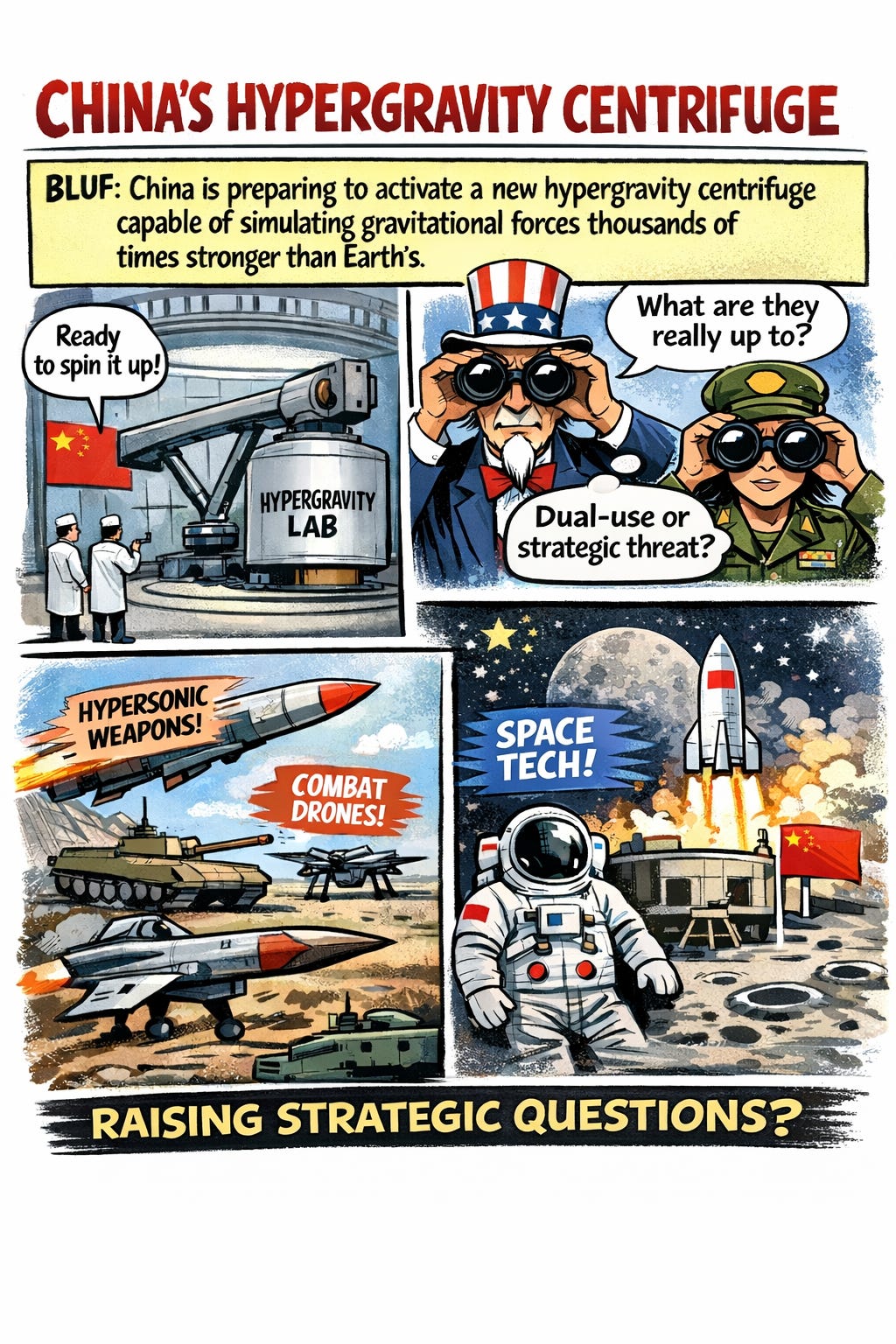
China’s Alleged Hypergravity Centrifuge Raises Strategic and Dual‑Use Questions
Bottom Line Up Front (BLUF): China is preparing to activate a new hypergravity centrifuge facility capable of simulating gravitational forces thousands of times stronger than Earth’s. While publicly framed as a scientific tool for studying materials and “compressing space‑time” effects, reporting highlighted by IFLScience underscores the system’s dual‑use potential. Beyond fundamental physics, the facility has clear implications for aerospace engineering, missile design, and military materials testing—areas directly relevant to China’s long‑term strategic competition with the United States.
Analyst Comments: Despite the sensational phrasing around “compressing space‑time,” the underlying technology is straightforward physics, not science fiction. The centrifuge generates extreme acceleration by spinning test chambers at very high speeds, allowing researchers to observe how materials, structures, and fluids behave under hypergravity conditions. No actual manipulation of space‑time is occurring; instead, the facility enables accelerated testing that would otherwise require years of real‑world stress. The strategic relevance lies in what can be tested faster and more cheaply. Hypergravity environments are well-suited to evaluating aerospace components, rocket-fuel behavior, hypersonic-vehicle structures, satellite hardware, and even nuclear‑related materials. For military planners, this shortens R&D cycles and reduces dependence on full‑scale flight testing—an advantage in developing missile, space, and hypersonic weapons.
READ THE STORY: IFL SCIENCE
From EDR to Autonomous Defense: Chinese Cybersecurity Community Tracks U.S. AI Battlefield Strategy
Bottom Line Up Front (BLUF): The U.S. military is integrating AI-enabled endpoint defense, red-team-informed model training, and cyber-physical sensor fusion to create self-healing, battlefield-resilient systems. Chinese cybersecurity experts interpret this as a shift away from reactive perimeter defense toward distributed, adaptive, and autonomous endpoint ecosystems that evolve in real time under operational stress.
Analyst Comments: This is not a surface-level critique—it reflects growing technical unease in Chinese cyber circles that the U.S. is achieving kill-chain survivability through real-time AI feedback loops. The FreeBuf post treats U.S. endpoint defense not just as cybersecurity tooling but as autonomous infrastructure embedded into frontline assets—UAVs, forward vehicles, soldier kits—each equipped with lightweight AI models that learn from live engagements and propagate threat adaptations laterally across the battlespace.
READ THE STORY: FreeBluf
Russia Renews Claims on U.S. Biolabs in Ukraine, Calls for UN Investigation
Bottom Line Up Front (BLUF): Russia is again pushing allegations that the U.S. operated military-linked biological laboratories in Ukraine, demanding a formal UN Security Council investigation. According to The Eastern Herald, Russian officials claim the Pentagon funded bioweapons research under the guise of public health cooperation. The U.S. and Ukraine have repeatedly denied the accusations, characterizing them as disinformation. While these claims are not new, their resurgence reflects continued Russian attempts to weaponize narrative warfare and undermine U.S. legitimacy in global forums.
Analyst Comments: The alleged “biolabs” narrative dates back to early 2022 and has been recycled repeatedly by Russian state media, often amplified by Chinese outlets and fringe conspiracy networks. From a cyber and influence ops perspective, this push is less about evidence and more about perception architecture. Russian information campaigns frequently blend partial truths (e.g., U.S.-funded labs in Ukraine for disease surveillance) with inflammatory allegations (e.g., bioweapons targeting ethnic groups) to maximize ambiguity and stoke fear. Expect renewed waves of state-linked amplification on Telegram, X (formerly Twitter), and sympathetic Western alt-media outlets.
READ THE STORY: Eastern Herald
SpaceX and China Drive Record-Breaking Year for Orbital Launches in 2025
Bottom Line Up Front (BLUF): Global orbital launch activity hit an all-time high in 2025, with SpaceX and China’s state-backed space programs accounting for over 70% of successful launches, according to SpaceNews. SpaceX completed a record 98 launches, while China conducted 67, led by CASC and rising commercial players like Galactic Energy and iSpace. The sustained tempo reflects not only commercial growth but also intensified strategic competition in orbit—including satellite megaconstellations, military ISR expansion, and proliferation of dual-use technologies.
Analyst Comments: On the one hand, SpaceX is scaling its Starlink deployment while supporting NASA, the DoD, and international customers. On the other hand, China’s launch ecosystem is maturing rapidly, with state-owned CASC enabling military payloads and commercial startups mirroring the SpaceX model—often with military crossover. For cyber defenders and space security analysts, the increase in launch cadence entails more assets in orbit, more downlink sites, and a larger attack surface. Ground segments, TT&C links, satellite firmware, and mesh network comms (especially Starlink-style constellations) are now high-priority targets for state actors and APTs. Expect both sabotage attempts and espionage campaigns aimed at payload telemetry, launch infrastructure, and AI-based satellite operations.
READ THE STORY: SPACENEWS
Chinese Researchers Disclose Novel JavaScript-Based Side Channel Targeting ChatGPT Interactions
Bottom Line Up Front (BLUF): Chinese researchers have demonstrated a JavaScript-based side-channel technique that can infer characteristics of ChatGPT user prompts by observing browser rendering and resource-loading behavior. While limited to a proof of concept, the research highlights a real privacy risk when LLMs operate in shared or poorly isolated browser environments.
Analyst Comments: RondoDox is the latest in a growing trend of botnets built for modular post-exploitation and infrastructure denial, not just DDoS. What stands out here is its aggressive use of anti-competition logic—terminating rival malware, Docker containers, and scheduled jobs—suggesting a “first-mover wins” approach to botnet persistence. The inclusion of "/nuts/bolts" as a custom-built process-killer/loader indicates a shift from commodity malware to purpose-built kits targeting modern cloud stacks.
READ THE STORY: FreeBluf
SpaceX Launches Italian COSMO-SkyMed Satellite, Bolstering European Earth Observation Network
Bottom Line Up Front (BLUF): SpaceX successfully launched Italy’s COSMO-SkyMed Second Generation (CSG) FM3 satellite aboard a Falcon 9 from Vandenberg Space Force Base. This marks the third satellite in the upgraded COSMO-SkyMed constellation, a dual-use Earth observation program managed by the Italian Space Agency (ASI) and the Italian Ministry of Defence. The launch reinforces Italy’s strategic capability in high-resolution radar imaging for both civilian and military applications.
Analyst Comments: COSMO-SkyMed may not make headlines in defense circles like military satellites or hypersonic tests, but its value lies in persistent ISR with synthetic aperture radar (SAR)—a capability that’s increasingly central to strategic competition. SAR enables all-weather, day/night imaging, providing Italy (and NATO partners) with enhanced capacity to monitor maritime zones, borders, and potential conflict zones—including the Mediterranean, North Africa, and Eastern Europe.
READ THE STORY: SPACENEWS
Tokyo FM Broadcasting Hit by Alleged Data Breach: 3M Records Claimed Stolen by Hacker Group “victim”
Bottom Line Up Front (BLUF): A hacker group calling itself “victim” has claimed responsibility for a breach at Tokyo FM Broadcasting Co., Ltd., allegedly exfiltrating more than 3 million user records. The compromised data includes PII such as names, emails, dates of birth, and internal login credentials. The incident, first flagged on January 1, remains unconfirmed by Tokyo FM but poses significant privacy and phishing risks if verified.
Analyst Comments: The media sector remains a high-value target—whether for visibility, data monetization, or broader influence operations. While this breach hasn’t been confirmed, the actor’s use of both clear- and dark-web platforms to publish claims, coupled with redacted proof-of-compromise screenshots, suggests a deliberate effort to gain credibility. If internal credentials were stolen, there’s risk beyond data leakage—potential lateral movement or broadcast disruption. Media orgs need to assume they’re soft targets and harden identity and access management, especially for backend systems.
READ THE STORY: GBhackers
Items of interest
Spanish Comms Satellite Damaged by Space Particle, Underscoring Rising Orbital Risk
Bottom Line Up Front (BLUF): A new Spanish communications satellite suffered a critical anomaly shortly after launch, with initial analysis pointing to a high-velocity space particle impact. According to SpaceNews, the incident affected the satellite’s onboard power systems; although operators have not confirmed a permanent failure, mission objectives are likely compromised. The event highlights growing concern about both orbital debris and natural space-environment risks—particularly for commercial and mid-tier national operators.
Analyst Comments: While described as a “space particle” impact, analysts should not rule out the possibility of micro-debris from prior launches or fragmentation events, including those from anti-satellite (ASAT) tests. For smaller space agencies and regional operators, such as Spain’s Hisdesat or telecom ventures with limited satellite fleets, a single incident can undermine national communications resilience and strategic autonomy.
READ THE STORY: SPACENEWS
The Mystery of the Invisible Space Particles (Video)
FROM THE MEDIA: Today, we're talking about neutrinos, those subtle and elusive invisible particles that have intrigued researchers for decades due to their unique particle properties. Billions of these ghost particles, fundamental elementary particles, pass through us every second without interference. This deep dive into neutrino research helps explain their subtle physics and how they interact with matter.
Virtual Particles: Empty Space’s Shocking Chaos Exposed (Video)
FROM THE MEDIA: Every second, trillions of virtual particles flicker in and out of existence beneath the fabric of reality — or so quantum physics tells us. But what if this entire idea is a convenient illusion, a mathematical trick that only pretends to describe what’s really happening in the quantum vacuum? In this new Frontiers of Infinity documentary, we ask the ultimate question: Are Virtual Particles Even Real?
The selected stories cover a broad range of cyber threats and are intended to help readers frame key publicly discussed threats and improve overall situational awareness. InfoDom Securities does not endorse any third-party claims made in its original material or related links on its sites; the opinions expressed by third parties are theirs alone. For further questions, please contact InfoDom Securities at dominanceinformation@gmail.com.
Really sharp framing on the U.S. cyber posture gap here. The simultaneous withdrawal from multilateral forums and dismantling of cyber bureaus couldnt have worse timing given the operational tempo from Salt Typhoon and related China-nexus campaigns. The reconnaissance angle you highlighted on infrastructure is the quiet part most policymakers are missing. In a past incident response case, I saw how actors use telecom access not for immediate exploitation but to map relationships and build contingency playbooks. The lack of coordination with allies only makes attribution and collective defense harder, which is exactly what adversaries want.