
Daily Drop (1218)
01-04-26

Sunday, Jan 04, 2025 // (IG): BB // GITHUB // SN R&D
Cyber Command Likely Behind PDVSA Hack as U.S. Layers Cyber and Kinetic Effects in Venezuela Strike
NOTE:
ICS targeting has repeatedly shown a disproportionate impact relative to the effort expended. Unlike traditional IT disruptions, attacks on control systems directly affect physical processes—electricity generation, refinery operations, safety interlocks, and load balancing—producing immediate, visible consequences. In Venezuela, simultaneous refinery blackouts and telecom failures indicate compromise at or near the OT layer, not merely administrative networks. This mirrors earlier proof points. Russian attacks on Ukraine’s grid in 2015–2016 confirmed that manipulating ICS environments could shut down power at will. Ukraine’s later resilience does not negate the effectiveness of the method—it demonstrates that defense works only after adaptation. Venezuela never adapted. Centralized control, legacy systems, poor segmentation, and politicized management created ideal conditions for cascading failure once ICS access was achieved.
Bottom Line Up Front (BLUF): A December cyberattack on Venezuela’s state-owned oil company PDVSA appears to be part of a coordinated U.S. offensive that included the January 3 military operation capturing Nicolás Maduro. While no official attribution has been made, experts and former officials argue that the incident’s scale, precision, and timing strongly point to U.S. Cyber Command. The attack disrupted power and communications across critical PDVSA facilities, aligning with known U.S. doctrine for shaping the battlespace before kinetic action.
Analyst Comments: The reported outage across PDVSA’s infrastructure—just weeks before the actual military strike—was likely a battlefield prep operation, designed to erode command-and-control and stall oil exports in advance of Operation Absolute Resolve. While the attack officially “only” hit administrative systems, reports of widespread refinery blackouts and comms loss suggest a deeper compromise than Caracas admitted. The most telling detail: the grid outage in Caracas during the strike itself. Chairman of the Joint Chiefs Gen. John Daniel Caine confirmed Cyber Command was involved. And Trump himself vaguely attributed the blackout to “a certain expertise we have,” a not-so-subtle nod to cyber capabilities. This was also a messaging play. The U.S. sent a strong signal to Venezuela’s external backers—Russia and China—that not only can it outfight them on the ground, but it can also outmaneuver them in cyberspace, even in their clients’ backyards.
READ THE STORY: BankInfoSec // Politico
U.S. Raid on Venezuela Seen as Cyber-Kinetic Template by Chinese Analysts
Bottom Line Up Front (BLUF): The U.S. raid on Venezuela showcased a real-world, coordinated use of cyber tools in support of kinetic military objectives. Chinese analysts on platforms such as FreeBuf are examining the incident not as a political act but as a template for integrated cyber-kinetic warfare—one that relies heavily on the precision disruption of critical infrastructure, real-time coordination across command structures, and stealthy pre-positioning of access to adversary networks.
Analyst Comments: The Caracas blackout during the raid is seen as the smoking gun for real-time cyber‑kinetic coordination. NetBlocks confirmed concurrent internet disruption; General Caine acknowledged Cyber Command’s role; and Trump’s vague “certain expertise” comment is viewed as coded validation of a cyber-led assault. Chinese interpretation emphasizes precision denial: systems were temporarily paralyzed—not destroyed—to delay response and obscure situational awareness, and were then restored. This signals a shift from attrition to control. The bigger concern in Chinese defense circles is the systems integration on display. The operation appears to have fused Cyber Command, ISR assets, and JSOC under a single execution loop—suggesting the U.S. has achieved real-time operational convergence. FreeBuf commentary emphasizes that this tempo demands not just tools, but doctrine: persistent access, automated tasking, and decentralized authority. The lesson is clear—A2/AD defenses reliant on digital infrastructure can be structurally bypassed if cyber access comes first. And in this model, cyber is no longer support—it’s the breach point.
READ THE STORY: FreeBluf
Operation Absolute Resolve: U.S. Captures Maduro in 3-Hour Decapitation Strike
NOTE:
While Washington intended this as a deterrent, it also provided Beijing with a blueprint. Chinese analysts are likely studying this as a fait accompli model for Taiwan—an operation so fast and decisive that global institutions can’t react before it’s over. The absence of occupation, the speed of withdrawal, and the legal narrative constructed after control was asserted all support the kind of justification Beijing may adopt.
Bottom Line Up Front (BLUF): In the early hours of January 3, 2026, U.S. forces launched Operation Absolute Resolve—a rapid, multi-domain special operation targeting Venezuela’s leadership. Within three hours, American aircraft disabled key air defenses and command networks, special operations forces inserted into Caracas, captured President Nicolás Maduro, and withdrew without lingering presence. The operation achieved complete strategic and tactical surprise, marking one of the fastest and cleanest regime-level takedowns in modern U.S. military history.
Analyst Comments: This is what a real “Special Military Operation” looks like: defined objectives, multi-domain dominance, and no mission creep. U.S. planners clearly took lessons from the chaos of post-2003 Iraq and the Russian war in Ukraine—this was Cold War-style intervention executed with 21st-century precision. The optics were as strategic as the execution. The use of EW and cyber to paralyze rather than destroy systems shows an evolving doctrine: degrade, disorient, insert, extract. Venezuela’s defenses weren’t overrun—they were blinded and bypassed. Maduro’s capture was less about Venezuela and more about sending a calibrated signal to peer competitors, particularly China and Russia, that the U.S. retains global strike credibility.
READ THE STORY: FDD // Le Monde // DefenseScoop
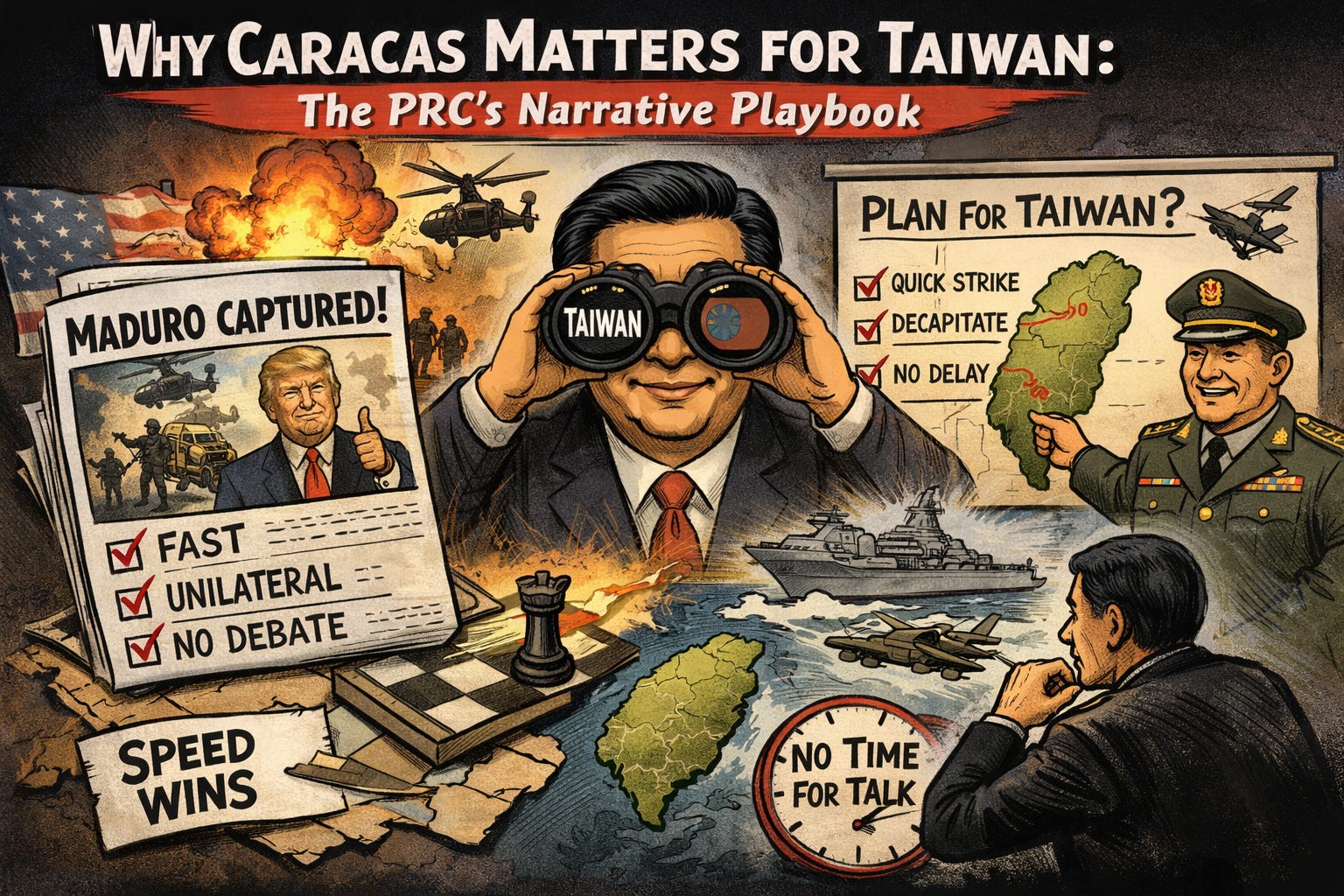
Why Caracas Matters for Taiwan: The PRC’s Narrative Playbook
NOTE:
The U.S. operation in Caracas was designed as a signal of deterrence and capability. Instead, it has become something more uncomfortable: a usable precedent. Within China’s strategic ecosystem—state media, military commentary, and online discourse—the Maduro raid is being interpreted less as an aberration and more as evidence that rapid, unilateral force can succeed before the international system has time to react. That logic maps cleanly onto how Beijing thinks about Taiwan.
Bottom Line Up Front (BLUF): Beijing is exploiting the U.S. seizure of Nicolás Maduro to advance a permissive narrative about decisive force. While publicly condemning the raid as illegal and hegemonic, Chinese actors are simultaneously internalizing its strategic lesson: speed collapses resistance, legality is constructed after control is established, and occupation is optional. The takeaway for Taiwan is not tactical imitation, but the normalization of a rapid, coercive resolution framed as an irreversible fact.
Analyst Comments: Caracas will not trigger immediate action on Taiwan. But it has shifted the narrative terrain. By acting first and explaining later, the United States unintentionally validated a worldview Beijing already holds: outcomes confer legitimacy, not procedure. That belief is now being reinforced across China’s information and analytical ecosystem. The danger is not imitation—it is normalization. Each successful, bounded use of force narrows the space for deterrence grounded in norms and processes. Caracas did not change China’s goals. It changed the perceived rules around how those goals might one day be pursued.
READ THE STORY: Bloomberg // GT (CN)
How Beijing Is Framing Caracas: Sovereignty, Speed, and the End of Restraint
NOTE:
Chinese state media and academics are using the U.S. operation in Venezuela to reframe how power works in the 2020s. While the public-facing language is legalistic—sovereignty, the UN Charter, international norms—the underlying message is clear: the U.S. removed a head of state within hours, faced no immediate penalty, and subsequently rewrote the legality. In that light, Caracas serves as a precedent Beijing can cite when pursuing its own “core interests,” particularly in Taiwan.
Bottom Line Up Front (BLUF): The PRC is amplifying the U.S. raid in Venezuela to argue that Washington no longer abides by the rules it claims to enforce. By highlighting the absence of international authorization, the post hoc legal framing, and the lack of consequences, China is constructing a narrative in which speed and unilateralism define modern legitimacy. The goal isn’t just to criticize—it’s to set the stage for Beijing to justify similar logic when it acts in its own sphere.
Analyst Comments: The protest coverage is serving dual purposes: undermining U.S. domestic unity while signaling to the Global South that resistance to hegemony is shared and justified. Quotes from Western media (CNN, Guardian, NYT) aren’t filler—they’re narrative weapons. By amplifying internal dissent, Beijing avoids appearing to manufacture outrage and instead appears to be simply reflecting global consensus. The legal framing (sovereign immunity, UN Charter, “domestic law over international law”) builds the same case China would make if it seized control of Taiwan in a fast, limited strike. Caracas becomes a mirror, not a warning.
READ THE STORY: GT (CN)
Venezuela’s Air Defenses Crushed in Minutes — But the Jungle War Is Just Beginning
Bottom Line Up Front (BLUF): The U.S. military dismantled Venezuela’s Russian-built air defense network in under 20 minutes during Operation Southern Spear, exposing the S-300VM system’s vulnerabilities in real-world combat. While the strike achieved tactical air superiority and paved the way for Maduro’s capture, analysts warn that the most challenging phase—counterinsurgency in terrain hostile to U.S. doctrine—is just beginning.
Analyst Comments: The S-300VM, long advertised as a regional equalizer, was neutralized with textbook electronic warfare, terrain masking, and rapid kinetic follow-through. For U.S. planners, it validated years of investment in jamming, anti-radiation targeting, and low-altitude strike planning. For Moscow and its clients, it was a humiliation—one likely to impact future arms deals, especially in Latin America and Africa. But this is where the victory narrative ends. Venezuela’s radar grid may be down, but its Flanker squadrons remain operational, dispersed into jungle airstrips with anti-ship capability. More concerning is what comes next: urban and jungle operations in an environment that strips away key U.S. advantages—satellite ISR, reliable comms, and rapid medevac.
READ THE STORY: We Are The Mighty
U.S. Strike on Venezuela Redraws Global Oil Map—but OPEC, Markets, and Infrastructure Stay Cold
Bottom Line Up Front (BLUF): The Trump administration’s 2026 military strike on Venezuela and the capture of Nicolás Maduro have triggered a realignment of global oil flows—but not a supply shock. U.S. Gulf Coast refiners are gaining renewed access to Venezuelan heavy crude, while Chinese buyers face tightened sanctions and enforcement. Meanwhile, OPEC has opted to hold output steady, signaling that Venezuela’s turmoil is no longer seen as a material factor in global oil strategy. Even with regime change, Venezuela’s oil sector remains structurally broken, and the overtly resource-driven rationale for U.S. intervention is fueling debate over war powers and energy policy.
Analyst Comments: This is a major geopolitical shift—but not a production one. The U.S. now has privileged access to a failed petrostate with the world’s largest proven reserves, but that doesn’t mean oil is flowing. Years of corruption, sanctions, and infrastructural decay have left PDVSA a hollowed-out shell. Trump’s move to seize Maduro and reassert U.S. presence in Venezuela may look like a strategic oil grab, but the actual barrels won’t follow quickly—if at all. OPEC’s calm response says it all: Venezuela hasn’t been a swing producer in years.
READ THE STORY: Reuters // NYT // The Guardian
Taiwan’s ‘Silicon Shield’ Raises Strategic Stakes Beyond Missiles
Bottom Line Up Front (BLUF): Taiwan’s dominance in advanced semiconductor manufacturing—especially via TSMC—has created a powerful form of strategic leverage dubbed the “Silicon Shield.” With over 90% of the world’s cutting-edge chips produced on the island, Taiwan is functionally irreplaceable in global supply chains. While this does not replace conventional defense, it significantly raises the cost of any Chinese military action, thereby creating a unique deterrent rooted in infrastructure interdependence rather than force projection.
Analyst Comments: Chips can’t stop missiles—but they can make launching them a global problem. Taiwan’s value isn’t just military or symbolic; it’s infrastructural. Its microchips power everything from U.S. fighter jets to Chinese telecom switches. That makes Taiwan’s tech sector both an economic linchpin and a deterrence multiplier. This is why targeting Taiwan isn’t just a military decision—it’s a bet against the stability of the global economy. The U.S., Japan, and the Netherlands have all embedded Taiwan in their national interests, whether through export controls, co-fab agreements, or joint R&D. It’s quiet, policy-level defense planning by economic means.
READ THE STORY: FH
China’s Military Pressure Spurs Taiwan-Japan Trade Alignment
Bottom Line Up Front (BLUF): Rising Chinese military pressure around Taiwan is accelerating strategic economic alignment between Taipei and Tokyo. According to reports from AZAT TV, Taiwan’s leadership is deepening trade cooperation with Japan in response to PLA air and naval maneuvers—moves increasingly seen as coercive attempts to shape regional policy through intimidation rather than direct engagement. While not a cybersecurity issue on the surface, the growing geopolitical tension carries second-order risks to regional digital infrastructure and supply chains, particularly in semiconductors and critical communications.
Analyst Comments: Japan and Taiwan are aligning their economies in direct response to Chinese military activity, particularly around chokepoints such as the Bashi Channel. From a cyber defense perspective, increased alignment between the Taiwanese and Japanese technology sectors likely entails shared threat intelligence, tighter supply chain interdependence, and coordinated development of cyber postures—particularly in semiconductor manufacturing, maritime infrastructure, and undersea cables. For China, this underscores a strategic miscalculation: military pressure is accelerating the very regional consolidation it seeks to prevent. From a defender’s perspective, the risk isn’t just kinetic—it’s the escalation of cyber probing, IP theft, and infrastructure mapping targeting Japanese-Taiwanese cooperative ventures. Expect Chinese APTs to intensify campaigns focused on energy logistics, shipping telemetry, and joint R&D platforms in the tech sector.
READ THE STORY: AZAT
Chinese Cyberattacks on Taiwan Rise 6% in 2025, Averaging Over 2.6 Million Daily Intrusions
Bottom Line Up Front (BLUF): China’s cyber offensive against Taiwan intensified in 2025, with the National Security Bureau (NSB) reporting an average of 2.63 million intrusion attempts per day—up 6% from 2024. The attacks increasingly target critical infrastructure, including energy, emergency response systems, healthcare, and the semiconductor industry. Taiwan’s intelligence services point to coordination between Chinese cyber units and PLA military exercises, raising concerns about synchronized gray-zone warfare.
Analyst Comments: The spike in cyberattacks around major political events, such as President Lai Ching-te’s inauguration, mirrors PLA military drills, confirming long-assumed coordination between Chinese cyber actors and conventional forces. These aren’t random hits; they’re battlefield preparation. Over half the attacks fall under “vulnerability weaponization,” a clear signal that Beijing is aggressively cataloging and exploiting zero-days across Taiwan’s public and private digital infrastructure. The targeting of Taiwan’s healthcare sector with ransomware and data leaks reflects a playbook seen in other authoritarian state operations: hit soft targets to cause chaos, erode trust, and force decision-makers onto the back foot.
READ THE STORY: Taiwan News
Ukraine as a Model, a Warning, and a Partner for Taiwan’s Drone Industry
Bottom Line Up Front (BLUF): As China expands its drone arsenal and surveillance over the Taiwan Strait, Taiwanese defense and tech sectors are studying Ukraine’s rapid drone adaptations, decentralized production, and foreign partnerships. The article highlights how Ukraine’s success with COTS drones, AI-based targeting, and local R&D may shape Taiwan’s approach to asymmetric aerial warfare—but warns that overreliance on imported technology and a lack of digital resilience remain critical risks.
Analyst Comments: Ukraine’s use of civilian drone platforms—often modified in the field—gave it flexibility and scalability, but also introduced vulnerabilities exploitable via RF jamming, GPS spoofing, or direct network intrusion. Taiwan’s threat environment differs in tempo but not in kind. If conflict breaks out in the Strait, expect PLA units to target Taiwan’s drone command links, backend data flows, and production logistics with cyber and electronic warfare. The concern isn’t just drone takedown—it’s drone hijack, feed spoofing, or data exfiltration via compromised battlefield apps or cloud storage used by civilian suppliers. If Taiwan follows Ukraine’s playbook, it must bake cyber resilience into every layer—from firmware to operator comms to telemetry redundancy.
READ THE STORY: The Diplomat
North Korea Launches Missiles in Warning Shot as South Korea Courts China Post-Venezuela Strike
Bottom Line Up Front (BLUF): North Korea fired multiple ballistic missiles into the sea on January 4, shortly after South Korean President Lee Jae Myung arrived in Beijing for a high-stakes summit with Chinese President Xi Jinping. Analysts view the launches as a geopolitical signal—both to deter deeper China–South Korea ties and to contrast North Korea’s posture with Venezuela’s rapid collapse following the U.S. capture of Nicolás Maduro.
Analyst Comments: North Korea habitually tests missiles in response to geopolitical shifts, but the timing here is too sharp to ignore. The barrage came within hours of President Lee’s arrival in Beijing, and follows the U.S. operation in Venezuela, where a sitting president was captured and a regime destabilized in under 48 hours. For Pyongyang, the takeaway is clear: don’t be Venezuela. By testing missiles as Lee steps onto Chinese soil, Kim is signaling resolve not just to Washington but to Beijing. It’s a direct challenge to China’s improving relations with Seoul, which have included recent cooperation on digital infrastructure and trade—Pyongyang’s message: deepening ties with the South won’t come without regional turbulence.
READ THE STORY: Aljazeera
Items of interest
Russia Threatens Starlink with Anti-Satellite Weapons, Sparking Global Security Concerns
Bottom Line Up Front (BLUF): Russia has reportedly begun targeting commercial satellite infrastructure, specifically SpaceX’s Starlink, with threats of anti-satellite (ASAT) capabilities. The move, disclosed by Russian officials and amplified through state media, signals a dangerous escalation in the militarization of space. Disabling or disrupting Starlink could cripple communications in conflict zones like Ukraine and have ripple effects across global infrastructure.
Analyst Comments: Starlink has become a key enabler of Ukrainian battlefield operations, and Russia sees it as a legitimate military target. But targeting commercial space assets—especially those serving both civilian and military purposes—crosses a threshold that could prompt broader geopolitical fallout. An ASAT strike, whether kinetic or via electronic warfare, risks collateral damage to other satellite systems and could trigger debris fields (à la Kessler Syndrome) that endanger all spacefaring nations. If Starlink or similar systems go down, expect degradation in GPS, communications, and satellite imagery for both civilian and defense users. NATO and the U.S. may interpret such actions as attacks on critical infrastructure, raising the stakes dramatically.
READ THE STORY: Milwaukee Independent
Ukraine Says Russia Is Using Starlink: How Elon Musk’s Satellites Work (Video)
FROM THE MEDIA: SpaceX’s Starlink, Elon Musk’s low-orbit satellite service, has been essential to Ukraine’s operations in the war against Russia. But officials in Kyiv say that Moscow’s forces have been buying satellite internet terminals and using them on the front line in its war against Ukraine, raising questions about what Musk and SpaceX can do, if anything, to shut down the effort.
Russia’s Alleged Shrapnel Plan Puts Starlink At Risk (Video)
FROM THE MEDIA: In this episode, we explore alarming claims by two NATO nations that Russia may be developing a new anti-satellite strategy targeting Starlink. Intelligence reports suggest Moscow could use clouds of orbiting shrapnel to disable multiple satellites at once. Such a move could severely disrupt battlefield communications in Ukraine and trigger widespread chaos in Earth’s orbit. Experts warn that this tactic would endanger not just Starlink but also satellites operated by several countries. The allegations raise fresh concerns about the future of warfare beyond Earth’s atmosphere.
The selected stories cover a broad range of cyber threats and are intended to help readers frame key publicly discussed threats and improve overall situational awareness. InfoDom Securities does not endorse any third-party claims made in its original material or related links on its sites; the opinions expressed by third parties are theirs alone. For further questions, please contact InfoDom Securities at dominanceinformation@gmail.com.