
Daily Drop (1217)
01-03-26

Saturday, Jan 03, 2025 // (IG): BB // GITHUB // SN R&D
Global Axis Pushback After U.S. Action in Venezuela: China, Russia, and Iran Frame Strike as Strategic Inflection Point
Bottom Line Up Front (BLUF): The U.S. military operation inside Venezuela has triggered coordinated backlash from China, Russia, Iran, and multiple Latin American governments, accelerating geopolitical polarization. For Washington’s principal rivals, the episode reinforces long-standing claims that U.S. power relies on unilateral force rather than multilateral legitimacy, thereby strengthening momentum toward alternative security, economic, and diplomatic alignments outside the Western system.
Analyst Comments: This incident is being interpreted internationally not as an isolated regional action, but as a precedent-setting assertion of U.S. coercive power. For Beijing, Moscow, and Tehran, the operation validates years of warnings that American dominance is enforced through regime pressure rather than rules-based order. Russia has positioned itself rhetorically as a defender of sovereignty, a narrative it has repeatedly leveraged to justify its own actions while courting partners across Africa, the Middle East, and Latin America. Expect Moscow to weaponize this event diplomatically—especially within the UN, BRICS+, and bilateral security relationships—to portray Washington as destabilizing rather than stabilizing.
READ THE STORY: Bloomberg // Aljazeera
Tehran Signals Willingness to Trade Weapons Outside the Dollar System Using Digital Assets
NOTE:
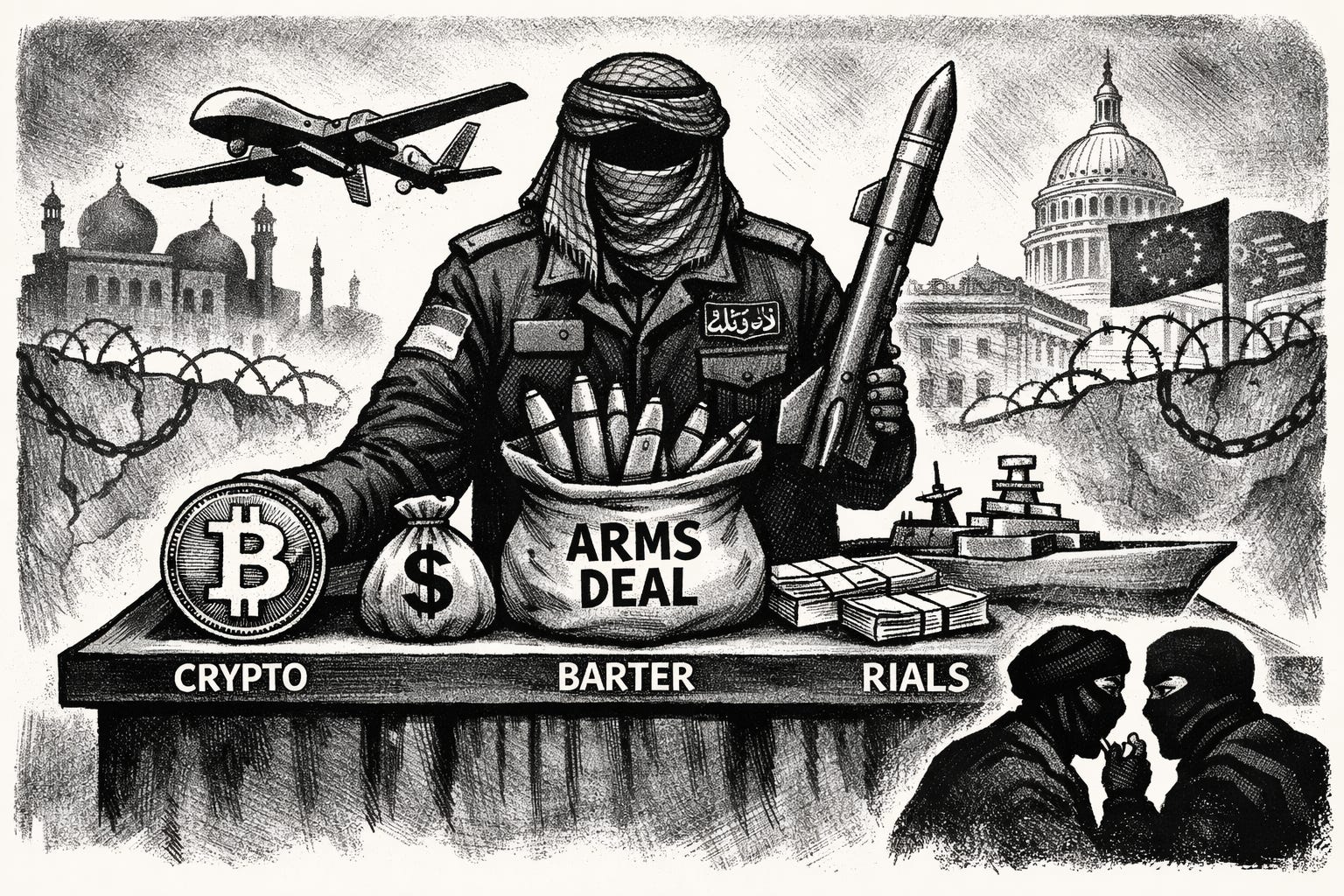
Iran’s state-run Ministry of Defence Export Center (Mindex) is publicly offering advanced military hardware — including ballistic missiles, drones, warships, air defence systems, and other weaponry — to foreign buyers, with the option to pay in cryptocurrency, as well as through barter arrangements and local currencies such as the Iranian rial. This initiative, documented on Mindex’s online portal and verified by the Financial Times, appears to be aimed at circumventing US, EU, and UK financial sanctions that restrict traditional banking channels for arms sales and reflects a broader pattern of Tehran using digital assets to sustain trade under sanctions. Mindex claims relationships with dozens of potential clients and promotes payment flexibility, including digital currencies, barter, and in-country settlement, while its FAQ suggests sanctions will not impede contract execution. Accepting crypto for strategic military exports is unusual for a sovereign state and raises concerns among analysts about sanctions enforcement, arms trade norms, and proliferation risks.
Bottom Line Up Front (BLUF): Iran has begun advertising state-produced military systems to foreign buyers, offering payment options that include digital currencies, commodity exchanges, and local settlement mechanisms. The initiative, promoted through a government-linked defense export platform, reflects a deliberate effort to operate beyond Western-controlled financial infrastructure and reduce exposure to international sanctions. Publicly signaling acceptance of nontraditional payment methods for weapons exports places Iran among a small group of states experimenting with crypto-enabled sanctions avoidance at scale.
Analyst Comments: This development represents a structural shift in how sanctioned states monetize military production. Rather than relying solely on covert intermediaries or opaque financial layering, Iran is openly presenting alternative settlement mechanisms as a feature—not a workaround—of its defense export model. The approach mirrors broader adaptations by heavily sanctioned governments seeking to preserve strategic revenue streams while minimizing reliance on traceable banking channels. From a technology and enforcement standpoint, the implications extend beyond arms proliferation. Digital asset settlement enables rapid cross-border value transfer, complicates attribution, and increases reliance on anonymization tools such as mixers and privacy-focused tokens. State-linked wallets, layered custody arrangements, and informal crypto brokers are likely to play a growing role in these transactions.
READ THE STORY: FT
Somali Pirates Hijack Chinese Fishing Vessel for Second Time Amid Rising Tensions Over Illegal Fishing
NOTE:
China has already established itself as an active maritime security actor beyond its near seas through documented actions rather than stated intent. Since 2008, the People’s Liberation Army Navy (PLAN) has maintained continuous anti-piracy escort deployments in the Gulf of Aden under UN mandates, conducting hundreds of convoy missions for Chinese and foreign vessels. In 2017, China opened its first overseas military logistics base in Djibouti, officially designated to support anti-piracy, peacekeeping, and humanitarian operations. Chinese-flagged commercial vessels, including fishing fleets, routinely operate with armed private security personnel, a practice legalized by Beijing in 2011 for high-risk waters. China also participates—though selectively—in information-sharing mechanisms with multinational maritime coalitions such as Combined Task Force 151 and EU NAVFOR, while retaining independent command of its forces. Diplomatically, China has used UN forums and FAO processes to emphasize the suppression of piracy and the protection of lawful fishing access. At the same time, bilateral agreements with coastal authorities have governed port access, logistics, and fishing activities. These actions collectively demonstrate that China already addresses maritime risk through escorts, overseas basing, private security, and limited multilateral coordination, rather than through ad hoc or reactive measures.
Bottom Line Up Front (BLUF): A Chinese fishing vessel, Liao Dong Yu 578, was hijacked off the Somali coast on New Year’s Day, marking its second capture by pirates in just over a year. The vessel was reportedly operating illegally in Somali waters, targeting depleted yellowfin tuna stocks. The incident underscores growing maritime insecurity in the Indian Ocean and highlights geopolitical friction stemming from foreign fishing fleets exploiting African coastal resources with limited oversight.
Analyst Comments: While piracy off Somalia had declined in recent years, this incident signals a dangerous resurgence — one increasingly tied to unresolved grievances over illegal, unreported, and unregulated (IUU) fishing. Chinese vessels operating under questionable licenses from Puntland’s semi-autonomous authorities are now both an economic flashpoint and a tactical vulnerability. Pirate groups are repurposing the same vessels used for resource extraction as motherships to attack larger merchant ships. From an international security perspective, the hijacking plays directly into a broader pattern: China’s global commercial footprint — from West African ports to Indian Ocean fisheries — is becoming entangled with governance failures, criminal exploitation, and maritime insecurity. Beijing’s support for opaque fishing deals is not just generating resentment; it’s creating kinetic risk.
READ THE STORY: Marine Insight
Beijing Prioritizes Industrial Output Over Consumption Amid Deflation Pressures
Bottom Line Up Front (BLUF): Despite persistent deflation, collapsing property markets, and international backlash over soaring trade surpluses, China’s leadership is doubling down on its state-led, export-driven economic model. With the 15th Five-Year Plan (2026–2030) set to prioritize manufacturing self-sufficiency and technological dominance, Beijing is signaling that it has no intention of pivoting toward domestic consumption—even as economic imbalances deepen and global pressures mount.
Analyst Comments: China’s strategic trajectory is becoming clearer: external demand is being used to offset internal weaknesses, not to replace them. Years of industrial deepening—backed by state finance, local government subsidies, and policy support for high-tech manufacturing—have positioned exports as the primary shock absorber against deflationary pressure at home. While Chinese officials continue to emphasize consumption growth rhetorically, policy execution suggests a limited appetite for the structural reforms required to rebalance the economy meaningfully. Household confidence remains weak, property values continue to decline, and local governments are constrained by debt. In this environment, export competitiveness has emerged as the most politically controllable lever for sustaining growth.
READ THE STORY: FT
Tariff Cut Signals China’s Push to Control Battery Recycling Inputs
Bottom Line Up Front (BLUF): China has reduced import duties on key lithium-ion battery scrap materials, cutting the tariff on so-called “black mass” from 6.5% to 3% effective January 1, 2026. The move is intended to ease feedstock constraints, support underutilized domestic recycling capacity, and reduce reliance on newly mined battery metals as EV deployment accelerates.
Analyst Comments: The tariff adjustment reflects Beijing’s growing focus on circular supply chains as a strategic complement to mining and overseas resource acquisition. While China already dominates global black mass processing, domestic recyclers have faced uneven utilization due to limited scrap availability and tighter environmental enforcement. Lower import duties modestly improve the economics of sourcing battery waste from abroad. In practice, the impact may be incremental rather than transformational. China maintains strict quality and purity requirements for imported black mass, limiting the volume of material that meets current standards. Many recycling streams from Europe and North America require additional preprocessing before they are eligible, constraining near-term inflows despite the tariff cut.
READ THE STORY: Bloomberg
China Ends 2025 with Massive Taiwan Drills as U.S. Bolsters Defense Ties in Asia
Bottom Line Up Front (BLUF): Tensions in the Taiwan Strait reached a new high at the end of 2025, as China launched its largest-ever military exercises targeting Taiwan, simulating a blockade scenario. The drills followed the approval of an $11 billion U.S. arms package to Taipei and increasingly direct warnings from Japan and the Philippines. While an invasion doesn’t appear imminent, the risk of miscalculation or crisis escalation is rising, especially as Beijing nears its 2027 military readiness goals.
Analyst Comments: The PLA’s year-end drills emphasized real-world scenarios — encirclement, economic strangulation, and rapid mobilization — more than conventional amphibious assault. The U.S. arms package, heavy on asymmetric systems like drones and mobile missiles, reflects Washington’s strategy of complicating a Chinese offensive rather than matching it system-for-system. Japan’s evolving doctrine and the Philippines’ growing involvement hint at a broader coalition calculus Beijing must now consider. While no shots have been fired, China’s increasingly explicit threats and multidomain pressure (air, sea, cyber) signal a slow boil strategy: maintain sustained coercion, test red lines, and erode Taiwan’s political resilience.
READ THE STORY: Fox News
Kuwait Awards First Phase of Mubarak Al-Kabeer Port to China’s CCCC
Bottom Line Up Front (BLUF): China Communications Construction Company (CCCC) has secured a $4.1 billion engineering, procurement, and construction (EPC) contract for the first phase of Mubarak Al-Kabeer Port on Kuwait’s Boubyan Island. The project represents China’s largest confirmed port construction deal in the Gulf. It marks a significant expansion of Belt and Road–linked infrastructure in a region long shaped by U.S. security and commercial influence.
Analyst Comments: The agreement strengthens China’s commercial foothold in the northern Persian Gulf, a strategically sensitive maritime zone near Iraq and Iran, and adjacent to key regional shipping routes. While the port is explicitly civilian and aligned with Kuwait’s economic diversification goals, its scale and location underscore Beijing’s growing role as a long-term infrastructure partner in the Middle East. For China, the project advances several objectives simultaneously. It reinforces access to Gulf trade corridors, deepens bilateral engagement with a close U.S. partner, and extends the use of Chinese engineering practices and technical standards in overseas logistics infrastructure. These features are increasingly common in mature Belt and Road projects, which emphasize durability, operational integration, and repeat business over rapid expansion alone.
READ THE STORY: Marine Insight
U.S. Dismantles Key Units as Foreign Malign Influence Surges, Despite New National Strategy
Bottom Line Up Front (BLUF): The latest U.S. National Security Strategy (NSS) calls foreign malign influence a top-tier threat to national sovereignty, but recent government actions contradict that priority. Despite this strategic shift, key counter-influence programs—including the FBI’s Foreign Malign Influence Task Force and ODNI’s Foreign Malign Influence Center—have been quietly dismantled. This leaves the U.S. with diminished capacity to coordinate a whole-of-government response, even as Russia, China, and Iran escalate asymmetric campaigns against American institutions.
Analyst Comments: This is the definition of strategic mismatch: the U.S. formally recognizes foreign influence operations as a threat on par with terrorism or cyberwarfare, yet decommissions the very teams designed to fight them. The shift from "disinformation" to broader “influence operations” in the NSS is the right call—it's more accurate and harder to weaponize politically. But semantics don't stop hostile states from flooding U.S. platforms with propaganda, running persona-based ops, or bribing officials. Unless the White House rebuilds centralized leadership and invests in long-term deterrence, adversaries will continue to exploit the gap between strategy and execution.
READ THE STORY: National Interest
Thousands of Fortinet Firewalls Still Exposed to 2020 MFA Bypass Bug Amid Confirmed Exploitation
Bottom Line Up Front (BLUF): Over 10,000 Fortinet firewalls remain vulnerable to CVE-2020-12812 — a five-year-old multi-factor authentication (MFA) bypass flaw — as threat actors actively exploit the bug in real-world attacks. The vulnerability affects FortiOS SSL VPN configurations that combine local users with LDAP groups, allowing attackers to bypass MFA by manipulating usernames.
Analyst Comments: The flaw was patched in 2020, added to CISA’s KEV catalog in 2021, and is still present on thousands of externally reachable devices in 2026. The fact that a capitalization mismatch can defeat MFA highlights just how brittle security gets when old appliances are misconfigured and left to rot. Threat actors know this — ransomware crews and state-backed ops have been scanning and exploiting these setups for years. Fortinet confirmed active abuse again in late December 2025. If you’re still running unpatched FortiOS or haven’t locked down your VPN authentication flow, assume compromise.
READ THE STORY: CSH
Silver Fox APT Lures Indian Users With Income Tax Phishing to Deploy ValleyRAT Malware
Bottom Line Up Front (BLUF): A new Android malware campaign dubbed SilverFox is targeting users in India by impersonating the Telegram app. According to cybersecurity firm Cyble, the malware uses phishing websites to lure victims into downloading a trojanized APK that steals sensitive data, including SMS messages, contacts, and device metadata—potentially enabling access to financial accounts and OTPs.
Analyst Comments: By spoofing a popular, trusted app like Telegram and geo-targeting Indian users, SilverFox plays into familiar social engineering tactics. The fact that it's distributed via fake websites (not Google Play) suggests the attackers are relying on SMS, social media, or messaging lures. Given India's large mobile user base and reliance on SMS-based 2FA, campaigns like this can do real damage. Expect more region-specific variants—especially around major events or banking periods. Defenders should treat any sideloaded APK as suspect and monitor for outbound connections to known C2 infrastructure.
READ THE STORY: THN
Critical Infrastructure Faces Escalating Threats Amid Geopolitical Tensions and IT/OT Convergence
Bottom Line Up Front (BLUF): Cyber threats against critical national infrastructure (CNI) are increasing in both scale and sophistication, driven by heightened geopolitical tensions and the growing convergence of IT and operational technology (OT) environments. Security leaders warn that criminal groups and state-backed actors—most notably linked to Russia and China—are expanding operations against banking, energy, transportation, and defense sectors, leaving infrastructure operators with a broader and more exposed attack surface.
Analyst Comments: As IT and OT environments become more interconnected, attackers gain additional pathways to move laterally and disrupt operations. Industry leaders from Palo Alto Networks, Dragos, SonicWall, and ZeroFox are signaling a shift from episodic threats to persistent targeting. Nation-state actors are increasingly focused on pre-positioning and intelligence collection, while financially motivated groups are increasingly willing to impact OT environments directly. In this context, treating OT security as secondary or isolated from enterprise security strategy creates measurable risk.
READ THE STORY: SCMEDIA
Items of interest
Forensic Failures Still Undermine Cyber Investigations
Bottom Line Up Front (BLUF): Despite advances in cybersecurity tooling, post-incident digital forensics remains plagued by inconsistent practices, inadequate evidence collection, and organizational unpreparedness. In a new Infosecurity Magazine op-ed, industry experts argue that without a solid forensic foundation, even advanced detection and response efforts risk missing root causes and enabling repeat compromises.
Analyst Comments: Most orgs still treat forensics like an afterthought—until regulators or lawyers get involved. The result? Volatile evidence gets wiped, logs get overwritten, and attribution becomes guesswork. This isn’t just an IR maturity issue—it’s a gap in readiness. Whether you're a SOC lead or CISO, if your IR plan doesn’t include pre-approved forensic protocols and proper chain of custody, you're flying blind post-breach. The piece rightly calls for tighter integration between DFIR and threat-hunting teams and for greater investment in forensic readiness through tabletop and red-team exercises.
READ THE STORY: InfoSecMag
How to Identify Digital Evidence | Introduction to Digital Forensics (Video)
FROM THE MEDIA: While recovering data during the digital forensics process typically involves working inside a restricted lab, sourcing digital data requires traditional investigation work. Finding sources for digital data isn’t always as straightforward as seizing a computer’s hard drive.
What Is Digital Forensics? | Explained for Beginners (Cybersecurity & Cybercrime Investigation)(Video)
FROM THE MEDIA: Ever wondered how investigators catch hackers or recover deleted data? In this video, we break down Digital Forensics — from what it is, to how it’s used in solving cybercrimes, and the tools experts use to uncover digital evidence.
The selected stories cover a broad range of cyber threats and are intended to help readers frame key publicly discussed threats and improve overall situational awareness. InfoDom Securities does not endorse any third-party claims made in its original material or related links on its sites; the opinions expressed by third parties are theirs alone. For further questions, please contact InfoDom Securities at dominanceinformation@gmail.com.
Solid consolidation here. The Iran crypto-for-arms piece really underscores how sanctions enforcement is geting harder when states openly promote alternative settlement as a feature, not a bug. Once you mix privacy tokens and layered custody, traceability just collapses. I remeber digging through wallet graphs for a research project last year and the sheer complexity of attribution when mixers are involved is insane. The real issue is that this model could scale fast beyond Tehran if other sanctioned actors see it working.