
Daily Drop (1213)
12-29-25

Monday, Dec 29, 2025 // (IG): BB // GITHUB // SN R&D
Israeli Cyber Firm's Phantom Product Draws Global Attention—and Millions in Interest
Bottom Line Up Front (BLUF): Multiple governments have expressed interest in a purported Israeli cyber weapon, but Haaretz reports that the product does not yet exist. Instead, executives at the company—backed by high-level former defense officials—allegedly pitched vaporware to global buyers, raising serious questions about oversight, ethics, and commercialization of cyber capabilities in Israel’s defense industry.
Analyst Comments: When former Mossad and Unit 8200 brass lend credibility to unproven tech, it creates a diplomatic and security liability—not just a marketing scandal. If the claims in this report hold up, this incident could damage trust between Israeli vendors and foreign intelligence clients, especially amid growing scrutiny of spyware exports following the NSO affair. This also reflects a broader risk in cyber mercenary markets: state-grade credibility being used to push unverified tools in a largely unregulated space.
READ THE STORY: Haaretz
Iran Shifts to Disposable Spy Networks in Israel: Mass Digital Espionage Campaign Uncovered
Bottom Line Up Front (BLUF): Since October 7, 2023, Iranian intelligence has launched an unprecedented espionage offensive against Israel, recruiting over 48 citizens—many without ideological alignment—through Telegram, social media, and crypto payments. These recruits provided intelligence directly linked to missile strikes, drone attacks, and assassination plots. Israeli authorities now describe this as one of the most severe intelligence breaches in the nation’s history.
Analyst Comments: According to a detailed investigation by Gregg Roman for the Middle East Forum, Iran has fundamentally restructured its espionage doctrine. Rather than developing long-term agents, Tehran is now recruiting thousands of Israelis online, offering small cryptocurrency payments for information, graffiti campaigns, arson, and eventually targeted surveillance and assassination. A key case, the “Haifa Seven,” involved Jewish-Israeli citizens photographing military sites, including F-35 airbases and Mossad HQ. Their intelligence enabled drone and missile strikes that killed IDF soldiers and damaged critical assets. Recruits include ultra-Orthodox Jews, immigrants from the Caucasus, and ex-convicts—none of whom fit the traditional profile of spies. Israel has responded with public awareness campaigns, arrests, and escalating espionage charges that include wartime collaboration.
READ THE STORY: Middle East Forum
China Moves to Ban “AI Relatives” for the Elderly Amid Concerns Over Dependency, Manipulation
Bottom Line Up Front (BLUF): China’s Cyberspace Administration (CAC) released draft regulations banning emotionally interactive AI from simulating relatives or personal relationships for elderly users. The proposed rules also include restrictions on emotional manipulation, addiction risks, and the use of interaction data for training AI models.
Analyst Comments: This draft policy is another step in China’s broader campaign to tightly regulate emerging AI technologies—especially those that touch on emotion, psychology, and social cohesion. The ban on “AI relatives” signals Beijing’s discomfort with emotionally manipulative AI, likely viewed both as a psychological risk to the elderly and a threat to the Party’s ideological control. Expect continued restrictions on AI that mimic human behavior, especially in contexts that blur emotional boundaries or simulate identity. This also preempts potential foreign influence operations via generative AI personas and reflects China’s broader push for “emotionally aligned” AI grounded in socialist core values.
READ THE STORY: The Register
Victoria State Government Hit by Alleged Data Leak from Ransomware Group BianLian
Bottom Line Up Front (BLUF): The BianLian ransomware group claims to have exfiltrated and leaked nearly 120GB of data from the Victorian Government in Australia. While the authenticity of the data remains unverified, the threat actors assert it includes sensitive government documentation. Victoria’s cybersecurity team is investigating, with limited public comment.
Analyst Comments: BianLian published an extortion post on its leak site, claiming to have stolen 120GB of data from Victoria's government networks. The listing includes examples of allegedly stolen files and references departments such as Justice and Community Safety. The Victorian Government's official statement confirms it is aware of the claim and is “working with relevant authorities to investigate.” No confirmation has yet been made on the authenticity or scope of the data. BianLian has a documented history of targeting healthcare, education, and public-sector organizations, often relying on remote-access compromises and living-off-the-land techniques.
READ THE STORY: The Register
Russia Accused of Using Embassies as Hybrid Warfare Outposts
Bottom Line Up Front (BLUF): Ukraine’s Center for Countering Disinformation (CCD) has accused Russia of systematically abusing diplomatic privileges to support sabotage, cyber operations, and disinformation—marking a clear violation of the Vienna Convention. Examples in Poland and Germany show Russian diplomatic missions allegedly facilitating hybrid operations under diplomatic cover.
Analyst Comments: The CCD stated Russia is “turning its missions into elements of hybrid warfare,” citing diplomatic facilities used to mask sabotage and intelligence activity. In Poland, Russia is defying orders to vacate its consulate in Gdańsk, citing the residency of its technical staff. In Germany, authorities attributed a 2024 cyberattack on aviation systems to APT28 (Fancy Bear), a GRU-linked group, and reported coordinated election disinformation in early 2025. These incidents support the broader claim that Russian embassies increasingly function as platforms for hybrid threats across Europe.
READ THE STORY: UATV
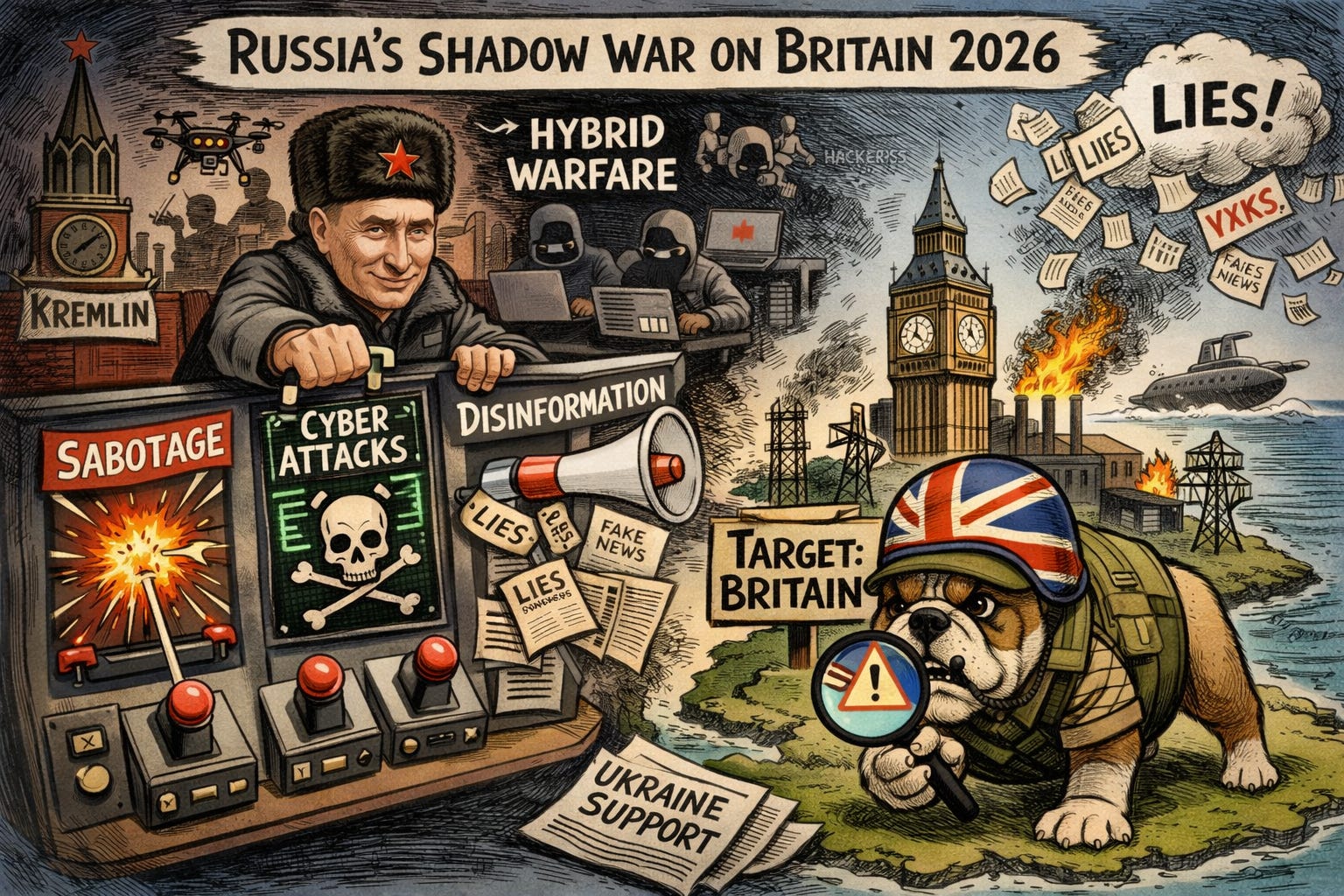
How Putin Will Threaten the UK in 2026: Hybrid Warfare, Not Invasion
Bottom Line Up Front (BLUF): Russia is unlikely to initiate direct military conflict with the UK in 2026, but the Kremlin will escalate its hybrid campaign of sabotage, subversion, cyberattacks, and disinformation. Britain’s vocal support for Ukraine and its intelligence capabilities make it a priority target in Moscow’s ongoing shadow war against the West.
Analyst Comments: Dr. Mark Galeotti outlines Russia’s projected 2026 strategy: weaponized propaganda, political amplification of anti-Ukraine voices, targeted cyberattacks on officials, physical sabotage (like arson and rail disruptions), and military intimidation through maritime encounters. While Russian intelligence resources in the UK are diminished due to embassy expulsions, Moscow is reportedly resorting to unconventional tactics—smuggling agents via cargo ships or recruiting petty criminals. A 30% increase in Russian vessel activity near UK waters, including spy ships like Yantar, underscores a persistent physical presence. With sanctions exhausted, UK officials are hinting at more robust, SOE-style countermeasures, but the strategic focus remains on resilience and deterrence.
READ THE STORY: The ipaper
Bitget Confirms Data Leak Impacting Nearly 200,000 Users in KYC Breach
Bottom Line Up Front (BLUF): Crypto exchange Bitget confirmed that a third-party vendor breach exposed KYC data for approximately 190,000 users. Leaked information includes names, addresses, and ID documents. Bitget says no funds were compromised and has suspended cooperation with the affected vendor.
Analyst Comments: Nearly 200,000 users had their most sensitive identity documents exposed because of a third-party failure, not a compromise of Bitget's core infrastructure. While wallets weren’t drained, the risk now shifts to identity theft, phishing, and SIM swap attacks. This incident reinforces a hard truth in crypto: centralized KYC data is a long-term liability. Bitget’s response—cutting ties with the vendor and auditing access policies—is necessary but reactive. Crypto platforms that rely on external KYC providers need stricter vendor risk assessments, encryption at rest for ID data, and faster breach disclosure.
READ THE STORY: Chain Catcher
White-Hat Hackers Uncover Hijack Flaws in Chinese Robots, Raise Global Security Alarms
Bottom Line Up Front (BLUF): Ethical hackers at Shanghai’s GEEKCon revealed critical vulnerabilities in Chinese-made robots, particularly Unitree models, that allow hijacking via whispered voice commands and Bluetooth exploits. The flaws enable the formation of robotic botnets capable of physical disruption, surveillance, and even potential harm to humans. With global deployments underway—including in sensitive environments—experts warn of urgent national security risks tied to unsecured AI-driven robotics.
Analyst Comments: The fact that robots can be hijacked using low-complexity vectors such as Bluetooth and unauthenticated voice commands indicates a profound lack of basic security hardening. Combine that with AI integration and international distribution, and the threat shifts from theoretical to operational. These aren’t sci-fi hypotheticals anymore: industrial bots forming botnets, gathering GPS data, or physically attacking targets isn’t just possible—it’s already being simulated. We’re looking at Mirai with legs. Expect regulatory pressure, especially in the U.S. and EU, to tighten controls on Chinese robotics exports. Any vendor deploying autonomous or semi-autonomous systems without rigorous security audits is inviting disaster.
READ THE STORY: WPN
Insider Behind Coupang Data Theft Sold Stolen Info for Less Than $10,000
Bottom Line Up Front (BLUF): South Korean e-commerce giant Coupang has confirmed that an insider stole and sold sensitive customer data—names, addresses, and order histories—for under $10,000. The former employee, who worked at a logistics center, was arrested and reportedly acted alone. Coupang claims payment information was not compromised.
Analyst Comments: A logistics center employee—far from the corporate perimeter—was able to exfiltrate customer data and monetize it on the cheap. While the financial impact may appear minor, long-term erosion of trust could be worse, especially in markets like South Korea, where privacy expectations are high. This incident underscores that data exposure doesn’t always involve APTs or ransomware; sometimes it’s an underpaid worker with database access. Organizations need to monitor internal access at all layers—not just HQ.
READ THE STORY: The Register
Sam Altman Warns: AI Agents Now Exposing Critical Vulnerabilities in Real-World Systems
Bottom Line Up Front (BLUF): OpenAI CEO Sam Altman has publicly acknowledged that advanced AI agents are now surfacing critical software vulnerabilities, marking a significant shift in how the company frames risk. These agents, Altman says, are not just tools for productivity—they’re starting to uncover systemic security weaknesses with minimal human prompting, raising the stakes for defenders and threat actors alike.
Analyst Comments: The idea that AI agents can now independently discover zero-days—or at least assist in exploit development at scale—is no longer speculative. Altman's comments follow recent reports of AI-powered cyberattacks, including Anthropic’s Claude being abused by Chinese APTs. We’re entering a phase where offensive capabilities may rapidly outpace defensive controls, and model alignment alone won’t be enough. This public acknowledgment should accelerate policy debates on AI red teaming, model access restrictions, and dual-use risk mitigation. Expect an uptick in nation-state interest in the behavior of large language models as part of broader cyber operations planning.
READ THE STORY: Storyboard 18
Items of interest
Putin Framed Ukraine as “Part of Russia” in 2001 Talk with Bush, Newly Released Transcript Reveals
Bottom Line Up Front (BLUF): Declassified transcripts from the US National Security Archive show that Vladimir Putin told President George W. Bush in 2001 that Ukraine was historically part of Russia—foreshadowing the ideological justification for the 2022 full-scale invasion. The conversation underscores how far back Putin’s revanchist worldview stretches, despite Russia’s earlier diplomatic overtures toward NATO.
Analyst Comments: Putin’s 2001 remarks aren’t a rhetorical anomaly—they’re consistent with the worldview that now shapes Russian policy: that post-Soviet borders are negotiable and historical grievances justify territorial claims. The fact that Putin mentioned Ukraine, Kazakhstan, and the Caucasus as “given away” territories reflects a profound continuity between his early leadership and today’s expansionism. It also casts his past overtures to NATO in a more transactional light—less a desire for partnership than a maneuver to shape Western perceptions while pursuing long-term strategic goals. For analysts, this reinforces the importance of treating ideological signals as strategic intent, not just diplomatic posturing.
READ THE STORY: United 24
Russians at War - Inside a Russian Battalion on the Front Lines in Ukraine (Video)
FROM THE MEDIA: Russians at War is a rare, unauthorized look inside a Russian battalion during the invasion of Ukraine. Filmed by director Anastasia Trofimova, the documentary follows soldiers, medics, and newly drafted men as they move from the rear to some of the war’s deadliest front lines, including Krasny Liman and Bakhmut.
Ukraine says Russia is recruiting African mercenaries to fight in its war (Video)
FROM THE MEDIA: Since last fall, more than 12,000 North Koreans have reportedly been deployed to fight with the Russian army in Ukraine. Recently, Ukraine accused the Kremlin of recruiting foreign fighters from African nations as it struggles to recruit troops among its own population. Special correspondent Simon Ostrovsky investigates the reliance on mercenaries in the world's deadliest conflicts.
The selected stories cover a broad array of cyber threats and are intended to aid readers in framing key publicly discussed threats and overall situational awareness. InfoDom Securities does not endorse any third-party claims made in its original material or related links on its sites; the opinions expressed by third parties are theirs alone. For further questions, please contact InfoDom Securities at dominanceinformation@gmail.com.The selected stories cover a broad array of cyber threats and are intended to aid readers in framing key publicly discussed threats and overall situational awareness. InfoDom Securities does not endorse any third-party claims made in its original material or related links on its sites; the opinions expressed by third parties are theirs alone. For further questions, please contact InfoDom Securities at dominanceinformation@gmail.com.
Really strong reporting here on the Bitget breach, especially the insight on third-party KYC vendors being the actual weak point. I've seen this playbook before in other exchanges: centralized identity databases become honeypots the moment they go to external contractors. The part about shifting risk to SIM swaps and phishing after identity exflitration is spot on. Makes me wander if the crypto space will ever figure out decnetralized identity verification or if we're just stuck with this attack surface forever.