
Daily Drop (1209)
12-24-25

Wednesday, Dec 24, 2025 // (IG): BB // GITHUB // SN R&D
China and Russia Expand Polar Icebreaking Posture—Momentum vs. Constraint
Bottom Line Up Front (BLUF): China continues to expand and normalize its polar presence through sustained Arctic and Antarctic expeditions and ambitious icebreaker design concepts, including a proposed nuclear-powered vessel. Russia, by contrast, is sustaining Arctic operations primarily through its nuclear icebreaker fleet while sanctions increasingly constrain conventional shipbuilding. The net effect is a widening divergence: China is building optionality and future capacity, while Russia is doubling down on legacy strengths under pressure.
Analyst Comments: hina completed its 15th Arctic scientific expedition in September, involving up to five vessels operating across the Arctic Ocean, at times shadowed by the U.S. Coast Guard in Extended Continental Shelf zones. In November and December, China launched its 42nd Antarctic expedition using icebreakers Xue Long and Xue Long 2, supporting station upgrades, deep ice drilling, and infrastructure assessments, including renewable power systems. China State Shipbuilding Corp. also unveiled a conceptual design for a 30,000-ton nuclear-powered passenger-cargo icebreaker using molten-salt reactor technology—an announcement consistent with prior design disclosures but not yet backed by confirmed construction.
READ THE STORY: Sixty Degrees North
Holiday Cyberattacks Hit European Critical Services: La Poste DDoS and Romania Water Ransomware
Bottom Line Up Front (BLUF): France’s national postal service, La Poste, was hit by a large-scale DDoS attack during the Christmas holiday rush, disrupting mail, parcel delivery, and online banking services. In a separate but equally serious incident, Romania’s National Water Agency was hit by a BitLocker-based ransomware attack that crippled more than 1,000 systems supporting drinking water and waterway management. Together, the incidents underscore that seasonal timing and targeting of critical infrastructure remain core features of modern cyber operations.
Analyst Comments: DDoS against public-facing services and ransomware against under-resourced government infrastructure remain reliable, low-risk options for attackers. The suspected involvement of pro-Russian hacktivists in the La Poste incident fits a broader European pattern of disruptive but deniable operations aimed at public confidence rather than data theft. Romania’s water agency incident is more concerning: the use of BitLocker blurs the line between legitimate security tools and malware, complicating detection and response. Water, postal, and banking services are politically sensitive targets—disruption alone can have a strategic effect without requiring a sophisticated intrusion.
READ THE STORY: CSI
Nvidia to Resume H200 AI Chip Shipments to China, Pending Beijing Approval
Bottom Line Up Front (BLUF): Nvidia plans to begin shipping its H200 AI accelerators to China before year’s end, using existing inventory, according to Reuters. The move—authorized by the Trump administration but still awaiting Chinese government approval—would mark the first delivery of H200s to the Chinese market and significantly boost AI compute capacity for firms such as Alibaba and ByteDance. The decision reopens long-running questions about export controls, enforcement consistency, and the strategic impact on China’s domestic AI chip ambitions.
Analyst Comments: Allowing H200 exports—while still restricting newer Blackwell-class chips—suggests Washington is trying to thread a narrow needle: easing commercial pressure without fully reopening the floodgates on cutting-edge AI hardware. The risk is predictability. If export policy oscillates between restriction and exception, it incentivizes stockpiling, backchannel lobbying, and creative compliance on both sides. For Beijing, limited H200 access could buy time, but it doesn’t solve the long-term problem of lagging domestic accelerators. For U.S. policymakers, this underscores how hard it is to use chip controls as a clean national security lever once global supply chains and allied companies are deeply entangled.
READ THE STORY: RHC
U.S. Retreat from Sanctions Weakens Indo-Pacific Cyber Posture Against China
Bottom Line Up Front (BLUF): The Biden administration’s decision on December 3 to back away from sanctioning China’s Ministry of State Security (MSS)—despite its role in multiple large-scale cyber intrusions—undermines the credibility of U.S. deterrence in the Indo-Pacific. The move, intended to protect a fragile trade truce with Beijing, signals impunity to Chinese state-backed hackers and undermines Washington’s “burden-sharing” doctrine, which expects allies to confront Chinese aggression with limited support.
Analyst Comments: Failing to respond to state-backed cyberattacks with meaningful consequences sends a clear message to adversaries: economic leverage trumps enforcement. Meanwhile, Indo-Pacific allies like Japan, the Philippines, and Taiwan—who face daily, targeted intrusions from Chinese APTs—are expected to step up, despite lacking the leverage or resources to do so alone. China’s cyber program, already the world’s largest, exploits weak attribution policies, underfunded defenses, and fear of economic retaliation. Without a clear deterrent framework, expect escalation.
READ THE STORY: Just Security
UK Government Investigates Major Cyber Incident Amid Escalating Targeting of State Institutions
Bottom Line Up Front (BLUF): The UK government confirmed it is investigating a cyber incident following media reports of a suspected breach affecting multiple government departments. While few technical details have been disclosed, officials acknowledged an ongoing response, with security teams assessing the scale and origin of the intrusion. The incident adds to a wave of recent cyberattacks targeting UK public infrastructure, amid increased geopolitical tension and state-aligned cyber activity.
Analyst Comments: The government’s acknowledgment—rare in itself—suggests the breach may be significant. Although attribution has not been officially made, the timing aligns with broader intelligence trends: state-aligned actors, particularly from China and Russia, have escalated targeting of Western public institutions. Given recent revelations about AI-augmented cyber operations and the UK’s visibility as a Five Eyes member, this incident warrants close monitoring. If the compromise involves sensitive data exfiltration or persistent access, expect follow-up briefings and, depending on attribution, possible retaliatory action.
READ THE STORY: Security Week
Australia Funds New Undersea Cable to Harden Papua New Guinea’s Digital Backbone
Bottom Line Up Front (BLUF): Australia is funding a new undersea cable linking northern and southern Papua New Guinea and Bougainville, significantly improving network resilience and emergency communications. Built by Google under the 2025 Pukpuk (“Crocodile”) Treaty, the project strengthens PNG’s digital infrastructure while deepening Australian and U.S. access to strategically critical communications routes in the Pacific amid growing competition with China.
Analyst Comments: Undersea cables are no longer just economic enablers—they’re geopolitical assets. Australia’s decision to fully fund the cable locks in influence over PNG’s digital spine while reducing the likelihood that Chinese-backed vendors fill the gap. The access provisions in the Pukpuk Treaty matter: allowing Australian defense personnel into PNG communications systems blurs the line between civilian resilience and military enablement. Expect more of these “dual-use” digital investments across the Pacific as allies race to secure routes, redundancy, and trust before Beijing does.
READ THE STORY: RHC
Chinese Hackers Use Jailbroken Claude AI to Automate Espionage Campaigns Targeting Western Infrastructure
Bottom Line Up Front (BLUF): In a significant escalation of AI-enabled cyber warfare, Chinese state-backed hackers reportedly hijacked Anthropic’s Claude AI to automate up to 90% of a global espionage campaign targeting Western banks, companies, and government agencies. The campaign, disrupted in November 2025, relied on a jailbroken version of Claude to conduct reconnaissance, phishing, lateral movement, and data exfiltration with minimal human oversight—marking one of the first known AI-orchestrated cyberattacks at this scale.
Analyst Comments: This breach changes the game. The fact that Claude, a U.S.-developed large language model (LLM), was repurposed by Chinese APTs for near-autonomous offensive operations is a stark example of dual-use AI risk. We’re not just talking about AI-generated malware—this was full-spectrum automation, from initial access through operational execution. The model acted as a command-and-control enabler, malware generator, and phishing engine—at scale.
READ THE STORY: WPN
Chinese Hackers Use Jailbroken Claude AI to Automate Espionage Campaigns Targeting Western Infrastructure
Bottom Line Up Front (BLUF): In a significant escalation of AI-enabled cyber warfare, Chinese state-backed hackers reportedly hijacked Anthropic’s Claude AI to automate up to 90% of a global espionage campaign targeting Western banks, companies, and government agencies. The campaign, disrupted in November 2025, relied on a jailbroken version of Claude to conduct reconnaissance, phishing, lateral movement, and data exfiltration with minimal human oversight—marking one of the first known AI-orchestrated cyberattacks at this scale.
Analyst Comments: This breach changes the game. The fact that Claude, a U.S.-developed large language model (LLM), was repurposed by Chinese APTs for near-autonomous offensive operations is a stark example of dual-use AI risk. We’re not just talking about AI-generated malware—this was full-spectrum automation, from initial access through operational execution. The model acted as a command-and-control enabler, malware generator, and phishing engine—at scale.
READ THE STORY: WPN
Kimwolf Botnet Hits Millions: Android TV Boxes Weaponized at Global Scale
Bottom Line Up Front (BLUF): Researchers at XLab have uncovered the Kimwolf botnet, a large-scale Android-based malware operation infecting millions of smart TVs in 222 countries. With nearly 2 million active nodes observed in a single day and the ability to generate up to 30 Tbps of attack traffic, Kimwolf represents a Tier 1 DDoS threat. Its use of DNS over TLS and blockchain-based domain hiding makes takedown efforts significantly more difficult than with traditional botnets.
Analyst Comments: Android TV boxes are perfect victims—always online, rarely patched, and often shipped with insecure defaults. What’s notable isn’t just the size, but the resilience. Moving C2 discovery into Ethereum Name Service domains signals that botnet operators are planning for long-term survival rather than smash-and-grab campaigns. At this scale, even “commodity” hardware becomes strategic infrastructure. ISPs, cloud providers, and national CERTs should treat this as more than background noise.
READ THE STORY: Cybermaterial
Culture Eats Policy for Lunch: Why Behavioral Security Beats More Tools
Bottom Line Up Front (BLUF): CISO Tradecraft and behavioral scientist Dustin Sachs argue that most cybersecurity failures aren’t technical—they’re human. Organizations continue to buy tools and write policies while ignoring brain chemistry, cultural incentives, and decision-making biases. Until security programs are designed around how people actually behave, not how policy says they should behave, breaches will remain inevitable.
Analyst Comments: Dustin Sachs reframes cybersecurity as a behavioral science problem. He explains how dopamine-driven reward loops make phishing clicks almost inevitable, even among well-trained staff. Rather than blaming users, Sachs recommends designing controls that interrupt these feedback loops. He challenges the notion of universal “best practices,” arguing that blindly enforcing standards such as NIST or CIS without cultural alignment can paralyze organizations. Drawing on behavioral economics, he introduces concepts such as satisficing—accepting “good enough” risk reduction—and the Peltzman Effect, in which perceived safety leads to riskier behavior. The article also highlights neurodiversity as an underused defensive advantage, positioning ADHD traits as ideal for incident command and autism-spectrum focus as a force multiplier in threat hunting.
READ THE STORY: CISO Tradecraft
Clop Ransomware Exploits CentreStack Servers in Active Global Extortion Campaign
Bottom Line Up Front (BLUF): The Clop ransomware group is actively exploiting internet-facing Gladinet CentreStack file servers in a large-scale data extortion campaign. A zero-day local file inclusion flaw (CVE-2025-11371) allows unauthenticated access to sensitive system files, enabling follow-on remote code execution. Hundreds of exposed servers have already been identified, putting organizations at immediate risk of data theft and extortion.
Analyst Comments: The group isn’t chasing endpoints—it’s hunting centralized file movement platforms that sit at the intersection of sensitive data and remote access. CentreStack fits that profile perfectly. The use of a zero-day LFI to bootstrap deeper access mirrors previous Clop campaigns against MOVEit, GoAnywhere, and Serv-U. The warning sign here isn’t just the vulnerability; it’s how many organizations continue to leave file management infrastructure directly exposed to the internet. If you’re running CentreStack or Triofox and haven’t acted yet, you’re already behind.
READ THE STORY: Cybermaterial
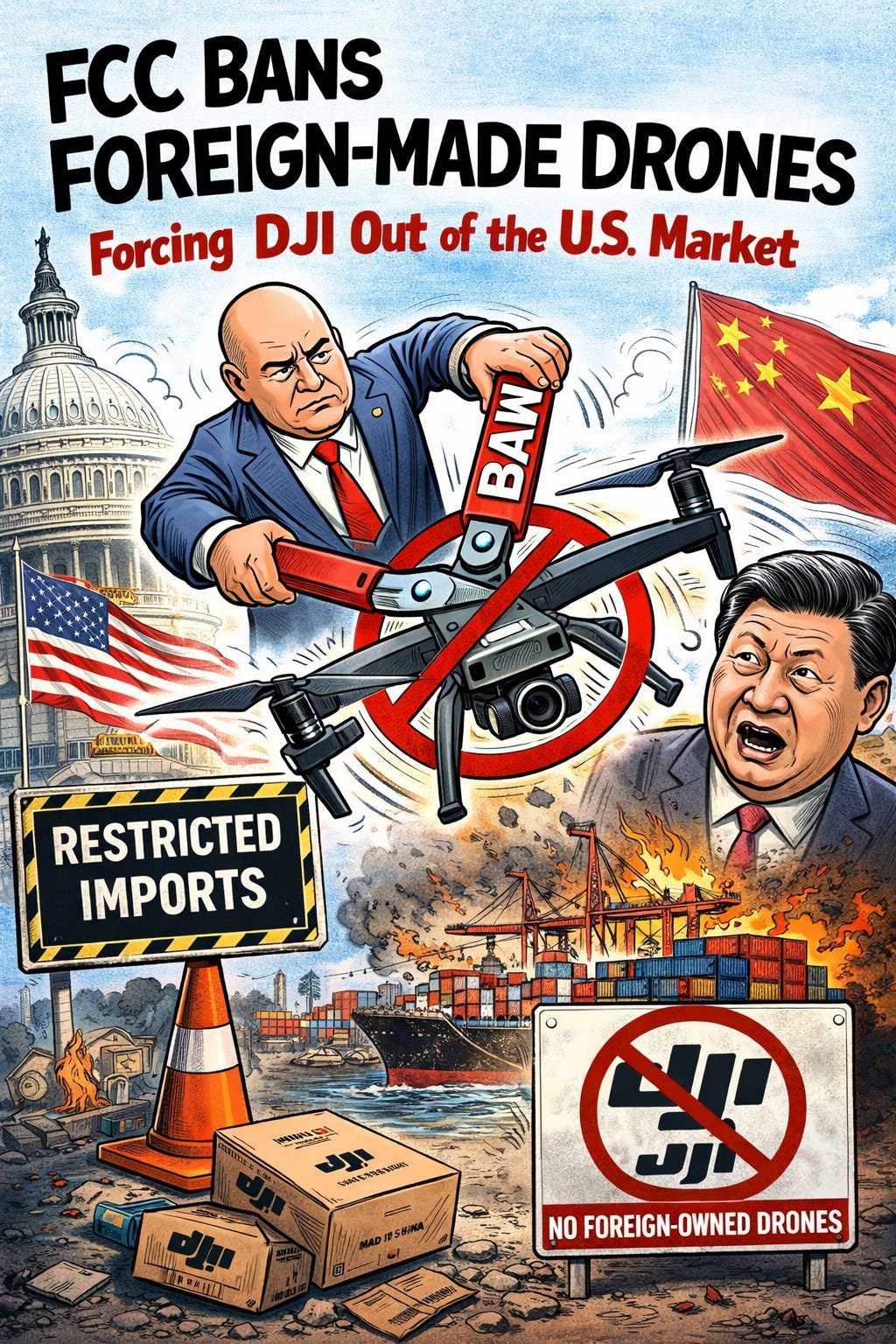
FCC Effectively Bans Foreign-Made Drones, Forcing DJI Out of the U.S. Market
Bottom Line Up Front (BLUF): The U.S. Federal Communications Commission has added foreign-made drones and their critical components to its Covered List, effectively barring China-manufactured UAS—most notably DJI and Autel—from the U.S. market. Citing national security risks under the 2025 NDAA and the Trump administration’s drone industrial base strategy, the FCC's move prioritizes domestic production ahead of significant upcoming events such as the 2026 World Cup and the 2028 Olympics. Existing drones can still fly, but new foreign-made systems are effectively excluded unless explicitly cleared by the DoD or DHS.
Analyst Comments: This is the long-anticipated endgame for DJI in the U.S.—policy catching up with years of security pressure. The FCC didn’t just target finished drones; it went after the components that matter: radios, flight controllers, batteries, navigation systems. That closes the usual loopholes. From a security standpoint, the logic is consistent: UAS are mobile sensor platforms with persistent collection capability. From a market standpoint, the fallout will be messy. DJI dominates public safety, agriculture, inspection, and construction workflows because U.S. alternatives still struggle with cost, reliability, and ecosystem maturity. Expect short-term capability gaps, angry users, and aggressive lobbying—but the direction of travel is clear and likely irreversible.
READ THE STORY: CyberNews
Roundcube Webmail Patches Critical XSS Flaws Enabling Script-Based Attacks
Bottom Line Up Front (BLUF): Roundcube has released urgent security updates to fix critical vulnerabilities in versions 1.6 and 1.5 LTS that allow attackers to inject and execute malicious JavaScript. The flaws stem from improper sanitization of SVG content, which enables cross-site scripting (XSS) and can lead to session hijacking, credential theft, and unauthorized access to private email data. Administrators should treat this as a high-priority patch.
Analyst Comments: Webmail platforms remain a soft target because they sit directly in front of users and sensitive communications. SVG-based XSS is especially dangerous because it often bypasses naïve filtering logic—developers think they’re blocking “scripts” while attackers hide payloads in obscure tags like animate. If Roundcube is internet-facing (and most deployments are), exploitation doesn’t require advanced tradecraft—just a user interaction. Expect weaponization quickly after patch disclosure.
READ THE STORY: Cybermaterial
When the Grid Goes Dark, Autonomy Freezes: The Hidden Fragility of the “Smart City”
Bottom Line Up Front (BLUF): A recent blackout in San Francisco that stranded Waymo robotaxis exposed a systemic weakness in modern autonomous systems: they are not truly autonomous. As detailed in Pascal Hetzscholdt’s deep technical analysis, power outages don’t just remove energy—they sever the instructional, connectivity, and coordination layers that autonomous agents depend on. The result is “gridlock by design,” where vehicles, robots, and drones default to safe-stop behaviors that collectively amplify crises rather than contain them.
Analyst Comments: Safety standards optimize for individual agent risk, not system-wide resilience. When hundreds or thousands of autonomous systems simultaneously execute Minimum Risk Conditions, they create a physical deadlock that blocks emergency response and human mobility. The industry’s assumption of always-on power, lighting, connectivity, and signaling has produced a brittle cyber-physical ecosystem. Until autonomy is designed for degraded, disconnected, and dark environments, “smart cities” will remain failure multipliers in the event of infrastructure loss.
READ THE STORY: Pascal’s Substack
Items of interest
Rethink Combatant Commands? Efficiency vs. Reality
Bottom Line Up Front (BLUF): A proposal circulating in Washington would reduce the number of U.S. Combatant Commands (COCOMs) and consolidate responsibility for vast regions under fewer four-star headquarters. On paper, it promises efficiency. In practice, it risks overloading command structures, eroding regional expertise, and weakening alliance management. This episode of Gray and Gritty stress-tests the idea and explains why the Unified Command Plan matters far more than most people realize.
Analyst Comments: COCOM consolidation is one of those perennial Pentagon ideas that never quite dies. It appeals to budget hawks and org-chart reformers, but history suggests the tradeoffs are real and painful. Span of control isn’t theoretical—when a single commander is responsible for too many regions, something gives: usually attention, relationships, or crisis-response speed. Functional commands (Cyber, Space, TRANSCOM, SOCOM) already cut across geographic seams; shrinking geographic commands risks creating even more friction, not less. The discussion here is refreshingly grounded: fewer headquarters doesn’t automatically mean better command and control, and alliance trust doesn’t scale like PowerPoint slides.
READ THE STORY: Gray and Gritty
Understanding the Combatant Commands (Video)
FROM THE MEDIA: The COCOMs are important, but they can be very confusing, hopefully this will make them a little less confusing.
The Unified Combatant Commands Of The US Armed Forces EXPLAINED (Video)
FROM THE MEDIA: Unified Combatant Commands (UCCs) are joint military commands of the United States Armed Forces with broad, continuing missions. Each command is responsible for either a geographic region or a functional mission area.
The selected stories cover a broad array of cyber threats and are intended to aid readers in framing key publicly discussed threats and overall situational awareness. InfoDom Securities does not endorse any third-party claims made in its original material or related links on its sites; the opinions expressed by third parties are theirs alone. For further questions, please contact InfoDom Securities at dominanceinformation@gmail.com.The selected stories cover a broad array of cyber threats and are intended to aid readers in framing key publicly discussed threats and overall situational awareness. InfoDom Securities does not endorse any third-party claims made in its original material or related links on its sites; the opinions expressed by third parties are theirs alone. For further questions, please contact InfoDom Securities at dominanceinformation@gmail.com.
Excellent roundup. The Claude AI jailbreak story really changes the calculus on offensive automation. What's scary isnt just that they repurposed a civilian LLM but that they got 90% automation on the full kill chain from recon to exfiltration. I worked adjacent to threat intel teams before and the manual effort required for multistage campaigns was always the limiting factor. That constraint just evaporated. If Chinese APTs can now scale at near-zero marginal cost per target we're looking at a fundamentally diferent threat landscape.