
Daily Drop (1206)
12-20-25

Saturday, Dec 20, 2025 // (IG): BB // GITHUB // SN R&D
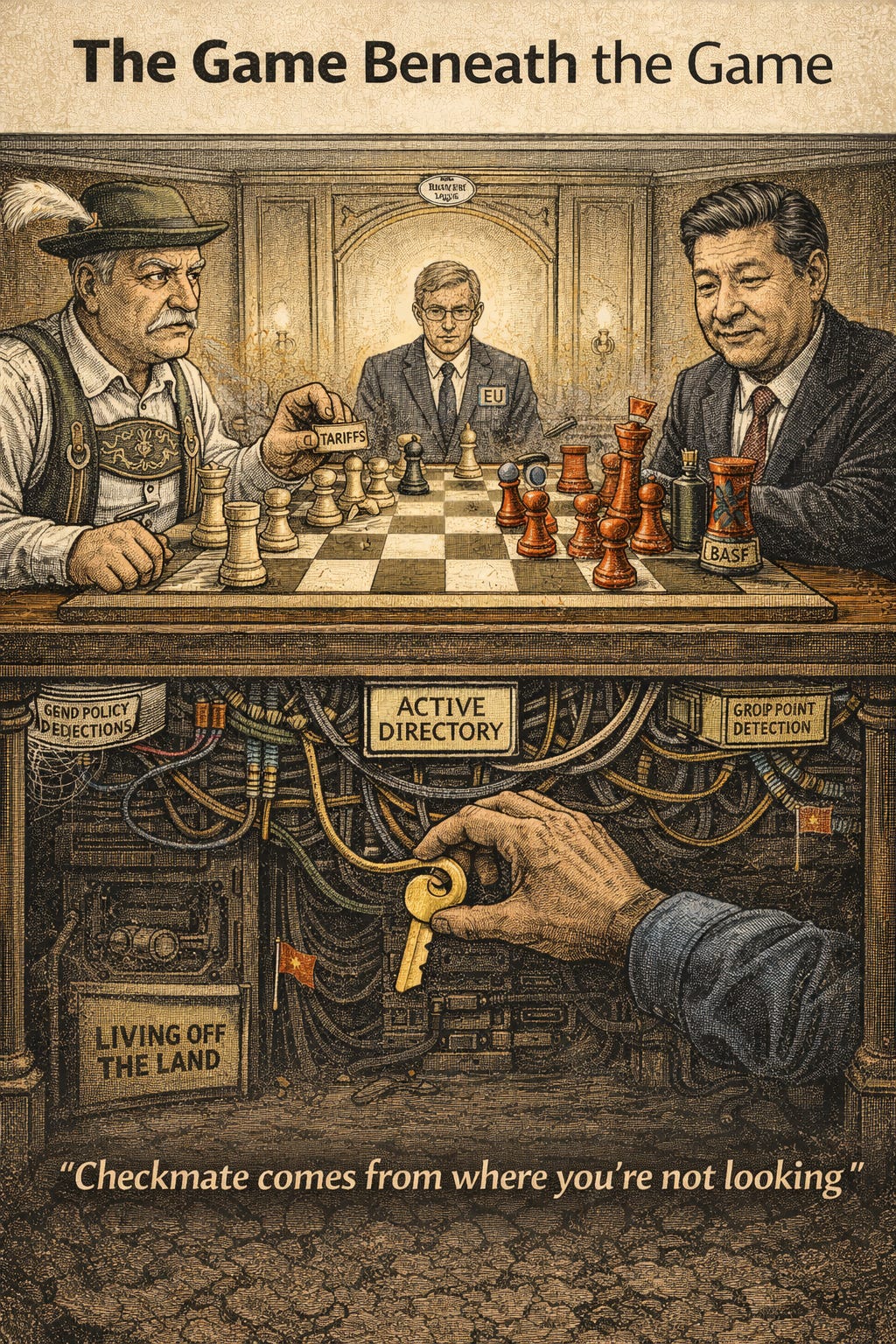
Beijing Codifies the ‘China Standard’: Ag Trade Now a Tool of Statecraft
Bottom Line Up Front (BLUF): China is institutionalizing a new regulatory regime over agri-food trade, using updated laws, certification systems, and strategic controls to enforce what officials call the "China Standard." The framework, now embedded in foreign trade, export control, and customs law, enables Beijing to weaponize access to its vast market while promoting PRC-branded exports abroad. Foreign suppliers face expanding compliance burdens and shrinking predictability.
Analyst Comments: The ‘China Standard’ fuses strategic export controls, retaliatory legal tools, and inspection regimes to protect domestic producers, assert regulatory power, and project Chinese influence into global agri-value chains. Beijing isn’t just building trade walls; it’s exporting its rules. Expect this model to ripple beyond agriculture, especially as China links Belt and Road diplomacy with biosecurity, traceability, and certification expansion. For global agribusiness, access to China’s market increasingly means submission to its terms.
READ THE STORY: China Policy Leads
US and UK Sanction China-Linked Hackers for Targeting Lawmakers, Critics, and Electoral Infrastructure
Bottom Line Up Front (BLUF): The US and UK have formally accused China of orchestrating cyberattacks against lawmakers, dissidents, and democratic institutions, including the UK Electoral Commission and members of the US Congress. Sanctions were imposed on APT31, a known Chinese state-aligned cyber unit, along with associated front companies and individuals involved in global espionage and influence operations.
Analyst Comments: APT31 isn’t just an espionage group anymore; this move repositions them as a hybrid actor, using cyber means for both intelligence collection and intimidation. The group’s known targeting of critics, journalists, and election infrastructure also reinforces how blurred the lines have become between classic cyberespionage and state-driven digital coercion. Attribution is no longer just academic—it’s now baked into policy, with coordinated sanctions and indictments.
READ THE STORY: FT
China’s Civil Affairs Agenda: Beijing Pushes Social Stability Amid Aging, Inequality, and Regional Tensions
Bottom Line Up Front (BLUF): China is ramping up social governance reforms ahead of the 15th Five-Year Plan, focusing on addressing an aging population, expanding welfare services, and regulating grassroots charitable and civil society organizations. Concurrently, Beijing is deploying diplomatic pressure over U.S.-Taiwan arms sales and stepping up regional mediation efforts, notably in Cambodia-Thailand tensions and China-Sri Lanka ties.
Analyst Comments: The Ministry of Civil Affairs’ detailed roadmap emphasizes aging services, welfare expansion, and tighter control over NGOs, suggesting the CCP’s social contract is evolving to buffer inequality, demographic stress, and internal discontent. Civil society is being developed—but on Party terms. Meanwhile, China’s foreign ministry is capitalizing on regional instability (Cambodia-Thailand), Belt and Road diplomacy (Sri Lanka), and perceived U.S. provocations (Taiwan arms sales) to frame itself as a stabilizing power in contrast to Washington. Beijing’s dual-pronged approach—domestic control plus diplomatic expansion—shows how the CCP blends social management with geostrategic positioning.
READ THE STORY: Tracking People’s Daily
Ivanhoe Mines Faces Growing Geopolitical and Cyber Risk in Congo
Bottom Line Up Front (BLUF): Ivanhoe Mines, a Canadian firm operating one of the world’s richest copper and cobalt deposits in the Democratic Republic of Congo (DRC), is increasingly entangled in geopolitical tension and infrastructure risk, making it a likely target for cyber-enabled espionage and disruption, particularly from state-aligned actors with vested interests in global energy transition supply chains.
Analyst Comments: Ivanhoe’s high-value position in the global cobalt/copper supply chain—critical for EVs, AI chips, and energy storage—puts it squarely in the crosshairs of not just physical instability but cyber-enabled sabotage and espionage. China's deep investment in Congolese mining (including neighboring JV partners) and growing strategic tensions with Western mineral suppliers mean we should expect not just IP theft but also possible disruption campaigns targeting logistics, operational technology (OT), or financial systems supporting Ivanhoe.
READ THE STORY: Richard Gibson
China Sharpens Focus on Frontier AI Risks—But Keeps State in the Driver’s Seat
Bottom Line Up Front (BLUF): China is deepening its engagement with AI safety, releasing new policy documents, model evaluations, and legal commentary that acknowledge long-term AGI risks, cyber misuse threats, and AI-enabled CBRN vulnerabilities. However, near-term governance prioritizes enforceability, technical maturity, and alignment with state control. While frontier-risk discussions are maturing, actual policy remains expert-led, not politically driven—yet.
Analyst Comments: The CAICT’s latest evaluations flag cyber-offense misuse by coding models as medium-to-high risk—remarkable candor from a state-affiliated think tank. Yet AGI-related existential risks are still classified as “medium-low” priority. This isn’t ignorance—it’s strategic triage. The legal push from figures such as Zhou Hui to grant the State Council authority to suspend AI systems in crisis scenarios reflects growing acceptance that control—not just compliance—is central to Chinese AI governance. Frontier risks are on Beijing’s radar. The question is whether political leadership will move them to the front of the stack.
READ THE STORY: AI Safety in China
UK Attributes MoD Payroll Breach to China: Defense Personnel Data Compromised in Targeted Cyberespionage Campaign
Bottom Line Up Front (BLUF): The UK government had attributed a significant cyberattack on its Ministry of Defence (MoD) payroll system to Chinese state-backed actors. The breach exposed personal data of thousands of active-duty and veteran personnel, including names, bank details, and National Insurance numbers. The attack was described as targeted reconnaissance, not financially motivated, and is now seen as part of a broader campaign to collect sensitive personnel data across allied militaries.
Analyst Comments: China has a long history of mass data exfiltration (OPM, Equifax, Marriott) to create cross-referenced intelligence maps. By breaching the UK MoD’s payroll systems, attackers could identify vulnerable service members, track movements, infer clearance levels, and potentially compromise operational security. This should trigger immediate reviews across NATO of personnel system hardening and third-party risk—especially from outsourced or cloud-based HR systems.
READ THE STORY: FT
China’s Rise Isn’t Strategy—It’s a Byproduct of Western Self-Sabotage
Bottom Line Up Front (BLUF): China’s perceived global ascendance is less the result of strategic genius and more a consequence of leadership missteps by the United States and Russia. In a scathing assessment, historian Phillips P. O’Brien argues that Beijing’s rise reflects not long-term planning, but the collapse of U.S. strategic cohesion and Russia’s descent into Chinese dependence following its failed war in Ukraine.
Analyst Comments: We’re seeing opportunism in a power vacuum. O’Brien’s take echoes a growing sentiment in Western strategic circles: that Washington and Moscow handed Beijing leverage it didn’t earn. Trump’s tariff regime alienated Indo-Pacific allies just as they were aligning against China, while Putin’s blunder in Ukraine has turned Russia into a de facto Chinese vassal. The result? A fragmented West, an emboldened China, and a Eurasian balance tilted not by planning, but by luck. If this trend continues, expect China to keep winning by default—unless strategic coherence returns to Washington.
READ THE STORY: Phillips Newsletter
Germany Recalibrates China Ties as Beijing Edges Toward Weaponizing Steel Exports
Bottom Line Up Front (BLUF): Germany’s longstanding trade symbiosis with China is unraveling as exports drop nearly 10% and China falls out of Berlin’s top five export destinations for the first time since 2010. This structural shift reflects deepening economic decoupling, not just soft demand. Simultaneously, Beijing is introducing export licensing for over 300 steel product categories starting Jan 1, 2026—marking a shift from free-flowing trade to strategic leverage over industrial inputs.
Analyst Comments: A combination of domestic industrial retrenchment, political recalibration, and security-driven scrutiny of supply chains has upended Germany’s free-trade orthodoxy. The Volkswagen case—expanding R&D in Hefei while shuttering its first German plant—is emblematic: engagement with China continues, but now on defensive terms.
READ THE STORY: China Boss News
China’s Soft Power Campaigns Extend Beyond Cyber
Bottom Line Up Front (BLUF): Eastward, Westward, the new book by historian Frank Dikötter, underscores China’s long-term strategy of reshaping global narratives through selective memory, intellectual outreach, and targeted influence operations. This dovetails with Beijing’s cyber-enabled efforts to surveil, intimidate, and influence foreign academics, media, and diaspora communities—particularly those critical of the Chinese Communist Party (CCP).
Analyst Comments: Dikötter’s work is a reminder that narrative control is a national security issue. The CCP’s ability to weaponize history—by rewriting its role in global development or downplaying past authoritarianism—feeds into broader strategies that include cyber-enabled disinformation, targeted harassment, and data-driven influence ops. These campaigns often blend soft and hard power: what begins in publishing, academia, or cultural exchange frequently connects to APT campaigns that track and suppress dissent abroad.
READ THE STORY: WSJ
China-Linked Hack Targets UK Foreign Office Ahead of Starmer's Beijing Trip
Bottom Line Up Front (BLUF): UK officials have confirmed a cyber intrusion targeting the Foreign, Commonwealth and Development Office (FCDO) in October 2025. Although not publicly disclosed at the time, the breach reportedly targeted tens of thousands of sensitive documents. While the UK government has stopped short of official attribution, multiple sources point to a China-linked APT group—possibly Storm 1849—as the likely perpetrator. The attack comes weeks before PM Keir Starmer’s scheduled visit to China and amid domestic controversy over plans to approve a large new Chinese embassy in London.
Analyst Comments: A successful intrusion into the FCDO—responsible for British diplomacy and global intelligence coordination—signals a bold escalation by Chinese-affiliated actors. The suspected use of Storm 1849 tracks with past Chinese cyber-espionage operations targeting government ministries in the Five Eyes alliance.
READ THE STORY: FT
Items of interest
AI-Generated Answers Pose Growing Threat to Ad-Driven Search: Security, Privacy, and Trust Risks Emerge
Bottom Line Up Front (BLUF): As AI-generated search answers (like Google's Search Generative Experience) replace traditional link-based results, the digital advertising industry faces a revenue cliff. But beyond economics, this shift introduces significant cybersecurity, privacy, and trust concerns—ranging from hallucinated content and brand impersonation to new avenues for SEO poisoning and misinformation injection.
Analyst Comments: Hallucinated AI responses could amplify phishing risks (“fake facts” embedded in answer boxes), and brands lose visibility and control—ideal for attackers spinning up convincing impersonations. It also raises challenging questions for defenders: How do you detect and counter SEO poisoning or reputation hijacking in an answer-first world with no visible URL path? We're entering an era where generative search becomes both the attack surface and the vector.
READ THE STORY: WSJ
Why AI search tools pose an ‘existential threat’ (Video)
FROM THE MEDIA: AI Overview, ChatGPT, Claude, Grok, Perplexity: the list goes on. AI-powered tools are replacing Google searches and causing chaos among news publishers.
82% Don’t Trust AI Search. Here’s the Shocking Part (Video)
FROM THE MEDIA: We surveyed 1,000+ people and found 71% have caught AI search results giving inaccurate, biased, or even harmful information. Here's why we're all using AI search: we know it’s broken.
The selected stories cover a broad array of cyber threats and are intended to aid readers in framing key publicly discussed threats and overall situational awareness. InfoDom Securities does not endorse any third-party claims made in its original material or related links on its sites; the opinions expressed by third parties are theirs alone. For further questions, please contact InfoDom Securities at dominanceinformation@gmail.com.The selected stories cover a broad array of cyber threats and are intended to aid readers in framing key publicly discussed threats and overall situational awareness. InfoDom Securities does not endorse any third-party claims made in its original material or related links on its sites; the opinions expressed by third parties are theirs alone. For further questions, please contact InfoDom Securities at dominanceinformation@gmail.com.