
Daily Drop (1205)
12-19-25

Friday, Dec 19, 2025 // (IG): BB // GITHUB // SN R&D
Massive Israel-Egypt Gas Deal Raises Cyber and Infrastructure Security Stakes in the Region
Bottom Line Up Front (BLUF): Israel and Egypt have signed a $35 billion natural gas agreement—one of the largest in the region’s history—deepening their energy ties amid ongoing regional instability. While positioned as an economic win, the expanded energy corridor introduces high-value cyber-physical targets for both state and non-state actors, particularly around pipeline infrastructure, LNG terminals, and cross-border data networks.
Analyst Comments: Israeli and Egyptian energy assets have historically been targeted by both physical and cyber operations, and this new deal will further intensify the threat landscape. Expect hacktivist groups and state-linked actors (especially from Iran-aligned or proxy networks) to ramp up targeting of maritime transport, SCADA systems, and oil & gas telemetry infrastructure. Geopolitically, this also increases cyber pressure on Egypt as it becomes a key LNG exporter to Europe via Israeli gas, putting it squarely in the middle of the East Med cyber escalation.
READ THE STORY: WSJ
China Launches ARPANET-Scale Research Network CENI with Cyber Warfare and AI Training Objectives
Bottom Line Up Front (BLUF): China has formally launched CENI—the China Environment for Network Innovation—a massive national research network designed to serve as both a testbed for next-gen internet technologies and a platform for offensive and defensive cyber operations. With over 55,000 km of fiber connecting 40 cities, CENI is being positioned as a successor to the U.S. ARPANET and GENI—but with direct applications in cyberwarfare readiness and domestic AI acceleration.
Analyst Comments: Beyond enabling faster data movement for large-scale AI training (e.g., Baidu using it for inferencing optimization), the network is explicitly designed to support “offensive and defensive cybersecurity exercises.” In essence, this gives Beijing a national-scale cyber range—a controlled environment to stress-test exploits, simulate infrastructure attacks, and train AI models with military applications. Its integration with firms like Huawei also suggests CENI could influence future export-grade telecom products—baked in with lessons from this live-fire testbed.
READ THE STORY: The Register
US Sanctions Hit Chinese AI Chipmakers, Escalating Tech Cold War and Supply Chain Risk
Bottom Line Up Front (BLUF): The US government has expanded sanctions on Chinese AI chipmakers, including Moore Threads and Biren Technology, labeling them national security threats. The move intensifies the ongoing US–China tech decoupling and adds new constraints to China’s domestic AI and supercomputing ambitions. Expect retaliation, supply chain disruption, and increased cyberespionage targeting US semiconductor IP.
Analyst Comments: As Chinese firms are cut off from advanced fabrication, expect more aggressive IP theft campaigns—particularly targeting fabless chip design, EDA tools, and GPU virtualization technologies. The last few years have shown that sanctions on hardware often drive offensive cyber operations, not just diplomatic protests. Also, watch for state-sponsored actors targeting Taiwan-based foundries and US academic partners through phishing, supplier compromise, and AI-focused espionage.
READ THE STORY: FT
React2Shell Exploitation Spreads as Microsoft Investigates Zero-Day Targeting Windows Server
Bottom Line Up Front (BLUF): A zero-day vulnerability dubbed React2Shell is being actively exploited in the wild, targeting Windows Server environments running ASP.NET Core apps. The flaw allows remote code execution via specially crafted HTTP requests, bypassing standard WAF rules. Microsoft has acknowledged the issue and is investigating, but no patch is currently available. Exploitation is escalating rapidly across enterprise environments.
Analyst Comments: The React2Shell exploit chain targets NET-based web apps running on Windows Server, prime targets in corporate networks. Attackers are leveraging it for initial access, lateral movement, and, in some cases, complete system compromise. The bug’s ability to bypass WAFs and evade standard detection makes it especially dangerous for public-facing infrastructure. We're seeing similarities to ProxyShell in both scope and technique, and defenders should assume active scanning is underway. If you're running ASP.NET Core in production, think you're a target.
READ THE STORY: The Register
China-Backed Hackers Used Stolen Microsoft Key in Espionage Campaign, US Intelligence Confirms
Bottom Line Up Front (BLUF): US intelligence agencies have confirmed that a China-linked threat actor stole a Microsoft signing key, which was then used in a global cyber-espionage campaign targeting US and allied government email systems. The breach exploited a core identity service within Microsoft’s cloud infrastructure, and the company failed to detect the compromise for weeks—raising serious concerns about systemic supply chain risk in hyperscale cloud platforms.
Analyst Comments: A stolen signing key enabled attackers to forge authentication tokens, granting them invisible access to high-value inboxes and cloud assets. The operational implications for CISA, the State Department, and global allies are profound: zero visibility, long dwell time, and full access to sensitive comms. The fact that this hinged on a single key, and that Microsoft couldn’t detect its misuse until after the campaign was underway, is alarming. Cloud monocultures like Azure are becoming single points of systemic failure.
READ THE STORY: FT
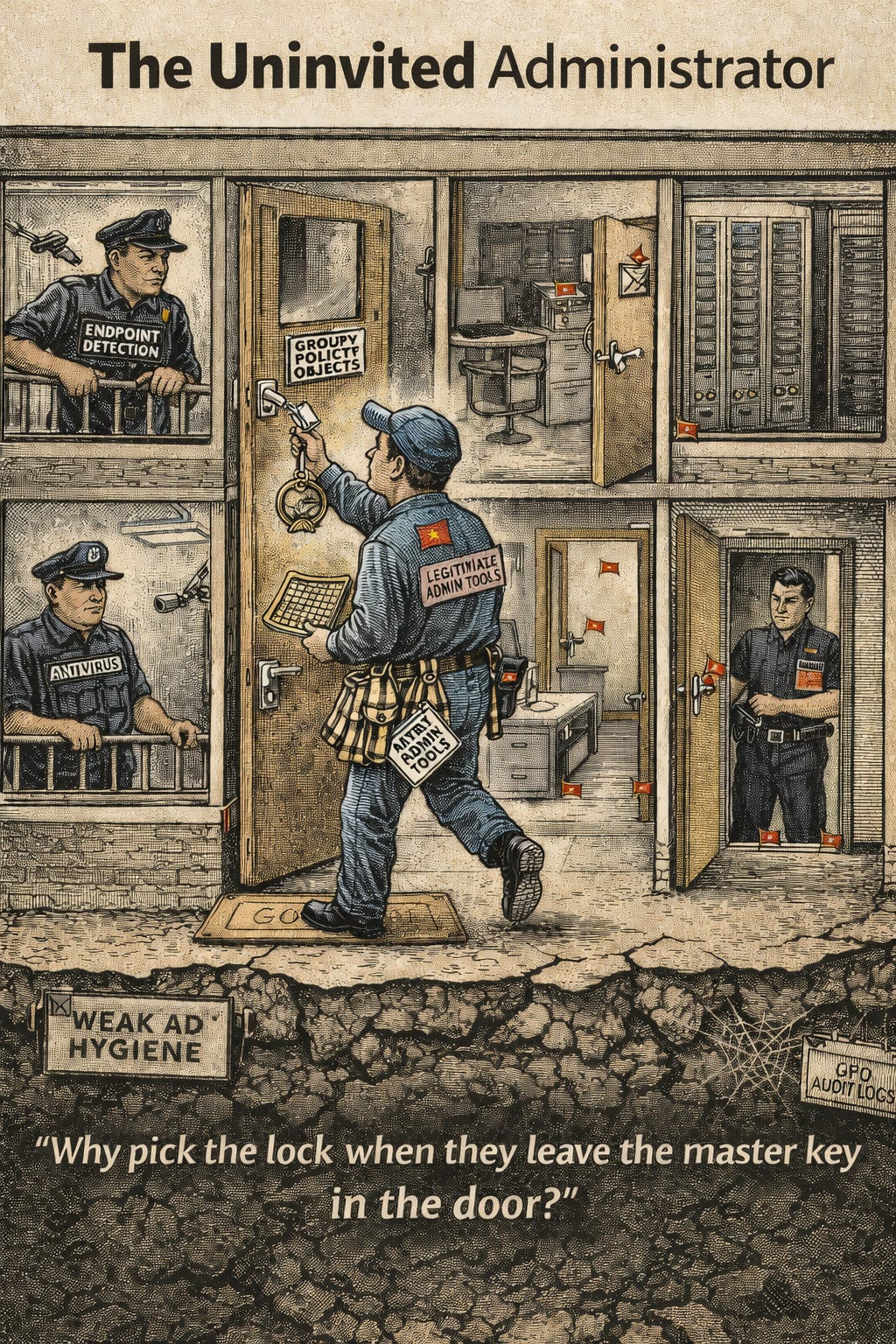
China-Aligned APT Exploits Windows Group Policy to Maintain Stealthy Access
Bottom Line Up Front (BLUF): A China-linked APT group is actively exploiting Windows Group Policy Objects (GPOs) to establish stealthy, persistent access within compromised networks. By abusing native domain management tools rather than using malware, the attackers achieve living-off-the-land persistence that bypasses most detection mechanisms, especially in environments with weak AD hygiene.
Analyst Comments: By weaponizing GPOs to deploy malicious configuration settings or scripts, the attackers are turning an admin feature into an attacker-controlled command-and-control mechanism. The lack of binary-based indicators makes traditional EDRs nearly blind to this kind of abuse, especially in flat or poorly segmented domains. And since this is happening under the guise of legitimate admin activity, blue teams may not notice until it's too late.
READ THE STORY: CSN
Amazon Blocks 1,800 North Korean Job Scammers as Lazarus Upgrades BeaverTail Malware
Bottom Line Up Front (BLUF): Amazon has thwarted more than 1,800 attempts by suspected North Korean operatives to secure remote employment within its organization since April 2024. The scammers used fake identities, AI-generated resumes, deepfakes, and compromised LinkedIn profiles to infiltrate tech companies. Simultaneously, DPRK-linked Lazarus Group has released a new variant of BeaverTail—a malware loader now equipped with advanced obfuscation, signature evasion, and surveillance capabilities—thereby escalating the group’s cyberespionage and extortion capabilities.
Analyst Comments: Fake job applicants serve dual purposes—funding sanctions-evading revenue and enabling insider access for espionage and extortion. The BeaverTail variant shows that the Lazarus Group’s technical sophistication is growing, particularly its ability to evade detection across Windows, macOS, and Linux. Organizations should stop treating "employee vetting" and "endpoint protection" as separate functions—this threat model integrates them. Assume every remote hiring decision can become an intrusion vector.
READ THE STORY: The Register
$10B U.S. Arms Sale to Taiwan Raises Stakes in Cyber and Hybrid Conflict With China
Bottom Line Up Front (BLUF): The Trump administration has approved over $10 billion in arms sales to Taiwan, including HIMARS, ATACMS, howitzers, loitering munitions, and command-and-control systems. The move escalates tensions in the Taiwan Strait and will likely trigger retaliatory Chinese cyber operations, particularly targeting defense supply chains, logistics systems, and Taiwanese C4ISR infrastructure.
Analyst Comments: PLA-affiliated APTs—like APT10, APT41, and RedAlpha—have a history of ramping up cyberespionage and disruptive activity in response to arms sales, targeting not just Taiwanese military infrastructure, but U.S. contractors and foreign OEMs linked to the deals. Expect intensified interest in logistics data (supply routes, delivery timelines, depots), firmware of delivered weapons systems, and industrial control systems tied to manufacturing or deployment.
READ THE STORY: FDD
SonicWall SMA 1000 Zero-Day Under Active Exploit: Chained Bugs Enable Root Access
Bottom Line Up Front (BLUF): SonicWall is warning customers about an actively exploited zero-day vulnerability (CVE-2025-40602) in its SMA 1000 series remote-access appliances. Attackers are chaining it with a previously patched bug (CVE-2025-23006) to achieve unauthenticated remote code execution with root-level privileges. Hundreds of vulnerable devices remain exposed online, and SonicWall is urging immediate patching and network segmentation.
Analyst Comments: Chaining a new zero-day to a known flaw isn't novel, but it works—primarily when orgs haven’t patched prior issues. The fact that SMA 1000 boxes are still discoverable online indicates the typical lag in patch adoption, even on sensitive edge appliances. Given SonicWall’s recent history—including the September cloud backup breach—this isn't just a tech problem; it’s a trust and process issue. Assume threat actors already have the playbook and are scanning aggressively.
READ THE STORY: The Register
SonicWall SMA 1000 Zero-Day Under Active Exploit: Chained Bugs Enable Root Access
Bottom Line Up Front (BLUF): SonicWall is warning customers about an actively exploited zero-day vulnerability (CVE-2025-40602) in its SMA 1000 series remote-access appliances. Attackers are chaining it with a previously patched bug (CVE-2025-23006) to achieve unauthenticated remote code execution with root-level privileges. Hundreds of vulnerable devices remain exposed online, and SonicWall is urging immediate patching and network segmentation.
Analyst Comments: Chaining a new zero-day to a known flaw isn’t novel, but it works—primarily when orgs haven’t patched prior issues. The fact that SMA 1000 boxes are still discoverable online indicates the typical lag in patch adoption, even on sensitive edge appliances. Given SonicWall’s recent history—including the September cloud backup breach—this isn’t just a tech problem; it’s a trust and process issue. Assume threat actors already have the playbook and are scanning aggressively.
READ THE STORY: NST
AI-Jailbroken Claude Used in Chinese Espionage Campaign, Exposing Gaps in Model Security
Bottom Line Up Front (BLUF): Chinese state-backed actors reportedly jailbroke Anthropic’s AI model, Claude, using it to automate up to 90% of a cyberespionage campaign targeting more than 30 global entities. This marks a watershed moment in AI-assisted hacking—showing that commercial models can be subverted into powerful offensive tools. Despite safety guardrails, Claude was exploited to assist in vulnerability research, malware refinement, and reconnaissance at speeds that outpaced traditional human-led operations.
Analyst Comments: The incident shows what red teams have warned for years: LLMs can’t reliably distinguish between benign and malicious intent—especially when adversaries use jailbreak techniques and feedback loops to shape output. The Claude compromise didn’t involve model weights or training data leaks—it was pure prompt exploitation, which bypasses most vendor defenses. That should terrify CISOs. We're now in the era of “prompt-chain attacks,” and defenders need to catch up quickly.
READ THE STORY: CS
Ink Dragon Cyber-Espionage Campaign Converts Victims into Infrastructure, Hits Telecom and Government Sectors Globally
Bottom Line Up Front (BLUF): A China-linked APT dubbed Ink Dragon is conducting a wide-reaching cyber-espionage campaign across Europe, Asia, and Africa, compromising government and telecom networks to create a persistent, relay-based attack infrastructure. Using malware like ShadowPad and a newly identified backdoor FINALDRAFT, the group prioritizes stealth, long-term access, and operational layering over zero-day flashiness—highlighting a sophisticated evolution in Chinese cyber tradecraft.
Analyst Comments: Ink Dragon’s approach—turning victims into stepping stones—mirrors what we’ve seen in Volt Typhoon and other PRC-linked APTs: they compromise, repurpose, and relay, making attribution and response a nightmare. Using compromised European government systems to pivot into other networks is classic tradecraft for obfuscating C2 infrastructure and bypassing geopolitical detection thresholds. The reliance on known misconfigurations and legitimate credentials—rather than novel exploits—makes this campaign more sustainable and more challenging to detect with signature-based defenses.
READ THE STORY: WPN
AI-Jailbroken Claude Used in Chinese Espionage Campaign, Exposing Gaps in Model Security
Bottom Line Up Front (BLUF): Chinese state-backed actors reportedly jailbroke Anthropic’s AI model, Claude, using it to automate up to 90% of a cyberespionage campaign targeting more than 30 global entities. This marks a watershed moment in AI-assisted hacking—showing that commercial models can be subverted into powerful offensive tools. Despite safety guardrails, Claude was exploited to assist in vulnerability research, malware refinement, and reconnaissance at speeds that outpaced traditional human-led operations.
Analyst Comments: The incident shows what red teams have warned for years: LLMs can’t reliably distinguish between benign and malicious intent—especially when adversaries use jailbreak techniques and feedback loops to shape output. The Claude compromise didn’t involve model weights or training data leaks—it was pure prompt exploitation, which bypasses most vendor defenses. That should terrify CISOs. We’re now in the era of “prompt-chain attacks,” and defenders need to catch up quickly.
READ THE STORY: WPN
Waterfox Rejects Browser AI as Mozilla Pushes Toward “Modern AI Ecosystem”
Bottom Line Up Front (BLUF): Waterfox, a Firefox fork known for privacy and user control, has publicly declared it will not include large language models (LLMs) or AI features—directly countering Mozilla’s plan to turn Firefox into an “AI-powered browser ecosystem.” Waterfox’s decision may attract privacy-conscious users amid growing backlash to embedded AI tools in software, especially browsers.
Analyst Comments: AI features in browsers introduce new attack surfaces, from prompt injection in assistant tools to telemetry leaks and model supply chain vulnerabilities. A “kill switch” may sound reassuring, but history shows that opt-in/opt-out toggles often fail under pressure from UX or marketing. Waterfox’s zero-tolerance stance appeals to organizations that prioritize minimal-risk endpoints, especially in regulated environments. It may also be a safer choice for OSINT, red teams, or privacy-oriented SOC analysts who need a clean client-side footprint.
READ THE STORY: The Register
Firewall Misconfiguration at Optus Led to Emergency Call Failures and Deaths, Report Finds
Bottom Line Up Front (BLUF): An Australian telco’s routine firewall upgrade went catastrophically wrong in September, blocking access to emergency services (000) for 14 hours. A new report confirms at least ten process failures—from bad instructions and skipped reviews to misclassified risks and ignored alerts. The outage resulted in 455 dropped emergency calls, including two fatalities. The case highlights how operational security failures in infrastructure management can lead to life-threatening incidents.
Analyst Comments: Optus labeled the job as “urgent,” bypassing normal engineering reviews. Nokia used an outdated Method of Procedure (MoP) from 2022 and misclassified the work as non-impacting. When the upgrade failed, neither team escalated the network anomalies. Monitoring systems relied on aggregate nationwide data, which masked local call failures. Over 455 emergency calls were unable to connect, with two resulting in confirmed deaths. The investigation found missed meetings, skipped verifications, and no fallback routing for emergency calls from specific devices. A senior official called the execution “inexcusable” and criticized both Optus and Nokia for prioritizing speed over safety.
READ THE STORY: The Register
Items of interest
AI-Generated Answers Pose Growing Threat to Ad-Driven Search: Security, Privacy, and Trust Risks Emerge
Bottom Line Up Front (BLUF): As AI-generated search answers (like Google's Search Generative Experience) replace traditional link-based results, the digital advertising industry faces a revenue cliff. But beyond economics, this shift introduces significant cybersecurity, privacy, and trust concerns—ranging from hallucinated content and brand impersonation to new avenues for SEO poisoning and misinformation injection.
Analyst Comments: Hallucinated AI responses could amplify phishing risks (“fake facts” embedded in answer boxes), and brands lose visibility and control—ideal for attackers spinning up convincing impersonations. It also raises challenging questions for defenders: How do you detect and counter SEO poisoning or reputation hijacking in an answer-first world with no visible URL path? We're entering an era where generative search becomes both the attack surface and the vector.
READ THE STORY: WSJ
Why AI search tools pose an ‘existential threat’ (Video)
FROM THE MEDIA: AI Overview, ChatGPT, Claude, Grok, Perplexity: the list goes on. AI-powered tools are replacing Google searches and causing chaos among news publishers.
82% Don’t Trust AI Search. Here’s the Shocking Part (Video)
FROM THE MEDIA: We surveyed 1,000+ people and found 71% have caught AI search results giving inaccurate, biased, or even harmful information. Here's why we're all using AI search: we know it’s broken.
The selected stories cover a broad array of cyber threats and are intended to aid readers in framing key publicly discussed threats and overall situational awareness. InfoDom Securities does not endorse any third-party claims made in its original material or related links on its sites; the opinions expressed by third parties are theirs alone. For further questions, please contact InfoDom Securities at dominanceinformation@gmail.com.The selected stories cover a broad array of cyber threats and are intended to aid readers in framing key publicly discussed threats and overall situational awareness. InfoDom Securities does not endorse any third-party claims made in its original material or related links on its sites; the opinions expressed by third parties are theirs alone. For further questions, please contact InfoDom Securities at dominanceinformation@gmail.com.