
Daily Drop (1204)
12-18-25

Thursday, Dec 18, 2025 // (IG): BB // GITHUB // SN R&D
India and China in Deep Water Over Himalayan Hydropower Surveillance Risks
Bottom Line Up Front (BLUF): Tensions between India and China are intensifying over Himalayan hydropower infrastructure, with emerging concerns that cross-border surveillance, data access, and cyber intrusions could escalate alongside physical water disputes. India’s strategic dam projects and China’s upstream megadams on the Brahmaputra (Yarlung Tsangpo) are not just about hydroelectric power—they are becoming cyber-physical flashpoints in a broader conflict over water, sovereignty, and strategic dominance in the region.
Analyst Comments: As both countries digitize dam management systems—often deploying SCADA/ICS technologies with remote monitoring—they create new targets for state-sponsored cyber operations. Beijing’s surveillance posture, combined with past precedent of cyber intrusions into Indian critical sectors, raises legitimate fears that hydropower telemetry could be manipulated, intercepted, or disabled in a future conflict.
READ THE STORY: JD
China’s AI Chip “Manhattan Project” Seeks to End Western Semiconductor Dependence
Bottom Line Up Front (BLUF): China has launched a state-backed AI chip development initiative—likened to a “Manhattan Project”—to break free from Western dominance in advanced semiconductors. According to ET CIO, the effort has pooled resources across China’s top universities, military-linked institutes, and private companies to accelerate self-reliance in AI hardware amid escalating US export controls and geopolitical tech decoupling.
Analyst Comments: By controlling the full AI stack—from algorithm to silicon—China can harden its critical infrastructure, train more powerful surveillance and military AI, and reduce exposure to Western pressure points such as TSMC, ASML, and Nvidia. What makes this effort particularly concerning from a security standpoint is its fusion of civilian and military research (“mil-civ integration”), where AI hardware advances directly support PLA goals in cyberwarfare, intelligence automation, and autonomous systems.
READ THE STORY: ET
Defending Against AI-Powered Threats from Cyberspace: Experts Warn of Accelerating Offensive Capabilities
Bottom Line Up Front (BLUF): Cybersecurity experts warned that AI-enabled cyber threats are rapidly expanding in both scale and sophistication. From automated phishing to deepfake-driven deception and autonomous malware, threat actors' use of generative AI—especially state-linked APTs—is outpacing defensive adaptation. Panelists emphasized that traditional cyber defense models are insufficient to detect and mitigate AI-enhanced attacks.
Analyst Comments: Offensive operations now benefit from AI-generated content for social engineering, LLM-assisted vulnerability discovery, and faster development of polymorphic malware. Combine that with deepfake technology and voice cloning, and adversaries can now automate trust abuse at a scale previously limited by human effort. Nation-state actors and ransomware groups alike are leveraging AI to increase success rates in phishing, impersonation, and reconnaissance. The real danger is the widespread operationalization of low-cost, high-impact cyber tools—a scenario in which novice attackers with ChatGPT-tier models can execute campaigns that used to require advanced tradecraft.
READ THE STORY: ASP
Chinese APT Exploits Cisco AsyncOS 0-Day for Root Access on Secure Email Appliances
Bottom Line Up Front (BLUF): Cisco has confirmed that a zero-day vulnerability (CVE-2025-20393) in its AsyncOS platform is being actively exploited in the wild by a suspected Chinese APT group tracked as UAT-9686. The flaw allows unauthenticated attackers to execute commands with root privileges on vulnerable Secure Email Gateway (SEG) and Secure Email and Web Manager (SEWM) appliances. Exploitation began in late November 2025, and no patch is currently available.
Analyst Comments: The use of AquaShell and chisel tunneling shows a shift toward low-signal persistence, with operators preferring built-in Linux utilities and Python-based backdoors to evade detection. Cisco’s lack of a patch timeline is concerning. The fact that exploitation continued for weeks before public disclosure suggests either late detection or delayed coordination of the response. Organizations still running SEG/SEWM appliances with the Spam Quarantine feature exposed to the internet are at serious risk of full compromise.
READ THE STORY: The Register
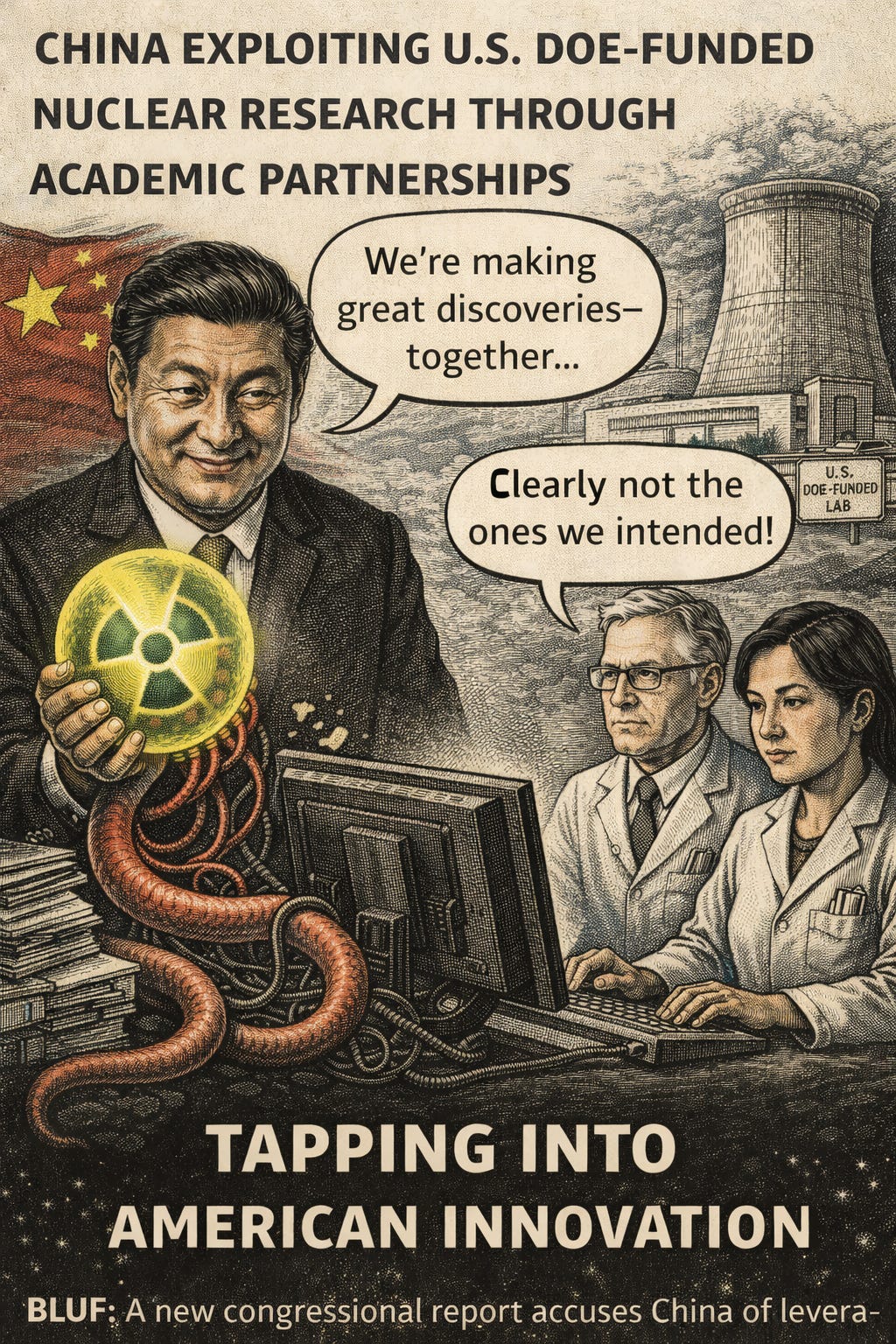
Congressional Report: China Exploiting U.S. DOE-Funded Nuclear Research Through Academic Partnerships
Bottom Line Up Front (BLUF): A new congressional report accuses China of leveraging research collaborations with U.S. scientists—funded by the Department of Energy (DOE)—to access sensitive nuclear and high-tech innovations with direct military applications. Over 4,300 publications between mid-2023 and 2024 involved DOE-funded U.S. researchers and Chinese partners, half of which had ties to China’s military or industrial base. The findings raise alarms over lax security controls and systemic policy failures in safeguarding taxpayer-funded research from foreign exploitation.
Analyst Comments: Turning government servers into hop points for international espionage isn’t just clever—it’s strategically devastating. Ink Dragon is effectively building a stealth mesh C2 system on European infrastructure, using native Microsoft services and dormant sessions to remain undetected. The updated FinalDraft malware is particularly concerning—it’s tuned to blend into Microsoft Cloud traffic, making detection via traditional indicators nearly useless. This reflects a growing trend in which state-sponsored groups don’t just operate within networks—they remodel them to serve broader campaign objectives.
READ THE STORY: SeattlePI
TikTok Defies EU Ruling, Continues Sending European User Data to China
Bottom Line Up Front (BLUF): The Dutch Data Protection Authority (DPA) has issued a fresh warning to TikTok users in the Netherlands, stating that the platform continues to transfer personal data to China, in defiance of a joint EU regulatory ruling deeming such transfers illegal under the GDPR. This raises significant concerns over data sovereignty, regulatory defiance, and espionage risks, particularly for younger users and government-linked organizations.
Analyst Comments: The continued movement of sensitive personal data outside the EU to jurisdictions with little to no data protection parity (e.g., mainland China) exposes users and institutions to surveillance, profiling, and potential access by foreign intelligence services. This issue is more than a privacy debate—it is an active geopolitical and cybersecurity vector, especially given known Chinese laws obligating tech firms to assist state intelligence operations. The risks are not theoretical: in combination with behavioral, location, and device-level data, foreign actors could conduct long-term profiling, social engineering, or even indirect influence operations.
READ THE STORY: Cybernews
Pentagon Report Highlights Threat to Aircraft Carriers from Chinese Hypersonic Missiles
Bottom Line Up Front (BLUF): A leaked Pentagon study (“Overmatch Brief”) reveals China could neutralize or destroy U.S. carrier strike groups using coordinated hypersonic missile salvos, cyberattacks, and anti-satellite operations. The simulation-driven assessment highlights a multi-layered PLA campaign capable of degrading U.S. targeting, routing, and naval operations in a high-intensity conflict—posing a serious threat to U.S. naval dominance in the Indo-Pacific.
Analyst Comments: The Overmatch Brief confirms what many in the defense and cyber communities have suspected: China’s ability to blend kinetic and non-kinetic effects (cyber + space + missiles) is maturing. Cyber professionals should pay close attention to the role of cyberattacks on space assets—likely targeting satellite ground stations, GPS timing infrastructure, and communications relays. When paired with electronic warfare and space denial, this could blind carrier strike groups at the worst possible moment.
READ THE STORY: IE
WARP PANDA Targets VMware-Based Cloud Infrastructure in India, Raising Espionage Alarm
Bottom Line Up Front (BLUF): A China-linked cyber espionage group known as WARP PANDA has been quietly infiltrating cloud environments using VMware technologies—a critical component of infrastructure across the Indian government, defense, and industrial sectors. The group’s ability to compromise central control systems within cloud environments grants it deep, persistent access to sensitive data, representing a significant national security threat.
Analyst Comments: WARP PANDA’s operations reinforce a growing reality: virtualization and cloud platforms are now strategic espionage targets. By compromising VMware hypervisors, the threat actor gains control over multiple virtual machines, bypassing traditional endpoint security and avoiding detection by operating below the OS layer. This aligns with China’s broader shift toward stealthy, long-haul cyber operations designed for strategic intelligence collection rather than disruption.
READ THE STORY: MSN
Chinese Syndicates Fuel $15 Trillion Cybercrime Economy via Crime-as-a-Service Networks
Bottom Line Up Front (BLUF): The Chinese triads and organized crime groups have professionalized and globalized the cybercrime ecosystem, offering crime-as-a-service (CaaS) tools ranging from SMS blasters to AI-powered deepfakes. These syndicates blur the lines between fraud, cyber espionage, and state influence, and are now operating transnationally—with hubs in Southeast Asia, Africa, and even the UK. Law enforcement remains overwhelmed by the scale, speed, and reach of this cybercriminal economy, now estimated to cost over $15 trillion annually.
Analyst Comments: Chinese syndicates are operating like multinational corporations, offering plug-and-play cybercrime kits, IMSI catchers, and malware subscription services to criminals, scammers, and even nation-state actors. What’s most alarming is the convergence: cybercrime, state espionage, and geopolitical influence operations are increasingly indistinguishable. Chinese criminal networks are reportedly training others, laundering billions in cryptocurrency, and leveraging infrastructure in jurisdictions such as the Isle of Man and Palau to evade sanctions and embed themselves in legitimate economies.
READ THE STORY: FT
Chinese BrickStorm Hackers Target Global Defense Sector in Espionage Campaign
Bottom Line Up Front (BLUF): A newly identified Chinese cyber-espionage group, dubbed BrickStorm, has been linked to sustained targeting of global defense and aerospace sectors. According to The Defense Post, the group has been conducting covert operations since at least mid-2022, focusing on exfiltration of sensitive military data via stealthy malware implants and compromised contractor networks.
Analyst Comments: BrickStorm appears to be a dedicated PLA-affiliated espionage unit tasked with infiltrating the defense industrial base across North America, Europe, and Asia-Pacific. While the TTPs are consistent with earlier Chinese APT playbooks, the campaign’s longevity and low detection profile point to a refined operational security (OPSEC) model—suggesting both high-value targets and significant investment.
READ THE STORY: IE
French Authorities Detain 22-Year-Old Over Cyberattack on Interior Ministry
Bottom Line Up Front (BLUF): French law enforcement has arrested a 22-year-old suspect in connection with a cyberattack on the Ministry of the Interior. The breach reportedly targeted internal systems and may have involved unauthorized access to sensitive government data. The attack occurred earlier in December and prompted an immediate investigation by French cybersecurity and counterterrorism units.
Analyst Comments: While the technical specifics are limited, the rapid arrest suggests the attacker made operational security (OPSEC) mistakes—potentially a lone actor or small group lacking nation-state tradecraft. The fact that internal government systems were targeted is significant; even partial success in such an attack raises concerns about segmentation, monitoring, and insider-threat defenses across French ministries. Expect more details to emerge around access vectors—whether this was a credential compromise, phishing, or exploitation of public-facing infrastructure.
READ THE STORY: France 24
Amazon Flags North Korean IT Worker via Keystroke Biometrics
Bottom Line Up Front (BLUF): Amazon reportedly identified and terminated a North Korean IT worker posing as a remote contractor after detecting suspicious activity using keystroke biometric data. The worker was part of a broader DPRK strategy to generate foreign income through IT outsourcing, thereby circumventing sanctions.
Analyst Comments: This is a rare public confirmation that a major tech company is leveraging behavioral biometrics—not just IP or device fingerprints—to identify sanctioned actors. It also underscores how deep North Korea’s IT infiltration has become. Their operatives are skilled and patient, often operating under proxy identities and through U.S.-based intermediaries. Enterprises using remote contractors should adopt keystroke dynamics and behavioral analytics, especially in high-trust environments such as code access or infrastructure roles.
READ THE STORY: Bloomberg
Trump Signals AI Chip Crackdown May Escalate U.S.-China Tech War
Bottom Line Up Front (BLUF): President Donald Trump indicated he would pursue even harsher restrictions on AI chip exports to China if elected in 2024. He specifically criticized companies such as NVIDIA, arguing that their sales of advanced semiconductors to China undermine U.S. national security. While not a policy announcement, the rhetoric points to a likely continuation—and possible escalation—of the U.S.-China tech decoupling, with direct implications for the semiconductor and AI sectors.
Analyst Comments: Trump’s remarks highlight a bipartisan U.S. consensus on restricting China’s access to advanced chips. For security professionals, this has downstream effects: an accelerated push by China to develop indigenous AI hardware and an increased risk of IP theft and supply chain espionage. It also raises the likelihood of retaliatory cyber operations targeting U.S. chipmakers, fabs, and AI startups. Defenders in these sectors should anticipate heightened interest from nation-states and prepare accordingly.
READ THE STORY: The New York Times
Ink Dragon Turns Compromised Government Servers into Espionage Infrastructure
Bottom Line Up Front (BLUF): China-linked APT Ink Dragon is shifting tactics—repurposing compromised government infrastructure, particularly in Europe, into active command-and-control (C2) nodes for broader espionage operations. According to Check Point Research, the group is exploiting simple web-facing flaws in Microsoft IIS and SharePoint servers to gain persistent access, then deploying a custom IIS-based relay module and updated variants of the FinalDraft backdoor to convert victims into infrastructure hubs covertly. These relays help conceal attacker traffic behind seemingly legitimate enterprise web activity.
Analyst Comments: The scale of collaboration detailed in the report highlights China’s long game: quietly integrate into Western scientific ecosystems, extract dual-use innovations, and funnel them into its defense-industrial pipeline. What’s especially concerning is the overlap with entities flagged by the Pentagon for military and cyber operations, including state-owned labs and universities under PLA oversight. U.S. federal grants are propping up the same institutions linked to cyberattacks and human rights violations.
READ THE STORY: CyberNews
FBI Dismantles $50M Money Laundering Operation Supporting Cybercrime
Bottom Line Up Front (BLUF): The FBI has dismantled an alleged $50 million cryptocurrency money-laundering ring that facilitated ransomware payments and cybercriminal profits. The operation used over-the-counter (OTC) crypto brokers, shell companies, and mixing services to obfuscate the origin of funds.
Analyst Comments: By targeting OTC brokers who knowingly process tainted funds, law enforcement is signaling tighter pressure on the gray market that supports ransomware. However, for every busted laundering ring, new services emerge, especially in jurisdictions with lax enforcement. Financial teams in SOCs should strengthen on-chain transaction tracing capabilities and flag crypto activity tied to high-risk wallets or laundering typologies.
READ THE STORY: The Record
Items of interest
China’s KnowSec Leak Exposes State–Corporate Cyber Nexus and Global Surveillance Ambitions
Bottom Line Up Front (BLUF): Leaked documents from Chinese cybersecurity firm KnowSec reveal its deep operational ties to state intelligence, including collaboration with the Ministry of Public Security and People’s Liberation Army (PLA). The breach exposes a surveillance infrastructure supporting both domestic repression and international influence operations—framing private tech firms as integral tools of China’s cyber-sovereignty doctrine. Products like ZoomEye, marketed as security platforms, also function as offensive reconnaissance tools that map global infrastructure and enable disinformation campaigns across democratic ecosystems.
Analyst Comments: China blends private sector innovation with national-level information control. The KnowSec documents confirm what many suspected: that commercial cybersecurity tools are being routinely weaponized for offensive surveillance and propaganda. ZoomEye, in particular, mirrors Shodan but with state backing and strategic intent, giving Beijing a near-real-time view of foreign vulnerabilities.
READ THE STORY: ORF
Anthropic Claude Code automating APT hacks, KnownSec leak, Chinese buses with remote access (Video)
FROM THE MEDIA: Three Buddy Problem - Episode 72: We unpack Anthropic’s conflicting self-promotion around the “first AI-orchestrated cyberattack” using Claude Code and the future of automated APT attacks.
A Microsoft Engineer Noticed 0.5 Seconds—And Saved the Internet (Video)
FROM THE MEDIA: March 29, 2024. A Microsoft engineer, Andres Freund, noticed that his SSH logins were taking 0.5 seconds longer than usual. He decided to investigate.
The selected stories cover a broad array of cyber threats and are intended to aid readers in framing key publicly discussed threats and overall situational awareness. InfoDom Securities does not endorse any third-party claims made in its original material or related links on its sites; the opinions expressed by third parties are theirs alone. For further questions, please contact InfoDom Securities at dominanceinformation@gmail.com.The selected stories cover a broad array of cyber threats and are intended to aid readers in framing key publicly discussed threats and overall situational awareness. InfoDom Securities does not endorse any third-party claims made in its original material or related links on its sites; the opinions expressed by third parties are theirs alone. For further questions, please contact InfoDom Securities at dominanceinformation@gmail.com.
Solid aggregation on Ink Dragon repurposing government servers as relay infrastructure. The detail about IIS-based modules to blend with enterprise traffic is exactly the kind of low-signal tactic that burns through traditional perimeter telemetry. I ran into similar schemes in a past engagement where comproised SharePoint instances were used as data exfil staging points because outbound traffic from MS endpoints looked completely benign. Defenders need to treat internal web apps as potential threat infastructure, not just assets to protect.