
Daily Drop (1202)
12-14-25

Sunday, Dec 14, 2025 // (IG): BB // GITHUB // SN R&D
India Pushes Back Against Mexico’s Unilateral Tariff Hike on Steel and Aluminum Imports
Bottom Line Up Front (BLUF): India is in formal talks with Mexico regarding Mexico’s sudden tariff hike on several steel and aluminum products, which could significantly impact Indian exports. New Delhi called the move “unilateral and abrupt” and is working through diplomatic and trade channels to resolve the issue without escalating to formal dispute mechanisms under the World Trade Organization (WTO).
Analyst Comments: India’s Ministry of Commerce is engaging with Mexican counterparts after Mexico imposed tariffs on a range of steel and aluminum imports, including those from India. These hikes—imposed without prior bilateral consultation—have raised concerns among Indian manufacturers and exporters. New Delhi is currently seeking a diplomatic resolution, but hasn’t ruled out increasing the matter at the WTO if no progress is made. The development comes amid global trade realignments and protectionist policies gaining traction across advanced economies.
READ THE STORY: The Hitavada
CBI Chargesheets 4 Chinese Behind ₹1,000 Crore Cybercrime Racket; 111 Shell Companies Unmasked
Bottom Line Up Front (BLUF): India’s Central Bureau of Investigation (CBI) has filed a charge sheet against four Chinese nationals accused of orchestrating a large-scale cybercrime and financial fraud operation worth over ₹1,000 crore (approximately $120 million USD). The scheme leveraged 111 shell companies to launder stolen funds, primarily sourced through phishing, digital loan app fraud, and money mule networks. This marks one of India’s most expansive crackdowns on transnational cyber-enabled financial crime, with implications for regional cyber defense and international law enforcement cooperation.
Analyst Comments:
This case marks one of the most substantial Chinese-linked cyber-financial operations exposed in India to date. While the activity is criminal, not directly APT, the infrastructure overlap—fake firms, money laundering via shell entities, and digital payment fraud—mirrors methods used by state-backed groups. Expect India to increase diplomatic and cyber scrutiny of PRC-linked financial entities operating in the region.
READ MORE: MSN
Fears Grow That Chinese-Made Electronics Could Be Weaponized in a U.S. Cyber Conflict
Bottom Line Up Front (BLUF): U.S. officials and security experts are sounding alarms about the national security risks posed by Chinese-made components embedded in critical power infrastructure. Concerns center on the potential for built-in vulnerabilities or hidden backdoors in grid equipment—particularly transformers and control systems—that could be exploited during a cyber conflict or geopolitical escalation. The threat isn’t just theoretical: intelligence assessments suggest these components could be used to remotely disable or disrupt portions of the U.S. electric grid during a crisis.
Analyst Comments:
This is part of a growing recognition that hardware supply chains represent not just a procurement issue but a live threat surface. Legacy SCADA systems, industrial controls, and even innovative grid components may contain undocumented access paths. The concern is less about espionage and more about pre-positioned disruption capability in case of a kinetic or cyber-physical conflict with China.
READ MORE: AOL
Cyber Warfare and Maritime Tensions: China’s Escalating Hybrid Tactics in the South China Sea
Bottom Line Up Front (BLUF): China is increasingly using cyber operations as a parallel pressure tactic in the South China Sea, targeting regional adversaries with espionage campaigns, disinformation, and digital sabotage. Recent reporting highlights coordinated efforts by Chinese state-backed threat actors to compromise military, maritime, and government networks in Southeast Asia, particularly in the Philippines and Vietnam. This blending of cyber and geopolitical aggression is reshaping regional security dynamics and testing cyber defense readiness across the Indo-Pacific.
Analyst Comments: The strategy is clear: destabilize regional opposition via cyber pressure while asserting physical control at sea. Groups like APT40 and Naikon are likely involved, aligning intrusion campaigns with PLA Navy deployments. The dual use of cyber and maritime gray-zone tactics makes attribution more challenging and defense more complex. CERTs in ASEAN nations need closer collaboration and improved maritime IT security protocols.
READ THE STORY: Maritime Fairtrade
Ransomware Attacks Surge 50% in 2025: Microsoft, Apple, Oracle Among Targets
Bottom Line Up Front (BLUF): According to threat intelligence firm Cyble, ransomware activity surged by over 50% in 2025, with high-profile vendors including Microsoft, Apple, and Oracle among the targets. The report highlights growing operational sophistication, frequent use of double extortion, and the targeting of supply chains to amplify impact. Key drivers include AI-assisted automation, recycled access from infostealer markets, and increased RaaS (Ransomware-as-a-Service) group activity. The scale and targeting indicate that ransomware is no longer just a financial crime—it’s a systemic threat to the software supply chain.
Analyst Comments: The ransomware ecosystem is evolving fast. Operators are exploiting MFA fatigue, token theft, and app misconfigurations, not just perimeter vulnerabilities. Zero-days are increasingly used as initial access vectors. Cloud-first organizations must rethink their ransomware response playbooks—containment must assume cross-tenant access and cloud-native persistence.
READ MORE: NDTV
Google Warns of React2Shell Exploit Actively Used to Spread Malware via Web Apps
Bottom Line Up Front (BLUF): Google’s Threat Analysis Group (TAG) has issued a warning about active exploitation of the “React2Shell” vulnerability—a critical flaw in specific React-based web applications that allows remote code execution (RCE). Threat actors are using the bug to deploy malware through malicious components embedded in compromised or third-party React apps, effectively turning trusted web platforms into delivery vehicles.
Analyst Comments: The name echoes Log4Shell for a reason: if a vulnerable app allows remote injection via misconfigured dangerouslySetInnerHTML or similar components, attackers can gain shell-level access via obfuscated payloads. Google TAG’s warning signals a surge in exploitation, particularly in malware campaigns leveraging React apps used by enterprises and developers. Developers should audit React codebases immediately, especially where unsafe rendering practices are in use.
READ THE STORY: CSN
FBI’s Counterintelligence Capabilities Strained Amid Espionage Resurgence and Political Interference
Bottom Line Up Front (BLUF): Researchers have uncovered a new campaign that deploys Phantom Stealer, information-stealing malware targeting Windows systems. The threat actors are distributing the malware via fake installers, cracked software, and trojanized utilities, enabling them to exfiltrate credentials, browser data, crypto wallets, and system info from infected machines. The malware is being actively traded on dark web forums, indicating growing adoption by low-skill cybercriminals.
Analyst Comments: Phantom Stealer isn’t new in capabilities—but its resurgence reflects a broader trend: information stealers are becoming plug-and-play kits for entry-level threat actors. The distribution method (trojanized software and “utility” tools) points toward opportunistic infections rather than targeted campaigns. However, the impact can still be significant—especially for small businesses or users handling sensitive credentials outside managed environments. Organizations should monitor for unusual browser syncs, MFA resets, and outbound C2 traffic, particularly from unmanaged endpoints.
READ THE STORY: The Bulwark
New Phantom Stealer Malware Campaign Targeting Windows Users via Trojanized Installers and Fake Tools
Bottom Line Up Front (BLUF): Threat actors are distributing malware via fake installers, cracked software, and trojanized utilities, enabling them to exfiltrate credentials, browser data, crypto wallets, and system information from infected machines. The malware is being actively traded on dark web forums, indicating growing adoption by low-skill cybercriminals.
Analyst Comments: Phantom Stealer isn’t new in capabilities—but its resurgence reflects a broader trend: information stealers are becoming plug-and-play kits for entry-level threat actors. The distribution method (trojanized software and “utility” tools) points toward opportunistic infections rather than targeted campaigns. However, the impact can still be significant—especially for small businesses or users handling sensitive credentials outside managed environments. Organizations should monitor for unusual browser syncs, MFA resets, and outbound C2 traffic, particularly from unmanaged endpoints.
READ THE STORY: CSN
China’s Dual Threat in the South China Sea: Cyber Operations Escalate Alongside Maritime Tensions
Bottom Line Up Front (BLUF): China is intensifying its strategic posture in the South China Sea by pairing aggressive territorial maneuvers with coordinated cyber operations targeting regional governments, maritime infrastructure, and critical industries. According to open-source analysis reported by Maritime Fairtrade, this hybrid pressure campaign reflects a broader shift in China’s regional doctrine—leveraging cyberwarfare as a force multiplier to support its disputed territorial claims.
Analyst Comments: China’s behavior in the South China Sea combines physical coercion (harassment of vessels, construction of artificial islands, gray zone naval tactics) with sustained cyber espionage and disruption campaigns. These operations often target ASEAN members’ defense ministries, coast guards, oil exploration firms, and satellite communications. Notably, groups such as APT40 and Naikon, long linked to China’s state intelligence apparatus, are suspected of conducting cyber intrusions that align with periods of maritime escalation. For regional defenders and maritime operators, cyber threats must now be assessed alongside naval strategy.
READ THE STORY: Maritime Fairtrade
CISA, NSA, and Allies List 2025’s Most Exploited Vulnerabilities: Old Bugs Still Driving Breaches
Bottom Line Up Front (BLUF): The U.S. Cybersecurity and Infrastructure Security Agency (CISA), NSA, and international partners released a joint advisory listing the Top Exploited Vulnerabilities of 2025. Despite years of patches and public awareness, many of the most targeted CVEs were disclosed before 2024—highlighting persistent failures in vulnerability management. Attackers continue to rely on unpatched internet-facing systems, with remote code execution (RCE), privilege escalation, and VPN appliance flaws topping the list.
Analyst Comments: Most of the top exploited bugs were known, patched, and widely documented, yet they still provided attackers with reliable entry points. It shows that patch velocity and asset visibility remain significant gaps, particularly across SMBs, education, and healthcare. If defenders are looking for ROI, start here. Don’t chase zero-days when known RCEs from 2021–2024 are still burning networks. If you’re not sure whether you’re exposed, assume compromise and validate.
READ THE STORY: CSN
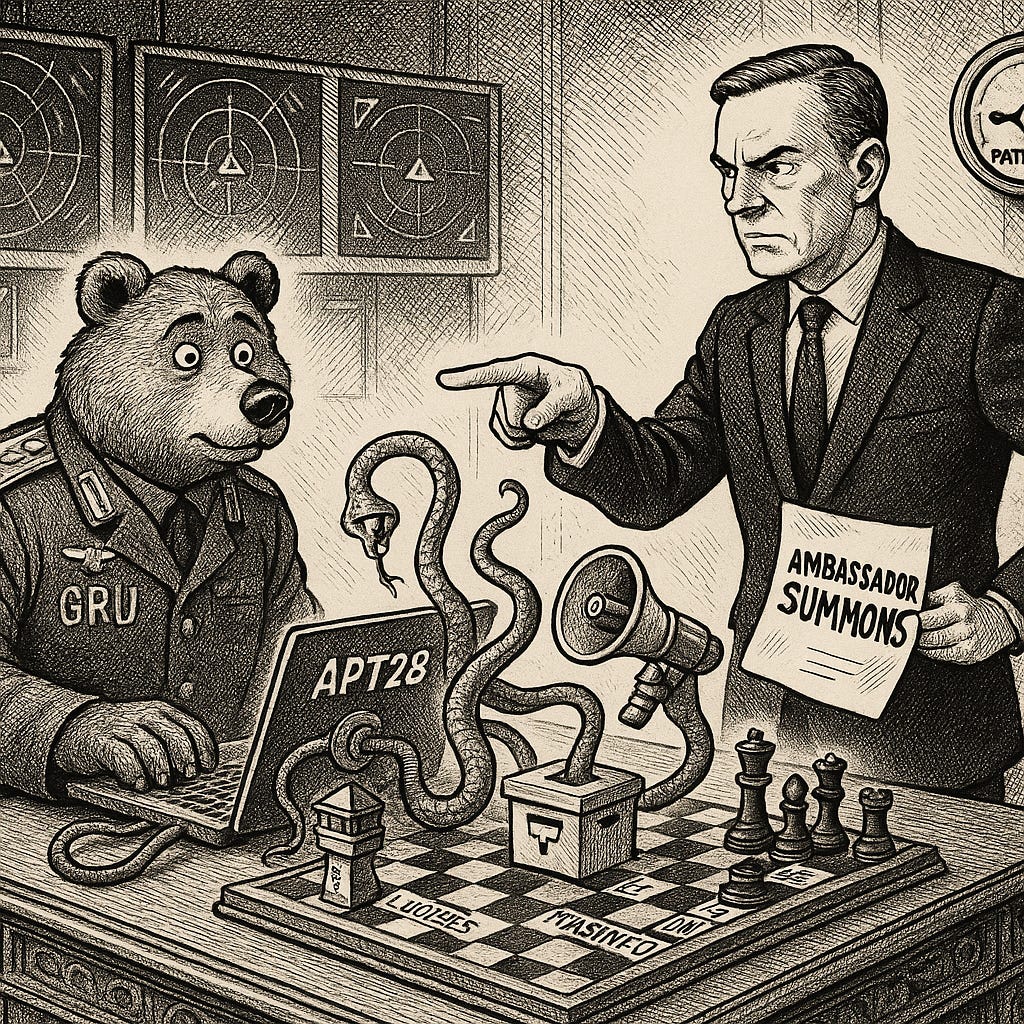
Germany Summons Russian Ambassador Over Election Interference and Cyber Sabotage
Bottom Line Up Front (BLUF): The German government has summoned Russia’s ambassador following public attribution of a sustained cyber campaign believed to originate from Russian state-backed actors. The campaign allegedly targeted German political parties, members of parliament, and critical infrastructure sectors in what Berlin describes as a coordinated effort to interfere in upcoming elections and destabilize civil society through cyber-enabled sabotage. The diplomatic move marks a significant escalation in Germany’s response to foreign influence operations, as Berlin pushes for a unified EU stance on cyber deterrence and calls for stronger collective defenses across the bloc.
Analyst Comments: Germany drawing a public red line over election interference and infrastructure-targeted sabotage underscores the shift from passive defense to active diplomatic signaling. While Russia has long tested European cyber resilience, this latest confrontation could trigger broader sanctions or retaliatory cyber measures coordinated through EU and NATO structures. Threat intel teams should anticipate similar TTPs across member states—phishing, data leaks, infrastructure probes—especially ahead of elections or key political events.
READ THE STORY: WRAL
Allies Must Step Up Cyber-Defense Aid to Ukraine
Bottom Line Up Front (BLUF): Ukraine is urging its Western allies to accelerate defense aid, including cyber capabilities, amid mounting pressure from Russian hybrid warfare operations. While kinetic battles rage in the east, Ukrainian defense officials emphasize that Russia’s parallel cyber campaign is intensifying, targeting critical infrastructure, military logistics, and public communications. Officials argue that without timely cyber and intelligence support, Ukraine’s ability to maintain digital resilience and secure battlefield coordination will erode.
Analyst Comments: Defending Ukraine goes beyond tanks and artillery. Cyber is a second front — especially in energy, finance, and satellite comms. Western allies that overlook this domain risk underpowering Ukraine’s war effort. Increased cooperation through NATO cyber initiatives is essential.
READ THE STORY: The Independent
US DOJ Charges Russian Intelligence Officers Over Global Cyber Operations
Bottom Line Up Front (BLUF): The U.S. Department of Justice has unsealed indictments against several Russian intelligence officers for a multi-year cyber campaign targeting critical infrastructure, energy companies, and global supply chains. The operations, attributed to Russia’s FSB (Federal Security Service), use custom malware and living-off-the-land techniques to infiltrate networks across the U.S., Europe, and Asia. Prosecutors say the goal was to prepare pre-positioned access for future sabotage.
Analyst Comments: These charges detail operations that mirror tactics seen in Dragonfly, Energetic Bear, and other ICS-focused APTs. The use of credentials stolen years ago highlights the persistence of state-backed espionage and sabotage preparation. Defenders should reassess any legacy compromises—especially in the energy sector—and ensure network segmentation and IR plans include scenarios for sleeper implants and long-dwell adversaries.
READ THE STORY: NTD
PayPal Cuts Services in Russia Amid War, Escalating Tech Decoupling
Bottom Line Up Front (BLUF): PayPal has officially suspended its remaining services in Russia, citing the ongoing war in Ukraine and aligning with broader Western economic and digital sanctions. The move further isolates Russia from global financial networks and increases pressure on domestic users and businesses relying on cross-border digital payments. While PayPal halted new user onboarding in 2022, this marks a complete operational exit, reinforcing the broader trend of Western tech firms disengaging from Russia’s digital economy.
Analyst Comments: With services such as PayPal exiting, Russian users will turn to alternative or state-aligned fintech platforms, which may offer fewer protections and less oversight. This also increases the likelihood of greater cryptocurrency use for sanctions evasion and gray-market trade. From a threat landscape perspective, expect a spike in Russian cybercriminal forums pivoting toward illicit payment infrastructure, money mule recruitment, and money laundering services. This is an economic fracture that will ripple through cybercrime ecosystems.
READ THE STORY: Mashable
CyberVolk Ransomware Cracked by Cryptography Flaw
Bottom Line Up Front (BLUF): A newly emerged ransomware group, dubbed CyberVolk, has suffered a botched debut after researchers discovered critical flaws in its encryption routine. Analysts at BleepingComputer report that the malware’s weak cryptographic implementation allows for decryption without paying a ransom. This technical misstep significantly undercuts the threat posed by CyberVolk and may dissuade affiliates from joining or deploying the strain further.
Analyst Comments: CyberVolk’s encryption failure is a rookie-level mistake, and while the branding and payload mimic established players, the poor crypto shows it’s more hype than threat—for now. That said, failed ransomware doesn’t stay broken forever. Threat actors iterate fast. Expect v2.0 with hardened encryption to surface soon. Until then, defenders should treat CyberVolk as a teachable moment: use it to reinforce backup strategies, test incident response playbooks, and promote awareness of “ransomware without teeth.”
READ THE STORY: BleepingComputer
Askul Data Breach: 740,000 Customer Records Exposed
Bottom Line Up Front (BLUF): Japanese e-commerce firm Askul has disclosed a cyberattack that compromised approximately 740,000 customer records. While full details remain sparse, the company confirmed that personal information—likely including names, addresses, and contact details—was accessed by unauthorized parties. The breach underscores ongoing vulnerabilities in Japan’s commercial tech sector amid rising regional cyber threat activity.
Analyst Comments: Askul isn’t a global tech giant, but it’s a household name in Japan—and this breach is significant. With nearly three-quarters of a million records exposed, this incident fits the broader pattern of supply chain and e-commerce platforms being targeted for bulk data harvesting. The bigger issue? Japan continues to lag in mandatory breach disclosure timelines and enforcement. This creates a delayed response window that threat actors exploit. Expect follow-on phishing campaigns using stolen Askul data and renewed scrutiny on Japanese corporate cyber readiness.
READ THE STORY: Japan Times
AI-Powered Ransomware Accelerates: Cyble Flags 7 Trends Reshaping the Threat Landscape
Bottom Line Up Front (BLUF): Cyber intelligence firm Cyble has outlined seven alarming trends in AI-enhanced ransomware operations for 2025, highlighting increased automation, stealth, and targeting precision. These developments signal a shift in how ransomware gangs operate—leveraging generative AI to craft phishing lures, optimize payload deployment, and evade detection across hybrid enterprise environments.
Analyst Comments: The game-changer isn’t just automation—it’s adversarial AI being trained to mimic user behavior, probe weak points faster, and blend into network noise. AI-assisted reconnaissance and code obfuscation drastically reduce the time-to-breach window and raise the bar for detection. Enterprises relying solely on signature-based tools will fall behind. Threat actors are innovating faster than most defenders can adapt, and AI is widening that gap. Time to audit your EDR/ML stack—many “AI-driven” defenses are nowhere near ready for this.
READ THE STORY: TechGenyz
CISA Flags 7-Year-Old Sierra Wireless Flaw Amid Active Exploitation
Bottom Line Up Front (BLUF): CISA has added CVE-2018-4063 to its Known Exploited Vulnerabilities (KEV) catalog following confirmed in-the-wild exploitation. The flaw, affecting Sierra Wireless AirLink routers running outdated ALEOS firmware, enables remote code execution via unrestricted file uploads. These devices are widely deployed in critical sectors like utilities and transportation, raising significant operational and national security concerns.
Analyst Comments: Any CVE from 2018 still being exploited today usually signals two things: attackers are targeting unpatched legacy systems, and there’s a high likelihood of exposure in critical infrastructure. Patch or isolate any hardware running affected firmware. Add this CVE to detection logic if it’s not already covered.
READ THE STORY: WebProNews
Power Grid Cybersecurity Draws Policy Focus in India’s Parliament
Bottom Line Up Front (BLUF): India’s ongoing parliamentary session has highlighted growing concerns about the cybersecurity of its national power grid. Lawmakers are calling for formal audits, funding, and oversight mechanisms amid global threats to OT systems.
Analyst Comments: Power grid defenses in many developing economies remain years behind the capabilities of the threat. State-sponsored actors have already demonstrated the ability to disrupt electrical infrastructure. Expect a push for OT segmentation, ICS visibility, and compliance-driven reforms.
READ THE STORY: Energy Economic Times
2026 and Beyond: Industrial Cyber Strategy Urged Amid Converging Risks
Bottom Line Up Front (BLUF): A new report urges governments and critical infrastructure operators to adopt integrated cybersecurity strategies ahead of 2026, warning of converging threats from AI, ransomware, and geopolitical actors.
Analyst Comments: Too many sectors still treat cybersecurity as a compliance line item. This call to action is a reminder: OT security requires purpose-built tooling, not just IT port scanning. Time to get serious about defense in depth across energy, water, and manufacturing.
READ THE STORY: GovTech
Trump Administration Quietly Expands Cyber Offense, Curbs TSA Union
Bottom Line Up Front (BLUF): Leaked documents show the former Trump administration authorized expanded offensive cyber operations targeting foreign adversaries and simultaneously moved to limit union protections for TSA cyber personnel.
Analyst Comments: The policy shift underscores the growing link between national offensive capability and the structure of the homeland cyber workforce. Cutting TSA cyber union protections while expanding DoD cyber ops creates a long-term talent and morale gap—especially at civilian agencies managing CI.
READ THE STORY: Evrimagaci
“Five Layers of AI” Securing the Utility Sector
Bottom Line Up Front (BLUF): New research identifies five key AI-powered defensive layers that utility companies are beginning to adopt: threat detection, behavior modeling, asset discovery, anomaly detection, and incident response optimization.
Analyst Comments: AI in industrial cybersecurity is maturing fast, but effectiveness hinges on data quality and domain expertise. Utilities adding AI without deep OT context risk building fragile systems. That said, these five layers provide a practical framework for CI operators modernizing the defense sector.
READ THE STORY: PowerMag
Former Administration Leaned on Private Cyber Firms for CI Protection
Bottom Line Up Front (BLUF): Investigative reporting confirms the Trump administration increasingly outsourced critical infrastructure cyber defense to private contractors during its final two years—citing urgency, capability gaps, and staffing shortages.
Analyst Comments: Private-sector partnerships can fill tactical gaps, but when public CI systems depend on opaque vendor relationships, accountability and oversight degrade. This trend underscores why modernizing and staffing internal CI cyber teams remains urgent.
READ THE STORY: RollingOut
Items of interest
UK Sanctions Chinese and Russian Groups for Cyber-Enabled Information Warfare
Bottom Line Up Front (BLUF): The British government has sanctioned multiple Russian and Chinese individuals and entities accused of conducting cyber-enabled information warfare, including election interference, disinformation operations, and cyberespionage targeting UK political figures and institutions. The move marks a more aggressive stance by the UK against state-aligned influence campaigns.
Analyst Comments: This formalizes what analysts have tracked for years: Chinese and Russian operators increasingly blend cyber intrusions with influence operations. Sanctions won’t disrupt MSS or GRU contractors, but the public attribution matters. It highlights the hybrid nature of modern state activity and shows that the UK is beginning to treat IO campaigns as part of the same threat surface as cyber intrusions.
READ THE STORY: The Record
UK FM Warns of Russian Information Warfare (Video)
FROM THE MEDIA: Covers UK Foreign Secretary Yvette Cooper discussing the growing threat of Russian information warfare and hybrid threats to collective security — contextually relevant to sanctions on Russian and Chinese entities involved in similar operations.
Beijing expresses ‘firm opposition’ to UK cyber sanctions on Chinese firms (Video)
FROM THE MEDIA: Beijing’s foreign ministry says during a regular briefing that it “firmly opposes” British sanctions on two Chinese companies -- i-Soon and Integrity Technology Group -- after London alleged they were involved in cyber activities against the UK and its allies.
The selected stories cover a broad array of cyber threats and are intended to aid readers in framing key publicly discussed threats and overall situational awareness. InfoDom Securities does not endorse any third-party claims made in its original material or related links on its sites; the opinions expressed by third parties are theirs alone. For further questions, please contact InfoDom Securities at dominanceinformation@gmail.com.The selected stories cover a broad array of cyber threats and are intended to aid readers in framing key publicly discussed threats and overall situational awareness. InfoDom Securities does not endorse any third-party claims made in its original material or related links on its sites; the opinions expressed by third parties are theirs alone. For further questions, please contact InfoDom Securities at dominanceinformation@gmail.com.
Solid roundup. The UK sanctions piece on Russian and Chinese info ops is particualrly important because it signals a shift toward treating influence campaigns as actual cyber threats, not just soft power noise. Once you start attributing IO to the same actors running intrusions, the resposne playbook changes dramatically. I've watched a lot of orgs still treat these two domains separately, which lets adversaries exploit the seam.