
Daily Drop (1195)
12-04-25

Thursday, Dec 04, 2025 // (IG): BB // GITHUB // SN R&D
China Proposes Sweeping Cyber Governance Overhaul: Draft Measures Signal Tighter Enterprise Oversight
Bottom Line Up Front (BLUF): China’s Ministry of Public Security has released a draft update to its cyberspace security supervision framework, signaling a significant shift from traditional “internet management” toward a full-spectrum “cyberspace governance” model. The new Measures for the Supervision and Management of Cyberspace Security (Draft for Comments) propose expanding state authority over data processors, supply chains, cloud platforms, and even third-party security providers. This marks a consolidation of power under the Public Security Bureau and aims to unify enforcement across China’s cybersecurity, data security, and personal information protection laws.
Analyst Comments: The new framework gives the Ministry of Public Security sweeping supervisory powers, particularly around routine inspections, remote vulnerability scanning, and mandated supply chain auditing. It institutionalizes continuous oversight—including for Level 3+ classified networks and critical infrastructure—with a mandate for annual inspections and real-time vulnerability monitoring. Crucially, these Measures also target cloud and data service providers, effectively pulling modern DevOps environments into national security compliance. Enterprises operating in China—or partnering with firms there—must treat this not as a compliance checkbox, but as a fundamental operational risk vector.
READ THE STORY: Freebuf
China’s AI Warpath: PLA Weaponizes Artificial Intelligence for Strategic Edge
Bottom Line Up Front (BLUF): Despite public commitments to ethical AI use, China’s military is rapidly embedding AI across its operations—from cyberattacks to battlefield simulation. Internal procurement documents reveal that the PLA is pursuing AI not just to support operations but also to predict and autonomously respond to adversaries’ actions, raising fears of overconfidence and miscalculation in a Taiwan scenario.
Analyst Comments: AI-assisted planning and high-speed cyberattacks, such as the recent use of Anthropic’s Claude AI, suggest a shift from decision support to decision dominance. If Chinese leadership starts to believe AI models “prove” a fast win over Taiwan or a U.S. non-response, that becomes a crisis accelerator. The fusion of commercial AI tools into military systems also complicates attribution and escalation. This is less about Skynet, more about overconfident generals running a thousand simulations and liking the odds.
READ THE STORY: Politico
Senate Split Over Response to China’s Salt Typhoon Telecom Hacks
Bottom Line Up Front (BLUF): A U.S. Senate hearing on China’s “Salt Typhoon” cyberespionage campaign revealed deep divisions over how to secure national telecom infrastructure. While Republican lawmakers and FCC Chair Brendan Carr opposed stricter regulations, arguing they would impose burdensome compliance, Democratic senators and former officials warned that voluntary industry cooperation isn’t enough. Critics highlighted that top telecom providers failed to disclose incident responses fully, and warned that a lack of enforceable standards leaves critical infrastructure exposed.
Analyst Comments: Salt Typhoon, likely a state-sponsored Chinese operation, exploited basic security lapses (think weak passwords and unpatched systems). That shouldn’t still be happening in 2025. The core issue is that the U.S. still hasn’t set clear boundaries on how it expects companies to secure national infrastructure, nor on the consequences of failure. When red lines are vague, adversaries test them. Voluntary compliance might be viable for niche sectors, but not when telecoms underpin national defense and emergency services. The longer this debate stalls, the more room campaigns like Salt Typhoon have to operate.
READ THE STORY: SCMEDIA
Macron Pushes Xi on Ukraine Ceasefire as France and China Deepen Trade Ties
Bottom Line Up Front (BLUF): During a state visit to Beijing, French President Emmanuel Macron urged China’s Xi Jinping to support a ceasefire in Ukraine, particularly calling for a moratorium on strikes against critical infrastructure. While Xi did not directly endorse France’s proposal, he reiterated China’s general support for peace efforts. The visit also resulted in 12 new bilateral agreements, expanding cooperation in aerospace, nuclear energy, AI, and green tech—as Beijing seeks deeper economic ties amid its own slowdown.
Analyst Comments: Macron’s direct call for Chinese involvement in halting Russian aggression—especially targeting critical infrastructure—signals Europe’s growing frustration with Beijing’s implicit backing of Moscow. However, Xi’s carefully worded response suggests China will maintain its strategic ambiguity, continuing economic support for Russia while projecting neutrality. Meanwhile, trade remains the foundation of Franco-Chinese engagement. With France assuming the G7 presidency in 2026, Beijing sees an opportunity to fragment EU unity through bilateral deals. That approach has precedent—China previously secured a French exemption on cognac tariffs while retaliating against broader EU trade actions.
READ THE STORY: SeattlePI
China Embeds in U.S. Energy Networks for Future Disruption, Experts Warn Congress
Bottom Line Up Front (BLUF): At a U.S. House Energy and Commerce Committee hearing, cybersecurity leaders warned that China is maintaining persistent access to U.S. energy systems via groups like Volt Typhoon, aiming to pre-position for disruptive attacks in a potential conflict over Taiwan. While no cyber-induced blackouts have been recorded, experts testified that China’s long-term infiltration of grid and utility infrastructure poses a severe risk. Aging digital-analog hybrid systems and gaps in federal funding and information sharing leave the grid vulnerable.
Analyst Comments: This hearing confirms what the threat intel community has long suspected: Chinese cyber campaigns are not about smash-and-grab anymore—they’re about quietly waiting for the right moment to cause chaos. The Volt Typhoon operation isn’t an outlier; it’s the model. The U.S. grid, stitched together with outdated systems and inconsistent defenses, is the perfect target. These aren’t zero-day sprints—they’re multi-year footholds for wartime leverage. The fact that Congress is still debating whether to fund basic resilience programs while adversaries are already embedded is a strategic liability. Until the Cybersecurity Information Sharing Act is renewed and tools like the Rural Utility Cybersecurity Program are fully funded, the U.S. is playing defense with the power grid blindfolded.
READ THE STORY: UD
China Studies Satellite Disruption Tactics: Drone Swarms Could Jam Starlink Over Taiwan
Bottom Line Up Front (BLUF): Chinese military researchers have published new modeling that shows it would take 1,000–2,000 drones to jam Starlink communications across a region the size of Taiwan. The study, reported in Systems Engineering and Electronics and cited by the South China Morning Post, suggests the PLA is developing strategies to neutralize satellite constellations during regional conflict. While kinetic anti-satellite (ASAT) weapons remain a last resort, China appears to be investing heavily in electronic warfare (EW) and cyber capabilities to disrupt satellite communications without triggering escalation.
Analyst Comments: Satellite networks like Starlink have become integral to military and civilian comms, as seen in Ukraine, and China is planning for similar scenarios in Asia. The use of drone swarms for regional jamming is tactically feasible, cost-efficient, and deniable—classic gray-zone warfare. It also signals an operational shift: where large ASAT missiles once dominated, future satellite denial could come via coordinated EW, cyber intrusion, and satellite-on-satellite maneuvering. Network operators—especially dual-use providers like Starlink—must adapt threat models to account for real-time swarm-based jamming and persistent cyber probing.
READ THE STORY: DR
Nvidia Servers Supercharge Chinese AI Training, Including at Moonshot AI
Bottom Line Up Front (BLUF): Chinese AI firms, including Moonshot AI, are leveraging Nvidia’s high-performance servers to accelerate large language model (LLM) training speeds by up to tenfold, according to a Reuters report. Despite U.S. export controls, access to powerful Nvidia chips through previously shipped hardware is enabling breakthroughs in China’s frontier AI efforts.
Analyst Comments: Moonshot AI reportedly trained its Claude-like chatbot in under a week using Nvidia H800 GPUs—explicitly designed to comply with U.S. restrictions. The performance gains suggest Chinese AI firms are not only adapting to export constraints but optimizing them aggressively. Washington’s curbs may slow the flow of new hardware, but they’ve not neutralized the strategic edge of chips already delivered. This keeps China in the LLM race and raises urgent questions about whether future AI export controls should target capabilities (e.g. training thresholds), not just hardware specs.
READ THE STORY: Reuters
UK “Cash-for-Access” Scandal Exposes Security Gaps in Political Lobbying and Foreign Influence
Bottom Line Up Front (BLUF): A sting investigation by Democracy for Sale and Led By Donkeys has uncovered how a fake Chinese AI investor gained access to more than a dozen UK Labour MPs, including senior ministers, through a former Conservative MP-turned-consultant, Ben Howlett. The exposé raises serious questions about political access-for-hire, gaps in the UK’s lobbying laws, and vulnerabilities to foreign influence—just weeks after MI5 warned Parliament of Chinese espionage threats.
Analyst Comments: Howlett operated in the grey space between lobbying, consultancy, and influence peddling, and exploited the credibility of nonprofit policy institutes like Curia UK to provide cover. That MPs accepted meetings without rigorous vetting, even after MI5’s alert, shows how normalized casual access has become. It also shows how easily UK political infrastructure could be exploited by actual hostile state actors with real money and intent. This isn’t just a transparency problem—it’s a national security risk.
READ THE STORY: Democracy For Sale
China’s Dream Deferred: Scholar Minxin Pei Argues Reform Revived Totalitarianism
Bottom Line Up Front (BLUF): In a recent Keen On interview, China expert Minxin Pei discussed his new book The Broken China Dream: How Reform Revived Totalitarianism, arguing that economic liberalization under Deng Xiaoping and Xi Jinping paradoxically entrenched authoritarian rule. While acknowledging China’s material gains, Pei contends the Chinese Communist Party (CCP) has systematically suppressed political freedom and international integration, ultimately derailing the vision of a free, modern China.
Analyst Comments: Pei’s thesis is politically provocative but not unfounded: he links China’s economic reforms directly to the re-centralization of power under the CCP. That runs counter to Western assumptions that prosperity leads to liberalization. Instead, Pei sees the Party using prosperity to reinforce control, especially under Xi’s hardline consolidation. His analysis will resonate with China-watchers who view the post-reform era as a bait-and-switch—markets without freedom, growth without openness.
READ THE STORY: Keen On America
Major AI Companies Falling Short on Global Safety Standards, Study Finds
Bottom Line Up Front (BLUF): A new study from Stanford University’s Center for Research on Foundation Models reveals that most leading AI companies—including major U.S. and Chinese firms—do not meet basic international safety standards for transparency, risk management, or misuse prevention. Despite growing global concern over AI governance, companies remain largely self-regulated, with inconsistent and opaque safety practices.
Analyst Comments: The Stanford study evaluated 10 top AI companies—including OpenAI, Anthropic, Google DeepMind, Meta, Microsoft, Amazon, Mistral, and Chinese firms Baidu and Zhipu AI—against 24 safety and transparency indicators. None fully met the criteria. Most lacked external accountability structures, transparent processes for reporting misuse, or detailed disclosures about model limitations and training data. The findings come amid intensifying debate over global AI regulation, with the EU AI Act nearing finalization and the U.S. still relying on nonbinding safety commitments from private firms. Researchers warn that current gaps in practice leave both democratic and authoritarian states vulnerable to catastrophic failure or exploitation.
READ THE STORY: Reuters
Nvidia Lobbies Against GAIN AI Act, Wins Delay on Stricter Export Controls to China
Bottom Line Up Front (BLUF): The U.S. House has rejected the GAIN AI Act. This legislative proposal would have forced Nvidia and AMD to prioritize domestic AI chip customers over foreign buyers, particularly China. The proposal was dropped from the annual defense bill after Nvidia CEO Jensen Huang met with President Trump and key lawmakers, arguing that the regulation would harm U.S. competitiveness. Though Chinese access to advanced GPUs is already restricted, the move is seen as a lobbying win for Nvidia, with another, potentially stricter bill—the Secure and Feasible Exports Act—already in development.
Analyst Comments: While Nvidia’s argument—that the U.S. market isn’t being deprived—holds technically true, the broader strategic concern remains: advanced AI accelerators are now dual-use technologies with both commercial and military applications. The GAIN AI Act sought to formalize national security prioritization, but its exclusion means current controls remain executive-based and reversible. If a future administration tightens enforcement or passes legislation like the Secure and Feasible Exports Act, Nvidia and other chipmakers could face significant shifts in licensing, compliance, and manufacturing alignment. Short-term win for industry, but the long game isn’t over.
READ THE STORY: Tom’s Hardware
Trump Administration to Take Equity Stake in Ex-Intel CEO’s Chip Startup as Part of Strategic Tech Push
Bottom Line Up Front (BLUF): The Trump administration will acquire an equity stake in a U.S. semiconductor startup founded by former Intel CEO Bob Swan, marking an unprecedented move in government-backed tech investment. The decision, tied to national security and economic competitiveness, is part of a broader plan to boost domestic chip manufacturing and reduce reliance on East Asian supply chains.
Analyst Comments: It reflects the Trump administration’s aggressive approach to industrial policy—especially in strategic sectors like semiconductors, where China remains a central concern. Backing a startup led by a high-profile industry veteran like Bob Swan also signals a preference for market-savvy operators over bureaucratic grant processes. While likely to stir debate over government-market boundaries, this move is consistent with the administration’s transactional, security-first posture toward technology and supply chains.
READ THE STORY: WSJ
Is Japan Falling Behind in Cybersecurity? A Closer Look at the Market—and Whether Foreign Teams Could Help
Bottom Line Up Front (BLUF): Japan’s cybersecurity market is growing rapidly, projected to hit $17.2 billion by 2030. While it includes capable domestic firms (such as NTT Security and Trend Micro) and international giants (such as IBM and Cisco), the ecosystem still faces critical gaps—especially in offensive security, OSINT integration, and real-world threat simulation. A foreign team with deep expertise could offer value in select areas. Still, claims of outright superiority should be tempered by a realistic understanding of Japan’s unique cyber environment, legal frameworks, and geopolitical sensitivities.
Analyst Comments: Forming a foreign cybersecurity team to “help Japan” sounds ambitious, but it’s not impossible—if scoped correctly. Japan’s security posture isn’t weak, but it is conservative. There’s demand for advanced services such as red teaming, adversary emulation, and OSINT-driven threat hunting, particularly in sectors lagging in offensive security readiness (e.g., manufacturing, healthcare). That said, success depends less on technical skill and more on local trust, compliance with laws like APPI, cultural fluency, and understanding where your offering fits. Japan’s leading firms—like NTT Security, LAC, and FFRI—have deep government ties and proven track records. Simply being “stronger” doesn’t open doors; offering targeted capabilities, like AI-driven OSINT or post-breach forensics, does. Collaborating on threat simulation for the 2025 Osaka-Kansai Expo or AI cyberattack research could be real entry points.
READ THE STORY: Freebuf
U.S. Shelved Sanctions Against Chinese Spy Agency to Preserve Trade Talks
Bottom Line Up Front (BLUF): The U.S. government paused plans to sanction China’s Ministry of State Security (MSS) earlier this year—despite its alleged role in cyber espionage campaigns—to avoid derailing delicate trade negotiations with Beijing. The report highlights ongoing tensions between U.S. national security priorities and broader diplomatic and economic objectives.
Analyst Comments: The MSS is widely believed to sponsor prolific state-backed cyber operations, including theft of intellectual property, espionage targeting U.S. defense contractors, and exploitation of zero-days against critical infrastructure. Holding back sanctions sends a mixed signal to both allies and adversaries. The move echoes earlier hesitation by Western governments to impose cyber-related costs on China, often due to trade dependencies or broader strategic considerations—especially in a high-stakes tech rivalry that involves semiconductors, AI, and rare earths. For defenders, this underscores a hard truth: nation-state threat actors may operate with impunity when the economic consequences outweigh the costs of cyber deterrence.
READ THE STORY: GBhackers
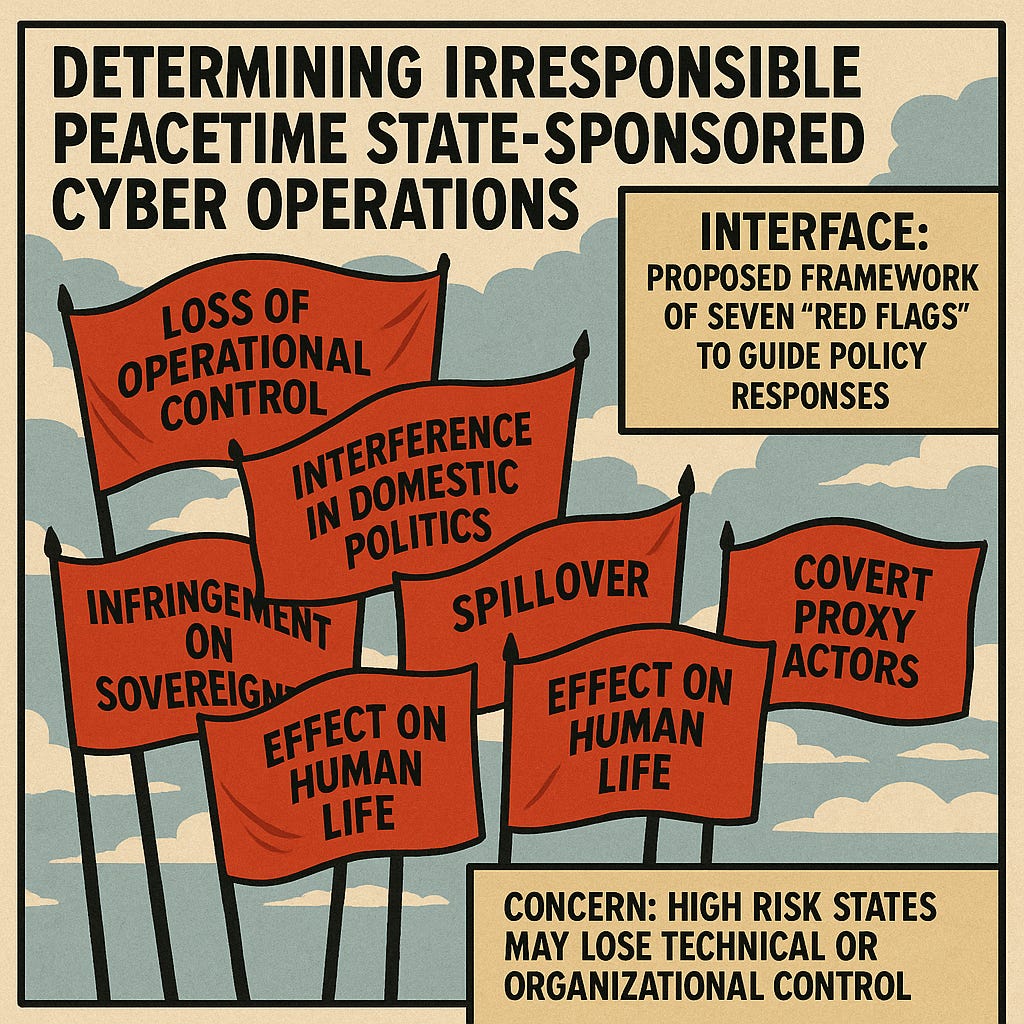
When Do Cyber Campaigns Cross the Line
Bottom Line Up Front (BLUF): A German think tank, Interface, has proposed a framework of seven “red flags” to help determine when peacetime state-sponsored cyber operations become irresponsible or escalatory. The framework aims to guide policy responses by identifying thresholds—such as the loss of operational control or interference in domestic politics—that should trigger international condemnation or retaliation. While some flags are theoretically sound, the paper admits that enforcement is elusive. Key concern: states may lose control of their cyber tools, either technically (e.g., NotPetya) or organizationally (e.g., China’s contractor ecosystems), with unpredictable consequences.
Analyst Comments: The Interface report lists seven types of irresponsible cyber activity, including physical harm, domestic political interference, and destructive operations. Of these, the most policy-relevant may be the risk of “losing control”—whether due to technical sprawl (NotPetya, Stuxnet) or poor oversight (Chinese cyber contractors going rogue). Other flagged behaviors, like pre-positioning malware in civilian infrastructure (Volt Typhoon) or influencing elections (Russia, Iran), are more challenging to deter due to murky attribution and political fallout. The report advocates stronger norms but concedes that, without enforcement, these “red flags” may remain symbolic. Still, it offers a practical lexicon for policymakers navigating cyber gray zones.
READ THE STORY: Risky Biz
Canada Blocks Billions of Daily Cyber Attacks, Says CSE Chief
Bottom Line Up Front (BLUF): In a wide-ranging interview with The Walrus, Communications Security Establishment (CSE) chief Caroline Xavier revealed Canada is now intercepting billions of malicious cyber actions every day, with ransomware, state-sponsored attacks, and AI-driven threats posing the most persistent challenges. Despite growing capacity, Xavier warns that adversaries are escalating faster than defenses, and that Canada’s decentralized infrastructure and limited cybersecurity capacity among small organizations leave the country vulnerable.
Analyst Comments: Caroline Xavier, head of CSE, says Canada’s digital borders face a relentless onslaught, defending against billions of malicious actions every day. The agency, now with over 3,800 employees, handles more than 2,000 cyber incidents annually and issues hundreds of pre-ransomware alerts. Ransomware remains the most persistent threat to Canadians, compounded by fragmented infrastructure ownership, under-resourced SMBs, and adversaries leveraging AI. CSE is also deeply involved in cyber support to Ukraine and Latvia, providing real-time threat intelligence, system hardening, and joint threat-hunting operations. The agency says it operates under strict oversight, with operations limited to foreign targets, and emphasizes transparency to maintain public trust.
READ THE STORY: The Walrus
Russian-Flagged Oil Tanker Reportedly Hit in Suspected Drone Attack Off Turkish Coast
Bottom Line Up Front (BLUF): A Russian-flagged oil tanker was reportedly attacked off the Turkish coast near the Bosporus Strait on December 2, according to the United Kingdom Maritime Trade Operations (UKMTO). While details remain limited, the incident raises concerns about expanding maritime threats in the Black Sea region amid intensifying shadow conflicts tied to the war in Ukraine.
Analyst Comments: The location—near a NATO member’s coastline and one of the world’s busiest maritime chokepoints—could raise alarms beyond the immediate conflict zone. Russia has used tankers extensively to evade sanctions and fund its war effort, making them increasingly viable targets. The ambiguity of attribution also fits a pattern of grey zone maritime warfare, including drone attacks on vessels in the Black Sea and eastern Mediterranean. Watch closely for retaliatory moves or expanded naval deployments from both Russia and NATO states.
READ THE STORY: Reuters
Germany Deploys Arrow 3 Missile Defense to Counter Russian Threat
Bottom Line Up Front (BLUF): Germany has officially deployed Israel’s Arrow 3 ballistic missile defense system, designed to intercept exo-atmospheric threats such as long-range missiles potentially launched from Russia. This marks the first European deployment of Arrow 3 and represents a strategic shift in NATO’s layered air defense posture, with Berlin citing increased threats from Russian missile capabilities in light of the Ukraine conflict and regional escalation risks.
Analyst Comments: Germany’s Arrow 3 deployment is a signal to both NATO and Moscow: Berlin is taking long-range missile threats seriously and is willing to invest heavily in multi-tiered defenses. This complements existing Patriot systems and upcoming European Sky Shield Initiative assets, forming part of an emerging continental missile shield. From a cybersecurity and C4ISR (Command, Control, Communications, Computers, Intelligence, Surveillance, and Reconnaissance) perspective, Arrow 3’s integration introduces new attack surfaces—especially in satellite uplinks and battle management systems. Expect Russian cyber units to probe these systems for weaknesses. Arrow’s U.S. tech stack will also deepen NATO-Israel intelligence and threat-sharing pipelines, increasing the value—but also the vulnerability—of shared digital infrastructure.
READ THE STORY: Reuters
New Windows LNK 0-Day (CVE-2025-9491) Actively Exploited by Chinese-Linked Threat Actors
Bottom Line Up Front (BLUF): A Windows shortcut (LNK) vulnerability, now tracked as CVE-2025-9491, is being actively exploited by a Chinese-affiliated group, UNC6384, in targeted attacks against diplomatic organizations in Europe. The flaw allows malicious code to be hidden beyond the 260-character limit of the LNK “Target” field, evading user inspection. Microsoft initially dismissed it as non-critical, later implementing a minimal UI fix. Security vendor 0patch has released a more aggressive micropatch to mitigate exploitation.
Analyst Comments: This is a classic case of a “low-severity” UI flaw turning into an operational zero-day. The vulnerability—first flagged in March—relies on the simple fact that the Windows UI truncates long commands in the “Target” field of shortcut files. That visual gap allowed attackers to bury PowerShell payloads out of sight, yet fully functional. Microsoft’s refusal to treat it as a security issue reflects a blind spot: anything that enables command obfuscation, especially in user-facing elements, should be threat-modeled, not dismissed. While the UI tweak in November technically “fixes” the issue by showing the whole string, it still puts the burden on users to identify obfuscated payloads in cramped dialog boxes.
READ THE STORY: GBhackers
Aisuru Botnet Launches Record-Breaking 29.7 Tbps DDoS Attack, Causes Widespread Disruption
Bottom Line Up Front (BLUF): Cloudflare reports that a new botnet named Aisuru launched the most significant Distributed Denial of Service (DDoS) attack ever recorded, peaking at 29.7 Tbps. The attack targeted financial, gaming, and telecom industries and caused collateral internet outages across U.S. ISPs. Aisuru leverages a global pool of 1–4 million compromised devices and is being partially commoditized as a botnet-for-hire service.
Analyst Comments: A 29.7 Tbps DDoS is well beyond what most mitigation infrastructure can handle unaided. What’s worse is how cheap this kind of destructive power has become: attackers can rent parts of Aisuru for a few hundred dollars. The DDoS landscape is evolving into shorter, faster, and more strategic attacks, often aligning with geopolitical tensions or civil unrest (as seen in the Maldives and France). These aren’t just bandwidth floods; they’re targeted, timed, and sometimes politically motivated. Traditional mitigation techniques, such as manual ACL updates or reactive scrubbing, won’t cut it anymore. Enterprises and ISPs must deploy automated, always-on defenses with dynamic traffic engineering, ideally integrated with threat intel that tracks botnet operators in real time. For high-risk verticals—especially finance and AI—proactive DDoS simulation and stress testing are no longer optional.
READ THE STORY: GBhackers
Operation DupeHike: DuperRunner Malware Targets Russian Corporate HR with LNK-Based Implant
Bottom Line Up Front (BLUF): Researchers at SEQRITE uncovered Operation DupeHike, a targeted spear-phishing campaign that uses malicious LNK files to deploy a new malware implant, DUPERUNNER, which ultimately connects to AdaptixC2 infrastructure. The operation focuses on Russian HR, payroll, and admin departments, using well-crafted decoy documents related to employee bonuses. The technical sophistication, targeting precision, and infrastructure suggest a possible nation-state actor or advanced financially motivated group.
Analyst Comments: The use of HR-themed documents with bureaucratic accuracy (e.g., bonus calculation policies under Russian labor law) shows unusually high domain-specific social engineering—crafted for trust, not clicks. The infection method exploits a malicious LNK shortcut with hidden PowerShell commands, an increasingly common but still highly effective technique. DUPERUNNER’s behavior—process injection, timestamped decoy docs, beaconing via port 443, and memory-resident payloads—indicates this isn’t commodity malware. It was likely built for stealth and persistence in enterprise environments with limited detection capabilities.
READ THE STORY: GBhackers
Perseus Mining Launches $1.3 Billion Takeover Bid for Predictive Discovery
Bottom Line Up Front (BLUF): Australia’s Perseus Mining has made a AU$1.3 billion (US$860 million) offer to acquire West African gold explorer Predictive Discovery, aiming to expand its footprint in Guinea’s highly prospective Siguiri Basin. The all-stock deal signals growing consolidation in the gold sector as miners seek to secure long-life, high-grade assets amid volatile markets and tightening supply.
Analyst Comments: With significant gold discoveries becoming scarcer, mid-tier miners like Perseus are using M&A to buy growth rather than dig for it. Predictive’s Bankan project in Guinea is one of the most significant new gold finds in West Africa, and its proximity to existing Perseus infrastructure makes it an attractive bolt-on. The deal reflects how geopolitical risk in regions like Guinea is no longer a dealbreaker—investors are more focused on scale and grade than jurisdiction. Expect more consolidation as gold prices remain strong and capital flows into Tier-1 deposits.
READ THE STORY: WSJ
Ukraine Hits Russian Oil Pipeline to Hungary and Slovakia in Targeted Drone Strike
Bottom Line Up Front (BLUF): Ukraine has reportedly struck the Russian-operated Druzhba (”Friendship”) pipeline with a drone attack, disrupting a key route for oil exports to Hungary and Slovakia. The strike—near the Bryansk region, west of Moscow—marks the latest escalation in Ukraine’s campaign to target Russian energy infrastructure supporting its war effort.
Analyst Comments: This is a sharp evolution in Ukraine’s strategy: hitting not just Russia’s refinery capacity or export terminals, but the infrastructure feeding energy to European nations with ambivalent stances on the war. Whether intentional or not, this draws Hungary and Slovakia—both EU members with warmer ties to Moscow—into the fallout. If confirmed, it’s a high-risk/high-impact move that could create diplomatic friction within the EU, especially with Hungary, which has consistently resisted stronger anti-Russia sanctions. Militarily, this shows that Kyiv is willing to extend its reach deeper into Russian strategic logistics. Expect a mix of denials, political backlash, and further hardening of energy security postures across Central Europe.
READ THE STORY: Reuters
U.S. “Narco-Terrorist” Drone War Risks Strategic Blowback
Bottom Line Up Front (BLUF): The U.S. shift from interdiction to preemptive drone strikes on suspected narco-traffickers in the Caribbean has triggered legal and strategic alarm. What began as a single missile strike is now a campaign of targeted killings—raising questions about war powers, maritime law, and the erosion of America’s long-standing counter-drug model. Analysis from Dr. Isaiah Wilson’s General Theory of Compound Security (GToCS) framework warns that the campaign is degrading U.S. resilience across legitimacy, adaptability, and regional cooperation.
Analyst Comments: The use of military force under ambiguous legal authority blurs the line between law enforcement and warfare, damaging trust among regional partners and undermining norms the U.S. once championed. The so-called “double-tap” strike on survivors of a sunk boat is especially alarming—both legally (possible violation of international humanitarian law) and structurally (indicative of degraded internal oversight). GToCS nails the wider point: when force supplants law and strategy, the system weakens. Expect mounting diplomatic resistance, regional hedging toward China, and legal challenges both domestic and international.
READ THE STORY: Compound Security, Unlocked
Hegseth Under Fire After U.S. “Double Tap” Strike on Drug Boat Raises War Crimes Questions
Bottom Line Up Front (BLUF): Defense Secretary Pete Hegseth is facing bipartisan criticism after a U.S. strike in the Caribbean killed survivors of an earlier missile attack on a suspected drug-smuggling vessel. The September 2 incident, carried out by Navy SEAL Team 6, has prompted calls for congressional investigations into potential violations of international law and the Pentagon’s rules of engagement.
Analyst Comments: The so-called “double-tap” tactic—striking a target, then hitting survivors—is heavily scrutinized under the laws of armed conflict, especially outside a declared warzone. The fact that multiple Republican senators are breaking ranks to demand answers signals that this has crossed a legal or ethical line. Hegseth’s deflection—blaming the “fog of war” while doubling down on lethality rhetoric—risks deepening trust issues with allies and may further politicize military operations under Trump’s second-term doctrine of direct, unrestrained force projection. Expect mounting pressure for a classified hearing and growing scrutiny of Trump-era rules of engagement in counter-narcotics ops.
READ THE STORY: FP
EU Launches €3.5 Billion Initiative to Secure Critical Raw Materials Supply Chains
Bottom Line Up Front (BLUF): The European Union has unveiled a €3.5 billion ($3.8 billion) package to strengthen its access to critical raw materials essential for clean energy, defense, and high-tech industries. The plan includes public and private investment to diversify supply chains, reduce reliance on China, and boost domestic processing and recycling capabilities.
Analyst Comments: With Beijing’s dominance over rare earths and other strategic inputs, the EU’s move is as much about geopolitical insulation as it is about industrial resilience. Expect this funding to support European mining ventures, international resource deals in Africa and Latin America, and new refining infrastructure across the bloc. It’s a start—but still lags the scale and urgency of U.S. and Chinese efforts. The real test will be whether Europe can execute without drowning in environmental permitting red tape or internal political gridlock.
READ THE STORY: WSJ
U.S. Import Prices Flat in September, Signaling Cooling Global Inflation Pressures
Bottom Line Up Front (BLUF): U.S. import prices were unchanged in September, according to Labor Department data, reflecting easing global supply pressures and a stronger dollar. The flat reading follows a 0.5% rise in August and suggests international inflationary forces are no longer a primary driver of price increases in the U.S.
Analyst Comments: This data point supports the broader narrative that imported inflation is tapering off, giving the Federal Reserve some breathing room. Energy prices have been volatile, but excluding fuel, import prices are relatively stable. A strong dollar is helping suppress foreign goods prices, but that also increases trade imbalances and puts pressure on U.S. exports. The Fed is likely watching this closely as it balances domestic demand cooling with the disinflationary impact of global trade dynamics.
READ THE STORY: WSJ
Items of interest
AI-Powered Pentesting Tool ‘Strix’ Automates Exploits with Real Attacks, Gains Traction on GitHub
Bottom Line Up Front (BLUF): A new open-source project called Strix, designed to simulate realistic penetration tests using AI agents, has rapidly gained attention—earning over 13,900 GitHub stars in under a month. Developed to integrate with CI/CD workflows, Strix mimics real-world hacker behavior, autonomously discovers vulnerabilities, and verifies them with actual exploit attempts. Unlike traditional static scanners, Strix focuses on attack-based validation, reducing false positives and offering detailed reports with reproducible evidence.
Analyst Comments: It’s a robust proof-of-concept for where AI can take offensive security automation. What makes this notable is how the tool chains multiple cooperating AI agents—each with distinct roles like recon, auth bypass, or injection testing—and has them share intelligence in real time. This mimics real APT workflows, not just vulnerability scanning. Integration with GitHub Actions means Strix can gate pull requests based on discovered flaws, pushing security left in the SDLC. That’s huge for DevSecOps teams—but also a red flag: offensive capabilities like this in the wrong hands (or misconfigured environments) could enable rapid, AI-driven recon and exploitation at scale.
READ THE STORY: Freebuf
Explore Strix - An Open Source AI Agent for Security Testing | AI For Security Testing (Video)
FROM THE MEDIA: Meet Strix, the open-source AI agent for security testing that acts like a real hacker — finding and confirming real vulnerabilities in your apps so you can ship secure code faster.
Chapter 8.1 AI-Powered Pen-Testing Tools - Strix. (Video)
FROM THE MEDIA: AI & Cybersecurity learning series, we showcase an AI-powered pen-testing bake-off featuring Strix, a cutting-edge agentic pen-testing platform. Watch as we test multiple AI-driven security tools against identical target systems to determine which offers the best combination of effectiveness, ease of use, comprehensiveness, accuracy, and cost efficiency.
The selected stories cover a broad array of cyber threats and are intended to aid readers in framing key publicly discussed threats and overall situational awareness. InfoDom Securities does not endorse any third-party claims made in its original material or related links on its sites; the opinions expressed by third parties are theirs alone. For further questions, please contact InfoDom Securities at dominanceinformation@gmail.com.The selected stories cover a broad array of cyber threats and are intended to aid readers in framing key publicly discussed threats and overall situational awareness. InfoDom Securities does not endorse any third-party claims made in its original material or related links on its sites; the opinions expressed by third parties are theirs alone. For further questions, please contact InfoDom Securities at dominanceinformation@gmail.com.