
Daily Drop (1194)
12-02-25

Tuesday, Dec 02, 2025 // (IG): BB // GITHUB // SN R&D
Russian Tanker Reports Kamikaze Drone Attack Off Turkish Coast Amid Rising Black Sea Tensions
Bottom Line Up Front (BLUF): A Russian-flagged tanker, MIDVOLGA-2, sailing from Russia to Georgia with sunflower oil, reported an attack 80 miles off Turkey’s coast on December 2. Turkish maritime authorities confirmed that no injuries were reported among the 13 crew. While details remain limited, Turkish media reports indicate a kamikaze drone was involved. This follows a recent Ukrainian drone strike on two sanctioned tankers, signaling a growing threat to civilian shipping in the Black Sea.
Analyst Comments: While MIDVOLGA-2 did not request assistance and continued toward Sinop, the implications are profound: kamikaze-style naval drones—previously aimed at Russian military and sanctioned assets—may now be targeting broader commercial traffic. This blurs the line between state-sanctioned economic warfare and indiscriminate risk to maritime operations. With Turkey publicly condemning the attacks and reaching out to “all related sides,” including Ukraine, Ankara is clearly signaling discomfort with threats near its territorial waters. For security professionals monitoring maritime infrastructure, logistics, or shipping insurance risk, this is another data point suggesting that naval drone proliferation—especially from Ukraine—could disrupt or deter commercial traffic well beyond strictly military targets.
READ THE STORY: Reuters
Ukraine Expands Maritime Warfare With Long‑Range Drone Strikes on Russian Fuel Tankers
Bottom Line Up Front (BLUF): Ukraine used its “SeaBaby” naval drones to strike three tankers linked to Russia’s shadow fleet—two in the Black Sea near Turkey and one off the coast of Senegal, thousands of miles from the war zone. The latter, a Turkish‑owned vessel carrying Russian oil, reportedly sank after the crew evacuated. If sustained, this marks a significant geographic expansion of Ukraine’s maritime campaign and signals Kyiv’s intent to disrupt Russia’s global energy logistics, not just its Black Sea operations.
Analyst Comments: Hitting a Russian-linked tanker near Turkey is expected; hitting one off West Africa is something else entirely. It shows that Ukraine’s maritime drones now have the range, targeting intelligence, and logistical footprint to operate intercontinentally—or that Kyiv is leveraging foreign partners or prepositioned assets in ways Moscow didn’t anticipate. Strategically, Ukraine is testing Russia’s shadow fleet where it’s weakest: long supply lines, lightly protected tankers, and permissive maritime spaces outside direct NATO‑Russia friction points. The risk is that any strike against a third‑country vessel (such as the Turkish-owned Mersin) drags commercial partners and insurers into the conflict calculus. If Ukraine keeps this up, expect immediate pressure on maritime insurers, rerouting of Russian fuel logistics, and potential diplomatic blowback from states caught in the crossfire.
READ THE STORY: Phillip’s Newsletter
NATO Considers Pre-Emptive Action Against Russian Hybrid Threats Amid Baltic and Cyber Escalation
Bottom Line Up Front (BLUF): NATO leadership is openly weighing “pre-emptive” action in response to Russia’s hybrid warfare tactics, including cyberattacks, undersea infrastructure sabotage, and drone incursions. Admiral Giuseppe Cavo Dragone, Chair of the NATO Military Committee, told The Financial Times that the alliance may need to adopt a more “aggressive” and proactive stance to deter Moscow—marking a major rhetorical and strategic shift as the Ukraine war enters its fourth year.
Analyst Comments: Dragone’s remarks point to an evolving doctrine—one where pre-emption could be redefined as defensive if it aims to stop infrastructure degradation or prevent strategic surprises. While cyberattacks and gray zone activities have long been tolerated below the Article 5 threshold, the scale and frequency of incidents—especially undersea cable tampering and drone incursions—are now forcing a strategic rethink. Operation Baltic Sentry was the first coordinated countermeasure; now NATO leaders are floating far more assertive options, even if legal and jurisdictional uncertainties remain. Russia’s response—calling the statements “irresponsible”—suggests that even signaling this shift may carry escalatory weight. This is a moment to watch: deterrence is starting to lean forward, which could reshape red lines in cyberspace and in below-the-threshold conflict zones.
READ THE STORY: Independent
U.S. Military Poised for Kinetic Action in Venezuela as Southern Caribbean Build-Up Peaks
Bottom Line Up Front (BLUF): The U.S. has amassed its most significant military presence in the Caribbean since 1994, positioning 15,000 personnel, multiple warships, and advanced air assets under the banner of Operation Southern Spear. Officially framed as anti-narcotics enforcement, the operation increasingly signals preparation for potential strikes on the Venezuelan regime of Nicolás Maduro—designated by the U.S. as a terrorist leader. With the USS Gerald R. Ford carrier group and Iwo Jima Amphibious Ready Group deployed near Venezuelan waters, Washington now can launch sustained precision strikes or support regime change, should the order be given.
Analyst Comments: The scale, composition, and posture of U.S. forces in the region far exceed what’s needed to take out drug boats. With satellite imagery confirming the USS Gerald R. Ford within striking distance of Venezuela, and a combined task force of missile cruisers, destroyers, AC-130s, stealth bombers, and F-35s, this is credible military pressure with operational teeth. It’s also a psychological operation. The target audience isn’t just Maduro—it’s his inner circle. By showcasing overwhelming force and reactivating the Roosevelt Roads naval base in Puerto Rico, the U.S. is broadcasting both capability and intent. A key question is how far this will go. A decapitation strike on command-and-control nodes or air defenses is well within reach. Full-scale regime change? Less likely without clear domestic or international support. But the architecture is in place, and the U.S. hasn’t deployed this kind of force projection lightly.
READ THE STORY: The Conversation
Taiwanese Charter Airline Offers Recon Flights to Support Military Surveillance of China
Bottom Line Up Front (BLUF): Taiwanese charter airline Apex Aviation has retrofitted a civilian aircraft with U.S.-made surveillance technology to monitor Chinese naval activity, pitching the data as a private-sector contribution to Taiwan’s national defense. The initiative is part of Taiwan’s broader “whole-of-society resilience” strategy, which seeks new approaches to counter mounting pressure from the People’s Liberation Army.
Analyst Comments: Apex Aviation, primarily a training and charter service, has modified a Tecnam P2012 aircraft with a U.S.-made IMSAR synthetic aperture radar and Teledyne FLIR sensors to monitor Chinese military vessels near Taiwan’s coast. The plane can detect objects as small as 0.09 square meters and operates within Taiwanese airspace. Apex proposes relaying this data to Taiwan’s military and coast guard. While the defense ministry has no formal agreement in place, it has expressed openness to public-private collaboration. The effort mirrors other local innovation pushes, such as Thunder Tiger’s SeaShark drone program, which adapts civilian tech for kinetic military use. Experts caution that civilian-led reconnaissance lacks a clear legal framework and risks escalating confrontation with China.
READ THE STORY: Reuters
China’s Cyber Supply Chain Tactics Pose Strategic Risk to U.S. National Security
Bottom Line Up Front (BLUF): The Chinese Communist Party (CCP) is leveraging global technology supply chains to preposition cyber access, embed vulnerabilities, and project digital influence worldwide. A new CSIS blog post by Peter Dohr outlines how China’s military-civil fusion model—combined with legal coercion of private firms—enables the systemic exploitation of foreign systems through hardware, firmware, and embedded components, well before deployment. U.S. countermeasures are increasing, but current strategies focused on relocation and decoupling remain insufficient to mitigate the risk fully.
Analyst Comments: Beijing’s legal and economic system allows it to turn any Chinese-origin tech—regardless of manufacturer—into a long-term cyber weapon. The combination of national intelligence laws, state-linked funding, and manufacturing dominance creates a multi-layered threat vector that transcends typical software or zero-day vulnerabilities. China’s ability to weaponize the supply chain itself has been hiding in plain sight. From Huawei’s telecom backbone risks to alleged hardware tampering in Supermicro servers, the game is positioning: enabling cyber persistence before the system ever reaches the end user. This is a shift from exploitation to embedded compromise. U.S. responses like vendor bans and domestic reshoring are a start—but legacy exposure, foreign-assembled Chinese components, and global infrastructure using Chinese tech mean the threat is already woven into critical systems.
READ THE STORY: CSIS
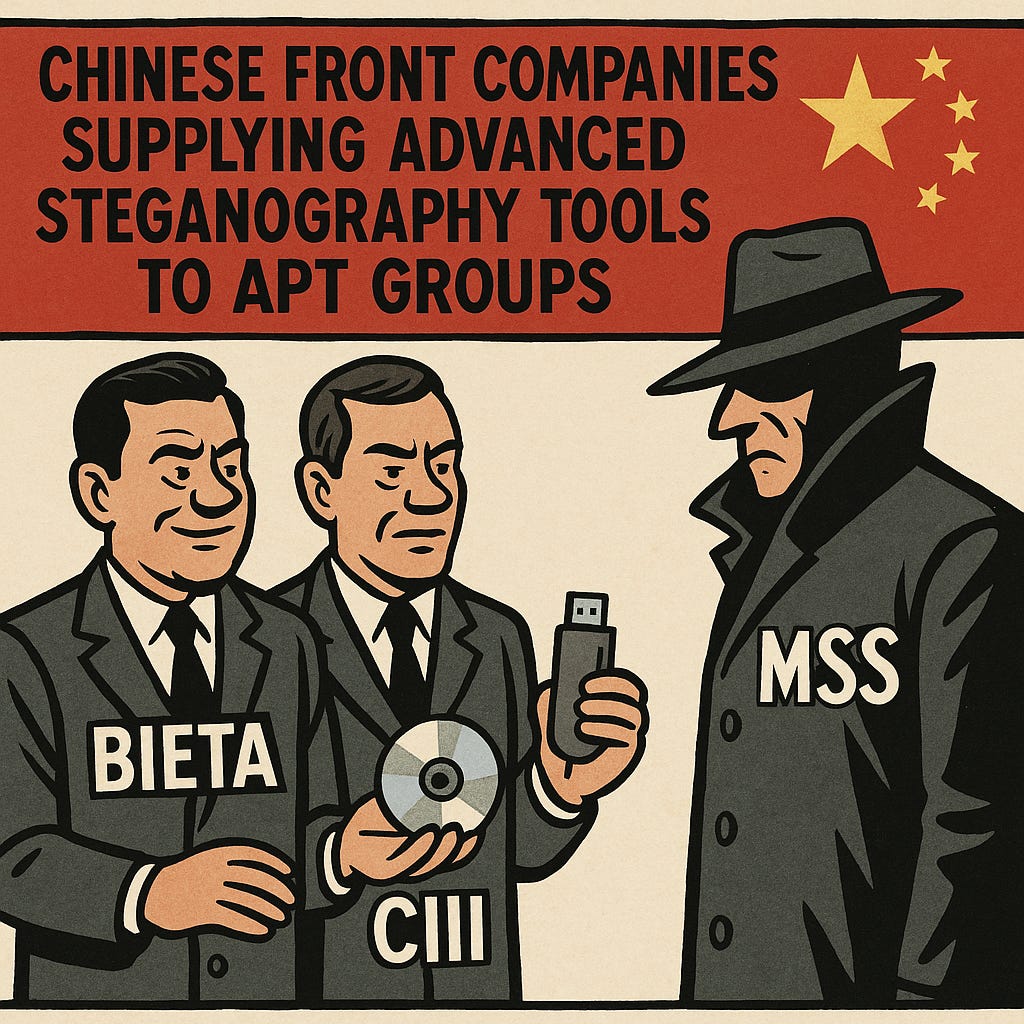
Chinese Front Companies Supplying Advanced Steganography Tools to APT Groups
Bottom Line Up Front (BLUF): Two Chinese firms—BIETA and its subsidiary CIII—are reportedly acting as fronts for China’s Ministry of State Security (MSS), developing and distributing advanced steganography tools for state-aligned APT groups. The companies appear to be deeply embedded in China’s cyber intelligence ecosystem, offering capabilities to exfiltrate data and deliver malware through covert methods such as embedding in image, audio, and video files.
Analyst Comments: While it rarely makes headlines compared to zero-days or ransomware, it’s a persistent tool in espionage toolkits. What stands out here is the institutional alignment: these aren’t rogue vendors but deeply linked research bodies supporting MSS and the PLA. With 40%+ of BIETA’s academic output focused on stego techniques, this is clearly a national-level priority. Expect to see increasingly stealthy payloads in APT operations that evade traditional file-scanning and detection tools.
READ THE STORY: GBhackers
China Grants Rare Earth Export Licenses After Trump-Xi Summit: JL Mag, Yunsheng, San Huan Among Recipients
Bottom Line Up Front (BLUF): China has issued the first wave of streamlined rare earth export licenses to at least three magnet producers, following the Trump–Xi summit in late October. JL Mag Rare Earth secured approvals for nearly all of its clients, while Ningbo Yunsheng and Beijing Zhong Ke San Huan received partial licenses. This move indicates a softening of export restrictions amid de-escalating U.S.–China trade tensions.
Analyst Comments: While the licenses don’t fully open the floodgates, they mark a shift from China’s historically tight grip on rare earth exports. Expect this to be framed as a goodwill gesture after the summit. Still, it’s also a sign that China is experimenting with more flexible “general license” frameworks—possibly to maintain leverage without triggering retaliation or supply chain decoupling. JL Mag’s near-universal client coverage is especially notable; it suggests the government is selectively favoring firms with cleaner compliance records or less geopolitical baggage. For Western buyers, this isn’t a return to normal—it’s a reminder of supply chain fragility dressed as temporary relief. Companies downstream should treat this as a window, not a guarantee, and continue diversification efforts.
READ THE STORY: Yahoo Finance
China Floods Emerging Markets with Gasoline Cars Amid EV Glut at Home
Bottom Line Up Front (BLUF): As domestic EV adoption surges, Chinese legacy automakers are offloading excess gasoline-powered vehicles into emerging and secondary markets worldwide. Backed by state support and armed with idle production capacity, firms like SAIC, Chery, Dongfeng, and BAIC have turned fossil-fuel exports into a lifeline—undercutting both their former joint venture partners and Western competitors across Latin America, Eastern Europe, and Africa.
Analyst Comments: Chinese fossil-fuel car exports have soared from 1 million in 2020 to a projected 6.5 million in 2025. Roughly 76% of those are internal combustion engine (ICE) vehicles, as companies offload surplus capacity created by the country’s aggressive EV pivot. China’s top exporters—including Chery, SAIC, Dongfeng, and Geely—are finding success in markets where EV infrastructure is lacking and price sensitivity is high. In countries like Poland, Mexico, and Uruguay, Chinese models now compete directly with their joint-venture partners, such as GM and Nissan, often with rebadged or lightly altered versions of those brands’ legacy models. The price gap is wide: Chinese pickups based on Nissan designs can sell for nearly a third less. Legacy automakers like Volkswagen and Stellantis are being forced to adapt or risk losing global market share.
READ THE STORY: Reuters
New Android Banking Trojan “Albiriox” Sold by Russian Cybercriminals for $720/Month
Bottom Line Up Front (BLUF): Researchers at Cleafy have identified a new Android banking trojan named Albiriox, currently sold on Russian-language forums under a malware-as-a-service (MaaS) model. The malware supports on-device fraud (ODF), real-time remote access, and overlay attacks—posing a growing threat to mobile banking and crypto platforms globally. The first campaigns were observed in Europe, with evidence of rapid evolution and stealth features designed to bypass detection.
Analyst Comments: Albiriox shows every sign of being a rising-tier tool in the Android malware ecosystem. Its combination of real-time control, phishing overlays, and a builder integrated with the Golden Crypt crypting service makes it especially problematic for the security of financial apps. That builder pipeline isn’t just for obfuscation—it’s a sign the operators are marketing this as an “enterprise-grade” criminal toolkit. Like other modern MaaS platforms, Albiriox lowers the barrier to entry for low-skill cybercriminals by offering prebuilt evasion and deployment tools. The inclusion of ODF is especially dangerous, since it allows attackers to bypass traditional backend fraud detection by making transactions from the victim’s own device and location.
READ THE STORY: SecWeek
Genesis Mission: U.S. Launches AI-for-Science Push—But It’s No Apollo Project
Bottom Line Up Front (BLUF): The U.S. government’s new Genesis Mission, signed into action by President Trump on November 24, aims to unify national labs, AI systems, and scientific data under a coordinated platform to accelerate discovery in energy, materials, quantum, and biotech. Despite comparisons to the Apollo Program or the Manhattan Project, Genesis is not a massive, singular crash project—it’s a strategic reorganization of existing infrastructure and funding priorities to embed AI into core scientific workflows.
Analyst Comments: What it is doing is more subtle but still powerful: weaponizing bureaucracy to make “AI for Science” the new default. That means any scientist applying for U.S. funding in the next decade will likely need an AI angle. The move consolidates compute resources, standardizes datasets, and sets aggressive deadlines. At the same time, the private sector spends orders of magnitude more on actual AI R&D. What makes this interesting from a national strategy perspective is its signaling function. Genesis is Washington’s formal acknowledgment that science policy must adapt to AI-native workflows—or risk falling behind. This is also a delayed response to China’s “AI Plus” and Europe’s Horizon-backed “RAISE” efforts, both of which are pouring billions into AI-for-science platforms. Don’t expect a breakthrough model tomorrow, but do expect labs, grants, and PhDs to shift accordingly.
READ THE STORY: David Shapiro
Anthropic Skills vs. OpenAI GPTs: Modular Capability vs. Monolithic Assistant
Bottom Line Up Front (BLUF): Anthropic’s Skills and OpenAI’s GPTs both represent a shift from ephemeral prompting to persistent, reusable AI capabilities. But they differ in execution. Skills are fine-grained, composable modules designed for structured systems; GPTs are end-user-facing assistants built as larger, standalone units. For organizations building intelligence or automation workflows, Skills offer greater modularity, auditability, and integration flexibility.
Analyst Comments: They let you structure workflows like software, chaining together document generation, formatting, and procedural logic. GPTs, by contrast, package all behavior inside a single assistant interface. If you’re building internal automation—like briefing generation, document QA, or report formatting—Skills give you far more control. You can separate concerns: one Skill handles structure (e.g., BLUF generation), another handles rendering (docx, pptx, etc.), and a third applies house style or compliance rules. The real power of Skills emerges in scaling expertise: encode how your org writes an intelligence report, builds a pitch deck, or formats a CVE bulletin—and reuse that method across teams or products. It’s like moving from scripting one-off tasks to building reliable internal APIs.
READ THE STORY: AI Disruptions
North Korea Uses Banned Nvidia GPUs to Build AI for Crypto Theft and Sanctions Evasion
Bottom Line Up Front (BLUF): North Korean state-linked actors are leveraging Nvidia GPUs—acquired despite export bans—to train AI models that enhance their crypto theft, identity fraud, and sanctions evasion operations. A newly surfaced report highlights Pyongyang’s longstanding AI development efforts, now repurposed to automate phishing, generate deepfakes, and route stolen crypto through obfuscation networks. The findings confirm that export controls have only partially hindered North Korea’s access to advanced AI capabilities.
Analyst Comments: Nvidia GPUs—banned for years in North Korea—are still showing up in lab research and cybercrime tooling. The AI applications here aren’t theoretical: deepfakes, voice cloning, and identity forgeries are already complicating KYC/AML checks across crypto exchanges. And now with AI optimizing laundering routes, expect even more trouble for investigators trying to track funds. This goes beyond sanctions evasion—it’s industrialized cybercrime, backed by a nation-state, using Western hardware to fund missile programs and intelligence operations.
READ THE STORY: Crypto Economy
U.S. and China AI Capex Hits All-Time Highs—This Is Infrastructure, Not a Bubble
Bottom Line Up Front (BLUF): U.S. and Chinese tech giants are spending record sums on AI infrastructure, signaling long-term strategic intent rather than speculative hype. Global AI investment will approach $1.5 trillion in 2025, according to Gartner, with over $400 billion in AI capex from U.S. tech firms alone—60% of which is going into data centers, GPUs, and model training infrastructure. Rather than chasing headlines, companies like Amazon, Alphabet, Meta, and their Chinese counterparts are entrenching AI as core economic infrastructure.
Analyst Comments: The financial signals are clear: Big Tech isn’t behaving like investors chasing hype. They’re acting like infrastructure builders laying track for the next industrial platform shift. In the U.S., cash-rich firms are pouring billions into AI without over-leveraging or showing stress on free cash flow. These are not crypto-era burn rates—they’re disciplined plays backed by ad, cloud, and enterprise margins. In China, the same strategy is unfolding under tighter capital controls and geopolitical constraints. While transparency is thinner, domestic giants like Alibaba and Baidu are accelerating data center buildouts, bolstered by government support and strategic guidance under the “AI Plus” national strategy. The scale is smaller, but the intent is the same: AI isn’t a feature—it’s the next foundation layer.
READ THE STORY: China AI Connect
Schneier and Sanders: Public AI Is Essential for Democratic Control
Bottom Line Up Front (BLUF): In an excerpt from their new book, Rewiring Democracy, Bruce Schneier and Nathan E. Sanders argue that democratic governments must go beyond regulating corporate AI—they must develop their own AI systems. “Public AI,” created under democratic control and free of profit motives, offers a path toward more transparent, trustworthy, and accountable uses of AI in civic life. Without such alternatives, the concentration of AI power in private hands poses a long-term threat to democratic governance.
Analyst Comments: Schneier and Sanders are right to frame AI not just as a technical challenge, but as a governance problem. AI isn’t neutral; it encodes incentives. And when those incentives are shaped solely by corporate profit or geopolitical advantage, democratic accountability is an afterthought. Their case for “Public AI” parallels earlier infrastructure debates: public roads, public utilities, public schools—all created because private industry alone couldn’t or wouldn’t serve democratic goals. The same argument applies here. Governments already use AI in areas like law enforcement, benefits distribution, and immigration. Doing so with proprietary, opaque tools from unaccountable vendors is, frankly, reckless. Will governments get this right? History suggests mixed results. But the alternative—ceding civic functions to closed, black-box AI controlled by monopolies—isn’t safer. If anything, it’s how democratic erosion begins.
READ THE STORY: The Contrarian
China’s Export Dependence Deepens Despite Years of ‘Rebalancing’ Rhetoric
Bottom Line Up Front (BLUF): More than a decade after Xi Jinping pledged to reduce China’s reliance on exports and boost domestic consumption, China’s economy remains anchored in external demand. In 2025, a widening goods trade surplus, falling fiscal revenues, and weak domestic tax growth point to structural imbalances—despite official GDP growth of 5.2%. Meanwhile, trade tensions, shifting export dynamics, and signs of labor market strain further complicate Beijing’s economic narrative.
Analyst Comments: If anything, China has leaned harder into its export machine, even as foreign demand and trade policy headwinds mount. That’s a risky position in a world that is increasingly weaponizing supply chains. The tension between reported GDP growth and weak tax revenue (+0.8% nominal YTD) is particularly revealing. In mature economies, robust GDP usually translates into tax growth. Not here. It suggests a mix of falling prices, consumption fatigue, and eroded profit margins. The 6.2% increase in farmland conversion taxes also exposes quite a few contradictions: the government says it’s protecting arable land, yet revenue shows the opposite.
READ THE STORY: SOAPBOX
TSMC Sues Former Executive Over Intel Jump: Alleged Trade Secrets Risk After Sudden EVP Appointment
Bottom Line Up Front (BLUF): TSMC has filed a lawsuit in Taiwan’s Intellectual Property and Commercial Court against former Senior VP Dr. Lo Wei-Jen, alleging violations of non-compete agreements and potential misappropriation of trade secrets following his immediate transition to Intel as an Executive Vice President. The lawsuit cites Lo’s late-stage access to advanced R&D data, misrepresentation during his exit interview, and the high risk that confidential process technologies will be exposed to a major competitor.
Analyst Comments: The timeline raises red flags: a strategic reassignment out of R&D, renewed access to sensitive data, and a post-retirement pivot straight into Intel’s executive team. Whether or not actual theft occurred, TSMC is betting the optics and risk are enough to justify legal action. From a security and industrial espionage standpoint, this is a reminder that the insider threat doesn’t always end with employment. Lo was briefed on his non-compete obligations by TSMC’s legal chief—and still allegedly concealed his real post-retirement plans. Legal remedies may be limited due to jurisdiction, but the case underscores how valuable and exposed proprietary semiconductor process knowledge is—especially as U.S. and East Asian foundry competition intensifies.
READ THE STORY: TechSoda
Items of interest
India Mandates Non-Removable Cybersecurity App on All New Phones, Setting Up Clash With Apple
Bottom Line Up Front (BLUF): India’s telecom ministry has ordered all smartphone makers to pre-install a state-run cybersecurity app, Sanchar Saathi, on all new devices sold in India—without an option to delete it. The move, aimed at combating phone-related fraud, will likely provoke strong resistance from Apple and raise privacy concerns. Companies have 90 days to comply with software updates required for devices already in the supply chain.
Analyst Comments: While the Sanchar Saathi app has helped recover millions of lost phones and block fraudulent SIMs, making it undeletable raises immediate red flags for privacy advocates and foreign vendors alike. Apple is in a bind. Its security model and App Store policies prohibit forced third-party pre-installs. In the past, it clashed with India’s telecom regulator over an anti-spam app, and it’s unlikely to quietly accept a government-mandated tool that circumvents its software integrity standards. Apple could seek a workaround—like opt-in nudges—but even that may fall short of government expectations.
READ THE STORY: Cybernews
Sanchar Saathi App FAQs Explained | What Is Sanchar Saathi App? | Is It Mandatory To Install? (Video)
FROM THE MEDIA: In a special report on the escalating political face-off, the focus is on the Department of Telecommunications’ new directive mandating the pre-installation of the ‘Sanchar Saathi’ app on all mobile phones.
India Orders All Smartphones to Preload Sanchar Saathi App | Privacy Concerns Rise (Video)
FROM THE MEDIA: The Indian government has directed all smartphone makers to pre-install the cyber-security app Sanchar Saathi on new devices, with users unable to delete it. Existing devices will receive the app via software updates within 90 days. The app helps combat cybercrime, SIM fraud, and phone theft, having already recovered over 7 lakh stolen phones. While authorities hail it as a significant security step, privacy advocates warn it removes user consent. Tech giants like Apple, Samsung, Vivo, Oppo, and Xiaomi must now comply, raising questions about implementation and digital privacy.
The selected stories cover a broad array of cyber threats and are intended to aid readers in framing key publicly discussed threats and overall situational awareness. InfoDom Securities does not endorse any third-party claims made in its original material or related links on its sites; the opinions expressed by third parties are theirs alone. For further questions, please contact InfoDom Securities at dominanceinformation@gmail.com.The selected stories cover a broad array of cyber threats and are intended to aid readers in framing key publicly discussed threats and overall situational awareness. InfoDom Securities does not endorse any third-party claims made in its original material or related links on its sites; the opinions expressed by third parties are theirs alone. For further questions, please contact InfoDom Securities at dominanceinformation@gmail.com.