
Daily Drop (1193)
12-01-25

Monday, Dec 01, 2025 // (IG): BB // GITHUB // SN R&D
Chinese Open AI Models Gain Ground in U.S. Startups Amid Fewer Guardrails
NOTE:
Open-weight models release the trained parameters so anyone can run or fine-tune them, but the training data, code, and methodology stay proprietary. Open-source in the strict sense means everything is public—weights, training data, training code, documentation—so the model can be fully reproduced. Most Chinese models marketed as “open-source” (DeepSeek, Qwen, Yi) are actually open-weight; you get the finished product but not the recipe. The distinction matters because open-weight gives you a tool while true open-source gives you the ability to audit how that tool was built.
Bottom Line Up Front (BLUF): A growing number of U.S. AI startups are building products on top of free, open-weight Chinese AI models like DeepSeek’s R1 and Alibaba’s Qwen. These models are closing the performance gap with leading U.S. closed systems such as OpenAI’s GPT-5 and Anthropic’s Claude, while offering lower costs, easier customization, and fewer restrictions on use. This isn’t accidental—China is using open-weight releases as a strategic lever to embed its models into Western infrastructure, create dependency, and shift the AI ecosystem toward tools Beijing can influence. The trend raises serious questions about U.S. AI competitiveness, supply chain integrity, and long-term national security.
Analyst Comments: The guardrails gap is the quiet part no one’s saying out loud. U.S. frontier models come with layers of safety training, refusal behaviors, and use restrictions that make them harder to deploy for edgy or unrestricted applications. Chinese open-weight models ship with minimal alignment, and whatever exists can be fine-tuned out in an afternoon. For startups that want speed, flexibility, and fewer “I can’t help with that” roadblocks, the appeal is obvious—and that’s precisely the point. Beijing isn’t releasing these models out of generosity; it’s a play to become the default infrastructure. Once American developers build pipelines, tooling, and products around Chinese model architectures, switching costs go up and leverage shifts. U.S. policy has fixated on frontier risk while ignoring the open-weight flank, and China has walked right through it.
READ THE STORY: NBC NEWS
China’s Ministry of Public Security (MPS) Proposes Sweeping Rules for Cybersecurity Inspections
Bottom Line Up Front (BLUF): MPS has released a draft of the Measures for Supervision and Inspection of Cyberspace Security for public comment. The proposed rules significantly expand law enforcement authority to inspect internet service providers, tech firms, and data handlers. Notably, they permit police at or above the prefectural level to conduct vulnerability scanning, penetration testing, and remote network inspections—including non-critical systems—provided prior notice is given. Feedback is open until December 28, 2025.
Analyst Comments: It builds on existing cybersecurity, data security, and personal information protection laws by embedding supervisory authority into the operational workflow of both public and private entities. The move echoes a broader trend of state-aligned cybersecurity governance but raises concerns about the scope and impartiality of inspections—particularly regarding offensive measures such as penetration testing. Enterprises operating in China, especially multinationals with hybrid infrastructure or foreign joint ventures, should carefully review these measures. The broad definition of entities subject to inspection (including data processors and algorithm service providers) signals increased scrutiny of sectors like AI, cloud services, and fintech. While some provisions require transparency and oversight (e.g., inspection logs, background checks on third-party testers), others remain vague, particularly around data access, retention, and cross-border implications.
READ THE STORY: Freebuf
ShadowV2 Botnet Uses AWS Outage as Live-Fire Test for IoT Malware
Bottom Line Up Front (BLUF): A new IoT botnet dubbed ShadowV2 was observed launching limited-scope attacks during the major AWS outage in October 2025, likely using the disruption as cover for a real-world test. Fortinet researchers report that ShadowV2 exploits at least eight known vulnerabilities — several in end-of-life (EoL) D-Link and TP-Link devices — and shows typical Mirai-derived DDoS capabilities, including support for UDP, TCP, and HTTP flood attacks. Its short-lived activity, global scope, and infrastructure indicate a likely trial run ahead of broader campaigns.
Analyst Comments: This is Mirai’s playbook, refined. ShadowV2 isn’t novel in its tech stack, but the timing and target profile matter. Using an AWS outage as temporal camouflage — when monitoring, logging, and response systems are under pressure — shows attacker confidence and strategic timing. The campaign exploited eight CVEs, several of which affected unsupported or unpatched IoT gear still widely deployed in enterprise, government, and telecom environments. Of particular concern are CVE-2024-10914 and CVE-2024-10915 — D-Link command injection flaws that the vendor explicitly stated will not be patched. That makes them long-term, persistent footholds. Organizations with unmanaged IoT assets — especially aging DVRs, NAS boxes, and consumer-grade routers — remain highly vulnerable.
READ THE STORY: Bleeping Computer
Central Asians Fighting Russia’s War: Coercion, Citizenship, and the Cost of Migration
Bottom Line Up Front (BLUF): Thousands of Central Asian migrant workers—mainly from Kyrgyzstan, Uzbekistan, Tajikistan, and Kazakhstan—have ended up on the frontlines of Russia’s war in Ukraine, many lured by promises of citizenship, wages, or coerced through threats and pretenses. Ukrainian officials estimate that at least 3,000 Central Asians have been recruited. Captured fighters now sit in Ukrainian POW camps, often expressing regret and a sense of betrayal—caught between economic desperation, systemic discrimination, and Russian military objectives.
Analyst Comments: It’s about structural coercion. Russia’s targeting of Central Asian migrants for wartime conscription reflects a dual exploitation: of labor migrants who keep their home economies afloat with remittances, and of marginalized communities with few legal protections inside Russia. The tactics range from “carrot” incentives—wages and fast-tracked citizenship—to “stick” methods like fabricated criminal charges or deportation threats. In interviews with POWs, the picture emerges of deception, desperation, and systemic vulnerability. Some, like Alik, claimed coercion by police. Others were promised they’d never see the front. Many lied to their families about why they enlisted—either out of shame or to protect them.
READ THE STORY: TT
Underwater Drone Arms Race Accelerates: UUVs Redefine Seabed Security and Submarine Warfare
Bottom Line Up Front (BLUF): Autonomous underwater vehicles (UUVs) are at the center of a global maritime shift, with significant powers—led by the U.S., U.K., and Australia—pouring billions into next-gen drone fleets to protect critical undersea infrastructure and dominate key maritime chokepoints. Driven by AI, advanced sonar, and stealth-focused engineering, UUVs are now vital tools in anti-submarine warfare, seabed cable defense, and maritime surveillance. But their rise brings new operational risks, legal gaps worldwide, and the looming threat of underwater clashes.
Analyst Comments: This isn’t theory: countries are actively fielding drones in hotspots like the GIUK Gap and South China Sea, where cable sabotage or sub-tracking could escalate fast. Australia’s $1.7B “Ghost Shark” program, the U.K.’s Project Cetus, and U.S. Navy integration of UUVs with SSNs show this isn’t just capability development—it’s force structure transformation. For defenders, UUVs are the answer to a persistent, cost-effective undersea presence. For adversaries, they’re high-value targets. That dynamic makes underwater drone-on-drone conflict a real possibility—one that’s currently outside most rules of engagement. With the line blurring between peacetime surveillance and offensive action, expect an increase in calls for international norms governing UUV behavior—likely too late to prevent incidents.
READ THE STORY: GG
China’s First Mass-Produced Imagination DXD GPU Debuts With Ray Tracing at ICCAD 2025
Bottom Line Up Front (BLUF): Chinese hardware vendor Xiang Di Xian has debuted what it claims is the first mass-produced graphics card based on Imagination Technologies’ high-performance DXD GPU IP. Showcased at ICCAD 2025 in Chengdu, the GPU supports modern features such as hardware ray tracing and super-resolution. The demo marks a significant step for China’s domestic GPU ambitions, though performance data remains vague and international availability is uncertain.
Analyst Comments: Imagination’s DXD IP was designed for higher-end desktop and cloud graphics workloads and introduces native DirectX compatibility — a significant feature for Chinese efforts to build non-U.S.-dependent PC and gaming infrastructure. Xiang Di Xian’s decision to showcase digital twin workloads and ray tracing highlights a push beyond entry-level 3D acceleration and toward closing the gap with AMD, Nvidia, and Intel. But this GPU’s real value may lie in geopolitics. With U.S. export controls tightening, China’s domestic GPU sector is under pressure to demonstrate progress. Using licensed IP from UK-based Imagination, which China’s Canyon Bridge owns, offers a path forward. Still, until we see real-world benchmarks, driver support, and deployment beyond a trade show, this remains more proof of concept than a paradigm shift.
READ THE STORY: Tom's HARDWARE
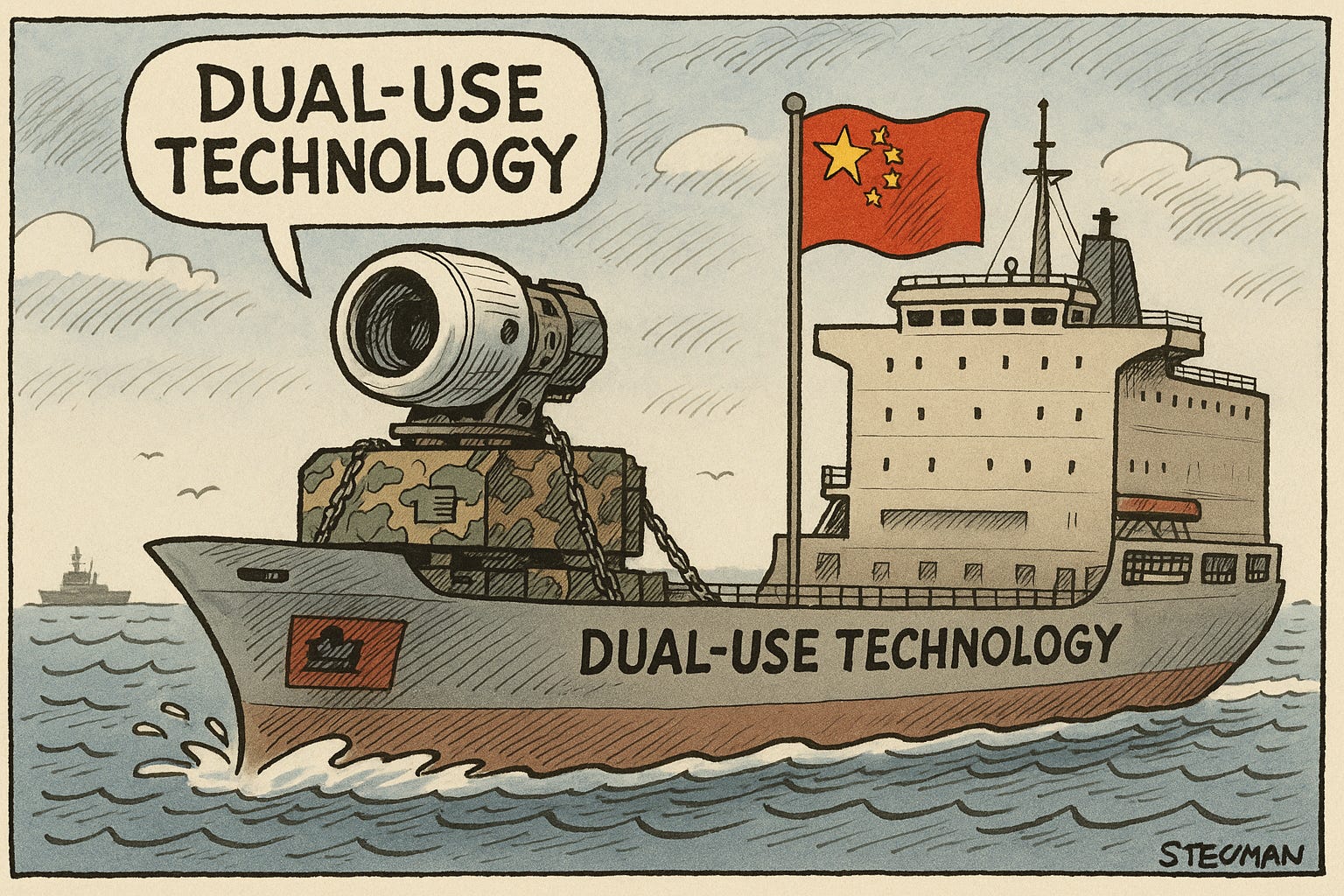
PLA Tests Ship-Mounted Laser Weapon on Civilian Vessel: Maritime Militarization Blurs Civil-Military Lines
Bottom Line Up Front (BLUF): Images circulating on Chinese social media reveal a test of the LY-1 laser weapon mounted on a civilian roll-on/roll-off (Ro-Ro) cargo ship. The unannounced trial suggests Beijing is exploring directed-energy defenses for commercial vessels, likely to be used in amphibious operations, particularly in scenarios such as a Taiwan invasion. The move highlights China’s continued integration of civilian infrastructure into military planning—raising red flags for regional militaries and maritime observers.
Analyst Comments: Mounting a tactical laser on a civilian ship isn’t just a technical trial—it’s a strategic message. China is preparing to repurpose civilian cargo ships for frontline roles, equipping them with point-defense systems to survive drone threats in contested waters. If conflict erupts over Taiwan, expect a surge of Ro-Ro vessels supporting PLA amphibious landings. Lasers like the LY-1 could provide last-ditch defense against loitering munitions or UAV swarms, especially when traditional shipborne CIWS is absent. The deployment also allows real-world testing of laser system limitations in maritime conditions—salt spray, roll compensation, visibility, and humidity—all key challenges for optical weapons. That these tests are occurring outside military channels and on civilian platforms complicates adversaries’ response calculations.
READ THE STORY: Defence Blog
Kvrocks RESET Flaw Grants Admin Access: Critical Vulnerability Exposes NoSQL Deployments
Bottom Line Up Front (BLUF): Apache Kvrocks, a Redis-compatible NoSQL database, is vulnerable to a critical privilege escalation bug (CVE-2025-59790) that allows any authenticated user to execute the RESET command and gain complete administrative control. A second vulnerability (CVE-2025-59792) leaks plaintext credentials through the MONITOR command. Both flaws affect all versions from v1.0.0 to v2.13.0. Apache has released version 2.14.0 to address both issues. Immediate patching is strongly advised.
Analyst Comments: The RESET The command exploit (CVE-2025-59790) enables complete configuration tampering, data exfiltration, or full service disruption by anyone with basic credentials. Worse, the MONITOR vulnerability (CVE-2025-59792) allows credential theft in plaintext—turning one compromised user into many. Kvrocks is often used in high-throughput environments due to its disk-based architecture and compatibility with Redis, making it attractive for caching, analytics, and distributed applications. These kinds of systems often sit in semi-trusted network zones, and attackers who gain lateral movement via exposed developer credentials or misconfigured CI/CD tokens can easily exploit these bugs. Cloud providers and DevOps teams should check for exposure in staging and production environments. If you’re using Kvrocks in multi-tenant setups or have federated API access, treat this as a high-priority incident. No workaround is safe—upgrade to v2.14.0 now.
READ THE STORY: Daily Cyber Security
Covert US Endorsement of South Africa’s ICJ Case Against Israel? A Provocative Hypothesis with Strategic Implications
Bottom Line Up Front (BLUF): A controversial hypothesis suggests the United States may have quietly supported—or even initiated—South Africa’s 2023 application to the International Court of Justice (ICJ), which accused Israel of genocide in Gaza. While the dominant narrative views the application as a challenge to Western powers, political analyst SM Muller argues that Washington, under the Biden administration, covertly greenlit the move to recalibrate its Middle East policy without overtly alienating Israel. If true, the strategy may now be at risk under President Trump’s return.
Analyst Comments: If Muller’s hypothesis holds water, it reveals a layered game of covert diplomacy, in which Washington used Pretoria as a proxy to apply legal pressure on Tel Aviv while maintaining plausible deniability. The circumstantial indicators—such as bipartisan South African support for ICJ funding, sudden shifts in opposition party alignment, and private meetings between U.S. diplomats and South African coalition leaders—are suggestive but not conclusive. The notion that the U.S. “deep state” may have tacitly backed the genocide filing for geopolitical leverage is plausible, especially given the Biden administration’s complex balancing act between traditional support for Israel and mounting international pressure over the Gaza conflict. It would also explain why U.S. sanctions threats and AGOA leverage remained dormant despite repeated South African provocations.
READ THE STORY: The Political Economist
Nobody’s Winning the AI Race — Because It’s Not a Race at All
Bottom Line Up Front (BLUF): In the latest Keen On America episode, Andrew Keen and Keith Teare argue that framing AI development as a “race” — with weekly winners and losers like a tech-sector Wacky Races — misses the point. The real questions are about capability, capital, and civics. The so-called race has no finish line. Instead, we’re in a long-term transformation with open-ended stakes, where success depends on how AI solves real-world problems, who funds the infrastructure, and how the benefits are distributed.
Analyst Comments: The narrative of an AI arms race — Google vs. OpenAI vs. Anthropic vs. China — makes for good headlines, but it obscures deeper realities. Capabilities are uneven, capital is concentrated, and civic outcomes are uncertain. Treating AI like a leaderboard distracts from the core issue: what is AI for, and who gets to decide? Teare’s reframing helps us shift from hype cycles to structural questions. As enterprises struggle to adopt AI at scale, and nation-states jostle over regulatory control, the “race” metaphor feels increasingly hollow. It’s not about winning — it’s about shaping the future before it shapes us.
READ THE STORY: Keenon
China’s Shadow Navy Rehearses Taiwan Invasion With Civilian Ships
Bottom Line Up Front (BLUF): China is preparing civilian cargo ships and ferries for frontline roles in a potential invasion of Taiwan, according to a detailed Reuters investigation combining satellite imagery and vessel-tracking data. This summer, 12 commercial ships participated in coordinated beach landing exercises in Guangdong, simulating the rapid deployment of military vehicles and personnel. The drills reveal a growing PLA capability to supplement its military fleet with China’s vast commercial maritime assets. This move could significantly increase initial invasion force capacity and complicate Taiwan’s defense planning.
Analyst Comments: This is the clearest signal yet that China is formalizing the use of its commercial fleet for military operations. Using low-cost, ramp-equipped deck cargo ships and roll-on/roll-off ferries as impromptu landing craft allows the PLA to massively scale up amphibious logistics at a fraction of the cost of building military-grade assault ships. That’s a significant force multiplier in a Taiwan scenario — especially in the critical first wave, when PLA forces would be most vulnerable. While Taiwan’s Ministry of Defense downplays the direct threat posed by civilian vessels, this blending of military and commercial capabilities poses serious detection, targeting, and escalation dilemmas for Taiwan and its allies. U.S. and Taiwanese experts note the PLA still faces enormous logistical and operational hurdles. Still, the trajectory is clear: China is building practical, scalable mechanisms to land and sustain forces on Taiwan’s shores physically.
READ THE STORY: Reuters
Chinese State Media Calls for Nuclear Strike on Japan After Tokyo Signals Taiwan Support
Bottom Line Up Front (BLUF): Guancha, a Chinese government-aligned media outlet, has openly called for a nuclear attack on Japan following Japanese Prime Minister Sanae Takaichi’s statement that Tokyo might support Taiwan in the event of a Chinese invasion. The article claimed that 72 warheads would be enough to destroy Japan’s military and economic strength. Though not an official government pronouncement, the threat reflects a growing normalization of nuclear rhetoric in Chinese state discourse—an alarming shift with strategic implications for U.S. allies in the Indo-Pacific.
Analyst Comments: Japan’s defense minister framed the deployment as routine, but China responded with a statement implying Japan must be punished to prevent a return to its “militarist past.” The article cited 72 nuclear warheads as sufficient to destroy Japan—an unambiguous threat despite the platform’s semi-official status. FDD notes the urgency for the U.S. to respond with both diplomatic clarity and enhanced military coordination with Tokyo. Meanwhile, China continues naval and air operations around Japan and Taiwan, testing its own carrier groups and expanding triad capabilities. U.S. DoD estimates China will exceed 1,000 operational nuclear warheads by 2030.
READ THE STORY: FDD
CISA Confirms Active Exploitation of OpenPLC ScadaBR XSS Vulnerability (CVE-2021-26829)
Bottom Line Up Front (BLUF): The U.S. Cybersecurity and Infrastructure Security Agency (CISA) has added CVE-2021-26829 — a cross-site scripting (XSS) vulnerability in OpenPLC’s ScadaBR system — to its Known Exploited Vulnerabilities (KEV) catalog. Despite being disclosed in 2021, the flaw is now actively exploited in attacks against operational technology (OT) environments. Federal agencies must patch or mitigate the vulnerability by December 19, 2025, under BOD 22-01.
Analyst Comments: The ScadaBR flaw (CWE-79) allows unauthenticated XSS injection via system_settings.shtm, letting attackers hijack sessions or alter configurations when an authenticated user visits the page. It’s low-complexity and browser-driven, but the implications in industrial contexts are severe — especially where security hygiene is inconsistent. ScadaBR and OpenPLC are widely deployed in academic, research, and some small-to-medium industrial environments due to their open-source accessibility. But that also means patching is decentralized and inconsistent — and legacy instances may be embedded in third-party solutions, making full exposure difficult to map.
READ THE STORY: CISA
Items of interest
NATO Signals Shift Toward Preemptive Cyber and Hybrid Responses Against Russia
Bottom Line Up Front (BLUF): NATO is publicly considering more aggressive and proactive responses to Russian hybrid warfare — including preemptive cyber actions — as part of an evolving strategic posture. In an interview with the Financial Times, Admiral Giuseppe Cavo Dragone, chair of NATO’s military committee, said the alliance is reevaluating its traditionally reactive stance amid continued cyber attacks, undersea sabotage, and airspace violations attributed to Russia. While no operational changes have been confirmed, the shift in rhetoric marks a significant policy signal.
Analyst Comments: Dragone’s remarks about exploring “preemptive strike as defensive action” reflect growing pressure from Eastern European members to escalate beyond deterrence and match Russia’s aggressive asymmetry. Expect increased cyber operations amid the ambiguity of Article 5, especially in response to gray-zone tactics such as cable cuts and drone incursions. But legal and jurisdictional constraints remain. Unlike Russia, NATO must navigate public accountability, member consensus, and international law, limiting its hybrid playbook. The alliance will likely rely on cyber operations, maritime interdiction, and electronic warfare to avoid kinetic escalation. Still, Dragone’s comments suggest that Baltic Sentry-style missions may expand, and more assertive actions in international waters or cyberspace are on the table.
READ THE STORY: FT
Double Whammy For Putin? Russia’s ‘Shadow Fleet Attacked Near NATO Nation’, ‘ICBM Burns Mid-Test’ (Video)
FROM THE MEDIA: Explosions hit two Russian shadow-fleet tankers, including the 274m Kairos, in the Black Sea near Turkey, sparking fires and prompting Turkish rescue teams.
Exposed: Western Europe Plans Cyberattacks On Russia While Trump Pushes Ukraine Peace Deal? (Video)
FROM THE MEDIA: Europe is crossing a line it once thought unthinkable. As Russia’s drones, spies, and cyber units intensify hybrid attacks across NATO territory, European leaders are now openly preparing plans to strike back.
The selected stories cover a broad array of cyber threats and are intended to aid readers in framing key publicly discussed threats and overall situational awareness. InfoDom Securities does not endorse any third-party claims made in its original material or related links on its sites; the opinions expressed by third parties are theirs alone. For further questions, please contact InfoDom Securities at dominanceinformation@gmail.com.The selected stories cover a broad array of cyber threats and are intended to aid readers in framing key publicly discussed threats and overall situational awareness. InfoDom Securities does not endorse any third-party claims made in its original material or related links on its sites; the opinions expressed by third parties are theirs alone. For further questions, please contact InfoDom Securities at dominanceinformation@gmail.com.