
Daily Drop (1191)
11-29-25

Saturday, Nov 29, 2025 // (IG): BB // GITHUB // SN R&D
Italy Unveils ‘Michelangelo Dome’: AI-Powered Multidomain Defense System Against Hypersonics, Drones, and Cyber Threats
Bottom Line Up Front (BLUF): Italy has introduced the Michelangelo Dome, a next-generation defense system developed by state-controlled aerospace and defense giant Leonardo. Designed to counter evolving Russian threats, it integrates artificial intelligence with multi-domain sensors and interceptors to protect NATO and European assets against hypersonic missiles, drone swarms, and cyberattacks. Full operational capability is expected by 2027–2028.
Analyst Comments: The Michelangelo Dome represents a strategic leap in European defense posture, combining the kinetic protection of traditional air defense with real-time integration across the cyber and space domains. Unlike Israel’s Iron Dome, which primarily counters short-range rockets, Michelangelo is tailored for multi-vector, AI-coordinated threat interception — including space-based missile detection, cyber-secure C2, and cross-domain “kill web” targeting. With war-tested vulnerabilities exposed during the Ukraine conflict — especially Russia’s use of hypersonics and swarming drones — NATO-aligned states are shifting toward proactive, predictive, and autonomous defenses. Michelangelo’s AI threat prioritization engine and interoperability with NATO platforms signal a move toward automated response systems capable of defending critical infrastructure without direct human input at the decision node.
READ THE STORY: ET
No Reset in Sight: Trump’s Overtures to Iran Undermined by His Own Policies
Bottom Line Up Front (BLUF): Despite public signals from Donald Trump suggesting renewed openness to diplomacy with Iran after participating in Israeli-led airstrikes in June 2025, prospects for a meaningful U.S.-Iran reset remain bleak. Iranian leadership is divided, internal pressures are mounting, and Washington’s mixed signals—offering deals while ramping up sanctions—have further eroded trust. At best, limited tactical agreements may emerge, but a strategic breakthrough remains unlikely.
Analyst Comments: There’s no coherent diplomatic strategy here—just opportunistic oscillation between coercion and outreach. Trump’s shift from launching B-2 strikes to offering “a hand of friendship” isn’t just confusing to Tehran—it’s fundamentally self-defeating. From Iran’s perspective, dialogue got them bombed. That’s a tough sell internally, especially to factions already skeptical of diplomacy. The hardening of U.S. demands—like reverting to zero enrichment—makes any path forward even narrower. While the window for limited agreements remains, the odds of a transformative détente are close to zero. And given domestic political incentives on both sides, escalation remains a very real possibility.
READ THE STORY: ET
EU Countries Tighten Infrastructure Rules to Counter Chinese Influence Amid National Security Fears
Bottom Line Up Front (BLUF): Amid growing concerns over Chinese involvement in critical infrastructure, several EU countries — including Sweden, Poland, and Austria — are implementing stricter rules to limit foreign access to strategic assets such as ports, railways, IT systems, and energy infrastructure. The EU is also preparing bloc-wide frameworks under the Military Mobility Package and an upcoming Port Strategy to address vulnerabilities exposed by Chinese and Turkish state-linked investments.
Analyst Comments: Europe is entering a new era of economic securitization, where strategic security imperatives are constraining the traditional liberal approach to trade and investment. The latest moves reflect growing discomfort with the dual-use nature of infrastructure — where railways, ports, or data centers serve both civilian and military purposes. China’s state-owned enterprises (SOEs) — including COSCO, CRRC, and Huawei — have long exploited legal gaps and procurement asymmetries to gain footholds across Europe. EU nations are now reasserting sovereign control, citing risks of espionage, sabotage, and wartime coercive leverage. Sweden’s forthcoming 2027 rules empower local authorities to block infrastructure bids from “hostile states” — explicitly targeting actors like China under the guise of neutrality.
READ THE STORY: Politico
ASEAN’s High-Tech Ambitions Exposed to Strategic Supply Chain Risks
Bottom Line Up Front (BLUF): Malaysia, Indonesia, and Thailand are racing to position themselves as critical nodes in the global semiconductor and EV battery supply chains. But as these ambitions scale, so do the risks. New export controls from China and the U.S., combined with infrastructure gaps and tech dependencies, have exposed ASEAN’s industrial upgrade strategies to severe geopolitical and engineering pressure. Without faster risk mitigation, these high-value sectors will remain fragile and overly dependent on external chokepoints.
Analyst Comments: Malaysia’s semiconductor clusters are pushing into advanced packaging, Indonesia is betting on nickel to anchor its battery value chain, and Thailand is retooling its auto industry for EVs. But in every case, imported tech and strategic materials remain single points of failure. The recent delays at Malaysian fabs and Thai EV assembly lines show how thin the margin for error is. China’s grip on rare earths and Indonesia’s reliance on Chinese processing firms for nickel refinement further highlight the exposure. ASEAN policymakers need to treat ports, precursor plants, and customs bottlenecks as national security issues—not just economic ones.
READ THE STORY: Modern Diplomacy
Russian Hacker Arrested in Poland for Breaching Local Business Networks
Bottom Line Up Front (BLUF): Polish authorities have arrested a Russian national accused of illegally accessing and tampering with the IT systems of a local online business. The suspect, who entered the country illegally in 2022 and later obtained refugee status, is facing charges for unauthorized access and damage to critical databases. The arrest signals a growing capability among EU law enforcement to track and detain foreign cybercriminals operating on European infrastructure.
Analyst Comments: While the suspect’s full affiliations remain unclear, the case raises the possibility of broader campaign activity targeting commercial infrastructure across the EU. The entry and refugee status angles add geopolitical complexity and raise questions about gaps in vetting for asylum applicants. For defenders, this underscores the persistent risk from low-profile actors exploiting lax access controls and under-monitored internal systems. Expect further scrutiny into lateral movement and data manipulation tactics within SMB and mid-market environments.
READ THE STORY: GBhackers
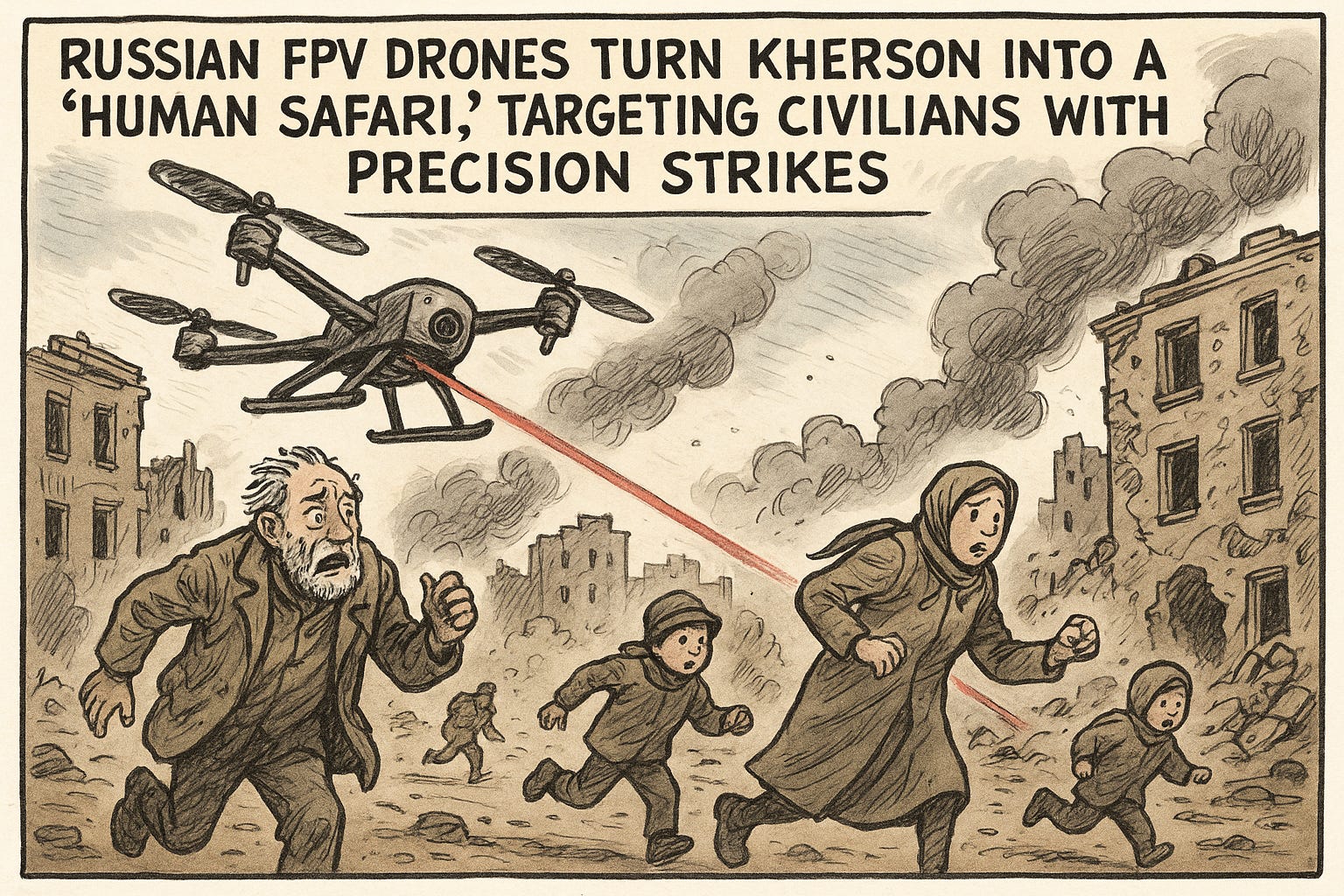
Russian FPV Drones Turn Kherson into a ‘Human Safari,’ Targeting Civilians with Precision Strikes
Bottom Line Up Front (BLUF): Russian forces are systematically deploying first-person view (FPV) drones against civilians in and around Kherson, Ukraine, transforming the area into what Ukrainian residents and military units call a “human safari.” These AI-assisted, manually guided drones loiter until they detect movement, then strike civilians, vehicles, livestock, and infrastructure with precision. The United Nations has called the attacks crimes against humanity, citing evidence of intentional targeting and psychological terror tactics.
Analyst Comments: FPV drones—cheap, accurate, and now AI-enhanced—are no longer just battlefield tools but instruments of civilian terror. Their use in Kherson blurs the lines between military utility and war crimes, especially as they’re deployed to hunt noncombatants in liberated areas deliberately. Operators wait for visual confirmation of targets—often unarmed individuals—before executing strikes, turning basic movement into a death sentence. The psychological toll is immense, with residents avoiding headlights, staying indoors, and living under the constant threat of aerial attack. The tactics are not incidental but systematic, evidenced by drone telemetry, open-source videos, and intercepted Russian communications. This isn’t just a battlefield tactic—it’s strategic intimidation.
READ THE STORY: Military dot com // Alarabiya
