
Daily Drop (1182)
11-17-25

Monday, Nov 17, 2025 // (IG): BB // GITHUB // SN R&D
Iran Halts All Uranium Enrichment After Airstrikes on Nuclear Facilities, Signals Openness to New Talks
Bottom Line Up Front (BLUF): Iranian Foreign Minister Abbas Araghchi confirmed on Sunday that the country is no longer enriching uranium at any of its nuclear sites, citing damage from Israeli and U.S. strikes during the June conflict. While Tehran insists its nuclear rights remain intact, the halt is portrayed as a sign of openness to negotiations—though talks remain unlikely without a shift in U.S. posture.
Analyst Comments: In an AP interview during a Tehran-hosted summit, Foreign Minister Araghchi said Iran is currently enriching no uranium at any declared site due to damage from the June airstrikes. He emphasized that the facilities remain under IAEA safeguards, and warned the U.S. against “maximalist” demands. Satellite imagery supports the lack of visible repair activity at key sites. Iran’s nuclear chief warned the country is under constant threat of further attack if it attempts to resume enrichment. While expressing openness to negotiation, Iranian officials stressed that their nuclear rights are non-negotiable.
READ THE STORY: Military
NATO Faces Growing Drone Threat as Russia Allegedly Probes European Air Defenses
Bottom Line Up Front (BLUF): Mysterious drone incursions over European airports, military bases, and energy infrastructure have triggered calls for a “drone wall” across NATO’s eastern flank. While most drones remain unarmed, Western security services suspect Russian state-backed actors or proxies are testing European airspace and response times as part of broader hybrid warfare tactics.
Analyst Comments: The September incident where Russian-origin drones crossed into Poland marked a critical breach of NATO airspace and escalated concerns about air domain awareness. The rise in civilian drone sightings near sensitive infrastructure—particularly in countries housing NATO command structures or frozen Russian assets—is likely part of a gray zone pressure campaign. The proposed “drone wall” is a rational response, but it’s unlikely to be fully effective without corresponding investment in electronic warfare, airspace coordination, and counter-launch capabilities. Watch for future incursions to serve dual roles: psychological operations and live-fire rehearsal.
READ THE STORY: BBC
AI Power Demands Strain Data Center Design: Nvidia’s 600kW Racks Signal the Dawn of “AI Factories”
Bottom Line Up Front (BLUF): As AI workloads surge, legacy data centers are buckling under power and cooling demands. Digital Realty CTO Chris Sharp warns that modern GPU deployments—led by Nvidia’s 600kW Kyber racks—are far beyond what traditional facilities can handle. A new breed of “AI factories” is being developed to keep pace with rack-scale compute densities and dynamic power loads.
Analyst Comments: The shift from 6–7kW air-cooled racks to 140–600kW liquid-cooled monsters isn’t just an engineering problem—it’s a geopolitical one. Power availability becomes a chokepoint for both national AI ambitions and cloud dominance. Sharp’s comment that “silicon innovation is going to be hampered by the permanence of concrete” underscores the strategic mismatch between chip design and physical deployment constraints. Datacenter operators that can’t adapt—electrically, thermally, and architecturally—will be left behind as Nvidia, Microsoft, and others move toward hyper-dense AI clusters.
READ THE STORY: The Register
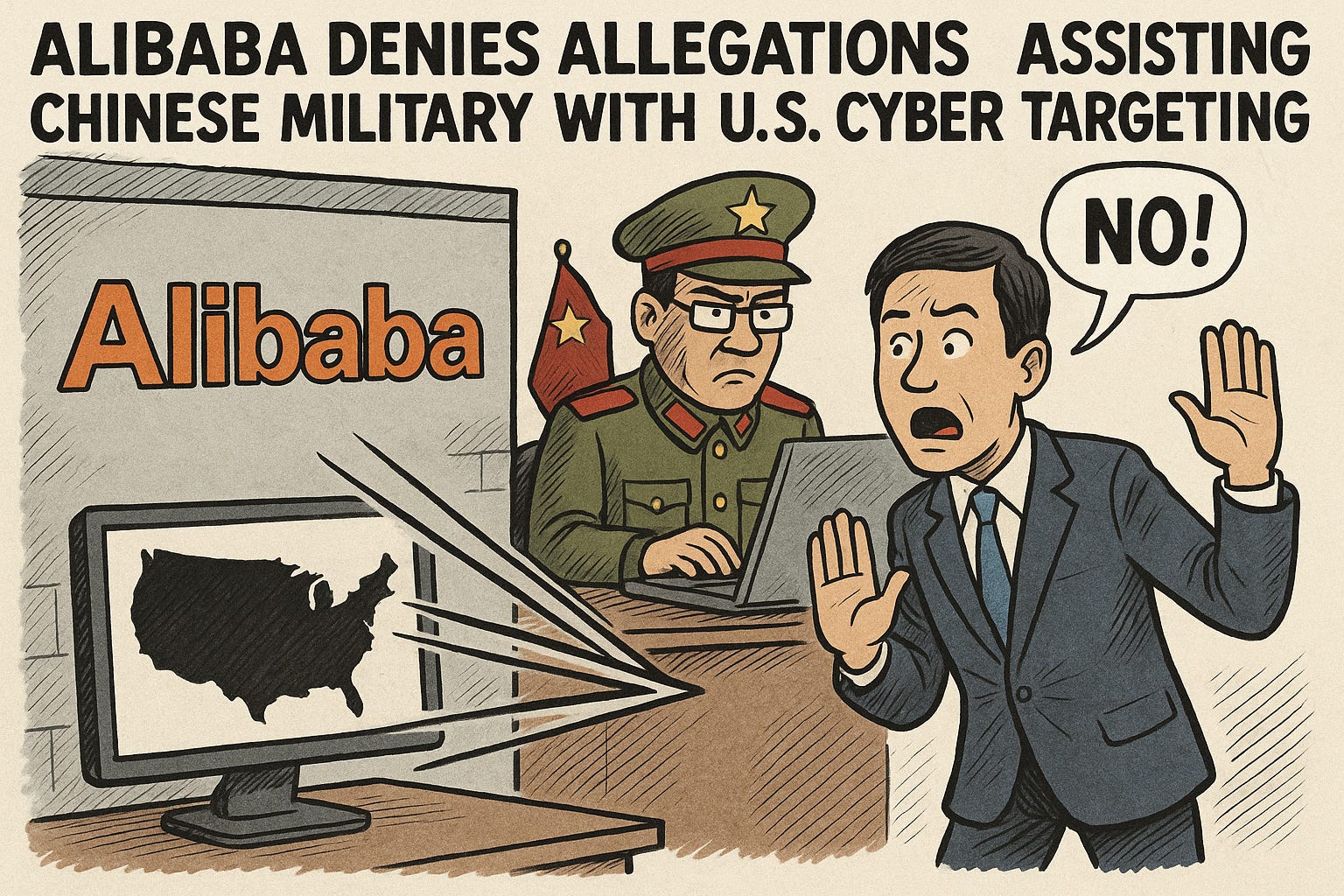
Alibaba Denies Allegations of Assisting Chinese Military with U.S. Cyber Targeting
Bottom Line Up Front (BLUF): A Financial Times report citing a White House memo alleges that Alibaba provides technological and data support to the Chinese military for cyber operations targeting the U.S., including sharing IP addresses, Wi-Fi metadata, and payment records. Alibaba categorically denies the claims, calling them “completely false” and politically motivated. The memo’s authenticity remains unverified, but the accusations reinforce long-standing U.S. concerns over Chinese tech firms’ potential role in state-sponsored cyber espionage.
Analyst Comments: Whether or not the claims hold water, they play directly into U.S. national security anxieties around supply chain risk and data sovereignty. Even without hard proof, the perception of compromise is enough to justify tightened restrictions on Chinese firms. With Trump back in office and actively reigniting the trade war, we can expect an uptick in allegations like this—some credible, some politically expedient. Defenders should watch for retaliatory campaigns or cyber influence operations linked to these tensions.
READ THE STORY: Spacewar
RansomHouse Hits Textile Giant Fulgar: Data Leak Impacts Adidas, H&M Supply Chain
Bottom Line Up Front (BLUF): Italian yarn manufacturer Fulgar S.p.A. has confirmed a ransomware attack attributed to the RansomHouse group. The attackers claim to have exfiltrated and encrypted data on October 31, leaking sensitive internal documents, including financials, invoices, and communications. Fulgar supplies materials to global fashion brands such as Adidas, H&M, Wolford, and Calzedonia, raising concerns about downstream exposure. The breach underscores persistent risks in third-party and supplier networks.
Analyst Comments: Fulgar confirmed the attack after its name appeared on RansomHouse’s leak site on November 12. The ransomware group claimed to have encrypted company systems as early as October 31. Leak site screenshots show bank statements, invoice records, and emails. The attackers issued a direct warning to Fulgar management, pressuring the company to negotiate. Fulgar is a major producer of polyamide 66 fibers and elastomers, operating Europe’s largest spinning mill with facilities in Italy, Turkey, and Sri Lanka. The breach follows similar incidents affecting fashion and retail supply chains, including those involving Mango and Muji, highlighting a pattern of ransomware targeting manufacturers behind global brands.
READ THE STORY: Tech Radar
Industrial Cyber Days 2025 Marks Strategic Shift in Cyber-Physical Defense
Bottom Line Up Front (BLUF): Speakers from across the industrial cybersecurity ecosystem emphasized practical resilience over theoretical models, calling for better engineering integration, scenario-driven risk analysis, and a shift from generalist approaches to deep OT specialization. As adversaries increasingly blend low-noise techniques and protocol exploitation, defenders are aligning around shared goals: clarity, awareness of consequences, and engineering-led cyber resilience.
Analyst Comments: Jonathon Gordon (Takepoint Research) opened the event by urging organizations to focus on small wins that build trust and momentum. Keynote speaker Justin Nga (CitiPower, Powercor, United Energy) challenged the overreliance on fear-driven engagement and called for deeper specialization in OT roles. Danielle Jablanski (STV) reframed crown-jewel analysis using operational scenarios rather than asset checklists and warned of the dangers of vendor lock-in and over-consolidation. Sarah Freeman (MITRE CIPIC) closed the event by highlighting adversary trends—quiet, AI-enhanced attacks and a shift away from noisy malware campaigns. Across sessions, speakers consistently called for cross-disciplinary cooperation, protocol-aware defenses, and an understanding of how manipulated data can cause real-world harm across sectors such as energy, water, and manufacturing.
READ THE STORY: Industrial
North Korean IT Operatives Infiltrated 136 U.S. Companies with Help from Five Americans
Bottom Line Up Front (BLUF): Federal prosecutors say five U.S. citizens helped North Korean IT operatives infiltrate at least 136 American companies by laundering identities, proxying access through “laptop farms,” and handling payroll to disguise DPRK workers as domestic remote employees. The scheme generated at least $6.8 million for Pyongyang and exposed U.S. firms—including defense and tech companies—to insider-level access and attempted malware deployment. The case highlights a glaring weakness in remote‑work identity verification and the ease with which state-sponsored actors can bypass hiring controls.
Analyst Comments: According to filings unsealed by the Department of Justice, the five defendants—Ahmed Hossam Eldin Elbadawy (23), Noah Michael Urban (20), Evans Onyeaka Osiebo (20), Jiacheng Liang (24), and Christina Marie Chapman (50)—pleaded guilty to roles in a multiyear scheme (2018–2024) that placed DPRK nationals into remote IT jobs at U.S. companies. Chapman allegedly managed more than 60 stolen identities and laundered paychecks, while the others operated “laptop farms,” receiving corporate-issued devices and spoofing domestic logins on behalf of DPRK workers. Federal investigators identified 300 targeted companies, of which 136 were successfully compromised. One North Korean operative reportedly attempted to install malware inside an employer’s network. The defendants face five to twenty years in prison, depending on the charges. Authorities link the revenue to DPRK weapons programs and cite this case as an example of North Korea’s increasingly sophisticated global IT infiltration strategy.
READ THE STORY: WPN
KnownSec Leak Exposes Scale of China’s Cyber Espionage Operations
Bottom Line Up Front (BLUF): A 95-terabyte breach of a Chinese cybersecurity firm, KnownSec, has exposed internal data detailing AI-enhanced malware, global cyberattack plans, and a contractor model deeply embedded in China’s state cyber operations. Leaked documents reveal offensive tools, command-and-control infrastructure, and targeting across 20 countries, including U.S. defense and European government networks. The breach is one of the most significant disclosures of China’s cyber apparatus to date. It marks a turning point in understanding how private contractors like KnownSec support state-backed espionage.
Analyst Comments: Leaked in early November and quickly scrubbed from GitHub, the breach includes over 12,000 documents: source code, RATs, AI-generated phishing kits, and surveillance-enhanced malware. The tools target sectors ranging from telecoms to defense, with specific campaigns targeting entities in the U.S., South Korea, India, and EU states. Notably, KnownSec reportedly used Anthropic’s Claude AI to assist with payload creation—marking one of the first confirmed uses of LLMs in nation-state attack pipelines. The contractor’s links to China’s Ministry of State Security mirror previous revelations in the 2024 I-Soon leak. Analysts warn that exposed malware and infrastructure may be repurposed quickly, pushing defenders to revalidate detections and response plans. Governments have already issued advisories and seizure warrants in response to the fallout.
READ THE STORY: WPN
Zero-Day Hits Logitech, CISA Stonewalls on Telecom Flaws, and npm Flooded with 78,000 Malicious Packages
Bottom Line Up Front (BLUF): Logitech disclosed that a zero-day vulnerability in a third-party platform allowed attackers to access its internal systems and exfiltrate company data. The breach likely exposed limited employee, customer, and supplier data—though Logitech claims no sensitive personal information (like national IDs or credit card data) was involved.
Analyst Comments: In a regulatory filing published November 15, Logitech revealed the incident stemmed from a zero-day vulnerability in software provided by an unnamed vendor. The flaw has since been patched, but the company admitted that “certain data” had already been copied from its internal IT systems. The impacted data “likely included” limited information on employees, customers, and suppliers, though Logitech maintains that sensitive identifiers and payment details weren’t stored on the affected systems. The filing does not clarify how long the attackers had access.
READ THE STORY: The Register
China’s AI Drone Swarms Present Strategic and Ethical Threat to U.S. Military Superiority
Bottom Line Up Front (BLUF): China is aggressively developing AI-powered drone swarms and autonomous systems to neutralize U.S. airpower and naval dominance. With minimal oversight and a civil-military fusion model, Beijing’s rapid militarization of AI raises serious concerns about strategic imbalance, ethical use of autonomy, and the erosion of U.S. deterrence in future conflicts.
Analyst Comments: Beijing’s commitment to drone swarming, loyal wingmen, and AI-enabled naval platforms—absent the legal and ethical brakes that constrain U.S. programs—signals a doctrine shift toward scale, speed, and autonomy. The Jiu Tian drone “mothership,” HSU-001 undersea drones, and the CETC kamikaze swarms show China isn’t waiting for consensus on AI safety. The U.S. needs to rethink its human-on-the-loop doctrine for high-speed engagements or risk fielding systems that can’t match adversaries in tempo or volume. The Pentagon’s CCA/NGAD program is a step in the right direction, but without matching China’s production pace and operational risk tolerance, it may be too little, too late.
READ THE STORY: National Interest
Items of interest
Army War College Warns: Fragmented U.S. Cyber Response Weakens National Resilience
Bottom Line Up Front (BLUF): A new U.S. Army War College analysis argues that the nation’s cyber incident response is dangerously fragmented, lacking a designated lead agency and consistent coordination across major breaches. Case studies of SolarWinds, Colonial Pipeline, and Change Healthcare show that governance—not just technical gaps—is undermining U.S. resilience against escalating cyber threats. Without structural reform, the U.S. remains ill-prepared to manage complex, cross-sector cyberattacks on critical infrastructure.
Analyst Comments: While cyber defenders often focus on zero-days and ransomware payloads, this report points out the real Achilles’ heel: bureaucratic inertia and overlapping mandates. PPD-41 and the NCIRP were supposed to clarify roles, but real-world incidents like SolarWinds and Colonial Pipeline exposed coordination failures in plain sight. The fact that the Office of the National Cyber Director (ONCD) was unstaffed during SolarWinds, and DOE was suddenly tapped to lead Colonial Pipeline response (without explanation), reflects the lack of a standing playbook and chain of command. Private sector autonomy adds another layer of complexity. Colonial Pipeline lawfully declined CISA’s help and chose Mandiant, revealing just how little federal agencies can compel cooperation under current authorities—even in critical infrastructure sectors. As the report points out, cybersecurity standards across sectors remain advisory in practice rather than enforced.
READ THE STORY: INK STICK
U.S. Cyber Officials Order Emergency Response After Federal Breach (Video)
FROM THE MEDIA: U.S. cyber officials have issued an “emergency directive” after discovering that an advanced hacking group breached at least one federal agency by exploiting vulnerabilities in Cisco firewall devices. All civilian agencies must scan, patch, and isolate affected gear by the end of Friday.
Sources: Reuters, Washington Post, Axios
Rare Interview Where US Cyber Command Reveals Their Ops🎙Darknet Diaries Ep. 50: Op Glowing Symphony (Video)
FROM THE MEDIA: In a rare interview, an officer from U.S. Cyber Command explains how the government found a way to attack the global ISIS network without putting a single boot on the ground.
The selected stories cover a broad array of cyber threats and are intended to aid readers in framing key publicly discussed threats and overall situational awareness. InfoDom Securities does not endorse any third-party claims made in its original material or related links on its sites; the opinions expressed by third parties are theirs alone. For further questions, please contact InfoDom Securities at dominanceinformation@gmail.com.
The KnownSec leak is absolutly massive in terms of what it reveals about Chinas contractor model for cyber operations. The fact they're using Claude AI for phishing payload generation is partcularly concerning. This level of transparancy into state-sponsored capabilities is rare and should inform how defenders prioritize threat modeling going forward.