
Daily Drop (1175)
11-08-25

Saturday, Nov 08, 2025 // (IG): BB // GITHUB // SN R&D
North Korea Launches Missile After US Sanctions, Threatens ‘Offensive Action’ Over Joint Military Posture
Bottom Line Up Front (BLUF): North Korea launched a ballistic missile on Nov. 7, prompting sharp condemnation from the U.S. military, which labeled the action as “destabilising.” The launch followed new U.S. sanctions targeting North Korean individuals involved in cyber-related money laundering. In response, Pyongyang threatened “more offensive action,” citing U.S.-South Korea military coordination—including the visit of a U.S. nuclear-powered aircraft carrier and security talks between defense chiefs—as justification.
Analyst Comments: This launch fits North Korea’s pattern of tightly choreographed military signaling in response to perceived U.S. provocations. But there’s more under the surface: the sanctions weren’t about missiles—they were cyber-focused. That detail matters. North Korea’s crypto-financed threat ecosystem is under growing pressure, and Pyongyang is reacting not just with missiles, but with messaging about its deterrence posture. The threat of “offensive action” should be read not only as saber-rattling but as a cue to watch for asymmetric responses—potential cyber retaliation, further weapons testing, or political disruption targeting South Korean elections or U.S. regional interests. The deployment of the USS George Washington to Busan, and discussions of nuclear-powered submarines for South Korea, only add to the North’s narrative of encirclement.
READ THE STORY: The Straits Times
EU Tightens Schengen Visa Rules for Russians Over Security Concerns
Bottom Line Up Front (BLUF): The European Commission announced new restrictions on Schengen visa issuance for Russian nationals, suspending most multiple-entry visas and limiting applications to single-entry only—except for select humanitarian or professional cases. The move cites security risks tied to Russia’s war against Ukraine, including cyber and industrial espionage, sabotage, and propaganda activity by Russian passport holders.
Analyst Comments: Russian state-aligned actors have repeatedly used mobility, dual-use infrastructure, and legal travel channels to mask everything from SIGINT collection to cyber reconnaissance. Suspending multi-year visas reduces operational cover for such activities. It also enables member states to re-evaluate applicants each time they travel—a subtle but essential shift in counterintelligence posture. The targeting rationale isn’t limited to traditional espionage. The Commission explicitly references cyber threats and industrial sabotage—two areas where Russian activity in EU countries has increased since 2022, including incidents tied to GRU-linked groups like Sandworm.
READ THE STORY: Meduza
Suspected Nation-State Hack Hits Congressional Budget Office, Exposes Legislative Communications
Bottom Line Up Front (BLUF): The U.S. Congressional Budget Office (CBO) suffered a cybersecurity breach believed to involve a foreign threat actor. Internal communications and data shared with Senate offices may have been exposed. Officials warned that the compromise could lead to targeted phishing attacks impersonating the CBO. Investigations are ongoing, and additional security controls have been deployed.
Analyst Comments: The CBO may not seem like a high-profile target, but its role as a non-partisan source of economic analysis makes it a valuable intelligence target for adversaries seeking insight into U.S. legislative planning or budgetary forecasts. More concerning is the downstream risk to other Congressional offices: attackers now potentially have access to real email threads, contact patterns, and internal dialogue—perfect fuel for highly targeted spearphishing or disinformation campaigns. It echoes tactics seen in prior APT intrusions into government bodies where lateral movement followed an initial, less-defended entry point. CBO’s public admission and prompt response are notable, but the absolute risk lies in what attackers do next with harvested data.
READ THE STORY: Reuters
Kimsuky Deploys EndClient RAT Against North Korean Human Rights Defenders
Bottom Line Up Front (BLUF): North Korea-linked APT group Kimsuky is using a new, advanced remote access trojan dubbed EndClient RAT in a targeted campaign against North Korean human rights activists. First observed in September 2025, the malware is delivered via malicious MSI installers and features advanced anti-analysis, polymorphic evasion, and credential hijacking capabilities. Researchers report that at least 39 secondary victims were exposed via compromised messaging accounts.
Analyst Comments: The malware is disguised in a fake “StressClear.msi” package and signed with a stolen certificate to bypass defenses. After wiping the victim’s Android device, attackers hijacked the user’s KakaoTalk to spread the backdoor to nearly 40 others. EndClient RAT supports remote shell access, file transfer, system recon, and uses polymorphic file mutation to evade Avast detection. Security experts are advising targeted organizations to implement targeted threat-hunting operations and monitor MSI execution chains for anomalies.
READ THE STORY: SC MEDIA
Iran-Linked Cyber Toufan Claims Long-Term Espionage in Israeli Defense Sector
Bottom Line Up Front (BLUF): Iranian state-linked threat group Cyber Toufan claims it maintained covert access to Israeli defense contractor Maya Engineering’s network for over 18 months. The group alleges compromise of surveillance systems, QNAP storage archives, and lateral movement into connected firms, Elbit and Rafael, with control over sensitive infrastructure such as routers, cameras, and phones. Footage of internal R&D meetings involving military systems was leaked to bolster their claims, though the breach has not been independently verified.
Analyst Comments: Iranian APT Cyber Toufan claims to have breached Maya Engineering, an Israeli defense contractor, maintaining access to internal video surveillance and QNAP file archives for over 18 months. The group alleges that this access facilitated lateral compromise of systems at defense firms Elbit and Rafael. Leaked internal footage allegedly includes classified discussions on military drones, tanks, and missile systems. While the claims remain unverified, security expert Kevin Garvey highlighted the breach as a stark reminder that connected peripherals must be part of vulnerability and secure configuration programs.
READ THE STORY: FDD
From Log4j to WinRAR: China-Linked APTs Weaponize Legacy Bugs for Global Espionage
Bottom Line Up Front (BLUF): Multiple Chinese state-backed APT groups—including APT41 subclusters (Earth Longzhi, Salt Typhoon), Kelp, and Space Pirates—are conducting persistent, stealthy cyber-espionage against U.S. policy organizations and foreign government entities. These operations exploit long-known vulnerabilities (Log4j, Atlassian OGNL, Apache Struts, GoAhead, WinRAR, and misconfigured IIS servers) to establish footholds, steal credentials, and exfiltrate strategic data. The campaigns highlight a growing trend: China’s offensive cyber units are quietly recycling legacy bugs at scale and sharing tooling to shape geopolitics from the shadows.
Analyst Comments: Symantec and Carbon Black identified a Chinese APT intrusion into a U.S. nonprofit tied to international policy advocacy. The attack began with mass scanning and exploit attempts (CVE-2022-26134, CVE-2021-44228, CVE-2017-9805), followed by the establishment of persistent backdoors via scheduled tasks and DLL sideloading. The attackers used tools like Dcsync and imjpuexc to escalate and persist, likely deploying a remote access trojan. Broader reporting from ESET and Elastic Labs highlights ongoing global campaigns, including SEO-focused web shell deployments via misconfigured IIS servers (REF3927) and adversary-in-the-middle attacks against defense, energy, and government targets across Latin America and Asia. APTs such as SinisterEye, PlushDaemon, and DigitalRecyclers are part of this expanding tool-sharing ecosystem.
READ THE STORY: THN
“Ransomvibe” Malware-Laced VSCode Extension Slips Past Marketplace Review
Bottom Line Up Front (BLUF): A malicious proof-of-concept Visual Studio Code extension—containing ransomware-like functionality—was published and remained accessible on Microsoft’s official marketplace, exposing critical review gaps. Dubbed Ransomvibe, the extension was overtly malicious, containing hardcoded C2 infrastructure, encryption tools, and AI-generated code comments, yet still passed Microsoft’s filters. The incident showcases how easy it is to inject malicious logic into trusted developer ecosystems under the guise of experimental tools.
Analyst Comments: Secure Annex researchers uncovered a Visual Studio Code extension (susvsex) that bundled file encryption, data exfiltration, and GitHub-based C2 operations into a publicly listed tool. The extension was published under the alias “Suspicious Publisher” and included easily accessible payloads, decryptors, and a GitHub PAT hardcoded into the source code. The extension uploaded compressed files from a test directory and checked GitHub commits for instructions. Researchers called it a “textbook case” of AI-assisted malware development—with a sloppy file structure and comments indicating code generation. Despite these flags, the extension remained live for some time. Microsoft confirmed its removal and reiterated standard abuse reporting processes, but researchers argue this highlights a growing pattern of abuse in open extension ecosystems.
READ THE STORY: CSO ONLINE
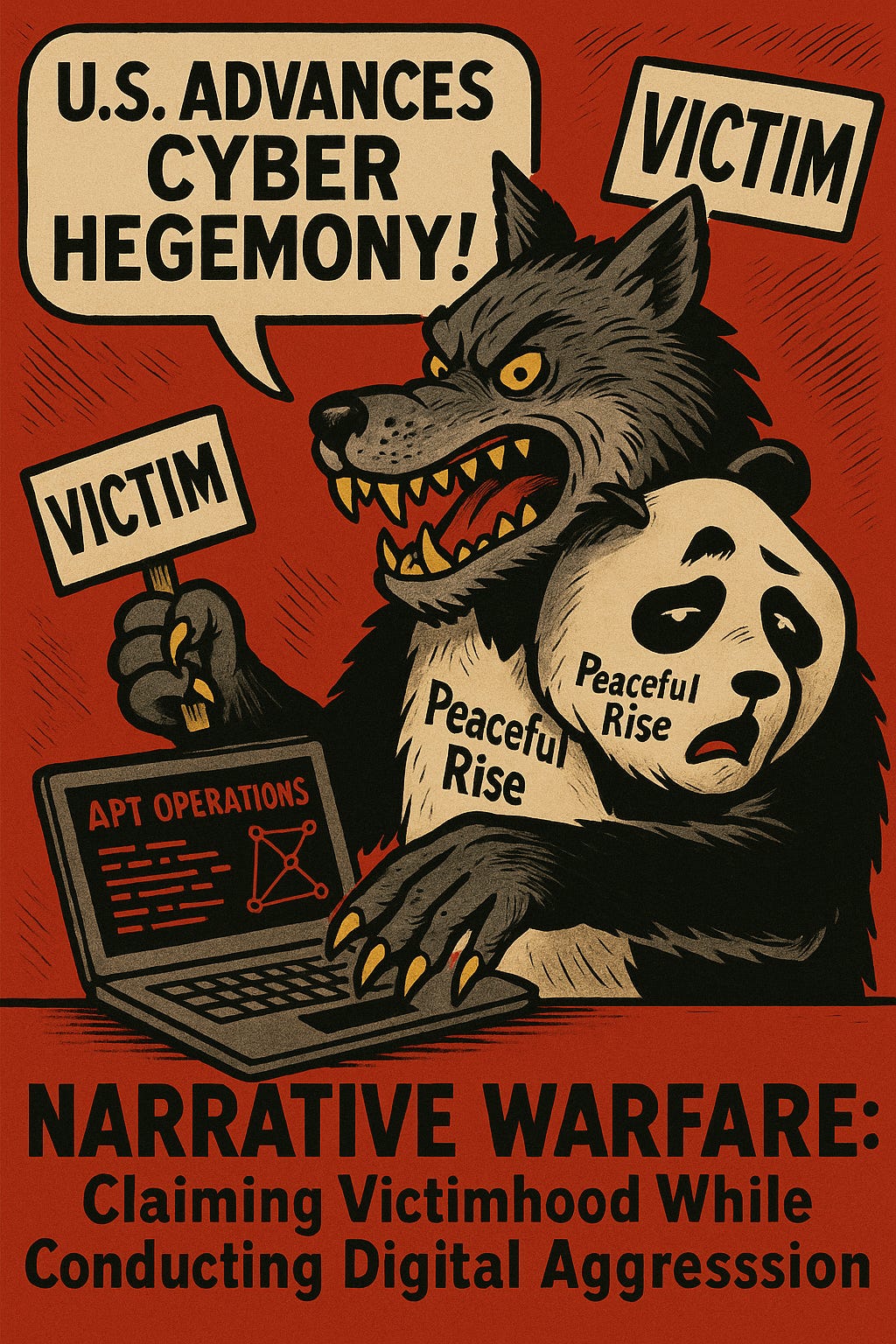
PRC Spins U.S. Cyber Operations into Narrative of Victimhood and Digital Hegemony
Bottom Line Up Front (BLUF): Following a reported U.S. cyber operation against China’s National Time Service Center (NTSC), Beijing is amplifying a narrative that frames the PRC as a victim of Western digital imperialism. Chinese state media and officials are using the alleged attack to call for a new “cyberspace order,” portraying the U.S. as the global instigator of instability while promoting China as a defender of sovereignty and a leader of the Global South in cyberspace governance.
Analyst Comments: Jonah Reisboard outlines how Chinese state media responded to an October 2025 cyberattack allegedly conducted by the U.S. against the NTSC. Chinese coverage emphasized the U.S. as the “hacker empire,” while denying the legitimacy of the “China cyber threat theory.” Unlike the aggressive reaction to a previous Taiwanese-linked attack, Beijing’s response to the U.S. operation focused more on narrative construction—leveraging the incident to advocate for a “fair, just, and transparent” international cyberspace order. Chinese officials tied the attack to a broader campaign to hinder China’s rise, framing it as part of a pattern of Western interference in sovereign development. Commentators like Jin Fei suggested that such actions reveal the “hegemonic nature” of U.S. strategy and signal the need for PRC-aligned global cyber norms.
READ THE STORY: The Jamestown Foundation
The Quiet Revolution: Regulation Pushes Cyber Accountability from Paper to Practice
Bottom Line Up Front (BLUF): New regulations—from the EU’s DORA to the U.S. SEC’s cybersecurity disclosure rules—are quietly but forcefully reshaping organizational security culture. Instead of checkbox compliance, frameworks now demand demonstrable readiness, architectural rigor, and real-time visibility. Accountability is no longer aspirational—it’s expected. This cultural shift rewards transparency, cross-functional collaboration, and a proactive mindset that views incident response as a board-level function, not just a technical process.
Analyst Comments: Graylog CTO Robert Rea argues that the biggest story in cybersecurity isn’t the subsequent breach—it’s the rising tide of accountability being driven by regulation. Frameworks like the EU’s DORA, the U.S. Secure-by-Design initiative, and the SEC’s disclosure rules are reshaping how organizations think about security. Key takeaways include the growing emphasis on architecture over patchwork fixes, the need for metrics that matter (such as Mean Time to Disclose), and the cultural shift toward anticipating failure rather than just preventing it. Rea advocates for regulation as a maturity map, not an obstacle, and calls on leaders to embed compliance into design, emphasize fundamentals, and embrace transparency as a differentiator.
READ THE STORY: CS
New Microsoft Teams Feature Raises Phishing and Malware Concerns
Bottom Line Up Front (BLUF): A new Microsoft Teams feature allowing users to initiate chats with any external email address—even if the recipient isn’t a Teams user—is rolling out globally by January 2026. While designed to boost collaboration, the feature introduces serious security risks: phishing, malware distribution, impersonation, and data leakage. Security researchers warn that the move may undermine organizational trust boundaries and create a new avenue for social engineering campaigns.
Analyst Comments: Enabled by default, the update uses Microsoft Entra B2B Guest policies but bypasses vetting steps that would normally block unsolicited connections. Researchers warn that this creates a high-value phishing vector, where malicious actors can impersonate partners and deliver malware via Teams. Unlike email, Teams files may not pass through existing security filters. Admins can disable the feature via PowerShell by setting UseB2BInvitesToAddExternalUsers = false. Experts also recommend enforcing MFA, auditing Teams policies, and providing user awareness training to reduce social engineering risk.
READ THE STORY: GBhackers
Items of interest
Russia-Backed Sandworm Steps Up Wiper Attacks on Ukraine’s Grain and Energy Sectors
Bottom Line Up Front (BLUF): APT Activity Report highlights a sharp escalation in destructive cyber operations by Russia-aligned Sandworm, targeting Ukraine’s grain and energy sectors from April to September 2025. The campaign included multiple wiper malware deployments across key infrastructure, with notable support from the UAC-0099 group for initial access. This marks a strategic shift toward economic disruption amid the ongoing war. The report also tracks global state-aligned activity, including expanded Chinese and Iranian operations, and North Korean crypto theft.
Analyst Comments: Sandworm’s renewed focus on economic sabotage—specifically targeting Ukraine’s grain exports—signals a deliberate strategy to destabilize a cornerstone of the country’s wartime economy. While wiper attacks have been a known Sandworm tactic since 2015, the emphasis on food supply chains is new, and deeply consequential. This isn’t just about IT/OT disruption; it’s an information warfare play to degrade national resilience and sow fear. The supporting role of UAC-0099, which hands off compromised targets for follow-up destruction, reflects tight coordination among Russian APTs. The use of Group Policy for wiper deployment also underscores a persistent gap in segmentation and lateral movement defenses within targeted networks. Meanwhile, the concurrent spike in spearphishing—some of it possibly AI-assisted—shows how Russia is blending low-cost initial access with high-impact payloads.
READ THE STORY: Industrial
CyberWar 2022: From Eastern Europe to Across the Globe (Video)
FROM THE MEDIA: Energy workers are scrambling to fix damage to the Ukrainian power grid to keep people from freezing to death amid a massive attack by the Russian military. Vladimir Putin calls the attack retaliatory for Ukraine’s use of U.S. missiles.
Industroyer2: Sandworm’s Cyberwarfare Targets Ukraine’s Power Grid Again (Video)
FROM THE MEDIA: Industroyer2 – a new version of the only malware to ever trigger electricity blackouts – was deployed in Ukraine amidst the ongoing Russian invasion. Like in 2016 with the original Industroyer, this recent cyberattack aimed to cause a major blackout – this time targeting 2+ million people, with components amplifying the impact and complicating recovery.
The selected stories cover a broad array of cyber threats and are intended to aid readers in framing key publicly discussed threats and overall situational awareness. InfoDom Securities does not endorse any third-party claims made in its original material or related links on its sites; the opinions expressed by third parties are theirs alone. For further questions, please contact InfoDom Securities at dominanceinformation@gmail.com.