
Daily Drop (1166)
10-26-25

Sunday, Oct 26, 2025 // (IG): BB // GITHUB // SN R&D
Israel’s Strategic Information Warfare Goes Digital: TikTok Control, AI Manipulation, and Global Influence Ops Under Scrutiny
Bottom Line Up Front (BLUF): A detailed exposé by the Voltaire Network outlines Israel’s intensified efforts to control global narratives through covert digital influence operations. Under Prime Minister Netanyahu, the Israeli government has expanded social media campaigns targeting international public opinion—particularly users under 35—via influencer networks, AI manipulation, and partnerships with U.S.-based media firms. “Project 545,” a $145 million initiative, allegedly aims to influence how generative AI systems and social media users interpret events like the Gaza conflict and criticism of the IDF.
Analyst Comments: The Voltaire Network reports that Israel is actively pursuing social media acquisition and manipulation campaigns, most notably through a $145M effort dubbed “Project 545,” aimed at influencing users under 25 and the output of generative AI systems. Campaigns have included TikTok influence (with Oracle handling U.S. data), a 75+ post influencer blitz via “The Esther Project,” and contracts with Clock Tower X LLC, run by Trump’s former campaign advisor Brad Parscale. An estimated $200M/year has reportedly flowed to ISGAP, which leads most of Israel’s external propaganda (hasbara) campaigns. Meanwhile, groups like Black Cube and Cyber Shield have previously been used to surveil and disrupt pro-BDS activists abroad.
READ THE STORY: Voltaire Net
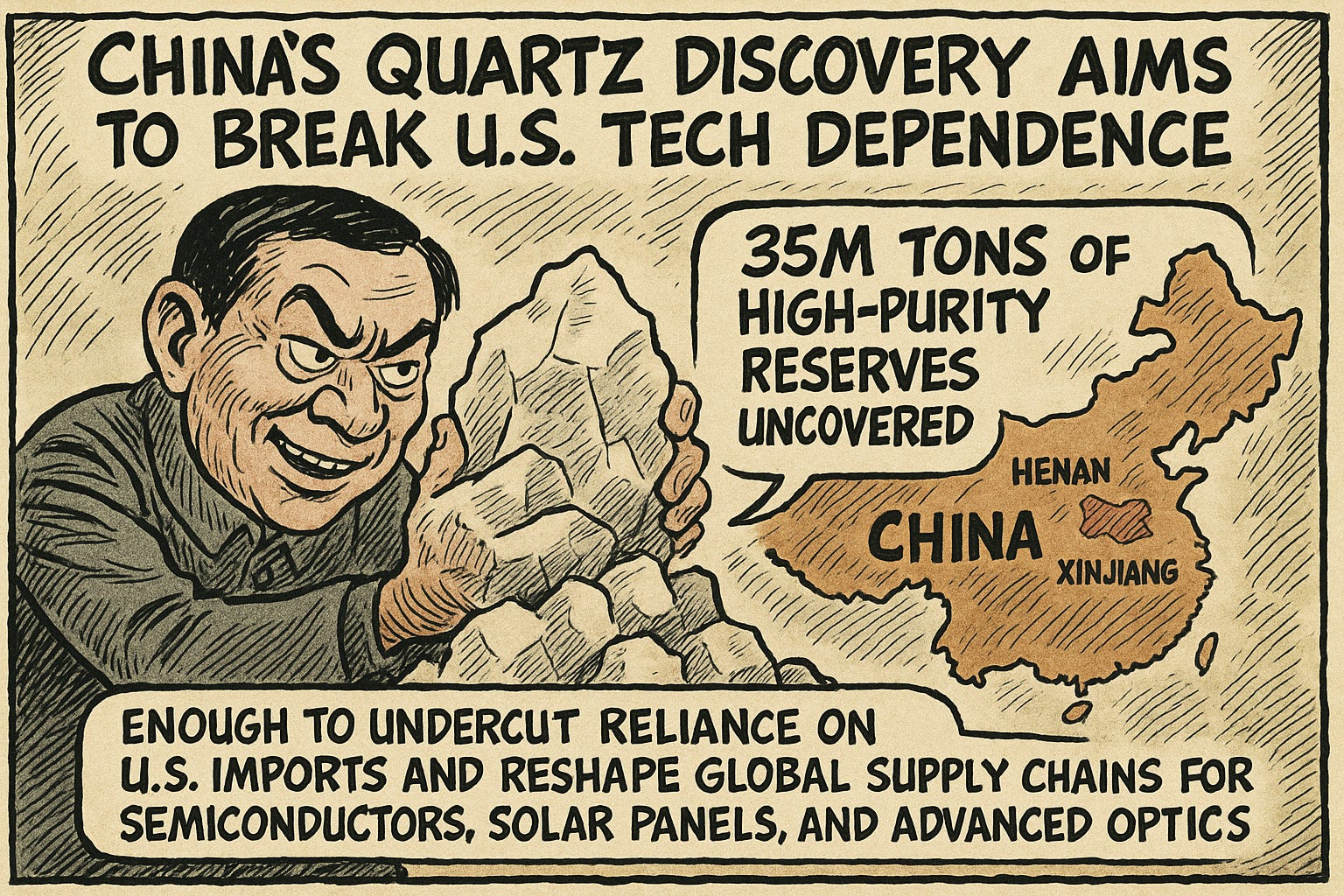
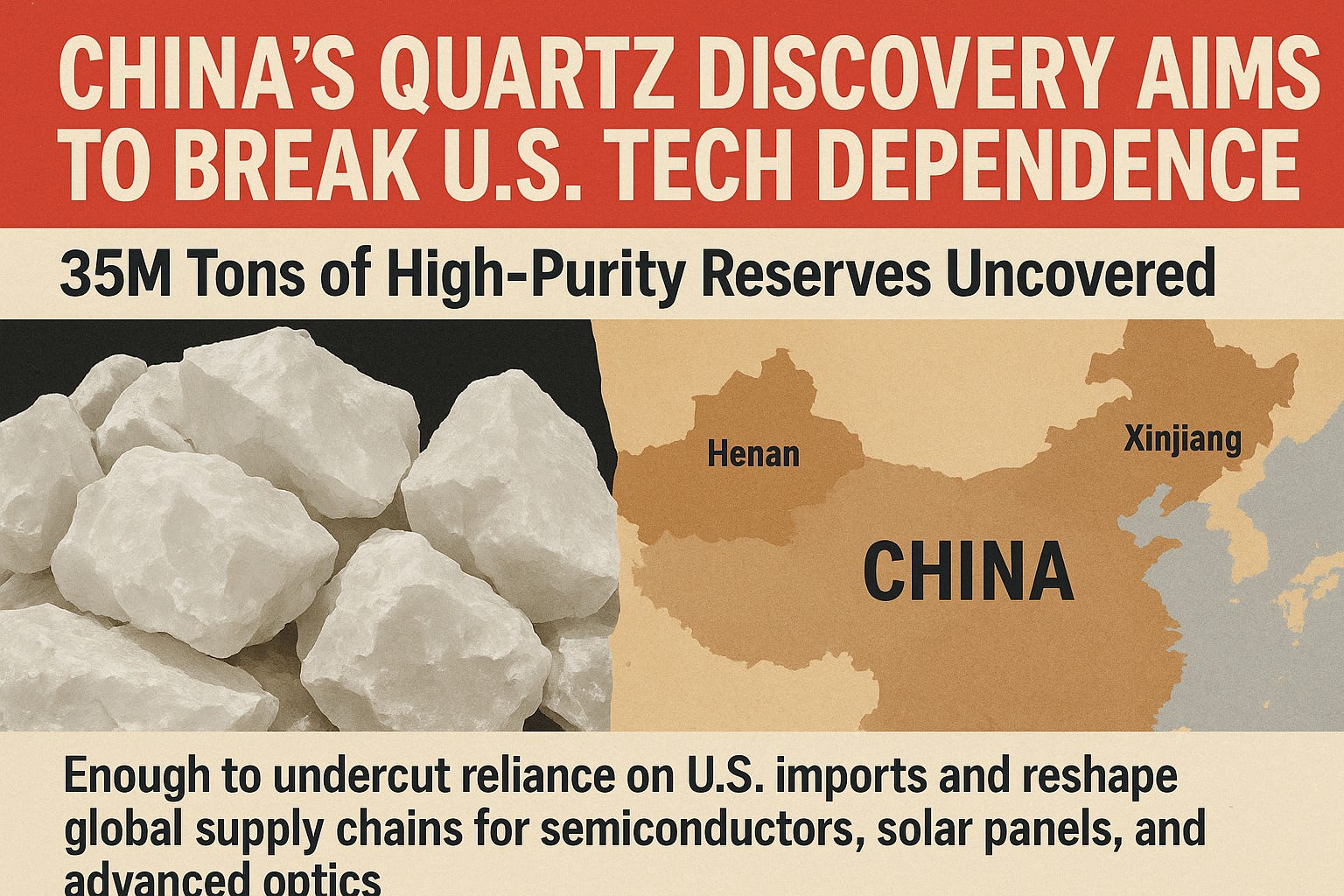
China’s Quartz Discovery Aims to Break U.S. Tech Dependence: 35M Tons of High-Purity Reserves Uncovered
Bottom Line Up Front (BLUF): China has discovered over 35 million tons of high-purity quartz (HPQ) in Henan and Xinjiang—enough to undercut its reliance on U.S. imports and reshape global supply chains for semiconductors, solar panels, and advanced optics. The move is strategic: HPQ is essential for manufacturing silicon wafers, and China currently imports ~80% of its supply, mainly from the U.S.
Analyst Comments: HPQ is foundational to microelectronics, and China has long depended on one primary U.S. source: the Spruce Pine mine in North Carolina. By localizing this supply, China reduces a critical vulnerability in its semiconductor and solar supply chains. The shift could marginalize U.S. material leverage in future tech disputes. The bigger question is: How fast can China move from raw material to refined, ultra-high purity wafers? If they hit 4N8 purity consistently, Western fabs could face stiffer competition or strategic shortages if existing sources are redirected or priced out.
READ THE STORY: Leravi
Hackers Use “ClickFix” to Deliver NetSupport RAT — Intelligence Briefing
Bottom Line Up Front (BLUF): Adversaries increasingly use a social‑engineering vector dubbed ClickFix (a fake remote‑support instruction page) to trick victims into pasting a single command into Windows Run. That command executes a multi‑stage PowerShell or MSI loader, which decodes Base64 payloads and installs NetSupport RAT with persistence via a startup shortcut. Multiple criminal clusters (EVALUSION, FSHGDREE32/SGI, XMLCTL/UAC‑0050) are observed using variants and bulletproof hosting. This vector bypasses many email filter/signature controls because it relies on interactive user execution.
Analyst Comments: ClickFix is simple, low‑tech, and effective: one human mistake (paste+Enter) converts a web social‑engineer into a dropper. The technique reduces attacker infrastructure complexity and increases success rates against organizations relying only on email/file detection. Using legitimate tools (PowerShell, msiexec.exe) and tactics (RunMRU cleanup, startup shortcuts) shows a conscious effort to blend with regular admin activity and erase forensic traces. Defenders should treat ClickFix as a persistent initial access vector and prioritize user‑facing controls, robust endpoint logging, and anomaly detection that looks for behavior rather than just known files.
READ THE STORY: GBhackers
Huawei’s Comeback Defies U.S. Sanctions: Mate 60 Pro Symbolizes Tech Sovereignty Amid Ongoing Economic War
Bottom Line Up Front (BLUF): Despite years of aggressive U.S. sanctions, legal pressure, and a global campaign to cripple its operations, Huawei has re-emerged with a domestically produced 5G smartphone powered by the Kirin 9000S—built on a 7nm process inside China. The Mate 60 Pro marks a pivotal shift: Huawei has survived the tech blockade and regained strategic momentum, signaling China’s accelerating push for self-reliant innovation.
Analyst Comments: The U.S. government spent years trying to decouple Huawei from global supply chains, targeting everything from chipmaking tools to overseas markets. However, with the Mate 60 Pro and its domestically manufactured SoC, Huawei has proved that China’s semiconductor industry—while not yet at parity with TSMC or Intel—can produce functional 7nm chips under sanctions. That means the tech war’s assumptions about choke points are crumbling. Expect Beijing to double down on “de-Americanizing” its tech stack across sectors, from phones to cloud infrastructure. This is a flashing red light for U.S. policymakers: the containment strategy has clear limits.
READ THE STORY: MRonline
Maritime Security Back on Global Agenda as Threats to Shipping Intensify
Bottom Line Up Front (BLUF): The UN Security Council has renewed its focus on maritime security amid a sharp rise in physical and cyber threats to global shipping. Between 2023–2025, over 200 missile and drone strikes in the Red Sea, escalating piracy, and rising cyberattacks have disrupted key trade routes and exposed vulnerabilities in global supply chains. Experts and governments are now calling for collective action—blending naval patrols, public-private cooperation, and cybersecurity modernization—to prevent further destabilization of maritime logistics, which underpin 90% of global trade.
Analyst Comments: In 2024 alone, nearly 150 piracy and armed robbery incidents were recorded globally, with 126 hostages taken—many exploited for political leverage. Since late 2023, over 200 drone and missile attacks have hit Red Sea shipping, cutting traffic by 50% and inflicting monthly losses of $800 million on Egypt alone. Meanwhile, the maritime sector sees cyberattacks with average costs exceeding $550,000 per incident. Experts and international organizations warn that cyber threats—from both state and non-state actors—will continue to multiply. Despite the resilience of global shipping, these compounding threats are pushing the system closer to a breaking point.
READ THE STORY: ORF
China’s Rare Earth Gambit Triggers Global Blowback as U.S. Builds United Trade Front
Bottom Line Up Front (BLUF): China’s sweeping export controls on rare earth elements have backfired diplomatically, drawing coordinated opposition from the U.S., EU, Japan, and G7 allies. As trade talks between Washington and Beijing resume, U.S. tariffs are poised to spike to 157% if no compromise is reached. Meanwhile, Washington is leveraging the moment to build a multilateral alliance to counter China’s dominance in critical minerals.
Analyst Comments: Beijing may have overplayed its hand. Rare earths are essential, but weaponizing them during an economic downturn and with strained foreign relations has triggered rare alignment among U.S. allies. The irony? Trump’s trade team—typically unilateral—now finds itself rallying multilateral support. China’s attempt to pressure Washington via export restrictions catalyzes what it sought to prevent: strategic decoupling and global rare earth diversification. Whether a deal is struck this week or not, the long-term result is clear: the West is accelerating efforts to reduce dependence on China for critical energy, defense, and tech inputs.
READ THE STORY: Fortune
China Allegedly Enhanced Missiles with UAE AI Tech, Sparking U.S. Intelligence Alarm
Bottom Line Up Front (BLUF): U.S. intelligence agencies concluded in 2022 that China used AI and software from the UAE’s G42—an Abu Dhabi-based tech firm with links to Huawei—to enhance the range of its PL-15 and PL-17 air-to-air missiles. The findings, reportedly tied to a commercial relationship between G42 and Huawei, triggered internal U.S. debate over whether the UAE is drifting into China’s orbit and raised concerns about Chinese gains in air superiority over American jets, particularly in a Taiwan conflict scenario.
Analyst Comments: The UAE sits at a critical intersection of U.S. military infrastructure and global AI investment. However, its willingness to engage deeply with U.S. and Chinese tech ecosystems presents a growing counterintelligence problem. That a U.S.-backed firm—partly funded by Microsoft and Mubadala—could indirectly enable the PLA’s missile advantage underscores the strategic fragility of allied tech pipelines. G42’s denials are forceful, and there’s no public evidence of legal wrongdoing, but intent is secondary here. The concern is capability leakage, not compliance. The Biden administration’s reported attempt to blacklist G42 and the Trump administration’s “guardrails” around AI cooperation suggest bipartisan recognition that strategic tech flows need tighter controls. In the future, any U.S.-UAE AI cooperation will hinge on verifiable decoupling from Chinese supply chains—a difficult ask given Huawei’s deep-rooted role in regional infrastructure.
READ THE STORY: FT
Senior Russian Envoy Visits U.S. Amid New Sanctions on Rosneft and Lukoil
Bottom Line Up Front (BLUF): Kirill Dmitriev, CEO of Russia’s sovereign wealth fund and a close Putin ally, arrived in the U.S. just days after Washington imposed sanctions on Russian oil giants Rosneft and Lukoil. The trip, confirmed by both sides, signals Moscow’s intent to re-engage through economic diplomacy despite escalating restrictions. Dmitriev claims the visit was pre-arranged and aims to assert that Ukraine—not Russia—is obstructing peace negotiations.
Analyst Comments: Dmitriev confirmed his U.S. arrival via social media, stating the goal was to “continue the US-Russia dialogue” and challenge Ukraine’s obstruction of peace talks. He referenced Putin’s recent remarks warning that “pressure does not work with Russia” and emphasized Moscow’s readiness for cooperation—if “its interests are respected.” While the U.S. confirmed the visit, it offered no details on who Dmitriev would meet. In April, He met Trump’s special envoy, Steve Witkoff, and attended the Putin-Trump summit in Anchorage. His pitch reportedly includes joint projects in the Arctic and a Bering Strait tunnel, but post-sanctions, even Russian elites are skeptical of the U.S. appetite for engagement.
READ THE STORY: FT
Items of interest
China Tightens Rare Earth Exports: US Defense Supply Chain Faces Strategic Risk, Contractors Downplay Impact
Bottom Line Up Front (BLUF): China’s new export restrictions on rare earth elements—particularly for defense applications—could severely disrupt US weapons production in the coming weeks. Despite this, top defense contractors Lockheed Martin, RTX Corporation, and Northrop Grumman downplayed the threat during recent earnings calls, citing proactive stockpiling and longstanding supply chain precautions.
Analyst Comments: Earlier this month, China announced new controls on rare earth mineral exports, including a full ban on any materials bound for foreign defense use. That’s significant because systems like the F-35 and Tomahawk missile depend on components made with these elements. While China holds around 70% of global mining capacity, it dominates processing and magnet manufacturing even more—over 90%. Despite this, Northrop Grumman CEO Kathy Warden stated the company has been preparing by securing its supply chain. Lockheed Martin’s leadership echoed similar confidence, attributing resilience to years of coordination with government and suppliers. Analysts like Morningstar’s Nicolas Owens believe this is less of an “if” and more of a “when” scenario, suggesting the primes have long anticipated this threat and built buffers accordingly.
READ THE STORY: Yahoo Finance
China’s Rare Earth Dominance: How Secure Is Its Global Leverage? (Video)
FROM THE MEDIA: China dominates the world’s rare earth supply, which is critical for tech, defense, and green energy. Can global powers break free from Beijing’s grip? Discover the stakes behind China’s rare earth leverage in this deep dive from China Panorama.
US, Australia sign $8.5bn deal to curb China’s rare earth dominance (Video)
FROM THE MEDIA: The U.S. and Australia signed an 8.5 billion dollar deal to secure rare earths and cut reliance on China. They hope to tap Australia’s 53 billion dollars in mineral reserves. Over six months, they’ll invest billions, set price floors, and fast-track mining, reshaping clean energy and defense supply chains. Our experts also talk about the deal.
The selected stories cover a broad array of cyber threats and are intended to aid readers in framing key publicly discussed threats and overall situational awareness. InfoDom Securities does not endorse any third-party claims made in its original material or related links on its sites; the opinions expressed by third parties are theirs alone. For further questions, please contact InfoDom Securities at dominanceinformation@gmail.com.