
Daily Drop (1130)
09-07-25

Sunday, Sep 07, 2025 // (IG): BB // GITHUB // SN R&D
Putin Wagers Ukraine’s Army Will Break Before His Economy Does
Bottom Line Up Front (BLUF): Russian President Vladimir Putin is rejecting U.S. peace overtures and continuing his war against Ukraine, wagering that Ukraine’s military will break down before sanctions and economic strain undermine his regime. Despite rising deficits and declining oil revenues, Russia’s war economy remains resilient, while Ukraine’s forces face critical manpower shortages and growing fatigue on the front lines.
Analyst Comments: Putin’s long-game strategy highlights the dangerous calculus of attritional warfare: betting on political endurance over military breakthroughs. His refusal to compromise signals confidence that Ukraine's allies will waver before his domestic situation becomes untenable. Meanwhile, Ukraine's reliance on Western support, both militarily and economically, is now more pivotal than ever. The war’s trajectory increasingly hinges on whether the West can accelerate sanctions enforcement and arms deliveries fast enough to outpace Ukraine's depletion and avoid a battlefield collapse.
FROM THE MEDIA: Russian economic growth in 2023–2024 gave Moscow breathing room, but recent oil revenue declines, growing deficits, and fuel shortages show emerging cracks. Still, analysts estimate Russia could sustain military operations for another 2–3 years unless tougher sanctions take hold. Ukraine struggles to replace exhausted infantry on the battlefield, particularly in critical regions like Donetsk and Zaporizhzhia. Despite improving its drone capabilities and expanding domestic arms production, Ukraine’s manpower crisis worsens due to uneven draft policies and falling morale. Experts warn that Russia may win its bet through sheer endurance unless Kyiv resolves structural military issues and Western support intensifies.
READ THE STORY: WSJ
Ukraine's Flamingo Missile Debuts in Combat, Reveals Both Promise and Limitations
Bottom Line Up Front (BLUF): High-resolution satellite imagery confirms Ukraine’s FP-5 Flamingo missile system's first known operational strike. Of the three missiles reportedly launched, only one appears to have successfully struck the intended target, with the others missing or failing mid-flight. Despite this partial success, the strike demonstrates Ukraine’s growing long-range precision capabilities and is a critical field test for the new weapon.
Analyst Comments: The Flamingo’s debut offers insight into the early-stage effectiveness of Ukraine’s indigenous missile development, revealing both progress and areas for refinement. While a 33% success rate may seem modest, it is a realistic outcome for a maturing system likely designed more for testing and signaling than for decisive battlefield effects. The cost of the strike package—estimated at up to $3 million—raises questions about operational ROI, especially given the high financial and strategic stakes involved in long-range missile use. Nevertheless, as Ukraine increasingly targets critical infrastructure and radar systems in Crimea, successful iteration of the Flamingo could enhance Ukraine’s ability to degrade Russian air defense and command-and-control capabilities.
FROM THE MEDIA: Missile analyst Fabian Hoffmann published a preliminary battle damage assessment of what he believes to be the first public use of Ukraine’s Flamingo missile system in combat. Satellite imagery showed a single accurate strike, one miss approximately 15–40 meters off-target, and a third missile that failed or was intercepted before impact. While no pre-strike imagery is available for full confirmation, visible craters and burn patterns support these findings. The target was chosen for test viability rather than maximum strategic value. Given the cost of each missile volley—estimated near $3 million—the importance of increasing hit probability in future strikes is high.
READ THE STORY: Fabian Hoffmann
Xi Jinping plots a post-American world
Bottom Line Up Front (BLUF): A lavish Chinese military parade commemorating WWII’s end brought together Presidents Xi, Putin, Kim Jong Un, and Iran’s Pezeshkian, showcasing deepening alignment among authoritarian powers. While Xi preached peace, the event highlighted military might and geopolitical defiance against the West. President Trump’s strained diplomacy weakens traditional alliances and inadvertently reinforces China-led multipolar ambitions.
Analyst Comments: The symbolic unity of Xi Jinping, Vladimir Putin, Kim Jong Un, and Iranian President Masoud Pezeshkian illustrates the consolidation of a de facto bloc challenging Western influence. Though internal contradictions exist among these nations, their shared grievances—against U.S. sanctions, NATO expansion, and Western economic dominance—drive deeper coordination. The absence of President Trump from the event, paired with his ambivalent stance toward traditional allies and tariffs on strategic partners, may accelerate geopolitical realignment. The West risks strategic isolation if it fails to rebuild trust and cohesion among its alliances.
FROM THE MEDIA: China held a massive military parade in Beijing marking the 80th anniversary of the end of World War II. The event was attended by over 25 world leaders, including Russian President Vladimir Putin, North Korean leader Kim Jong Un, and Iranian President Masoud Pezeshkian. In his speech, Xi Jinping spoke of peace and cooperation but was flanked by leaders supporting Russia’s war in Ukraine. The parade featured hypersonic missiles and other systems designed for regional dominance, particularly in the Taiwan Strait. At the accompanying SCO summit, leaders discussed launching a development bank and alternative financial systems to reduce reliance on the U.S. dollar.
READ THE STORY: FT
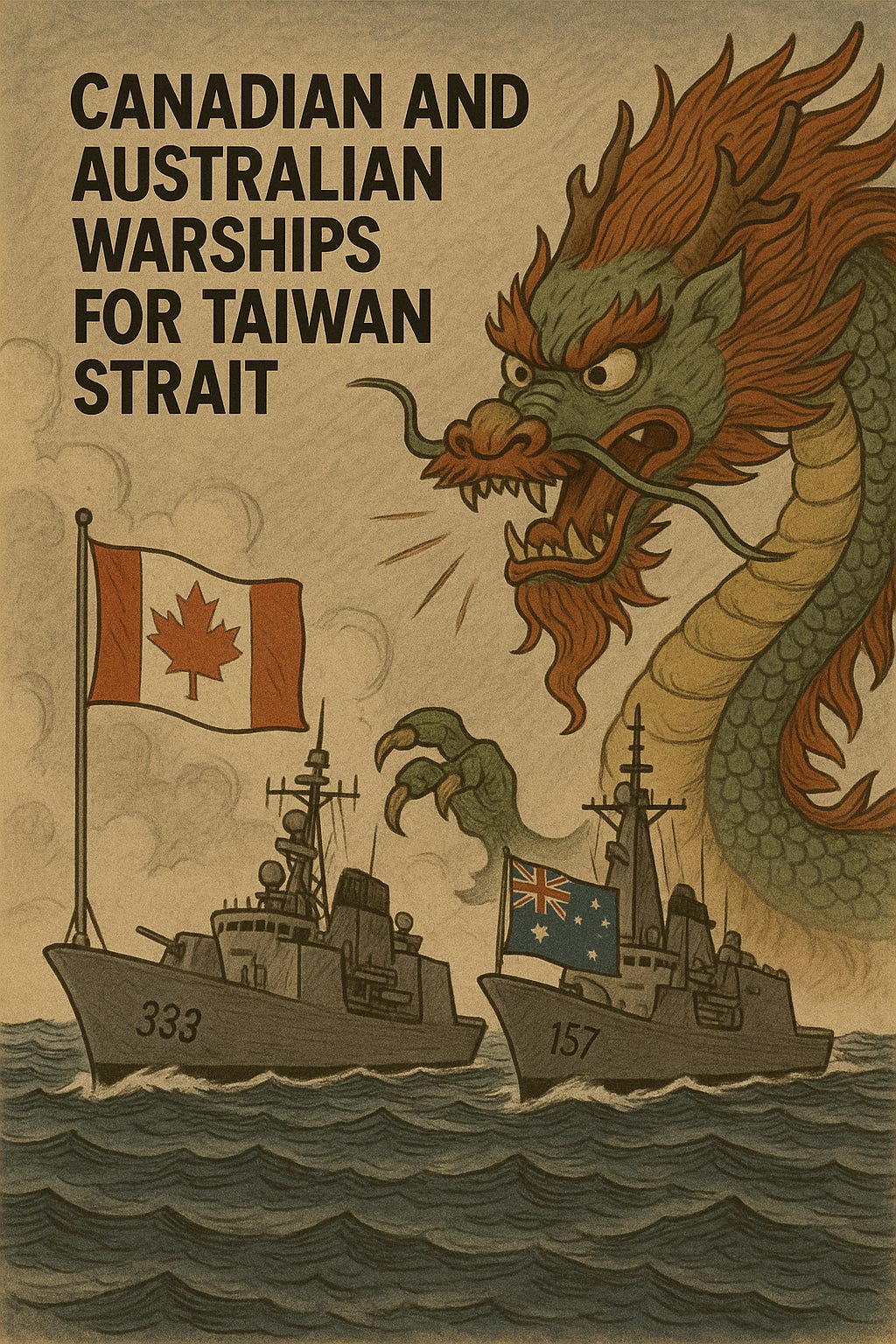
China Condemns Canadian and Australian Warships for Taiwan Strait Transit
Bottom Line Up Front (BLUF): China's military accused Canadian and Australian naval forces of "provocation" after their warships transited the Taiwan Strait on Saturday, September 6, 2025. The People's Liberation Army (PLA) tracked and monitored the Canadian frigate HMCS Ville de Québec and Australian destroyer HMAS Brisbane, warning that such actions increased regional security risks.
Analyst Comments: This latest naval transit reflects growing international support for freedom of navigation in contested waters, especially amid escalating tensions in the Indo-Pacific. China’s sharp response underscores Beijing’s sensitivity to foreign military presence near Taiwan, a flashpoint in U.S.-China geopolitical rivalry. Regular transits by U.S. and allied navies are testing China's claims to the strait as territorial waters. If these maneuvers continue, we may see more aggressive PLA countermeasures or a diplomatic escalation involving Australia and Canada.
FROM THE MEDIA: The PLA labeled the transit a deliberate "provocation" and said it deployed naval and air forces to monitor the warships throughout their passage. A spokesperson for Canada stated that the operation was part of "Operation Horizon," aimed at promoting stability in the Indo-Pacific, and that the ship had recently operated in the Philippine Exclusive Economic Zone during freedom of navigation exercises. Taiwan's Ministry of National Defense confirmed its monitoring and emphasized that the strait remains an international waterway.
READ THE STORY: Reuters
Autonomous Mass and the Coming Arms Race: The U.S. Bets on Warbots for Taiwan Defense
Bottom Line Up Front (BLUF): The United States is pursuing autonomous mass and man-machine teaming to address capability gaps in a potential conflict with China over Taiwan. Autonomous systems—such as drones, robotic vehicles, and AI-enabled platforms—are intended to absorb early strikes and maintain combat effectiveness in prolonged attritional warfare.
Analyst Comments: The current U.S. force structure faces disadvantages in production capacity, geography, and scale compared to the People’s Liberation Army. Autonomous systems are being developed to offset these disadvantages by increasing force survivability and persistence at lower cost. The People’s Republic of China has introduced concepts such as "mothership warfare" and demonstrated the capacity to mass-produce unmanned systems. Success in future conflict scenarios depends on rapidly iterating hardware and software, deploying systems effectively, and integrating autonomous units into command structures. Industrial flexibility and supply chain control are key determinants of strategic advantage.
FROM THE MEDIA: Autonomous platforms are being designed for scalability and deployment in high-risk environments to reduce reliance on manned systems. These include both small, expendable drones and larger, more capable platforms. The U.S. strategy emphasizes forward deployment, modular logistics, and rapid technological iteration to maintain operational momentum. China's potential to mass-produce autonomous systems at scale was identified as a significant strategic concern.
READ THE STORY: Breaking Beijing
US Army Awards $98.9M Contract to TurbineOne for AI Battlefield Target-Tracking System
Bottom Line Up Front (BLUF): The US Army has signed a five-year, $98.9 million contract with San Francisco AI startup TurbineOne to deploy its Frontline Perception System (FPS). This edge-based AI tool identifies and tracks battlefield targets. The platform processes sensor data without internet access, delivering real-time intelligence directly to soldiers' mobile devices while ensuring that humans retain ultimate decision-making authority.
Analyst Comments: TurbineOne's FPS aims to reduce the burden on analysts by offering an adaptable, no-code tool for frontline operators. However, battlefield use of AI—even with human oversight—raises critical ethical, operational, and legal concerns, especially in dynamic combat situations where false positives can have fatal consequences. The rapid transition from pilot to production highlights the DoD’s urgency to integrate private-sector AI solutions, perhaps faster than the technology’s maturity warrants.
FROM THE MEDIA: The FPS tool is model-agnostic and can ingest data from multiple sources—including air, land, sea, and space-based sensors—to generate actionable intelligence without needing connectivity to the internet or cloud. Soldiers can retrain and deploy models directly in the field, increasing adaptability during missions. While concerns over AI accountability in combat persist, TurbineOne claims its system aligns with the DoD’s Responsible AI Principles, as it supports—not replaces—human judgment.
READ THE STORY: The Register
West Point Reintroduces War Studies Amid Broader Debate on Military Education's Decline
Bottom Line Up Front (BLUF): The United States Military Academy at West Point is launching a new academic major in War Studies, reorganizing its Department of History to reflect this shift. This move comes as interest in military history and strategic thought continues to decline across American universities, raising concerns about the lack of rigorous education on the political, institutional, and operational dimensions of war.
Analyst Comments: While the field promises to be interdisciplinary, its actual implementation remains vague, risking a rebranding of existing silos rather than a genuine integration of political and strategic thinking. The move could help bridge the gap between theoretical and operational understandings of war—but only if it avoids the trap of reducing military education to either technical training or abstract theory. With rising global instability and the return of great power competition, future leaders must be intellectually prepared for war’s complex realities.
FROM THE MEDIA: West Point announced the creation of a War Studies major and the reorganization of its Department of History into the Department of History and War Studies. Brigadier General Shane Reeves, Dean of the Academic Board, emphasized the need for officers to become experts in warfare, describing the new approach as “multidomain” and “interdisciplinary.” While the program aims to integrate historical, strategic, and institutional perspectives, critics note the lack of clarity in its methodology—particularly its reference to a “Clausewitzian approach,” which can mean vastly different things depending on interpretation. This development follows a broader pattern of American higher education reducing focus on military history, with only 5% of history professors identifying military history as a core interest. In contrast, King's College London has maintained a robust War Studies department since the 1960s, offering a model of interdisciplinary engagement largely absent in the U.S. civilian university system.
READ THE STORY: Secretary of Defense Rock
