
Daily Drop (1128)
09-04-25

Thursday, Sep 04, 2025 // (IG): BB // GITHUB // SN R&D
Strategic Messaging Through V-Day Parade Attendance and Weapons Display
Bottom Line Up Front (BLUF): The unprecedented joint appearance of Xi Jinping, Vladimir Putin, and Kim Jong-un at China’s September 3, 2025, military parade marks a historic trilateral alignment amid global tensions. The event’s deliberate focus on Taiwan-targeted weapons and cyberwarfare capabilities and exclusion of Western participants reinforce a coordinated challenge to U.S. influence across nuclear, conventional, and digital domains.
Analyst Comments: This parade represents a fundamental evolution in China’s military signaling—eschewing the optics of peaceful rise for rigid power posturing. By showcasing hypersonic, anti-carrier, and cyber capabilities while elevating cyber forces to full military parity, Beijing sent a clear deterrence message to Washington and its allies. The optics of authoritarian solidarity—featuring leaders from Russia, North Korea, Iran, and Belarus—underscore the emergence of an informal, sanctions-defying axis. Notably, India's absence and the lack of Western representation contrast sharply with past parades, confirming the shift from diplomatic engagement to bloc-based confrontation.
FROM THE MEDIA: Chinese President Xi Jinping hosted a massive military parade in Beijing, attended publicly by Russian President Vladimir Putin and North Korean leader Kim Jong-un, marking their first-ever joint public appearance. The event also featured Iran’s President Masoud Pezeshkian and Belarus’s Alexander Lukashenko, while leaders of most democratic nations were absent. The parade highlighted advanced weapons, including the YJ-21 hypersonic anti-ship missile, DF-26D intermediate-range ballistic missile, and JL-1 air-launched nuclear missile—capabilities aligned with Taiwan conflict scenarios. Also on display were the Type 100 amphibious tank and unmanned underwater vehicles believed to target submarine cables. Cyberwarfare and information forces marched as standalone military branches, reflecting the strategic weight of China’s ongoing Salt Typhoon cyber campaigns targeting U.S. telecom infrastructure. The 2025 event sharply contrasted with the 2015 parade, where Western and democratic nations had been represented.
READ THE STORY: NR
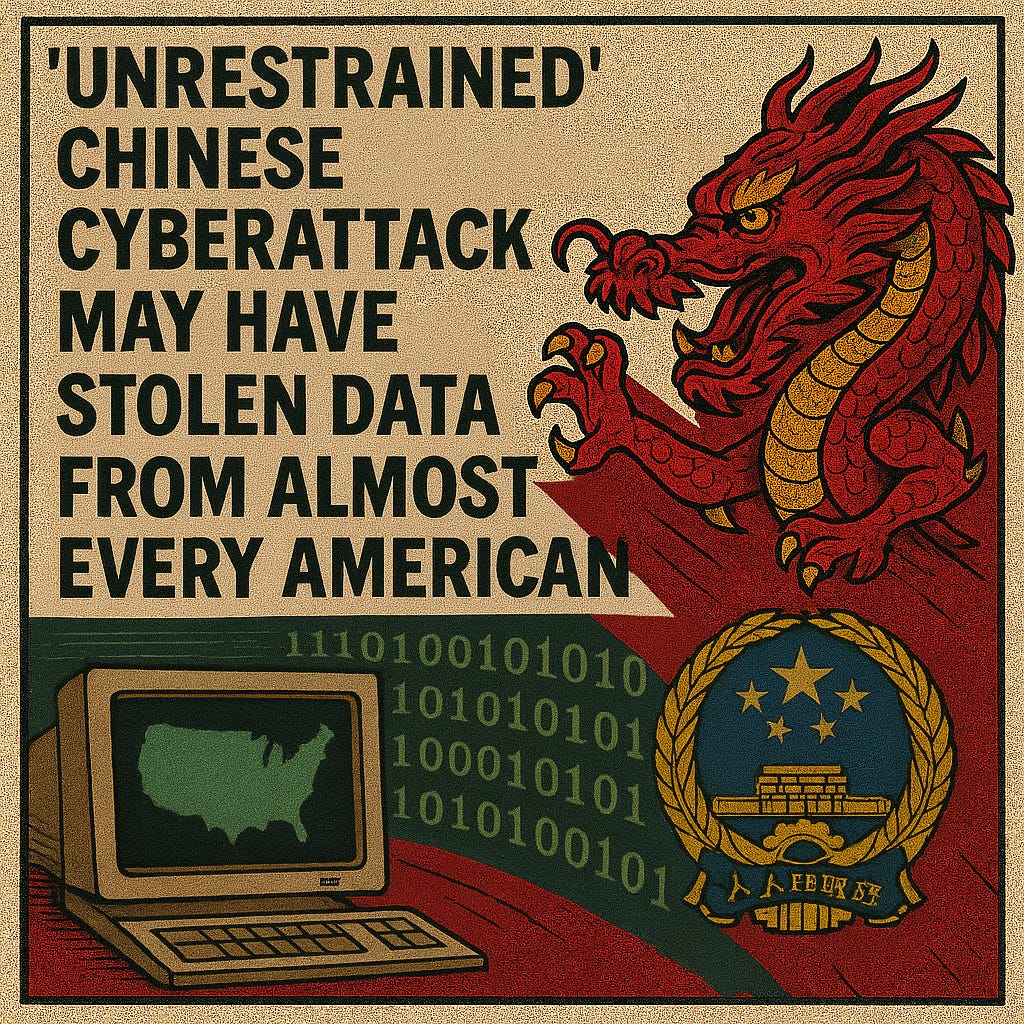
Salt Typhoon Attack May Have Compromised Data From "Almost Every American" Across 80+ Countries
Bottom Line Up Front (BLUF): The Salt Typhoon cyberattacks’ scope far exceeded initial assessments, potentially affecting data from nearly every American citizen while targeting over 80 countries' telecommunications, government, transportation, and military infrastructure networks. A joint statement from the U.S., UK, Canada, Finland, Germany, Italy, Japan, and Spain condemned the "unrestrained" and "indiscriminate" campaign, which has been active since at least 2019 but was only discovered last year.
Analyst Comments: Former FBI cyber division chief Cynthia Kaiser's assessment that "no American was spared" suggests adversaries now possess comprehensive communications metadata enabling pattern-of-life analysis at a population scale. The three-to-five-year undetected dwell time allowed Chinese operators to establish persistent access across global communications architecture, potentially creating backdoors that will take years to remediate fully. Jennifer Ewbank, former CIA deputy director for digital innovation, correctly identifies this as a generational leap from industrial espionage to infrastructure dominance. The coordinated Western response through joint attribution represents diplomatic escalation, but the lack of disclosed countermeasures suggests limited immediate remediation options. Targeting Trump and Vance's campaign phones alongside Democratic officials indicates strategic intelligence collection prioritizing future U.S. leadership regardless of party affiliation.
FROM THE MEDIA: Investigators linked the operation to at least three China-based technology companies operating since 2019, working for military and civilian intelligence agencies. According to Senator Mark Warner, the hackers exploited old network vulnerabilities to penetrate over six U.S. telecommunications companies alone, gaining capabilities to listen to phone conversations and read unencrypted text messages. The attack's breadth was unprecedented, with British and American officials using terms "unrestrained" and "indiscriminate" in their joint condemnation. In Foreign Affairs, a Biden administration cybersecurity official, Anne Neuberger wrote that this represents China's "positioning itself to dominate the digital battle space." The hackers' goal was obtaining "the capability to identify and track their targets' communications and movements worldwide," building on previous breaches of Marriott, health insurers, and the Office of Personnel Management. Jamie MacColl of the Royal United Services Institute noted China has collected large datasets for years, intending eventual exploitation as capabilities matured.
READ THE STORY: The New York Times
Xi Accelerates Military AI Through Civilian Partnerships, Tapping Hundreds of Private Firms and Universities
Bottom Line Up Front (BLUF): New data reveals that China is systematically incorporating private companies and civilian universities into its military AI development under its “civil-military fusion” strategy. Over 85% of Chinese AI defense contracts in 2023–2024 were awarded to nontraditional defense entities, including blacklisted firms and newly founded startups, with Shanghai Jiao Tong University emerging as a major contractor.
Analyst Comments: China’s integration of civilian tech talent and academia into military R&D is strategic and deeply embedded—posing a significant challenge to Western export controls and deterrence policies. Unlike the more fragmented U.S. approach, the PLA effectively aligns national resources around AI modernization. This unified model enables rapid adoption of advanced capabilities like drone swarms, autonomous kill webs, and real-time battlefield coordination. U.S. policymakers face a difficult choice: expand sanctions broadly or risk falling behind in AI-driven warfare readiness.
FROM THE MEDIA: Georgetown University’s CSET analyzed nearly 3,000 PLA AI-related contract awards and found that most were won by entities not traditionally linked to defense, including private startups and top-tier universities like Shanghai Jiao Tong. The university alone signed 14 defense AI contracts in 2023–2024, including one to build maritime “kill webs” that adapt to changing battlefield conditions in real-time. Other projects focus on underwater drone design, target tracking, and RF-sensitive drone swarms. Despite previous U.S. sanctions, firms like iFlytek Digital—an offshoot of blacklisted iFlytek—secured dozens of defense AI contracts by restructuring as new entities. China’s public bidding process for sensitive military tech is unusual among major powers, allowing insight into the scope of this AI mobilization. Experts warn the PLA is closing its innovation gap with the West by reducing barriers for civilian contributors and aggressively pursuing AI battlefield dominance.
READ THE STORY: WSJ
China's Cyber Strategy Evolution: From Economic Espionage to Infrastructure Warfare
Bottom Line Up Front (BLUF): CYFIRMA analysis reveals China's cyber operations have evolved through three distinct phases since the early digital age, transforming from opportunistic economic espionage to strategic political-military campaigns exemplified by Salt Typhoon's penetration of telecommunications in 80+ countries and Volt Typhoon's pre-positioning of "digital booby traps" across U.S. critical infrastructure. These campaigns exploit fundamental structural asymmetries between China's centralized, state-controlled cyber defenses and the West's fragmented, privately-managed infrastructure.
Analyst Comments: The structural analysis is particularly compelling—China's Great Firewall, initially built for censorship, now provides multilayered infrastructure protection while enabling offensive operations without fear of symmetric retaliation. The U.S.'s constitutional constraints against warrantless monitoring and reliance on profit-driven private entities create exploitable gaps that "living off the land" techniques leverage for years-long persistence. Volt Typhoon's targeting calculus—avoiding healthcare while focusing on dual-use infrastructure like power and water—reveals sophisticated strategic planning aligned with "active defense" doctrine for Taiwan contingencies. The campaigns' undetected multi-year dwell times suggest current detection capabilities remain inadequate against state-level adversaries employing legitimate process hijacking.
FROM THE MEDIA: Salt Typhoon achieved "Snowden-level" breach severity by compromising court-authorized wiretapping systems and aggregating comprehensive communications datasets enabling pattern-of-life analysis. The operation prompted FBI notifications to 600 potentially targeted companies and U.S. officials advising elites to assume communications compromise. Volt Typhoon embedded capabilities to trigger cascading infrastructure failures without directly attacking military targets, maintaining plausible deniability while imposing civilian costs to deter U.S. intervention. The campaigns exploited outdated telecommunications infrastructure despite the $3 billion equipment replacement program, as vulnerabilities existed in Western-manufactured systems. China's integrated monitoring through the Great Firewall contrasts with U.S. reliance on thousands of private entities with varying security capabilities—small utilities often use default passwords on outdated systems. The failure of the 2015 Obama-Xi agreement, followed by the 2023 Microsoft cloud breach, demonstrates diplomatic limitations against state-sponsored operations. FBI Director Wray emphasized the potential for “real-world harm” comparable to simultaneous ransomware attacks without financial motives, referencing the 2019 English forensics and Colonial Pipeline incidents.
READ THE STORY: CYFIRMA
