
Daily Drop (1126)
09-02-25

Tuesday, Sep 02, 2025 // (IG): BB // GITHUB // SN R&D
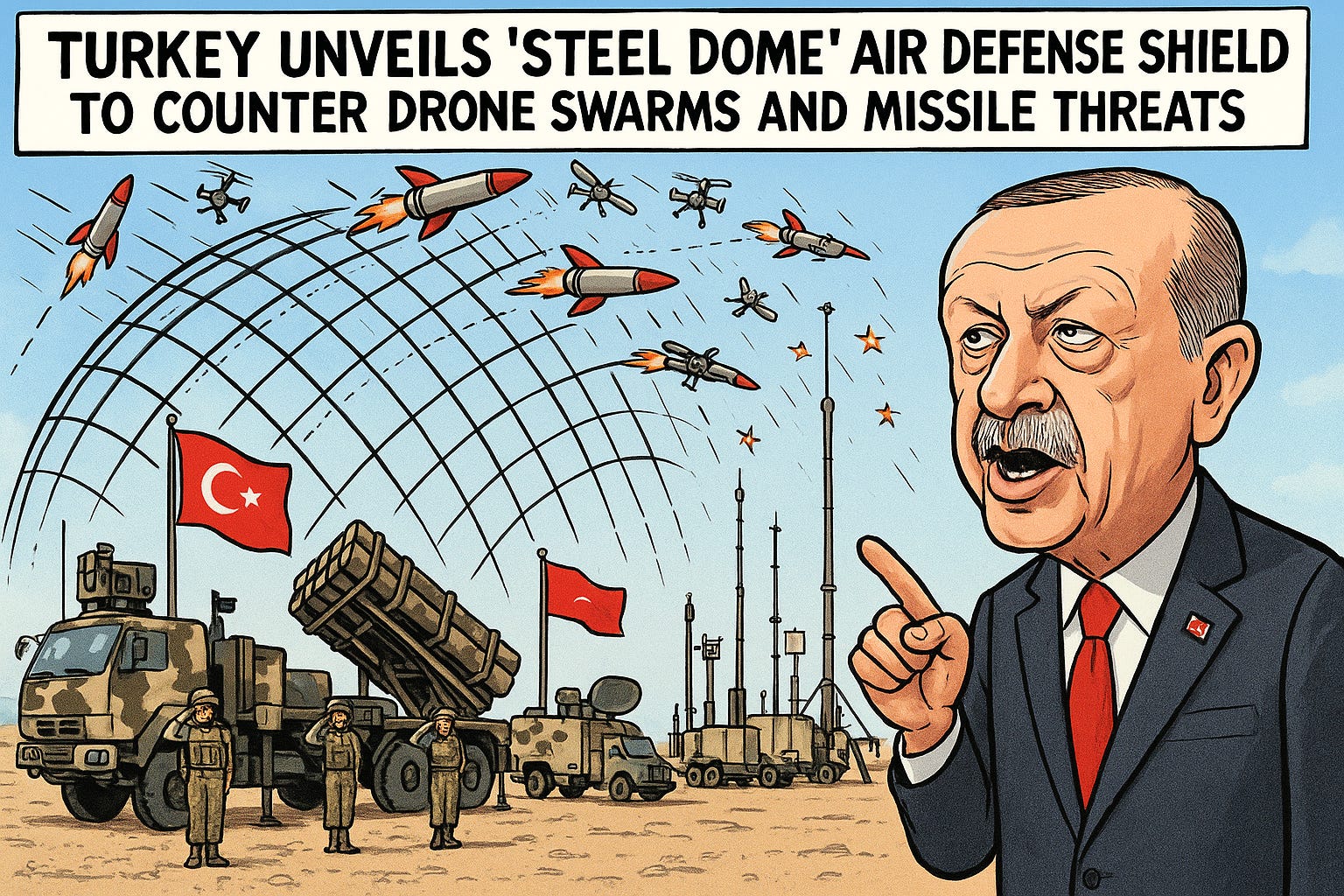
Turkey Unveils ‘Steel Dome’ Air Defense Shield to Counter Drone Swarms and Missile Threats
Bottom Line Up Front (BLUF): Turkey has launched the “Steel Dome,” a multi-layered, integrated air defense system to neutralize drone swarms, cruise missiles, and other aerial threats. Developed domestically with a $460 million initial delivery of 47 vehicles by Aselsan, the system combines radar, air defense, and electronic warfare capabilities in a unified, AI-enhanced platform.
Analyst Comments: This development is both a response to the growing use of drones in regional conflicts and an assertion of military independence. Turkey emphasizes domestic production and intends to reduce reliance on NATO-aligned suppliers amid shifting geopolitical dynamics. Integrating AI for threat recognition and response could be a model for similar systems in mid-tier military powers.
FROM THE MEDIA: Turkish defense contractor Aselsan delivered 47 air defense, radar, and electronic warfare vehicles worth $460 million to the Turkish Armed Forces as part of the initial deployment. President Recep Tayyip Erdoğan described the Steel Dome as a “security umbrella in the skies” and a leap forward in Turkey’s defense capabilities. The system is designed as a “system of systems,” integrating data from multiple sensors and platforms, refined by AI, to create a Recognized Air Picture (RAP) for national defense. The rollout will prioritize key installations—such as the Akkuyu nuclear plant, Ankara, and key maritime straits. While primarily developed locally, the project acknowledges limited foreign input and is carefully managed to preserve its Turkish identity.
READ THE STORY: MSN (IE)
China Releases 2030 Roadmap to Dominate Global Satellite Communications
Bottom Line Up Front (BLUF): China has unveiled a national strategy to expand its satellite communications sector by 2030, focusing on innovation, commercial participation, and integration with next-gen infrastructure. The plan, led by the Ministry of Industry and Information Technology, projects over 10 million satellite users and includes goals for sovereign supply chains, low-Earth orbit (LEO) satellite internet, and cross-sectoral applications.
Analyst Comments: The prioritization of LEO networks, private-public cooperation, and standardization parallels global ambitions of companies like SpaceX and Amazon, but with distinctly state-driven oversight. The dual-use nature of satellite systems also raises cyber and geostrategic concerns, particularly around mobile connectivity, airborne systems, and defense communications. Expect growing scrutiny of China’s satellite infrastructure in contested regions and international standards bodies.
FROM THE MEDIA: Released by the Ministry of Industry and Information Technology, the plan supports over 10 million projected users by the end of the decade and encourages widespread adoption of direct satellite-to-mobile services. Key priorities include advancing LEO satellite networks, supporting agricultural, energy, and urban tech use cases, and fostering cooperation between government and private sectors. The roadmap aligns with China’s national ambitions in digital infrastructure, manufacturing independence, and cyber-sovereignty.
READ THE STORY: Space Daily
China’s Victory Day Parade to Showcase Hypersonic Missiles, Stealth Drones, and Cyber-Warfare Capabilities
Bottom Line Up Front (BLUF): China will mark the 80th anniversary of its victory over Japan with a high-profile military parade on September 3, 2025, in Tiananmen Square. The event will serve as both a celebration and a show of force, featuring new hypersonic anti-ship missiles, mobile ICBMs, stealth drones, and advanced electronic warfare systems—underscoring Beijing’s growing ambition in cyber, space, and strategic deterrence domains.
Analyst Comments: China's unveiling of next-gen hypersonic and AI-powered weapon systems demonstrates its intent to challenge U.S. dominance, particularly in the Pacific. Including cyber and electronic warfare tools suggests future conflicts will increasingly unfold across digital and electromagnetic frontiers. Xi Jinping’s strategic narrative positions China as a peer competitor and potentially a technological leader in domains once dominated by the U.S. and its allies. Expect intensified investment and alliance recalibration across Indo-Pacific defense networks.
FROM THE MEDIA: Among the most anticipated are the YJ-15 through YJ-20 hypersonic anti-ship missiles—designed to threaten U.S. aircraft carriers as part of China’s A2/AD strategy—and new mobile ICBMs like the DF-31AG and DF-41, capable of second-strike nuclear capability. Also expected is the debut of the FH-97, a stealth “loyal wingman” drone equipped with AI, combat sensors, and jamming systems, designed to fly in coordination with manned aircraft. The parade will feature over 10,000 troops, 100 aircraft, and hundreds of vehicles, with President Xi and Vladimir Putin in attendance. Analysts note that the event will highlight China’s expanding arsenal of electronic warfare and directed-energy weapons, focusing on “intelligentized warfare” across multiple domains.
READ THE STORY: Wired
Venezuela Deploys Iranian-Made Armed Drones Amid U.S. Tensions, Enacts Civilian Drone Ban
Bottom Line Up Front (BLUF): Venezuela has begun assembling and deploying Iranian Mohajer-6 combat drones as part of a broader military readiness strategy aimed at deterring a perceived threat from the United States. These drones are capable of surveillance and precision missile strikes. While enhancing military capabilities, the Maduro regime simultaneously imposed a year-long ban on civilian drone use, citing security concerns.
Analyst Comments: By producing UCAVs domestically, Caracas signals a strategic leap in drone warfare capacity, especially in the contested Essequibo region. The parallel crackdown on civilian drones underscores a broader authoritarian pattern: centralizing advanced technologies for state use while restricting public access. Expect further regional destabilization as Venezuela's drone doctrine mirrors tactics seen in other conflict zones like Iran and Yemen.
FROM THE MEDIA: These armed drones, capable of long-range precision attacks, are being assembled locally under a strategic agreement with Tehran. In addition to the Mohajer-6, Venezuela is also operating Russian-made Orlan-10 drones, expanding its drone warfare toolkit. This military expansion comes at the same time the Maduro government has enacted a sweeping ban on all civilian drone flights, a move critics see as deeply hypocritical and emblematic of broader civil liberties suppression. Observers note that the drone buildup may escalate tensions and provoke a response from Washington or neighboring countries.
READ THE STORY: DroneXL
