
Daily Drop (1100)
08-03-25

Sunday, Aug 03, 2025 // (IG): BB // GITHUB // SN R&D
Australia Moves to Reclaim Chinese-Leased Darwin Port Amid U.S.-China Tensions
Bottom Line Up Front (BLUF): Australian Prime Minister Anthony Albanese has renewed efforts to regain control of the strategically critical Darwin Port, currently under a 99-year lease to the Chinese firm Landbridge. The move reflects rising security concerns amid U.S.-China rivalry and proximity to U.S. military assets in northern Australia.
Analyst Comments: The Darwin Port’s location near U.S. and Australian defense facilities makes it a sensitive asset, especially given China's global Belt and Road ambitions. With cyber threats and surveillance risks now overlapping with physical infrastructure control, Australia may push for tighter foreign investment reviews. The situation could influence other democracies to reassess Chinese stakes in critical assets and intensify digital scrutiny of logistics systems connected to foreign-owned infrastructure.
FROM THE MEDIA: Prime Minister Anthony Albanese, who criticized the lease during his election campaign, is under growing pressure from domestic political forces and the United States to reclaim the strategic asset. The port’s proximity to a U.S. Marine Corps base and its use by both U.S. and Australian naval forces have fueled concerns about espionage and surveillance. Beijing has pushed back firmly, with Chinese officials labeling the review discriminatory and politically motivated. Despite a prior government decision in 2023 not to alter the lease, rising geopolitical tensions and Chinese naval activity in the region have reignited debate. Speculation is also around a potential buyback involving U.S. private equity firm Cerberus and Japan’s Toll Group.
READ THE STORY: FT
$37.4 Billion Blockchain Security Gap Exposed by Guardians Chain’s Lubian Heist
Bottom Line Up Front (BLUF): A sophisticated exploit on Guardians Chain’s Lubian decentralized application has resulted in a major crypto theft, highlighting a $37.4 billion vulnerability gap across smart contract ecosystems. The breach has reignited urgent calls for enhanced blockchain security protocols and audit standards.
Analyst Comments: As blockchain protocols scale, unchecked code vulnerabilities and insufficient third-party audits continue to present rich opportunities for attackers. With digital assets now integral to broader financial ecosystems, this $37.4 billion estimate may grow if platforms don’t shift toward formal verification and continuous monitoring. Institutional adoption of DeFi remains at risk unless trust in blockchain infrastructure is restored through proactive defense.
FROM THE MEDIA: Though exact losses are still being assessed, early estimates point to millions of dollars stolen, with broader implications for decentralized finance. The incident has been traced to a smart contract bug that allowed attackers to bypass withdrawal restrictions and exfiltrate locked assets. This breach has prompted cybersecurity analysts to quantify an estimated $37.4 billion risk across DeFi protocols globally—attributed to unaudited or poorly secured smart contracts. Guardians Chain has initiated an emergency response plan and is coordinating with exchanges to freeze the stolen assets. The breach marks one of the most damaging security failures on a Layer 2 platform this year.
READ THE STORY: Ainvest
Chinese Hackers Exploit Microsoft SharePoint in Cyberattacks Targeting U.S. Infrastructure
Bottom Line Up Front (BLUF): A China-linked hacking group has exploited a vulnerability in Microsoft SharePoint to conduct cyber intrusions against U.S. critical infrastructure and private sector organizations. The campaign, active in mid-2025, has been attributed to a state-sponsored threat actor seeking to extract sensitive data and disrupt operations.
Analyst Comments: Exploiting widely used software demonstrates the high value adversaries place on lateral movement within business and government networks. Organizations must patch aggressively and enforce a zero-trust architecture to mitigate such risks. Expect increased scrutiny of Microsoft’s cloud security posture and a potential policy response from U.S. cyber authorities.
FROM THE MEDIA: The campaign targeted entities in the energy, transportation, and defense contracting sectors, aiming to exfiltrate sensitive operational data. Microsoft has confirmed the flaw and issued a security advisory, though many organizations have not patched it in time. The attackers used the SharePoint vulnerability to gain initial access, followed by credential theft and privilege escalation techniques. U.S. authorities have not disclosed the full scope of the impact but confirmed that the campaign is part of broader cyber-espionage activities associated with China’s strategic intelligence objectives.
READ THE STORY: AXIOS
Apple Issues Emergency Patches to Address Chrome Zero-Day Vulnerability
Bottom Line Up Front (BLUF): Apple has released critical security updates for macOS, iOS, and iPadOS to mitigate a high-severity zero-day vulnerability impacting the Chrome browser engine, WebKit. The flaw was actively exploited in the wild, prompting an urgent response from Apple.
Analyst Comments: Apple’s quick patch rollout signals the serious nature of the zero-day, which could allow attackers to execute arbitrary code via malicious web content. The vulnerability affects Safari and other WebKit apps, making it a high-risk vector for drive-by exploits and watering hole attacks. Given the vulnerability's active exploitation, organizations and users should prioritize applying these updates immediately. This incident also illustrates the broader risks shared browser engines pose across platforms.
FROM THE MEDIA: Apple issued emergency patches on August 2, 2025, for multiple operating systems, including iOS 17.6, iPadOS 17.6, macOS Ventura 13.6.2, and Sonoma 14.1.1, addressing a WebKit vulnerability tracked as CVE-2025-23315. The flaw was disclosed after Google’s Threat Analysis Group found it being actively exploited in targeted attacks via the Chrome browser. The vulnerability allows attackers to exploit WebKit through maliciously crafted web content, potentially leading to arbitrary code execution on compromised devices. Apple acknowledged the exploit's active use in the wild but withheld detailed technical data to prevent further abuse. Users of iPhones, iPads, and MacBooks are advised to update their systems immediately to protect against this threat.
READ THE STORY: ET
"Made in China" Drone Recovered at India-Bangladesh Border Sparks Security Probe
Bottom Line Up Front (BLUF): Indian security forces recovered a drone labeled "Made in China" near the India-Bangladesh border in Tripura, prompting a forensic investigation. Authorities are probing potential cross-border surveillance or smuggling operations linked to the device.
Analyst Comments: The presence of a Chinese-manufactured drone at a sensitive border zone raises concerns about grey zone tactics and asymmetric surveillance. Whether used by criminal networks or foreign operatives, such drones can collect sensitive imagery, track patrol patterns, or deliver contraband. The incident underscores the growing need for drone monitoring systems, counter-UAV technology, and robust cross-border intelligence coordination. As drone technology becomes cheaper and more accessible, low-altitude airspace will become a critical frontier in border security.
FROM THE MEDIA: According to The Indian Express, a drone marked “Made in China” was recovered by Indian security personnel near the Indo-Bangladesh border in Tripura’s Sepahijala district. The device was found in a field close to the fencing, raising alarms due to its proximity to a highly sensitive international boundary. Officials from the Border Security Force (BSF) seized the drone and have sent it for forensic analysis to determine its origin and payload history. While initial findings suggest potential use in cross-border smuggling, authorities have not ruled out surveillance or reconnaissance activities. This incident follows similar drone-related security alerts in other northeastern states, reinforcing concerns about illicit aerial activity in border regions.
READ THE STORY: The Indian Express
Ukraine Uncovers $40 Million Corruption Scheme Tied to Military Drone Procurement
Bottom Line Up Front (BLUF): Ukrainian anti-corruption officials have exposed a $40 million embezzlement scheme involving the country’s drone procurement program during wartime. The suspects are accused of overcharging the Ministry of Defense for never-delivered UAVs.
Analyst Comments: While Ukraine has ramped up anti-corruption efforts to reassure Western allies and donors, incidents like this could complicate future military aid and defense contracting. From a cybersecurity and defense logistics standpoint, corruption vulnerabilities may expose technical supply chains to insider threats, data manipulation, or procurement of subpar components. Expect tighter controls and oversight of Ukrainian defense acquisitions moving forward.
FROM THE MEDIA: The suspects, including officials within Ukraine's Ministry of Defense, allegedly signed inflated contracts for unmanned aerial vehicles (UAVs) and rerouted funds offshore without delivering any drones. The operation was part of Ukraine’s accelerated efforts to combat wartime corruption as it continues to fight Russian forces. Authorities have not disclosed the suspects’ names but confirmed that the illicit deals were uncovered with support from Ukraine’s Special Anti-Corruption Prosecutor’s Office (SAPO). The drones were reportedly vital for frontline surveillance and combat operations, making the disruption particularly severe in military terms.
READ THE STORY: CNN
India Confronts China and Pakistan in Escalating Grey Zone Warfare
Bottom Line Up Front (BLUF): India is increasingly engaged in grey zone warfare—covert, deniable operations just below the threshold of open conflict—by China and Pakistan. These tactics include cyber intrusions, disinformation campaigns, and border provocations designed to undermine India’s security without triggering war.
Analyst Comments: Cyber operations and information warfare are central to this new conflict landscape, with India now needing stronger digital defenses, counter-propaganda capabilities, and cross-agency coordination. As adversaries exploit legal ambiguity and asymmetric tools, India's long-term security will depend on building cyber resilience and expanding intelligence-led deterrence. Expect increased investment in AI-driven threat monitoring and cyber attribution technologies.
FROM THE MEDIA: These actions fall short of full-scale war but are strategically designed to erode India's internal cohesion and diplomatic standing. Cyber intrusions have targeted Indian power grids, telecom systems, and government databases. Concurrently, online campaigns have spread anti-India narratives, particularly in the Northeast and Kashmir regions. Military incidents such as Chinese incursions along the Line of Actual Control and Pakistan-backed proxy operations in border areas further blur the lines between peace and conflict. Security experts warn this sustained pressure could destabilize India’s strategic posture if left unchecked.
READ THE STORY: TT
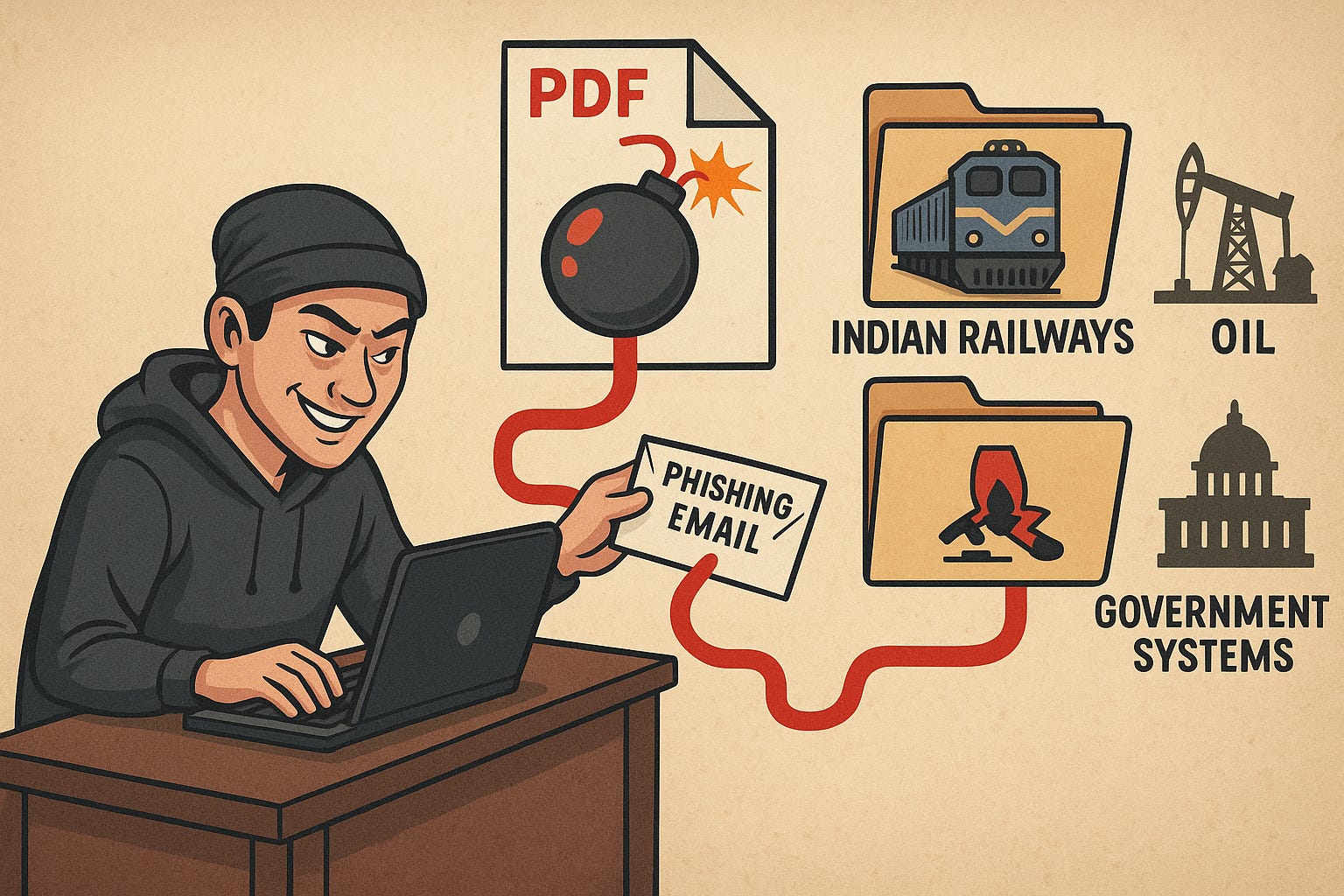
APT36 Hackers Weaponizing PDF Files to Attack Indian Railways, Oil & Government Systems
Bottom Line Up Front (BLUF): APT36, a Pakistan-linked threat group, is actively distributing weaponized PDF files via phishing emails to infiltrate Indian defense targets. These PDFs are embedded with malicious scripts that deploy information-stealing malware once opened.
Analyst Comments: PDF-based malware highlights a low-friction, high-success method of initial compromise, especially effective against personnel lacking advanced cyber hygiene. This tactic suggests an evolving social engineering capability and reflects broader regional cyber tensions. Defenders should monitor for spear-phishing campaigns using file formats perceived as benign.
FROM THE MEDIA: Cybersecurity researchers from Cyble Research and Intelligence Labs (CRIL) have identified an ongoing campaign by APT36, also known as Transparent Tribe, involving malicious PDFs disguised as Indian defense-related documents. These files are embedded with JavaScript that downloads further payloads such as Crimson RAT or LimeRAT—malware families frequently used by the group. The PDFs often impersonate official documents from the Ministry of Defence or other military organizations. Once opened, the documents execute scripts that contact command-and-control servers to exfiltrate sensitive data. APT36 has been linked to Pakistan and has consistently targeted Indian military and government personnel since at least 2013. This latest campaign continues their strategy of leveraging social engineering against geopolitical rivals.
(Source: Cybersecurity News, August 2025)
READ THE STORY: CSN
China Rapidly Expands Satellite Fleet to NEAR-PEER Space Superpower Status
Bottom Line Up Front (BLUF): China has launched over 150 satellites in the first half of 2025, accelerating its strategy to dominate global space infrastructure. The surge supports Beijing's ambitions for military, surveillance, and commercial superiority in orbit.
Analyst Comments: The dual-use nature of many Chinese satellites—supporting both civilian and military applications—raises concerns about the future of space as a contested domain. Increased Chinese orbital presence could complicate satellite traffic management, heighten the risk of espionage, and fuel global cyber warfare scenarios targeting satellite command systems. Strategic watchers should anticipate further investment in anti-satellite capabilities and secure satellite communications.
FROM THE MEDIA: China launched more than 150 satellites in just six months of 2025, with a target to deploy over 300 by year-end. This rapid pace, outstripping any other nation, reflects Beijing’s desire to create a space architecture that supports intelligence gathering, navigation, communications, and military command operations. The newly deployed satellites include high-resolution Earth observation systems, BeiDou navigation units, and signals intelligence platforms. China’s state-backed aerospace entities, including CASC and CASIC, are at the forefront of the effort, supported by a growing ecosystem of private-sector aerospace firms. This satellite boom is part of Xi Jinping’s vision of transforming China into a dominant space power by 2030, with substantial implications for military deterrence and cyber-enabled warfare.
READ THE STORY: The Sunday Guardian
Lazarus Group Deploys 234 Malicious Packages on npm and PyPI to Target Developers
Bottom Line Up Front (BLUF): Between January and July 2025, North Korea’s Lazarus Group infiltrated the npm and PyPI repositories with 234 weaponized packages disguised as legitimate developer tools. These packages delivered espionage malware targeting over 36,000 developers globally.
Analyst Comments: Lazarus Group’s use of modular, dormant payloads shows an understanding of remaining undetected within CI/CD workflows. As state actors increasingly abuse development environments, organizations must strengthen vetting processes for third-party components. This trend suggests future campaigns may aim not just at surveillance, but at deeper compromise of critical software infrastructure.
FROM THE MEDIA: Sonatype researchers uncovered that the Lazarus Group—also known as Hidden Cobra—has launched an extensive supply chain attack by injecting 234 malicious packages into npm and PyPI repositories. These packages impersonated standard developer utilities and tools, delivering multi-stage malware for persistence and espionage. Once installed, the malware would lie dormant until triggered by certain developer activities, enabling the theft of credentials, tokens, and proprietary code. Lazarus leveraged the decentralized and under-monitored nature of open-source projects and automated CI/CD pipelines to spread undetected. This campaign follows a long history of Lazarus attacks, including the Sony Pictures hack, the WannaCry ransomware, and recent crypto heists like the $1.5 billion ByBit theft. The malware used in this campaign integrated into development environments seamlessly, making detection especially difficult.
READ THE STORY: CSN
Items of interest
China’s Recon Scanning Arsenal Revealed: APT41 and i-SOON Leaks Illuminate State Cyber Ops
Bottom Line Up Front (BLUF): The Natto Team's technical reports expose China's extensive cyber reconnaissance ecosystem, highlighting tools used by state-linked threat actors like APT41 and hacker-for-hire firm i-SOON. Key findings include China’s unique subdomain enumeration tools, asset search engines, and reliance on open-source and domestic scanning platforms to identify targets before exploitation.
Analyst Comments: The depth of China's reconnaissance capabilities suggests that its cyber strategy prioritizes thorough network mapping before any offensive activity. These tools—many developed domestically—reflect an effort to localize critical stages of cyber operations and reduce dependence on foreign platforms. The crossover between law enforcement (Public Security Bureau) and offensive cyber operations is particularly concerning, blurring the line between civilian and military cyberspace governance. As AI-powered and regionally tuned tools proliferate, defenders must adapt threat modeling and detection systems to catch stealthier reconnaissance patterns.
FROM THE MEDIA: According to the Natto Team’s analysis, APT41 employs a mix of globally known tools like Nmap and region-specific utilities like OneForAll and Subdomain3 for subdomain enumeration. The leaked i-SOON documents—attributed to a contractor working with the Chinese Public Security Bureau—include frequent references to “TZ,” possibly shorthand for "special reconnaissance." The suite of tools also includes FOFA and ZoomEye, China-developed analogues to Shodan, offering insight into internet-facing assets, including ICS systems. Meanwhile, prominent hacker collectives such as XFocus maintain legacy tools like X-scan. These insights suggest a mature scanning tool ecosystem optimized for passive and active reconnaissance, all tailored to Chinese-language platforms and data sources.
READ THE STORY: Malcore
How Attackers Use Shodan & FOFA (Video)
FROM THE MEDIA: Lucie is joined by Renaud Leroy to dive into the fascinating world of Shodan and FOFA, two powerful search engines used by cybersecurity professionals and malicious actors. Discover how these tools uncover exposed devices, misconfigurations, and exploitable weaknesses across the internet. Learn practical tips to secure your attack surface, and discover why integrating this knowledge with the Vectra AI Platform can give you a proactive edge against threats.
How China Is Building an Army of Hackers (Video)
FROM THE MEDIA: The motivation behind Chinese Advanced Persistent Threat (APT) groups has always been deeply rooted in nationalistic pride. Former Chairman Deng XiaoPing once stated, “It doesn't matter if a cat is black or white as long as it catches mice”. These words ring true in the series of targeted attacks launched by the Chinese APT groups throughout the years to gather intellectual property and conduct cyber espionage. But what does it take to build a nation-state actor? Indoctrination in the early years? A hiring system built into the education system?
The selected stories cover a broad array of cyber threats and are intended to aid readers in framing key publicly discussed threats and overall situational awareness. InfoDom Securities does not endorse any third-party claims made in its original material or related links on its sites; the opinions expressed by third parties are theirs alone. For further questions, please contact InfoDom Securities at dominanceinformation@gmail.com.